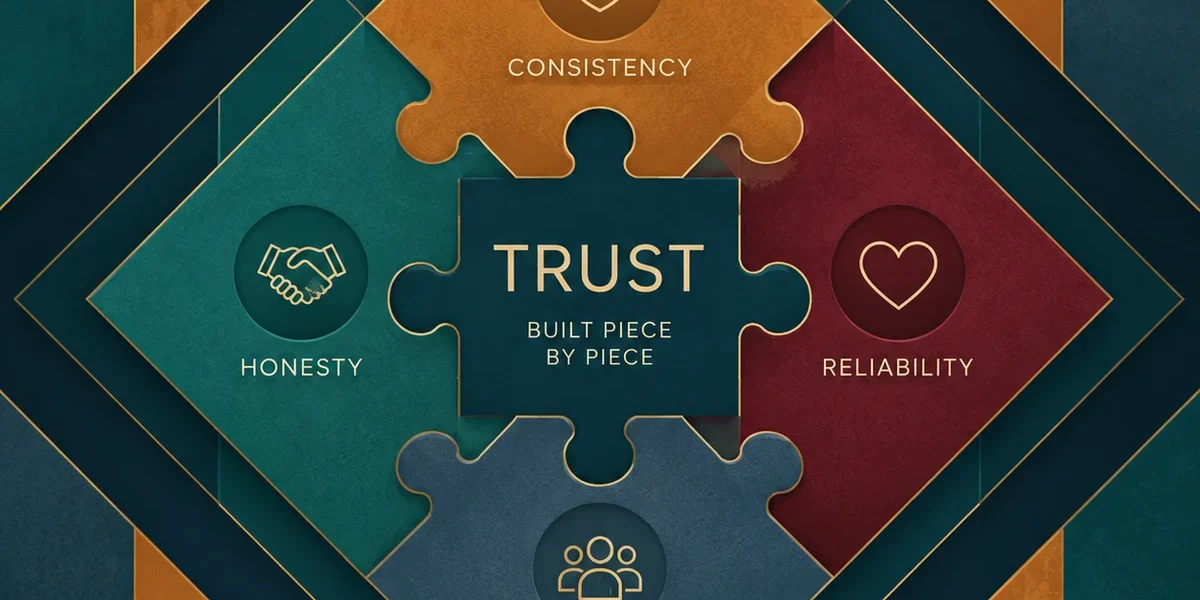
If there is one thing that determines whether cuckold dynamics thrive or unravel, it is not chemistry. It is not compatibility. It is trust. Not the generic kind of trust that comes with any relationship, but a specific, tested form of trust that has to hold under conditions most relationships never face. Trust in cuckold relationships has to survive vulnerability, compersion, jealousy, and public invisibility — sometimes all in the same week. This article looks at what that trust actually requires, how to build it, and how to recognize when it is slipping.
Why Trust Works Differently in Cuckold Dynamics
In a conventional monogamous relationship, trust often centers on exclusivity: I trust you not to be with anyone else. In cuckold dynamics, exclusivity is not the anchor. Trust shifts to something more nuanced: I trust you to honor our agreements, to stay emotionally present with me, and to not let exploration erode what we have built together.
This shift changes what trust-building looks like. It is not about monitoring behavior or verifying fidelity in the traditional sense. It is about consistency over time — the accumulated evidence that when your partner says they will check in after a date, they do. That when they agree to a boundary, they honor it even when no one is watching. That when you express vulnerability, they respond with care rather than defensiveness. Each of these moments is a brick in a structure that has to be strong enough to hold weight, as explored in our companion piece on balancing cuckold dynamics with everyday life.

The Transparency Baseline
Transparency is one of the most misunderstood concepts in non-monogamous relationships. It is often confused with surveillance — the idea that partners need access to every message, every thought, every detail. That is not transparency; that is a trust deficit dressed up as openness. Real transparency means both partners have access to the information they need to feel secure, not that every private interaction becomes public property.
Every couple needs to define their own transparency baseline. For some, that means sharing when conversations with potential partners are happening, and debriefing after dates. For others, it means full access to each other’s dating app accounts. Neither approach is inherently better — what matters is that both partners genuinely feel the baseline is enough. If one partner is asking for more transparency and the other is resisting, the issue is not the information itself. It is that one person does not feel safe, and that feeling deserves attention regardless of whether it seems “rational.”
A practical starting point: agree on what you will share, when you will share it, and what can stay private. Write it down. Revisit it after a few experiences. Transparency agreements that look good on paper often need adjusting once real emotions enter the picture.

Honoring Agreements — Even When It Is Hard
Every couple starts with agreements. No overnights. Always use protection. Share location during dates. Check in by a certain time. These agreements are easy to make in the abstract and much harder to keep when excitement, attraction, or convenience push against them. The moment that actually builds trust is not when keeping an agreement is easy — it is when keeping it costs you something and you do it anyway.
Consider the partner who is having an incredible time and really does not want to leave by the agreed-upon hour. Leaving anyway — because they said they would — is trust currency. The partner waiting at home receives a message not just about logistics but about priorities. You mattered enough for them to keep their word even when it was inconvenient. These moments compound. So do the opposite ones.
If an agreement genuinely no longer works — and this happens as dynamics evolve — the repair is not to quietly break it. It is to say: “This agreement is not working for me anymore. Can we renegotiate it?” That conversation itself is a trust-building act, because it treats the agreement as a shared structure rather than a rule imposed from outside. For more on navigating these negotiations, see our overview of how cuckold dynamics compare to other relationship structures.

Checking In Without Checking Up
There is a fine line between “I want to know how you are doing” and “I need to verify that nothing bad happened.” The first builds connection. The second signals distrust, and over time, it erodes exactly what it is trying to protect. Checking in should feel like reaching toward your partner, not like pulling on a leash.
Good check-ins are specific and emotional rather than logistical: “How did you feel during that moment?” instead of “What exactly happened?” They are timed thoughtfully — not ambushing your partner the second they walk through the door, but giving space for them to decompress first. And they go both ways: the partner who stayed home also has feelings to share, and their emotional experience matters just as much.
Some couples find it helpful to structure check-ins around three questions: What went well? What felt complicated? What do you need from me right now? This framework keeps the conversation productive rather than interrogative, and it surfaces issues before they become resentments.

Repairing Trust After It Has Been Shaken
Trust gets damaged. Agreements get bent. Feelings get hurt. This is not a sign that the dynamic is doomed — it is a sign that you are human. What distinguishes couples who recover from couples who do not is not whether trust ever breaks; it is whether both partners are willing to do the repair work when it does.
Effective repair starts with full ownership. Not “I’m sorry you felt that way” but “I broke our agreement and I understand why that hurt you.” The partner who was hurt needs space to express anger or sadness without being rushed into forgiveness. And both partners need to agree on concrete steps to prevent the same break from happening again — not just promises, but specific changes to how things operate.
Sometimes repair means pausing the dynamic entirely for a defined period. This is not punishment; it is creating space for the primary relationship to stabilize. The third partner deserves clear communication during this pause — they did not sign up to be collateral damage. Research on non-monogamous relationships suggests that couples who can navigate repair cycles tend to report stronger trust over time than those who never face challenges (VeryWell Mind).

Trust-Building Scripts for Real Conversations
Sometimes the hardest part of trust-building is knowing what to actually say. Here are conversation starters that couples can adapt to their own voices:
Before a Date
- “I want you to have a great time tonight. One thing that would help me feel secure is if you [text when you arrive / check in before bed / share one thing you enjoyed afterward].”
- “Is there anything you are nervous about? I want to hear it so I am not imagining things on my own.”
After a Date
- “I am glad you are home. Take whatever time you need to decompress, and when you are ready, I would love to hear how you are feeling.”
- “I noticed I felt [jealous / anxious / excited / disconnected] while you were gone. Can we talk about that?”
When Repair Is Needed
- “I broke our agreement about [specific thing]. I know that hurt you and I am not going to make excuses. What do you need from me to start repairing this?”
- “I am still angry, and I need [time / space / a longer conversation] before I am ready to work through this. I am not shutting you out — I am giving myself room to process.”

Red Flags That Trust Is Eroding
Trust erosion is often gradual — small omissions, delayed responses, vague answers — until one day you realize the foundation feels shaky. Recognizing the early signs gives you a chance to address them before they become crises:
- Information drift: Stories about what happened during a date change between tellings, or details that should be straightforward become oddly vague.
- Defensiveness as default: Questions that used to feel neutral now trigger irritation or accusations of “not trusting me.” Secure people can answer questions without taking them as attacks.
- Agreement erosion without conversation: Boundaries that were once clear start getting fuzzy — “I thought we said this, but maybe I misunderstood.” If it keeps happening, it is not misunderstanding.
- Emotional withdrawal after dates: Instead of the reconnection that was agreed upon, one partner comes home and retreats. The dynamic starts feeling like something that happens to the relationship rather than something the relationship does together.
- Third partner becomes a secret-holder: The third partner knows things about your dynamic that you do not. They become a confidante in ways that were never discussed or agreed upon.
If several of these signs are present, it is time for a serious conversation — ideally in a neutral setting, outside of any dynamic-related context. For more on managing the emotional complexities that can strain trust, our guide on jealousy versus compersion offers additional frameworks.
Trust in cuckold relationships is not a fixed destination. It is a practice — something you do every day, through small choices and honest conversations. The couples who sustain this long-term are not the ones who never struggle. They are the ones who have learned that trust is built in the repair, not just in the promises.
Editor’s note: This article continues 3Cupid’s series on cuckold relationship foundations. All content is intended for adults 18+ and emphasizes consent, communication, and emotional safety. Read our companion guide on balancing cuckold dynamics with everyday life for practical strategies on integrating exploration with daily responsibilities.