
When most people think about safety in unicorn dating, the mental checklist starts and ends with the unicorn: share your location, meet in public, tell a friend where you’re going. And yes — those precautions matter. But safety in ethical unicorn dating isn’t a one-sided responsibility. Couples who want to create a genuinely safe space for unicorn dating have their own work to do — and a lot of them skip it entirely.
The difference between a couple a third partner feels safe with and one they flee from usually isn’t about bad intentions. It’s about whether the couple has done the internal homework or just expects safety to magically emerge because they’re “nice people.” This guide walks through what creating a real safe space actually looks like — from the couple’s side of the equation.
Table of Contents
- Why Safety Isn’t Just the Unicorn’s Responsibility
- Start with Your Own Relationship Audit
- Transparency from the First Message
- Physical Safety Measures Couples Should Offer
- Emotional Safety: Beyond the First Date
- Respecting the Unicorn’s Autonomy
- Safe Space Checklist for Couples
Why Safety Isn’t Just the Unicorn’s Responsibility
There’s a quiet assumption baked into most unicorn dating advice: that the third partner — usually a bisexual woman — should be the one managing risk. She should vet the couple. She should pick the meeting spot. She should run the background check. And while those are reasonable precautions for anyone dating online, they also conveniently let couples off the hook.
Here’s the reality: couples hold most of the power in these dynamics. They outnumber the third partner. They have an established relationship history. They often control the logistics — whose place, which city, what time. With that power comes a proportionate responsibility to create safe space unicorn dating conditions. If you’re a couple, the burden of proving you’re safe is on you, not on the person you’re inviting in.
This isn’t about performative gestures. It’s about structural choices. As we explored in our piece on the unicorn’s perspective, third partners consistently report that the couples who felt safest were not the ones who said the right things — they were the ones who’d built safety into their process from day one.

Trust forms the foundation of any ethical three-person dynamic, and it starts with the couple.
Start with Your Own Relationship Audit
You can’t offer someone else emotional safety if your own foundation has cracks. Before you ever post a profile or send a message, sit down together and ask the hard questions.
Is anyone in this relationship hesitant? If one partner is enthusiastic and the other is going along to avoid conflict, that tension will leak into every interaction with a third. The unicorn becomes a pressure-release valve for a problem that predates them — and that’s fundamentally unfair.
Do you have a veto agreement? If so, how does it work? Veto power is one of the biggest safety concerns for third partners. If one member of the couple can unilaterally end the connection at any time — without discussion, without warning — the unicorn is dating under a sword. That’s not safety. That’s couple privilege dressed up as protection.

Healthy boundaries are not walls — they’re the framework that lets everyone feel secure enough to be authentic.
What happens if feelings develop? This question separates couples who’ve done the work from those winging it. If your answer is “that won’t happen” or “we’ll deal with it then,” you haven’t thought hard enough. A beginner’s guide for unicorns often flags this as a red flag — because it signals a couple who hasn’t planned for the most predictable outcome in human connection.
Transparency from the First Message
Safety starts before you meet. It starts in the first message, the profile, the initial conversation. Too many couples hide behind vague language — “looking for fun,” “open to possibilities” — that forces the third partner to play detective.
Be upfront about:
- What you’re looking for. One-time connection? Recurring arrangement? Potential triad? Say it. Ambiguity feels strategic but reads as evasive.
- Your experience level. If this is your first time exploring unicorn dating, say so. It lets the third partner calibrate their expectations and communicate their needs more clearly.
- Your relationship structure. Are you hierarchical? Do you have other partners? Is there a primary relationship that takes precedence? These aren’t details to disclose later — they’re foundational context.
- Who will be in the conversation. If only one partner handles messages while the other reads silently, disclose that. Group chats where one person is secretly absent erode trust fast.
Our ethical unicorn dating checklist covers this transparency layer in more detail, but the principle is simple: give the third partner enough information to make an informed choice, not a hopeful guess.
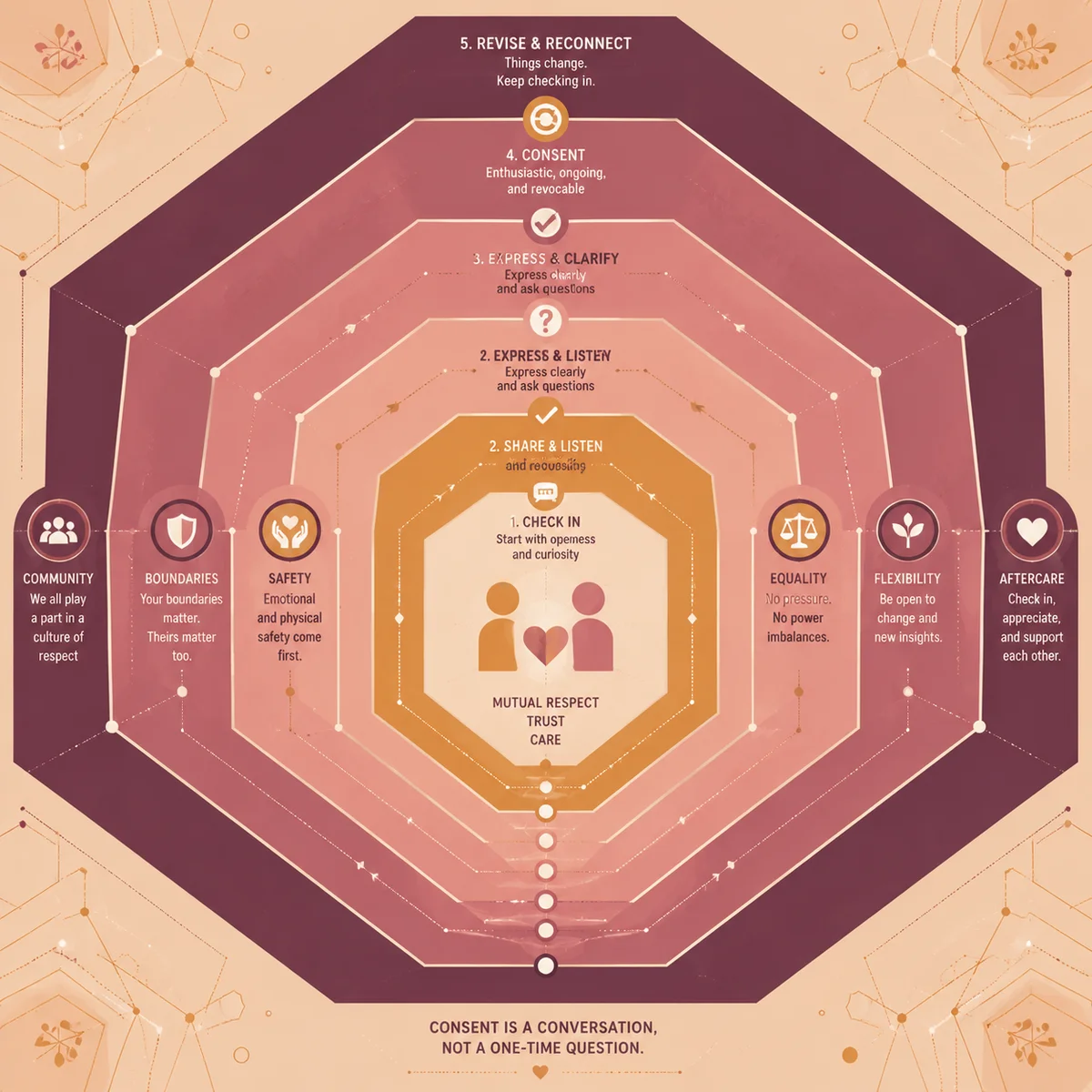
Consent isn’t a one-time checkbox. It’s a continuous conversation that deserves structural thoughtfulness.
Physical Safety Measures Couples Should Offer
Physical safety in unicorn dating needs to go beyond “meet in public.” Couples can — and should — take proactive steps.
Offer a video call before the in-person meeting. Not just “if you want to.” Proactively suggest it. It lets everyone confirm identities, read body language, and catch any mismatch between the profile and reality before anyone’s committed to showing up somewhere.

In unicorn dating, communication doesn’t just flow two ways — every person deserves a direct line to every other person.
Let the third partner choose the first meeting location. This is a small gesture with outsized impact. It communicates: your comfort matters more than our convenience. A coffee shop they know. A neighborhood they’re familiar with. A place where they have exit routes and social support nearby.
Share identifying information without being asked. Full names. Social media profiles. Where you work. If you expect a third partner to trust you with their physical safety, you should be willing to be equally identifiable. Couples who resist this — “we value our privacy” — are asking for a level of trust they’re unwilling to reciprocate.
Discuss sexual health proactively. Don’t make the third partner be the one to bring it up. Share your testing schedule, your safer-sex practices, and your expectations. A couple who leads with this conversation signals that they take everyone’s wellbeing seriously — not just their own.
Emotional Safety: Beyond the First Date
Physical safety is the floor, not the ceiling. The couples who build genuinely safe spaces for unicorn dating are the ones who think about emotional safety across the entire timeline — not just the first meeting.

Power balance in three-person dating requires active work, not just good intentions.
Have a post-date check-in protocol. After the first meeting — whether anything physical happened or not — reach out. Ask how they’re feeling. Don’t vanish into couple-processing mode for three days while the third partner wonders if they said something wrong. A simple “We had a great time and we’d love to see you again — no pressure to respond right away” goes a long way.
Don’t make the third partner manage your couple’s emotions. One of the most common complaints from experienced unicorns is being recruited as an unpaid couples therapist. If one of you felt jealous, or insecure, or uncertain — process that together, as a couple. Don’t bring it to the third partner as something they need to fix or reassure you about.
Plan for aftercare — for everyone. Aftercare isn’t just for intense physical scenes. It’s the debrief, the check-in, the explicit acknowledgment that what just happened mattered. Ask what felt good. Ask what felt off. Create space for honest answers without defensiveness. Research on relationship communication from Psychology Today reinforces that post-experience processing is what separates growing relationships from deteriorating ones. And if the arrangement ends — whether after one date or twenty — handle the ending with dignity, not a ghost.
Respecting the Unicorn’s Autonomy
The single biggest predictor of whether a third partner feels safe — or exploited — is whether the couple treats them as a full person with their own agency, or as an accessory to the couple’s experience.

A truly safe space makes room for everyone’s full self — including the parts that are still figuring things out.
They get to set the pace. Not the couple’s enthusiasm. Not the couple’s timeline. If the third partner wants to move slower than you’d prefer, you accommodate that without pressure, negotiation, or “just checking if you’ve changed your mind” follow-ups.
They get to have boundaries that inconvenience you. Maybe they don’t want to stay overnight. Maybe they want separate transportation to and from dates. Maybe they want one-on-one time with each of you before group dynamics. These aren’t unreasonable asks — they’re reasonable people protecting their wellbeing. A safe couple says “of course” not “but why?”
They get to leave. At any point. For any reason. Without owing you an explanation that satisfies your curiosity. The truest test of whether you’ve created a safe space is how you respond when someone exercises their right to exit it. If your reaction is anger, guilt-tripping, or bargaining — the space was never safe to begin with.
Safe Space Checklist for Couples
Before you post that profile or send that first message, run through this checklist together. If you can’t check every box honestly, that’s not a reason to abandon the idea — it’s a roadmap for the work you still need to do.
- ☐ Both partners are enthusiastically on board — not one enthusiastic, one “willing to try”
- ☐ You’ve discussed and agreed on what happens if feelings develop — with specifics, not generalities
- ☐ Your profile or first message clearly states what you’re looking for — no vague “seeing what’s out there”
- ☐ You’re prepared to share full names and verifiable information — before or at the first meeting, without being asked
- ☐ You have a plan for sexual health conversations — and you’ll initiate them, not wait for the third partner
- ☐ You’ve agreed on how — or whether — veto power works — and you’ll disclose this to the third partner
- ☐ You have a post-date communication plan — including who reaches out and when
- ☐ You’ve discussed how you’ll handle couple conflict without involving the third partner
- ☐ You’re prepared for the third partner to say no — or to leave — without taking it personally
- ☐ You see the third partner as a person with their own needs, not a solution to yours
Creating a safe space isn’t about perfection. It’s about intention, transparency, and the willingness to do the uncomfortable work before someone else’s wellbeing is on the line. The couples who get this right don’t just attract more compatible third partners — they build connections that feel genuinely good for everyone involved. And that’s the whole point.
Editor’s note: This article is part of 3Cupid’s ongoing series on ethical unicorn dating. For more on navigating couple privilege, see our guide on navigating couple privilege as a third partner. If you’re new to unicorn dating, start with Dating as a Unicorn: A Beginner’s Guide.