Imagine starting a new polyamorous relationship and receiving a short document from your partner that says: Here is how I work. Here is what I need. Here is what tends to go wrong, and what helps when it does. That is what a relationship user manual does — and in polyamory, where every new connection means learning a whole new person, it saves months of trial and error.
A relationship user manual for polyamory partners is not a contract and it is not a list of demands. It is a shortcut to understanding — a one-page guide to who you are in relationships, written by you, for the people who are getting to know you. In a relationship structure where you may be onboarding new partners while maintaining existing ones, having that clarity upfront benefits everyone.
Table of Contents
- What a Relationship User Manual Is (and Isn’t)
- Why User Manuals Work Especially Well in Polyamory
- What to Include in Your Relationship User Manual
- How to Write Your Manual Without Oversharing or Undersharing
- Sharing and Updating: Making the Manual a Living Document
- When User Manuals Help Most (and When They Don’t)
What a Relationship User Manual Is (and Isn’t)
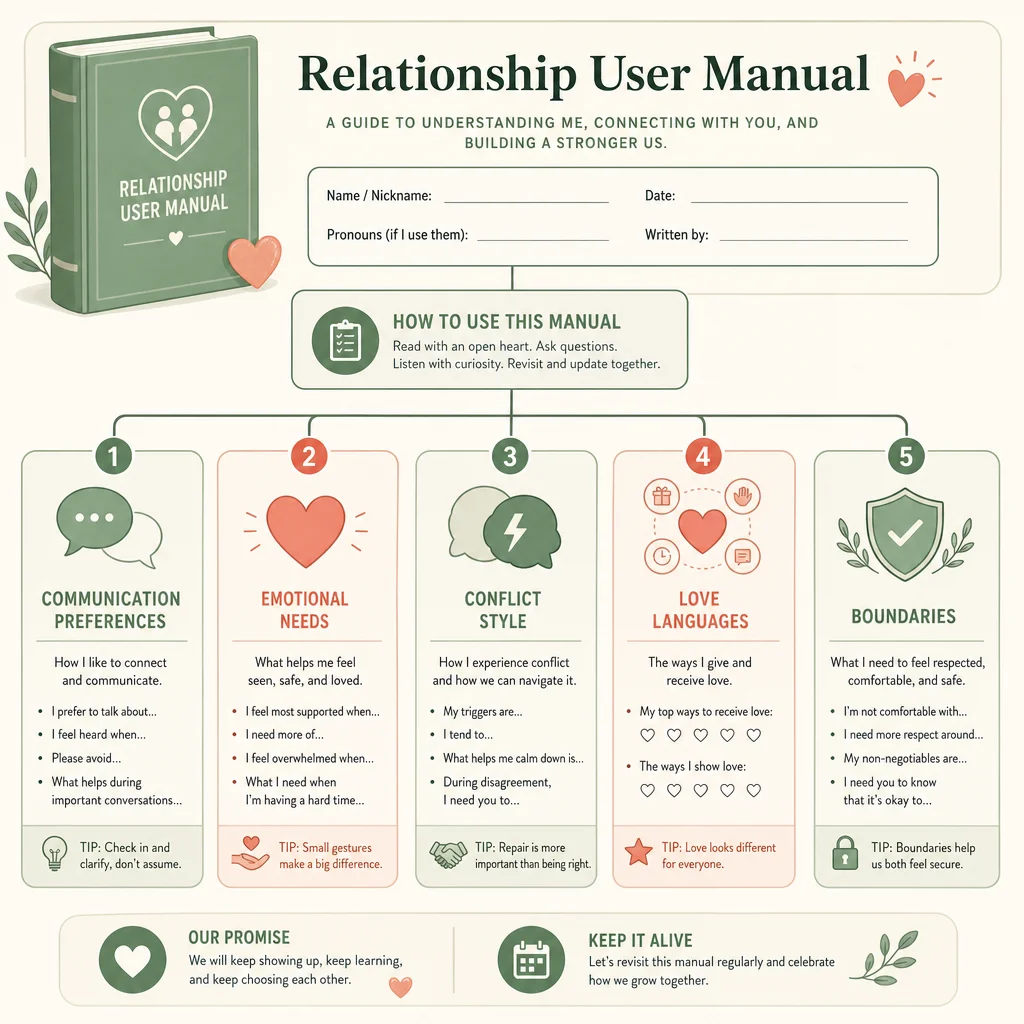
The concept of a personal “user manual” started in workplace culture — a short document colleagues share to explain how they work best. Adapted for relationships, a relationship user manual is a personal reference sheet covering your communication preferences, emotional triggers, conflict style, needs for connection, and needs for space.
It is not a list of rules your partner must follow. It is not a complaint document. And it is definitely not a substitute for ongoing communication — you cannot hand someone a PDF and say “read this, I’m done talking.” It is a starting point. An orientation guide. Something that says: before you spend six months figuring me out through misunderstandings, here is the cheat sheet.
Think of it as the difference between assembling furniture with instructions versus without. Both ways eventually get the job done. One involves a lot less frustration and fewer stripped screws.
Why User Manuals Work Especially Well in Polyamory
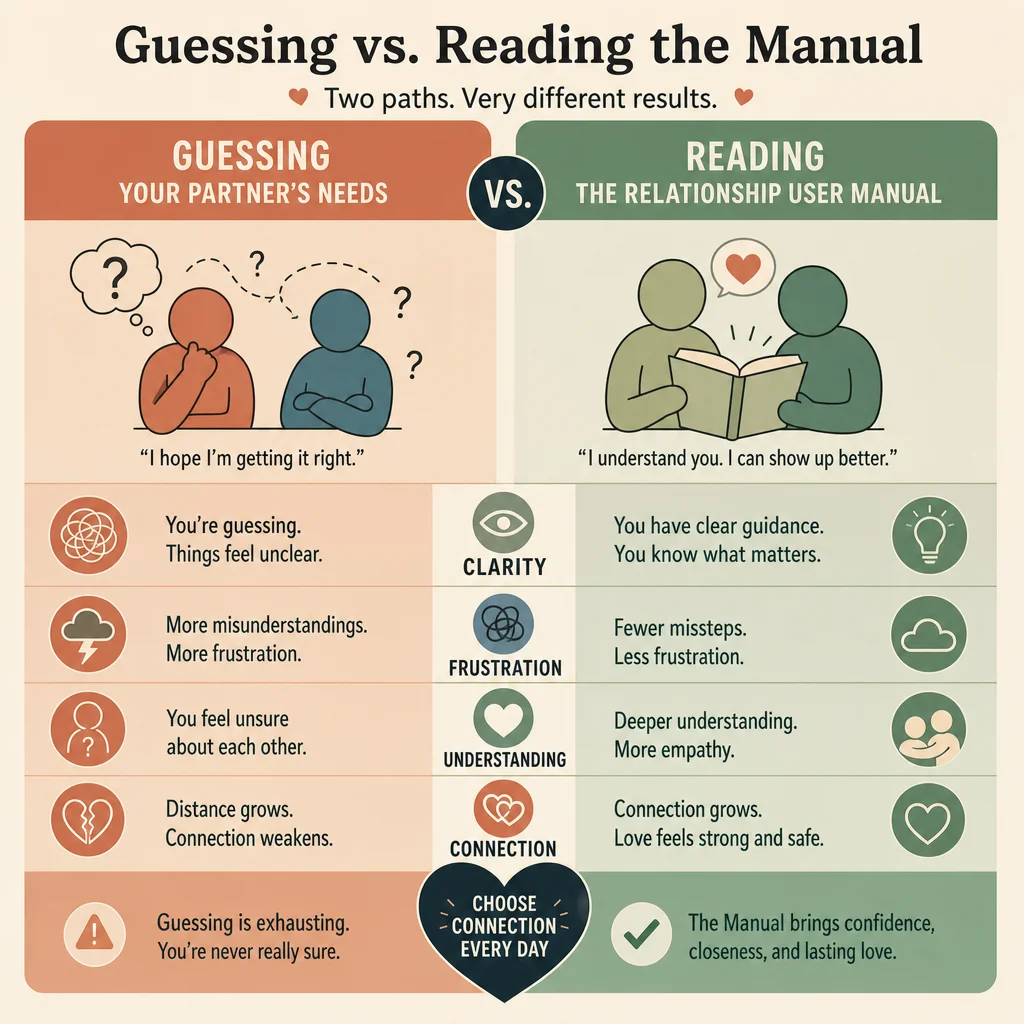
In monogamous dating, you typically learn one person at a time, and you have no other romantic partners whose needs you are balancing in parallel. In polyamory, you might be deepening a connection with a new partner while maintaining two existing ones — and your new partner is probably doing the same. That is a lot of people to learn, all at once.
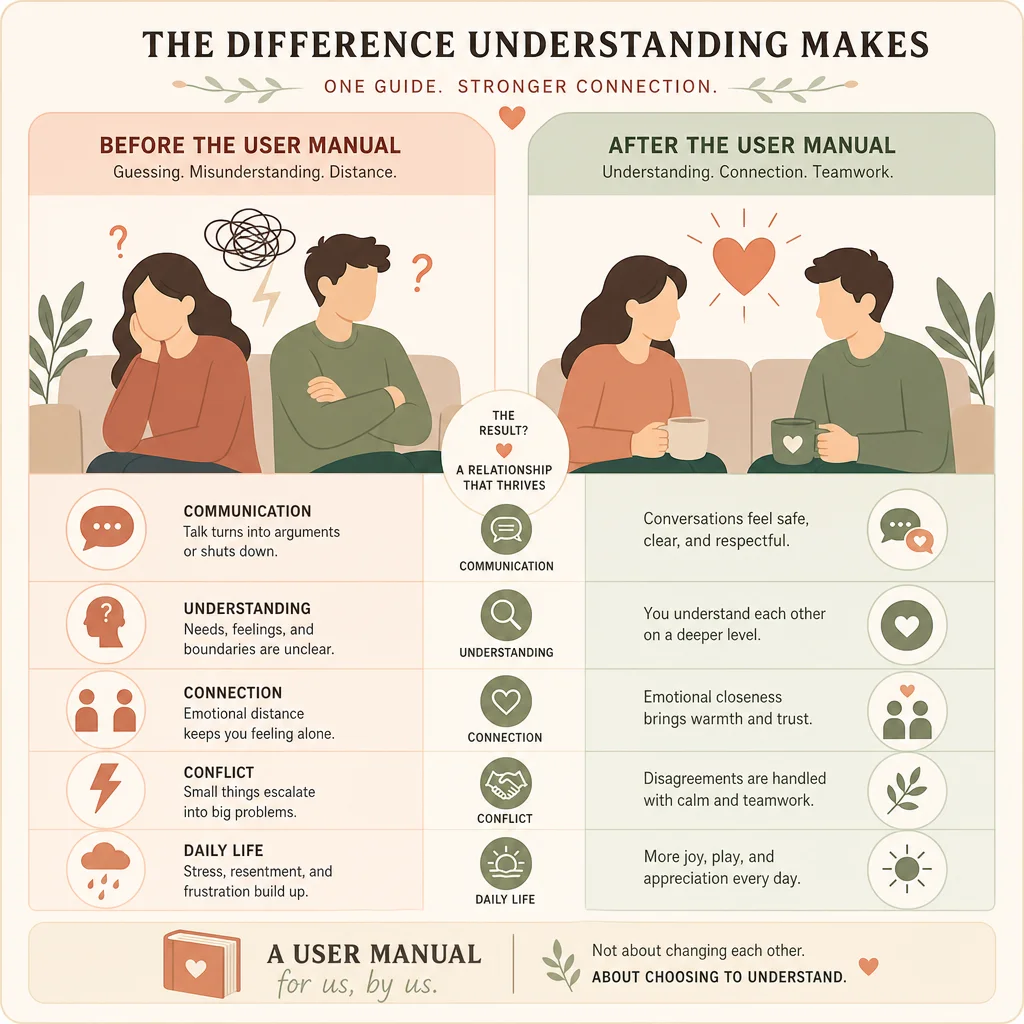
A relationship user manual compresses the learning curve. It answers the questions that usually take months to surface: Do you need space after conflict, or do you need to resolve things immediately? Does silence mean you are upset, or that you are thinking? What is the fastest way to make you feel cared for, and what is the fastest way to accidentally hurt you?
It also helps with what polyamory researchers call “relationship bandwidth” — the finite emotional and logistical capacity you have across all your connections. When each relationship runs more smoothly because partners understand each other faster, less bandwidth gets burned on preventable friction.
For a deeper dive into how structure supports healthy multi-partner dynamics, see our guide on creating a polyamory relationship agreement — the user manual and the relationship agreement work as complementary tools.
What to Include in Your Relationship User Manual
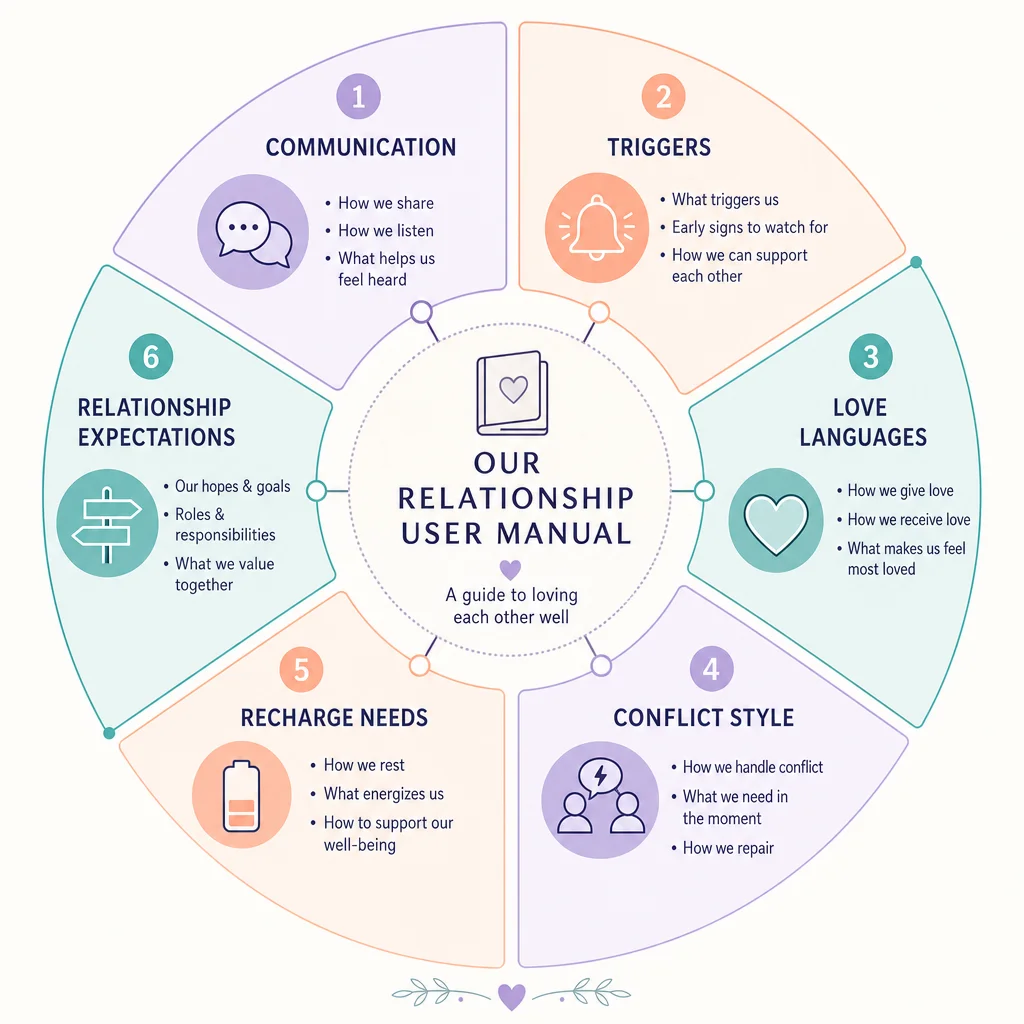
Your manual should be personal, but most effective ones cover similar territory. Here are the sections worth including, with examples of what to write in each:
- Communication preferences: “I prefer text for logistics, voice notes for emotional updates, and in-person for serious conversations. I read tone into short texts, so an extra emoji goes a long way with me.”
- Conflict style: “When I am upset, I get quiet — not to punish you, but because I need to process internally. I will come back to the conversation within 24 hours. Please do not push for resolution in the moment.”
- Emotional triggers and sore spots: “I get anxious when plans change last-minute without explanation. A quick ‘hey, something came up, can we reschedule?’ prevents a spiral.”
- Connection and recharge needs: “I need at least one evening alone per week to recharge. It is not about you — I need this with every partner I have ever had.”
- Love languages and feeling cared for: “Acts of service mean the most to me. Making me coffee in the morning registers as love more than any verbal affirmation.”
- Relationship structure and expectations: “I practice non-hierarchical polyamory. I do not want to be anyone’s primary, and I do not expect anyone to be mine. I am looking for autonomous, parallel connections with low enmeshment.”
The psychology of self-disclosure suggests that revealing this kind of information early — when done thoughtfully — builds trust faster than waiting for it to emerge through conflict.
How to Write Your Manual Without Oversharing or Undersharing
The hardest part of creating a relationship user manual is finding the right depth. Too vague and it is useless (“I like good communication” — who doesn’t?). Too detailed and it feels like trauma-dumping or a list of grievances from past relationships.
A good rule of thumb: write it for someone who already likes you and wants to treat you well, but does not yet know how. Frame everything as “here is what works for me” rather than “here is what my ex did wrong.” Keep it to one page. If you are writing more than that, you are probably over-explaining — or turning preferences into rigid rules.
Write in the present tense and in the first person. Instead of “I have been hurt when partners ignore my texts,” try “I feel most secure when I get a quick acknowledgment within a few hours — even just a heart emoji does the job.” The first version invites pity; the second invites partnership.
Sharing and Updating: Making the Manual a Living Document
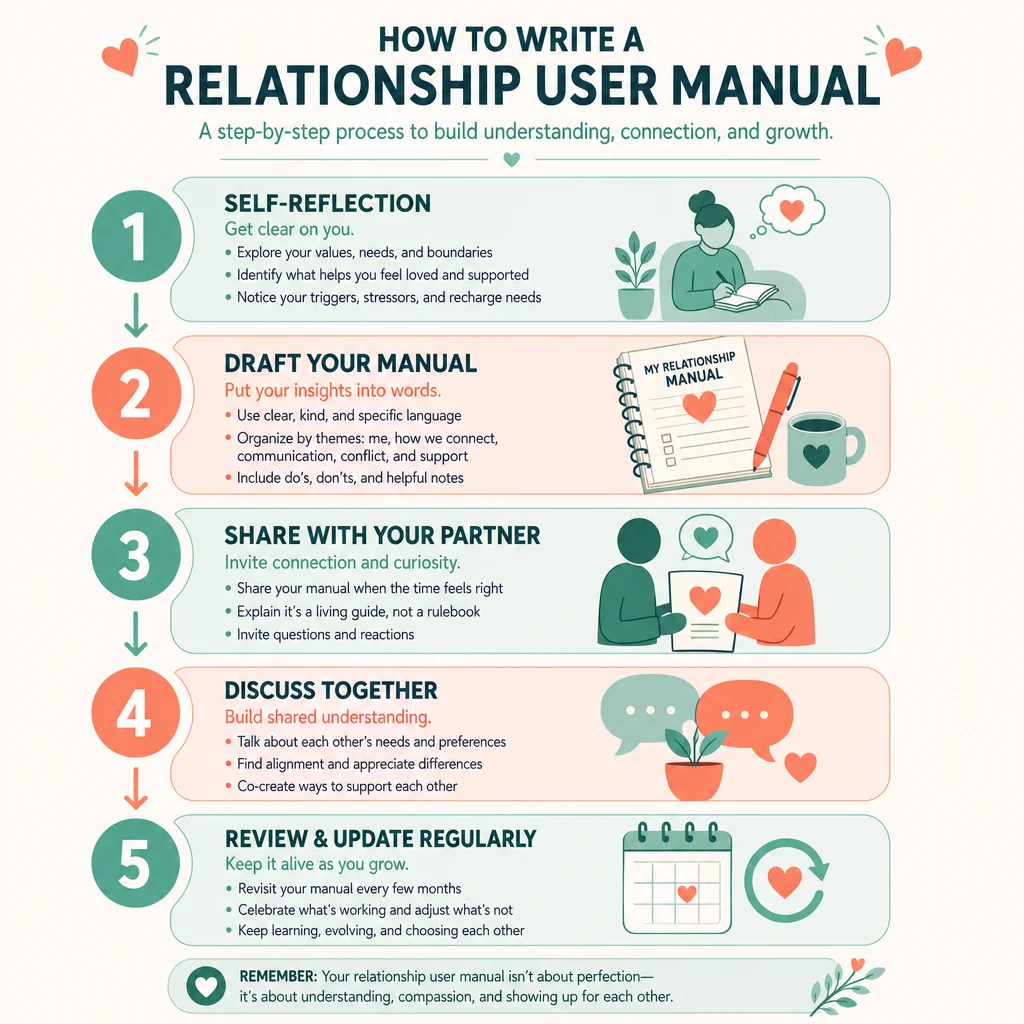
How you share your manual matters as much as what is in it. Do not send it cold. Say something like: “I put together a quick guide to how I work in relationships — not rules, just context. Want me to share it? And I would love to see yours if you ever make one.”
Timing is important. Sharing a manual on a first date can feel intense — it implies a level of commitment that has not been established yet. But after a few dates, when you are both clearly interested in continuing, it is a natural moment. Some polyamorous people include a link to theirs in their dating profile, which filters for people who value emotional clarity from the start.
Update it periodically. You are not the same person you were two relationships ago. Set a calendar reminder to revisit your manual every six months. What needs changed? What did you learn about yourself? Keeping it current is a form of self-respect — and a gift to anyone who reads it.
When User Manuals Help Most (and When They Don’t)
A relationship user manual shines in specific situations: when you are starting a new connection and want to skip the early guesswork; when you are neurodivergent and communication preferences are particularly important to name explicitly; when you have a history of being misunderstood in relationships and want to give partners a fair shot at understanding you; and when you are in a polycule where multiple relationships run in parallel and clarity reduces overhead for everyone.
It is less useful — and can even backfire — if you treat it as a finished product rather than a conversation starter. A manual that is handed over without discussion can feel like an assignment. A manual that is never updated becomes stale and inaccurate. And a manual written from a place of defensiveness (“here is everything my exes did wrong, don’t do that”) signals unresolved baggage rather than self-awareness.
The manual is not the relationship. It is a map. Maps are useful, but you still have to walk the terrain together.
If you are navigating different communication styles alongside the manual approach, our companion article on navigating different communication styles in polyamory pairs naturally with this one — the manual helps you name your style, and the communication strategies help you bridge the gaps.
And if you are still building the foundational skills, our polyamory for beginners guide covers the core concepts that make tools like the user manual possible: self-awareness, clear communication, and the willingness to be known.
A relationship user manual for polyamory partners is one of the simplest, most underused tools in the ENM toolkit. It costs you an hour of honest reflection and gives back months of clearer, kinder, more efficient connection. If you have never written one, there is no downside to trying — and a lot of upside waiting on the other side.
This article is part of our ongoing series on communication and practical relationship tools in ethical non-monogamy. All content is intended for readers 18 and older.