
The short version: lead with information, not apology; ask for one specific thing; set a date to revisit. Knowing how to talk to your partners about menopause matters far more than finding perfect words. You do not need a partner to fully understand endocrinology. You need them to understand what will be different, and what you want them to do about it.
Most people get stuck on the how rather than the whether. This piece is about how to talk to your partners about menopause: what to say to a partner of fifteen years versus one of five months, what to do when a partner takes it personally, and how to keep the conversation alive after the first one is over.
Table of Contents
- Why This Conversation Feels So Loaded
- Start With the Facts, Not the Apology
- Pick the Right Moment and the Right Format
- Three Scripts for When You Talk to Your Partners About Menopause
- What Partners Commonly Get Wrong
- When Metamours Belong in the Conversation
- After the Talk: Keeping It a Living Conversation
Why This Conversation Feels So Loaded
Three fears tend to sit underneath the hesitation. That you will be seen as less desirable. That your partner will quietly start looking elsewhere. That you are bringing a problem into a relationship that was fine until you mentioned it.
The non-monogamous context sharpens all three, because your partners genuinely do have other options. But having options is not the same as wanting to use them to replace you, and silence tends to feed the fear rather than starve it. When you go quiet about what is happening, partners fill the gap with their own theories, and their theories are almost always worse than your actual situation.
There is also a knowledge gap that is not anyone’s fault. Plenty of partners, including people who have lived through a partner’s menopause before, have never had it explained to them. A five-minute plain-language description from you is worth more than anything they will read on their own.

Naming the fear out loud is often the fastest way past it. I have been putting off telling you this because I was worried you would hear it as the beginning of the end. Once it is said, it is something you can both look at.
Start With the Facts, Not the Apology
Apologies frame you as the problem. Information frames the situation as the problem. Same facts, very different conversation. Compare sorry, I know I have been useless lately with my hormones are doing something predictable and here is what it looks like from the outside.
The description does not need to be long. Two or three sentences is plenty: perimenopause is the years before periods stop, hormone levels swing rather than decline smoothly, and the common effects include sleep disruption, mood changes, differences in desire and arousal, and changes in how the body responds. If your partner wants more detail, the Psychology Today overview of menopause is a reasonable thing to hand them, and the Office on Women’s Health symptom guide is a good plain-language reference for what you are describing.
Then separate the information conversation from the request conversation. Trying to explain the biology and ask for a schedule change in the same breath is a lot for one sitting, and the request tends to get lost inside the explanation.
A useful sentence to close the first conversation with: you do not need to do anything about this yet, I just wanted you to have the map. It gives them time to digest before anything is asked of them.
Pick the Right Moment and the Right Format
Timing does more work than wording. Do not open this in the middle of an argument, and do not open it in bed immediately after a disappointing night — both contexts will be read as explanation or excuse, however carefully you phrase things.
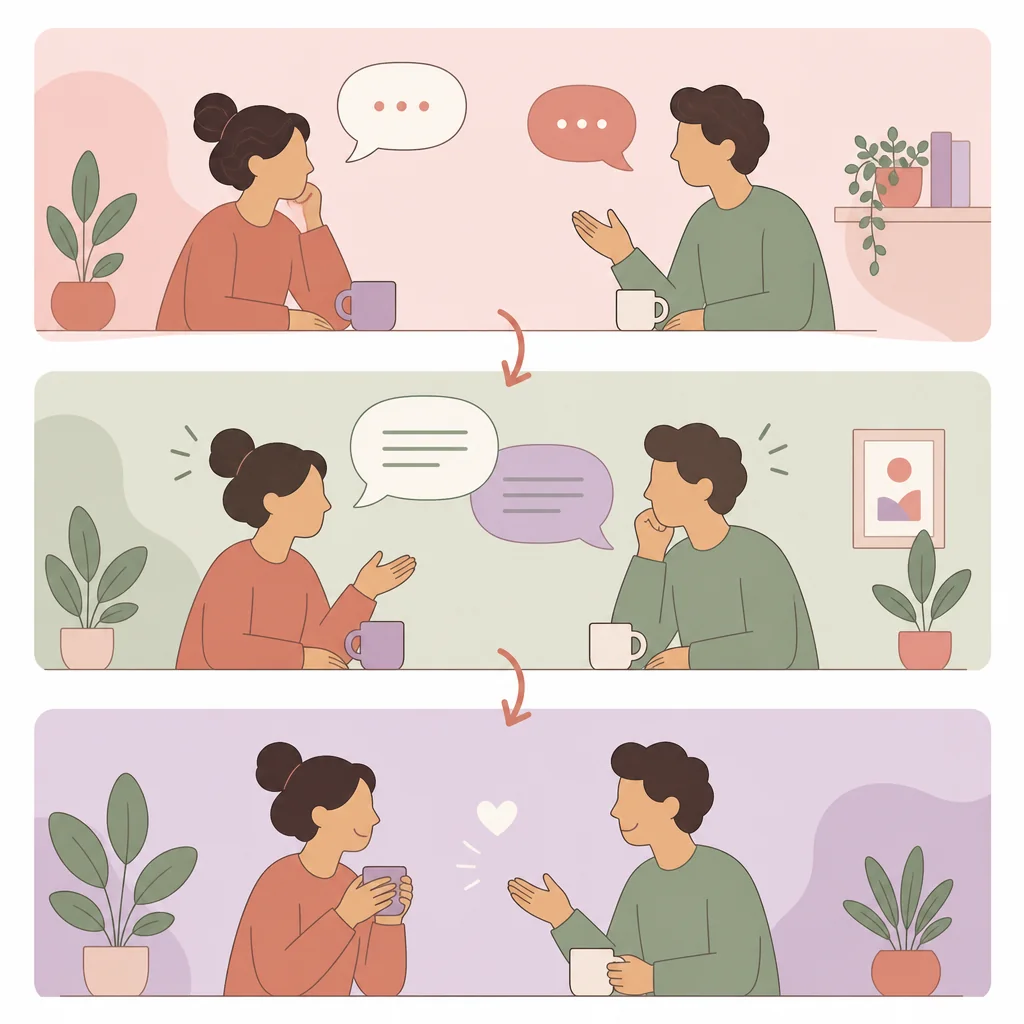
Format matters too. Some people talk well under pressure; others go blank, or tear up, or agree to things they did not mean. If that is you, write first. A message or a note that says there is something I want to talk through, I am going to write it down so I do not lose the thread gives your partner time to read it twice and come back with real thoughts instead of a first reaction.
Also decide whether this is one conversation or several. With a long-term partner it is usually three: here is what is happening, here is what I need, here is how we will know if it is working. Compressing those into one evening is how people end up overwhelmed and agreeing to nothing.
Same principle as any structured check-in — if you already use regular ENM relationship check-ins, this belongs in one, not squeezed into the ten minutes before you fall asleep.
Three Scripts for When You Talk to Your Partners About Menopause
These are starting points. Adjust the words until they sound like something you would actually say; a script delivered in someone else’s voice is worse than no script at all.
1. A long-term partner, when your desire has dropped.
This is not about you and it is not about us. My body is in a stage where desire shows up much later than it used to — I rarely feel it out of nowhere any more, but I do feel it once we start. What would help is a longer runway: more touching that is not a prelude to anything, and not reading my slow start as a no. Can we try that for a month and see how it feels?
2. A newer partner who is taking it personally.
I want to name something so you do not fill in the blanks. There is a hormonal stage I am in that affects my sleep and my energy, and it means I cancel more than I would like and I initiate less than I would like. Neither of those is a signal about how I feel about you. If you are ever unsure, ask me directly rather than guessing — I would rather have the awkward question.
3. When you need something concrete to change.
I am starting treatment and I am also going to need the calendar to look different for a while. Concretely: weeknight dates are hard for me right now, Sunday afternoons are much better. I would rather we plan around that than I keep cancelling on you. Can we look at the next six weeks together?

Notice that all three end with a specific, answerable question. How do you feel about that is not one; it invites a performance. Can we try this for a month is one; it invites a decision.
What Partners Commonly Get Wrong
Most partners who handle this badly are not being careless. They are reaching for the only tools they have. Here is what tends to miss:
- Jumping straight to solutions. Useful eventually, suffocating immediately. Ask first.
- “You should see a doctor” as a full response. It closes the conversation instead of opening it.
- Reading a body change as rejection. Lower desire is not a verdict on anyone’s attractiveness.
- Making it about their own ageing. Your perimenopause is not a mirror for them to check themselves in.
- Offering their other partner as the solution. Almost never lands the way it is intended.
- Treating one good week as proof it is over. The timeline is not linear; do not use a single data point to undo the plan.
What lands well instead: curiosity, patience, and follow-through on the specific thing you asked for. Partners who remember the accommodation without being reminded are doing more for you than partners who deliver a perfect speech once.
If a partner keeps taking it personally no matter how clearly you put it, that is worth a direct conversation about what they need in order to feel secure. It may not be about your body at all. Our piece on building emotional intimacy in non-monogamous relationships is a decent place to start that thread.
When Metamours Belong in the Conversation
Your medical information is yours. Nobody gets to share it because they think it explains something. Before any conversation that could reach a metamour, agree explicitly with each partner what they may pass along and what stays between you.
Sometimes metamours genuinely should know something — if scheduling ripples across a shared calendar, or if your capacity affects a group plan. In those cases, the cleanest version is usually a short, non-medical sentence: I have a health thing that affects my energy for a while, I am managing it, here is what it means practically. That respects your privacy and still gives people what they need.
If the metamour relationship is new or thin, keep it thinner. You can revisit later. Good metamour relationships are built over time, and the early stage does not need your full medical history to go well — see building a healthy metamour relationship for how to pace that.

One boundary worth stating early: please do not discuss my health with someone I have not told. Simple, reasonable, and much easier said before the situation arises than after.
After the Talk: Keeping It a Living Conversation
A single conversation about a multi-year transition does not hold. Build in review points — monthly works for most people, quarterly if things are stable — and use them to adjust rather than to re-litigate.

Keep a short symptom log if that helps you see patterns. Not for your partner, for you: it is much easier to ask for what you need when you can say the last three weeks have been bad and here is what made them easier rather than relying on how you feel on the day of the check-in.
And notice what is working. It is easy to turn every review into a list of what is still broken. The accommodations that stuck, the partner who adjusted without being asked, the fact that you said the hard thing and the relationship did not end — those are worth saying out loud too.
If you are also rethinking desire and pacing more broadly, perimenopause and non-monogamy covers what is changing underneath all of this, and talking to a partner about a libido mismatch has more language for the desire-specific side. For the wider life-stage picture, non-monogamy after 50 picks up the thread. There are plenty of people navigating this same stretch right here at 3Cupid.
Editorial note: general information for adults, not medical advice. Please talk to a qualified clinician about symptoms, treatment and anything that affects your health.