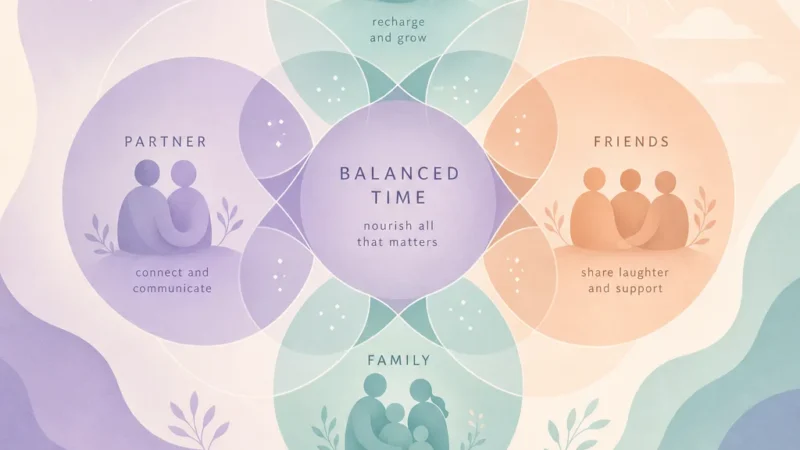
To balance a nesting partner and a new relationship, you need three things: clear expectations, fair scheduling, and regular check-ins. The mistake most people make is treating the nesting relationship as a default — something that does not need scheduling because you live together — while pouring all the planned time into the new person. That quietly erodes the home relationship and leaves everyone feeling shortchanged.
Here is a practical, judgment-free approach to holding both relationships with care, so your nesting partner does not fade into a roommate and your new partner does not become an afterthought.
This guide is for people in any non-monogamous structure — polyamory, open relationships, or an agreed arrangement of your own. The principles of fairness and attention transfer across all of them.
Table of Contents
- Why Balancing a Nesting Partner and a New Relationship Feels Hard
- Set Clear Expectations Early
- Build a Fair Scheduling System
- Give Each Relationship Its Own Space
- Manage New Relationship Energy Without Neglecting Home
- Hold Regular Check-Ins With Both Partners
- When to Revisit Your Agreements
Why It Feels Hard to Balance a Nesting Partner and a New Relationship
Time is finite, and a new relationship tends to feel urgent. That urgency has a name — new relationship energy, or NRE — and it can make the comfortable, familiar relationship at home look less exciting by comparison. None of this means the new relationship is more important; it just means your attention is being pulled.
The nesting partner’s pain is quieter. They may not ask for more time because they see you every day and assume that counts. But shared logistics are not the same as quality time, and over months that difference compounds into distance.

Set Clear Expectations Early
Before the new relationship deepens, tell both people what you can realistically offer. If you have hierarchy, say so. If your nesting partner needs certain evenings protected, say so. Ambiguity feels kind in the moment, but it sets up disappointment later.
A written relationship agreement can help here. You do not need a legal document — just a short, shared understanding of time, holidays, overnights, and what “priority” means in practice. Our guide on creating a polyamory relationship agreement walks through this step by step.
One more thing: say the uncomfortable part out loud. If your nesting partner will always come first in a crisis, or if the new partner can never spend the night at your place, name it now. Early honesty costs a little awkwardness and saves a lot of hurt later.

Build a Fair Scheduling System
The simplest fix for a time imbalance is to schedule your nesting relationship the way you schedule dates with anyone else. Put it on the calendar. A recurring weekly date night, a shared meal, a weekend walk — whatever it is, treat it as a commitment, not a fallback.
Then build the rest of the week around it. Fair scheduling does not mean equal hours; it means everyone understands the plan and agrees it is reasonable. If you are not sure where to start, our guide to fair scheduling in polyamory offers a framework that works without keeping score.
A quick do-and-don’t list keeps the week honest:
- Do schedule recurring quality time with your nesting partner, not just shared chores
- Do name which nights are protected before the week fills up
- Don’t let the new relationship quietly absorb every weekend
- Don’t treat “we live together” as a substitute for real dates

Give Each Relationship Its Own Space
Relationships need room to breathe on their own terms. If your nesting partner and your new partner are constantly in the same room, neither relationship gets to be fully itself. Decide together how much integration everyone wants.
Some people want a kitchen-table dynamic where everyone gets along. Others want parallel relationships that rarely overlap. Neither is wrong. What matters is that you do not force closeness before it is natural. If you are weighing the two styles, our kitchen table vs parallel guide can help you decide.
Your calendar is part of this. Giving the new relationship a dedicated evening and the nesting relationship a dedicated evening keeps the two from blurring into each other and makes each moment feel intentional.

Manage New Relationship Energy Without Neglecting Home
NRE is not something to suppress — it is a normal part of starting something new. The risk is letting it rewrite your priorities without a decision. When you feel the pull to text the new person during family dinner or to extend every date, pause and ask whether the choice serves both relationships.
A useful habit is to end each date with a small ritual of return: a quick text to your nesting partner, or five minutes of reconnection when you walk in the door. It signals that home still matters, even while something new is exciting. If NRE feels overwhelming, our guide to navigating new relationship energy has concrete strategies. Resources like More Than Two also offer deeper writing on the work of holding multiple relationships.
Remember that NRE fades. The relationship you are building now will eventually settle into something calmer, and the person you live with will still be there. Make decisions you will still be glad about six months from now.

Hold Regular Check-Ins With Both Partners
Balance is not a one-time fix; it is something you maintain. Set a recurring check-in with each partner — weekly or biweekly — to ask the same simple question: how is this feeling for you? Listen more than you explain.
Here is a short script you can reuse:
- “On a scale of one to ten, how connected do you feel right now?”
- “What is one thing I did this week that helped?”
- “What is one thing you need more of next week?”
The goal of a check-in is not to solve everything on the spot. It is to make sure small tensions get named before they become big resentments. Even five minutes of honest conversation beats a month of quiet guessing.

When to Revisit Your Agreements
Agreements should flex as life changes. A schedule that worked when the new relationship was casual may need to change if it becomes serious, if someone moves, or if a big life event lands. Revisit your agreements when the situation changes, not just when someone gets hurt.
If you notice you are breaking your own rules — skipping check-ins, canceling dates, or hiding plans — treat that as a signal to pause and talk, not a reason to beat yourself up. The goal is not a perfect system; it is a system everyone can actually live with.
Revisiting is not a sign of failure; it is what healthy systems do. Treat your agreements as a living document that grows with you, and you will spend less time fixing surprises and more time actually enjoying both relationships.
Learning to balance a nesting partner and a new relationship is a practice, not a finish line. Start with honest expectations, protect your time on purpose, and check in often. If this is new territory, our beginner’s guide to what a nesting partner is can ground you in the basics — and you will find more ENM support right here on the 3Cupid blog.
This article is for adults 18 and older and offers relationship guidance, not professional medical or legal advice.