
Words tell you what someone wants you to know. Body language tells you what they’re actually feeling. And when three people are sitting across from each other on a date, there’s a lot more body language to read — and a lot more ways to misread it.
Learning to read the unspoken signals in a threesome date isn’t about becoming a mind reader. It’s about paying attention to the things people can’t easily fake: posture, eye contact, physical spacing, and the subtle shifts that happen when someone goes from comfortable to uneasy — or the other way around. This guide walks you through what to look for, what the signals mean, and what to do with what you notice.

Why Body Language Matters More With Three People
In a one-on-one date, you only have to track one other person’s signals. In a threesome date, you’re tracking four dynamics: how A feels about B, how A feels about C, how B feels about C, and how the overall group energy is flowing. That’s a lot of data — and most of it isn’t spoken aloud.
People often say they’re fine when they’re not. Especially in group dating situations, politeness overrides honesty. Someone who’s uncomfortable might smile and nod because they don’t want to be the one who “ruins the vibe.” But their body will tell a different story — shoulders slightly turned away, hands in their lap, gaze fixed on a point just past your shoulder. Learning to spot these discrepancies is the difference between a date where everyone genuinely had a good time and one where someone went home feeling unsettled and never texted back.
Reading body language during a threesome date is a skill you can develop. Our guide to communicating during a threesome covers the verbal side, but non-verbal communication is equally important — and often more honest.
Green Lights: Signs Everyone’s Comfortable
When a threesome date is going well, the body language is unmistakable — but only if you know what to look for. Here are the clearest signs that everyone is genuinely enjoying themselves:

Open posture. Shoulders are relaxed and facing the group, not angled away. Arms are uncrossed and resting comfortably — on the table, on the armrest, or gesturing while talking. When all three people have open posture simultaneously, that’s the strongest green light you can get.
Equal eye contact distribution. This is one of the most reliable indicators. If Person A makes eye contact with both Person B and Person C roughly equally while talking, they’re genuinely engaging with the group. If they only look at one person, they might be more interested in that individual — or uncomfortable with the other. Watch for this pattern across all three people.
Mirroring. When people are comfortable with each other, they unconsciously mirror each other’s movements. If one person leans forward and the others follow within a few seconds — green light. If someone picks up their drink and the others follow — green light. Mirroring happens automatically when rapport is high, and its absence is noticeable when rapport is low.
Physical proximity that stays or closes. Comfortable people don’t back away. If everyone’s chairs stay where they are — or better yet, move slightly closer over the course of the date — the energy is flowing in the right direction.
Genuine smiles. A real smile involves the eyes — you’ll see crinkling at the corners, not just a mouth movement. Fake smiles are mouth-only and tend to appear and disappear quickly. On a threesome date, pay attention to whether smiles reach the eyes, especially when someone’s responding to a question or comment from the person they’ve interacted with less.

Yellow Flags: Signs Someone’s Hesitating
Yellow flags aren’t deal-breakers — they’re signals worth noting and potentially addressing. Someone might be nervous (which is normal) rather than uncomfortable (which is a problem). The distinction matters.
Fidgeting that seems nervous rather than energetic. Everyone fidgets sometimes. But when someone is repeatedly touching their face, adjusting their clothing, or bouncing their leg in a way that seems driven by anxiety rather than energy, it’s worth a gentle check-in: “How are you feeling about all this? First dates with three people can be a lot.”
One-sided conversation participation. If two people are doing most of the talking while the third is quieter than usual, don’t assume they’re just introverted. They might be withdrawing because something feels off. Try directing a question specifically to the quieter person: “What do you think, [name]? We’ve been going on about [topic] — we’d love to hear your take.”
Brief, closed responses. If someone who was previously engaged starts giving one-word answers, something shifted. It could be the topic, a comment someone made, or just their own internal processing. Either way, it’s a signal to pause the forward momentum and check the temperature.
Phone-checking that increases. A quick glance at a phone is nothing. But if someone starts checking their phone more frequently — especially when the conversation turns toward dating or relationship topics — they may be looking for an exit or signaling disengagement.

Red Flags: When to Pause or Stop
Red flags are signals that something is wrong and needs immediate attention — not later, not after the date, but right now.
Physical withdrawal. Someone physically moving their chair back, crossing their arms tightly, or turning their body away from the group is not subtle. This is a clear signal of discomfort or disengagement. If you notice this, the right move is to address it gently — or, if the date feels like it’s run its course, to wrap things up graciously.
Exclusion patterns. If two people are consistently angled toward each other, making eye contact only with each other, and the third person is physically outside the conversation bubble — that’s a problem. The excluded person feels it immediately, even if nobody says anything. If you’re part of the two, make a conscious effort to include the third. If you’re the excluded one, it’s completely appropriate to say something like: “I’m going to step out for a bit — you two seem to have a good rhythm going.” This isn’t passive-aggressive; it’s honest and gives everyone a chance to reset.
Pressure or boundary-pushing. If one person keeps steering the conversation toward physical topics despite others deflecting, or if someone makes comments that feel like pressure — that’s a hard stop. Threesome etiquette exists precisely to prevent these situations. Anyone who ignores boundaries in conversation is likely to ignore them in other contexts too.
Silence that isn’t comfortable. Comfortable silence feels warm and easy — people are processing, relaxing, or just enjoying the moment. Uncomfortable silence feels heavy and nobody knows where to look. If the silence tips into the uncomfortable zone and lasts more than a few seconds, it’s time for a check-in or a graceful exit.
Reading Chemistry Between Two Other People
One of the trickiest dynamics in a threesome date is watching your partner connect with someone else — and trying to assess whether that connection is genuine, performative, or somewhere in between.
The key question to ask yourself: Am I reading this accurately, or am I seeing it through a lens of insecurity? Jealousy can distort your perception. What looks like “they’re totally into each other and ignoring me” might actually be “they’re making an effort to connect because this is a group date and that’s the whole point.”
Look for balanced engagement. Is your partner making an effort to include you while also connecting with the third? Are they checking in with you visually — a quick glance, a small smile — while the conversation involves all three people? That’s healthy. If your partner is exclusively focused on the third and seems to have forgotten you’re there, that’s a conversation you need to have later.
Watch for the third’s signals toward you. If the third is engaging warmly with your partner but barely acknowledging you, that may indicate they’re more interested in one half of the couple — which rarely ends well. Our guide to threesome compatibility covers what genuine mutual interest looks like from all three sides.
What to Do When You’re the One Feeling Off
Sometimes you’re the one sending the yellow or red flags — and you might not even realize it. Here’s how to handle it when you’re the one feeling uncomfortable:
Name it early. The longer you sit with discomfort, the harder it is to address without making things awkward. A simple, honest statement works: “Hey, I’m feeling a little in my head right now — nothing anyone did, just my own stuff. Bear with me.” This releases the pressure, lets the other two people know it’s not about them, and often makes you feel better just by saying it out loud.
Use a pre-arranged signal with your partner. Before the date, agree on a simple signal — a specific phrase, a touch on the arm, or a look — that means “I need a check-in.” This lets you communicate your state without having to explain in front of the third person. After the check-in, you can decide together whether to continue or wrap up.
It’s always okay to end the date early. You don’t need a dramatic reason. “This has been really nice, and I think we’re going to call it a night — early morning tomorrow.” No justification required, no guilt necessary. Protecting your emotional well-being is more important than being polite.
If awkward moments do happen — and they will, because three-person dynamics are inherently unpredictable — our guide on handling awkward moments during a threesome date has scripts and strategies for recovering gracefully.
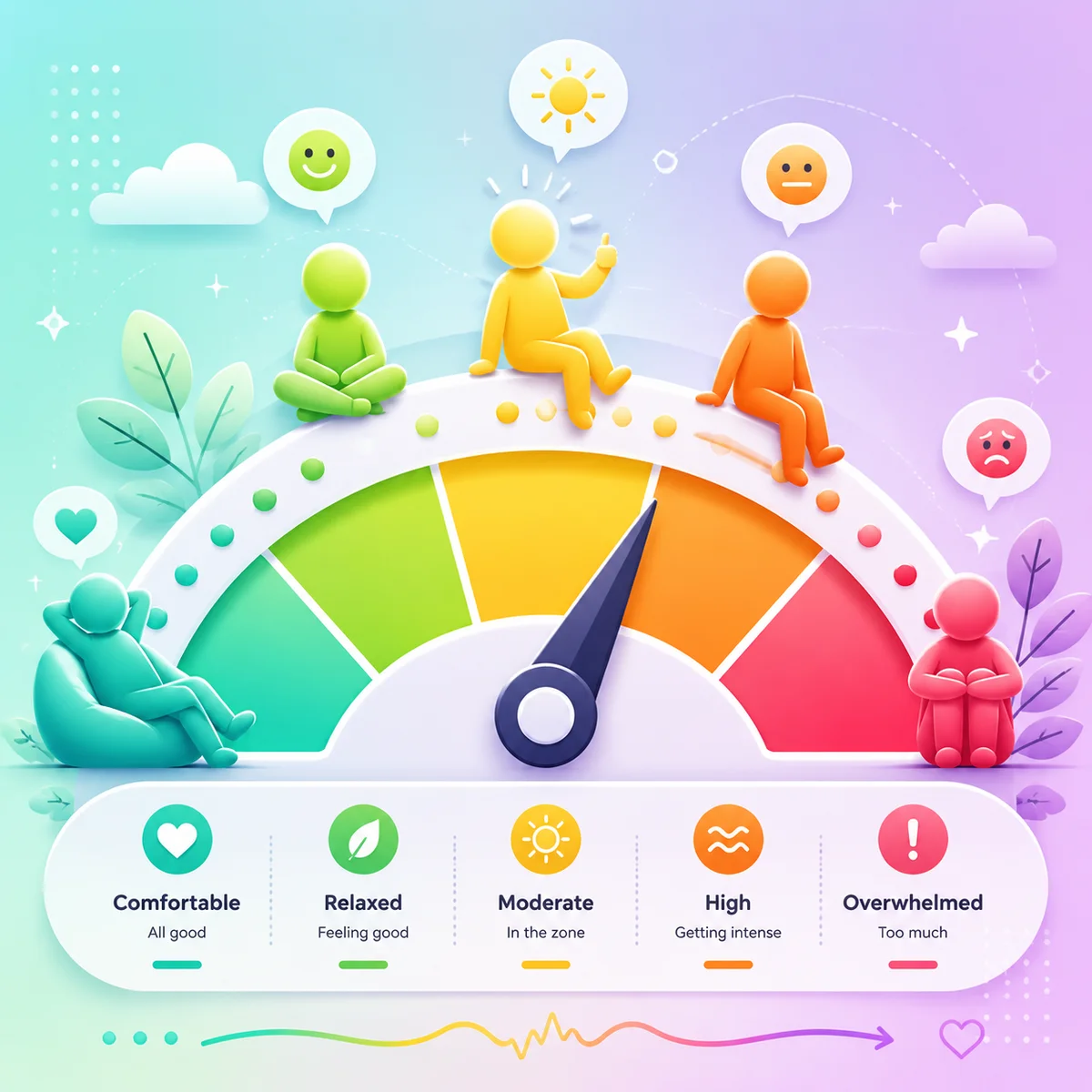
Body Language Cheat Sheet: Green, Yellow, and Red Signals
Save this. Next time you’re on a threesome date, scan for these signals across all three people — including yourself.
| Signal Zone | What to Look For | What It Means | What to Do |
|---|---|---|---|
| 🟢 Green | Open posture, equal eye contact, mirroring, genuine smiles, closing physical distance | Everyone is comfortable and engaged | Keep doing what you’re doing. Enjoy the connection. |
| 🟢 Green | Laughter that involves all three, overlapping speech, relaxed silences | Natural group chemistry is flowing | This is the goal. Note what’s working. |
| 🟡 Yellow | Nervous fidgeting, one person quieter than usual, brief responses | Someone may be nervous or uncertain | Gentle check-in. Ask the quieter person a direct question. |
| 🟡 Yellow | Uneven eye contact, one person checking phone frequently | Engagement dropping or discomfort building | Change the topic or location. Take a quick break. |
| 🔴 Red | Physical withdrawal, crossed arms + turned away, exclusion patterns | Someone is actively uncomfortable | Pause the date. Address directly or end gracefully. |
| 🔴 Red | Pressure, boundary-pushing, uncomfortable silence that persists | Safety or consent concern | End the date immediately. Debrief later. |
Five Check-In Questions You Can Use During the Date:
- “How’s everyone feeling? First dates with three people are a different experience.”
- “Should we take a quick breather? Grab water, stretch legs?”
- “Is this pace feeling good for everyone?”
- “I want to make sure we’re all on the same page — anything you’d like to ask or bring up?”
- “We’ve been talking for a while — should we wrap up here or keep going?”

Body language is a skill you build over time. Every threesome date teaches you something new about how people signal comfort, interest, discomfort, and chemistry. The more you pay attention, the better you’ll get at reading the room — and the more confident everyone will feel. For the full picture on building genuine connections with three people, start with our complete guide to finding a third safely. Ready to put these skills into practice? Join 3Cupid and start meeting people who share your curiosity about threesome dating.
Editor’s note: This article was written by the 3Cupid editorial team to help couples and singles navigate threesome dating with awareness, empathy, and practical tools. Our content prioritizes emotional safety, clear communication, and enthusiastic consent.