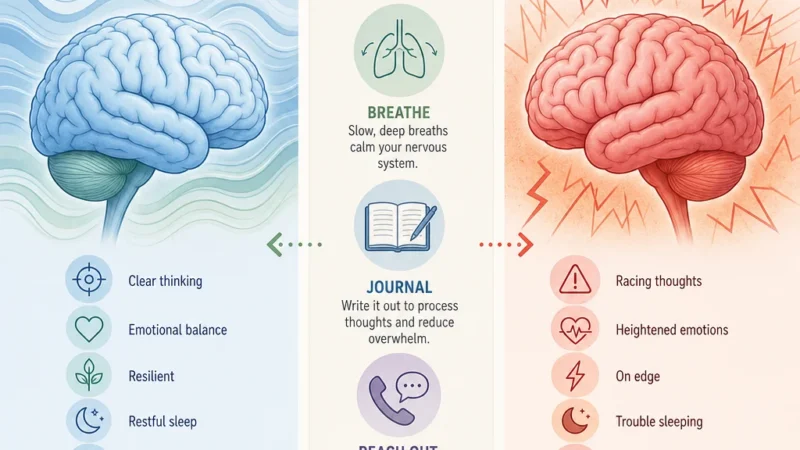
To support a partner with a trauma history in ENM, do three things: ask what helps instead of assuming, build predictability into the parts of open relationships that are inherently unpredictable, and keep your own boundaries intact so the support lasts. That is the short version.
The longer version matters because non-monogamy generates a particular kind of stress. Your partner is out with someone else. Plans shift at short notice. A new connection moves faster than anyone expected. There is no script for any of it. For someone whose history includes abandonment, coercion, or a loss of control over their own body or time, those ordinary features of open relationships can land with a weight that has nothing to do with you and a great deal to do with what came before.
You cannot fix that. You can stop adding to it, and you can make it easier for your partner to tell you when something is wrong. Everything below is in service of those two goals.

Table of Contents
- Start by Getting Consent for the Conversation
- Learn Their Early Signals, Not Just Their Story
- Make a Plan for the Hard Moments Before They Arrive
- What to Say in the Moment
- What Not to Do
- Supporting a Partner With a Trauma History Without Becoming a Therapist
- When to Encourage Professional Help
- Common Questions
Start by Getting Consent for the Conversation
Before asking anything about someone’s history, ask whether they want to talk about it at all. Something as simple as: “I would like to understand what is hard for you so I do not accidentally make it harder. Is that something you want to talk about, and is now a reasonable time?” That question hands over the timing, makes refusal easy, and signals that you are not collecting information for its own sake.
Be ready for no. Plenty of people have watched a disclosure get used against them later, and declining to share is not evasiveness — it is good sense. The encouraging part is that you can build a genuinely supportive structure without knowing the details at all. That is the whole premise of trauma-informed non-monogamy: the care comes first, and the story is optional.
If they do share something, resist the follow-up interrogation. “Thank you for telling me” is a complete response. Let them decide how much more to add and when.
Learn Their Early Signals, Not Just Their Story
Most people do not travel from fine to overwhelmed in a single step. There is usually a slope — a shorter fuse, terser replies, a particular kind of joke, going very quiet or very busy. If you learn what that slope looks like for your partner, you get to respond at the top of it rather than at the bottom.
Ask directly: “What does it look like when you are starting to struggle? I would much rather notice early than guess badly.” Then actually keep the answer in mind. This is not surveillance; it is the same attention you would pay to anyone’s tells.

One caveat worth repeating: signals drift. What was accurate a year ago may have shifted, especially if your partner has been doing their own work. Treat it as a living answer, not a permanent file.
Make a Plan for the Hard Moments Before They Arrive
The worst possible moment to work out what someone needs is the moment they need it. Sit down on an ordinary, uneventful evening and walk through the scenarios that actually occur in your lives: a plan changes with an hour’s notice, a date runs three hours long, a new connection escalates faster than expected, a message arrives from someone nobody was expecting.
For each one, agree on three things: what notice looks like, what the check-in looks like, and what happens if nobody can reach anyone. It is tedious to plan and invaluable in practice.
Write it down. Not because anyone intends to forget, but because stress reliably makes people forget — and a shared note removes the argument about what was originally agreed. If you already run a regular check-in, that is the natural place to keep it; how to run a RADAR check-in walks through one format that works well for exactly this.
What to Say in the Moment
You do not need eloquence. You need a handful of sentences you can reach for when your own brain is not helping.
- When something is clearly off and you do not know why: “I can see something is going on. I am not going to push you to explain. Do you want company, space, or a change of plan?”
- Before you head out: “I am leaving in about twenty minutes. I will message when I am home, and you can text me any time before that — I will pick up if I can.”
- When you got it wrong: “I did the thing we talked about and I can see it landed badly. That is on me. What would help right now?”
- When they say they are fine and clearly are not: “You do not have to be. I have time.”
Notice that none of these demand an explanation as the price of help. That is deliberate. People who are struggling usually cannot produce a clean account of why, and being asked to justify the feeling before receiving care tends to make everything worse.

The second script is the one that quietly prevents the most pain. Advance notice costs you almost nothing and buys your partner a great deal of steadiness — it is the difference between an unexpected gap and a scheduled one.
What Not to Do
Most of the damage in these situations is unintentional. Here are the patterns worth watching for in yourself.
- Do not negotiate a no. If they say they do not want to talk, or do not want you to go, or do not want a particular person involved, “but why?” is pressure wearing a question mark.
- Do not make their reaction the topic. “You are being irrational” is not feedback. It is a verdict, and it ends the conversation.
- Do not keep score on who has it harder. Your difficult evening does not cancel theirs.
- Do not repeat what they told you during a later argument. This is the single fastest way to end someone’s willingness to be honest with you.
- Do not take over everything. Managing every variable for someone shrinks their world and empties yours. Capable is not the same as well.
If you slip — and you will, everyone does — repair quickly and specifically. How to apologize and take accountability in polyamory covers what a real repair sounds like, as opposed to an explanation with an apology attached.

The distinction between a preference and a limit matters here too. If that line is fuzzy in your relationship, rules vs boundaries vs agreements in ENM is a useful reference.
Supporting a Partner With a Trauma History Without Becoming a Therapist
There is a version of support that quietly becomes a job. You are the one who regulates everything, anticipates every difficult moment, absorbs every hard evening. It feels honourable for about three months. Then it breaks, and it usually breaks badly.
Sustainable support has edges, and naming them is not a failure of care. “I want to be here for this, and I cannot be the only person you talk to about it” is a reasonable sentence. It is also the sentence that keeps the relationship alive.

Watch your own gauges: resentment that surprises you, dread before conversations, checking your phone constantly, feeling responsible for someone else’s mood. Those are early signals, not moral failings. We have written more about the warning signs in recognizing emotional burnout in ENM relationships, and about dividing the load in how to share emotional labor fairly in non-monogamy.
When to Encourage Professional Help
Some things are outside the range of what a partner can help with: flashbacks, panic that will not settle, avoidance that is steadily narrowing someone’s life, using alcohol or other substances to get through relationship situations, or any indication that they might harm themselves.
If safety is in question, do not manage it alone — in the US, calling or texting 988 connects to the Suicide & Crisis Lifeline, and outside the US your local emergency number or a national crisis line is the right call.
Raising it does not require an ultimatum or a diagnosis. “I am not sure I am the right person to help with this part, and I would like us to find someone who is. Can we look together?” invites collaboration instead of shame. You can also offer the concrete version: sit down together, open a directory, send the first message.
Two useful, non-sensational starting points: HelpGuide’s overview of trauma and PTSD symptoms, self-help, and treatment, and the NIMH guide to coping with traumatic events. Psychology Today’s trauma basics is a reasonable third stop for the emotional side.
When you are looking for a professional, ask one screening question up front: do you work with non-monogamous clients, and do you treat that as a valid relationship structure? The answer will save you both a lot of time.

Getting outside help does not mean you have failed at supporting them. It usually means the thing they are carrying was always bigger than one relationship could hold.
Common Questions
What if they have not told me they have a trauma history?
You do not need the label to act supportively. Giving notice, checking in, and making no easy to say are good practice with every partner, and they matter more — not less — when you do not know what someone is carrying.
Am I supposed to change my plans every time they struggle?
No. Support is not the same as accommodation without limit. The aim is to make the difficulty discussable and to respond thoughtfully, not to surrender every decision. Plans can stand and still be handled with care.
What if their reaction is aimed at someone else — a metamour, or my new partner?
Take the feeling seriously without treating the target as the cause. Often the person in front of you is the safe place to land, which is why the reaction lands there. It is worth saying out loud: “I hear you. I also want to be careful about how we talk about them.” More on handling those dynamics in building a healthy metamour relationship.
How do I know if I am doing okay at this?
Ask. “Is there anything I do that helps more than I realise, or anything that makes it worse?” Then sit with the answer without defending yourself. Nobody gets this right by instinct alone.
Learning to support a partner with a trauma history is mostly unglamorous work: asking instead of assuming, giving notice, keeping agreements, repairing quickly. None of it requires you to be a clinician. It requires you to be consistent — which, over time, turns out to be the thing that actually helps.
If you are figuring this out alongside people who take consent and care seriously, that is the company worth keeping — and you will find plenty of it right here at 3Cupid.
This article is for general education and is not a substitute for advice from a licensed mental health professional.