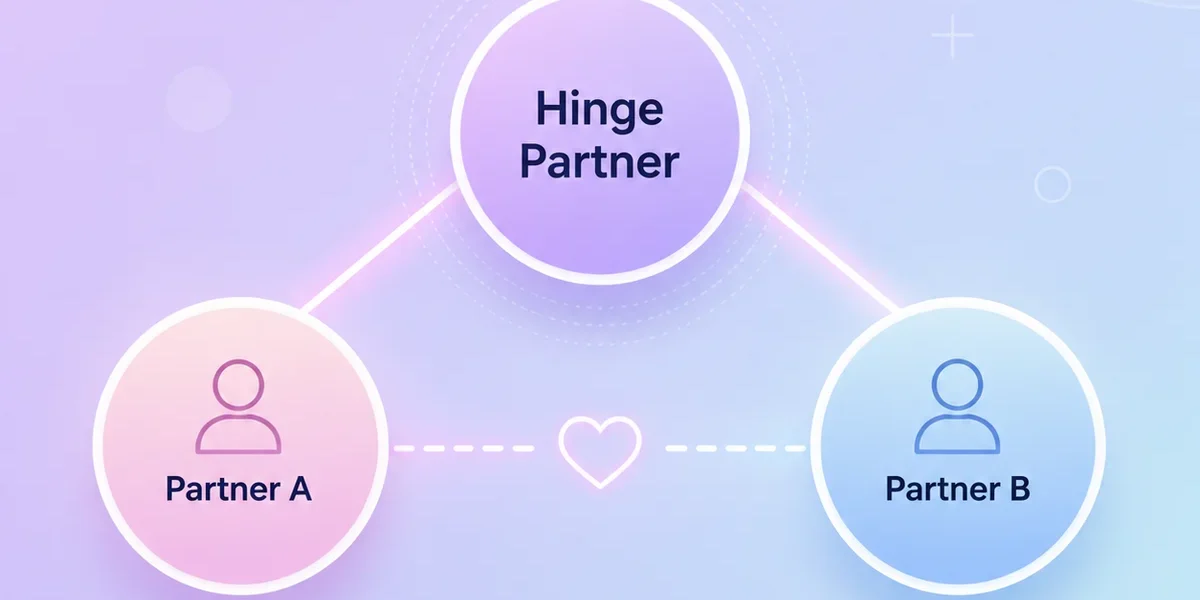
When you start exploring ethical non-monogamy — whether through threesomes, polyamory, or open relationships — you quickly encounter a word that doesn’t exist in the monogamous vocabulary: metamour. It’s one of those terms that sounds clinical at first, but describes something deeply human. Your metamour is your partner’s other partner — someone you might never date, but whose life now intersects with yours in ways both subtle and significant.
Learning to navigate a metamour relationship isn’t optional if you’re in ENM for the long haul. How you handle these connections often determines whether your non-monogamous dynamic feels stable and supportive or becomes a source of constant friction. This guide walks through what metamour relationships actually look like, the common pitfalls, and practical ways to build connections that work for everyone involved.
Table of Contents
- What Is a Metamour, Exactly?
- Different Types of Metamour Relationships
- Why Your Metamour Dynamic Matters More Than You Think
- Common Metamour Pitfalls and How to Avoid Them
- Building a Healthy Metamour Connection: A Practical Framework
- When the Metamour Relationship Isn’t Working
- Metamour Relationships Over Time
What Is a Metamour, Exactly?
A metamour is your partner’s other partner — someone connected to you through a shared romantic or sexual partner, but not someone you’re directly involved with yourself. If your girlfriend Alex is also dating Jordan, Jordan is your metamour. You and Jordan share a hinge partner (Alex), but your relationship with Jordan is its own distinct thing.
This might sound abstract until you actually live it. Suddenly there’s another person whose schedule affects your date nights, whose emotional state ripples into your partner’s mood, and whose boundaries shape what’s available to you. Whether you’ve exchanged three words or become genuine friends, that person exists in your relational ecosystem. According to research on polyamorous communities, the quality of metamour relationships is one of the strongest predictors of overall relationship satisfaction in non-monogamous arrangements (Psychology Today).
Metamours are especially relevant in threesome dating because the line between “metamour” and “partner” can blur quickly. A third who joins a couple for a one-time experience might become a metamour if one partner continues seeing them separately. A throuple dynamic, where all three people are dating each other, technically eliminates the metamour category — but only as long as all three relationships remain active and balanced.
Different Types of Metamour Relationships
There’s no single “right” way to relate to a metamour. The ENM community recognizes a spectrum, and where you land depends on your personalities, your partner’s preferences, and what everyone genuinely wants — not what anyone feels pressured into.
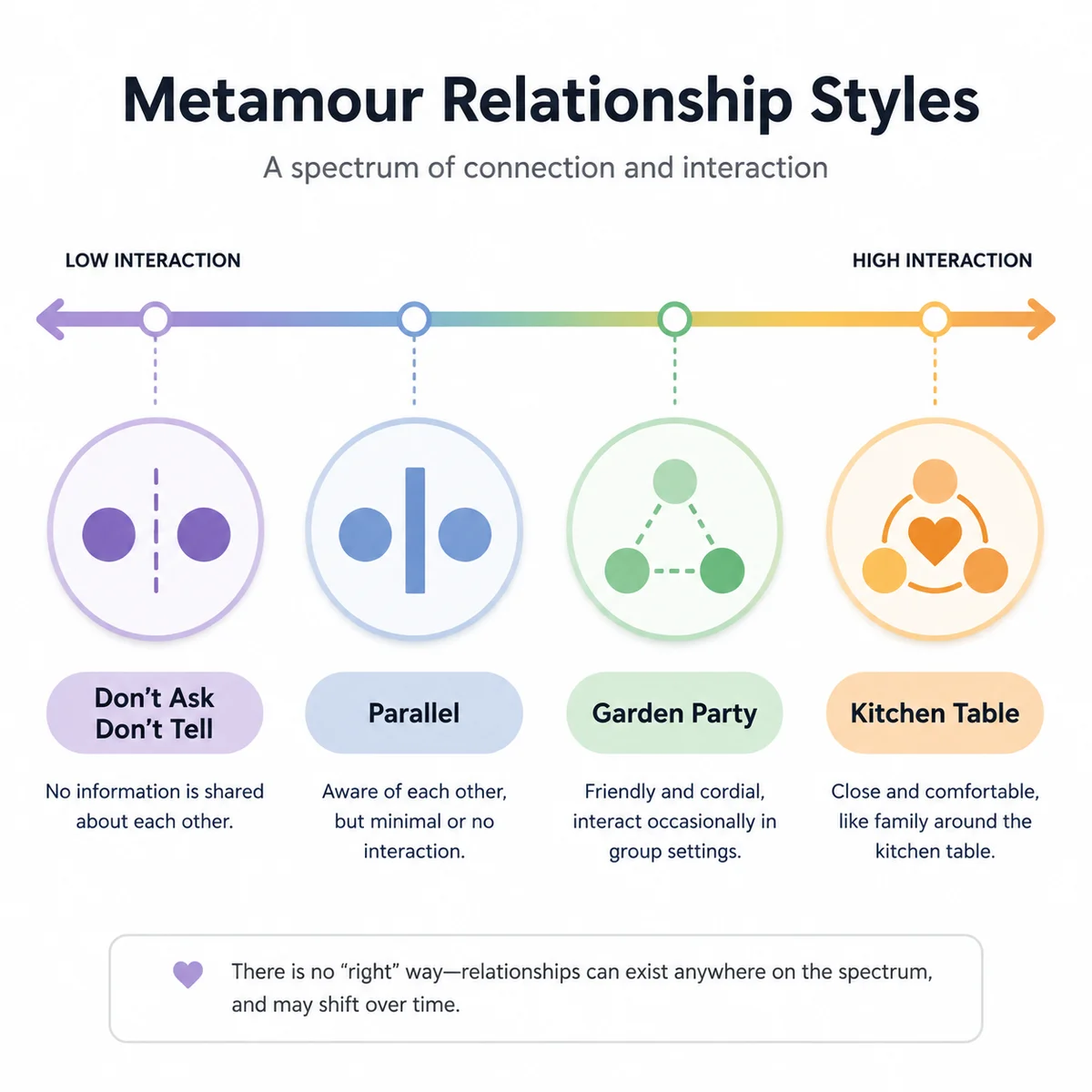
Parallel polyamory means you and your metamour have minimal or no direct contact. You know each other exists, basic safety information is shared, but you don’t hang out, text, or attend the same events. This works well for people who value clear separation and don’t feel a need for connection with their partner’s other partners. It’s also a reasonable starting point when everyone’s still figuring out their comfort levels.
Kitchen-table polyamory sits at the opposite end: you and your metamours are comfortable enough to sit around a kitchen table together — literally sharing meals, group hangouts, maybe even holidays. This doesn’t mean you’re best friends or that there’s zero awkwardness, but there’s genuine warmth and mutual respect. Many people find this reduces the emotional labor of compartmentalization.
Garden-party polyamory is the middle ground. You’re friendly at social gatherings — parties, birthdays, group events — but you don’t seek out one-on-one time with your metamour. You can coexist comfortably in the same space without the deeper integration of kitchen-table dynamics.
Don’t-ask-don’t-tell rounds out the spectrum: you know your partner has other partners but you receive zero information about them. While this can feel like the easiest path for avoiding jealousy, most experienced ENM practitioners caution that it tends to create more anxiety than it prevents. Not knowing often fuels imagination far more than knowing does.
Why Your Metamour Dynamic Matters More Than You Think
It’s tempting to treat the metamour relationship as a secondary concern — something you’ll figure out later, after you’ve sorted out your own relationships. But metamour dynamics don’t politely wait their turn. They show up in your partner’s stress levels, in scheduling conflicts, in the emotional bandwidth available for your dates, and in the overall atmosphere of your non-monogamous life.
When metamour relationships are tense or hostile, the hinge partner absorbs the strain. They become the messenger between two people who won’t communicate directly, the translator for grievances neither side feels safe expressing, and the emotional shock absorber for conflicts they didn’t create. This is exhausting and unsustainable. It’s also one of the most common reasons hinge partners burn out and relationships collapse — not because anyone was a bad partner, but because no single person can indefinitely carry the emotional weight of a broken metamour dynamic.
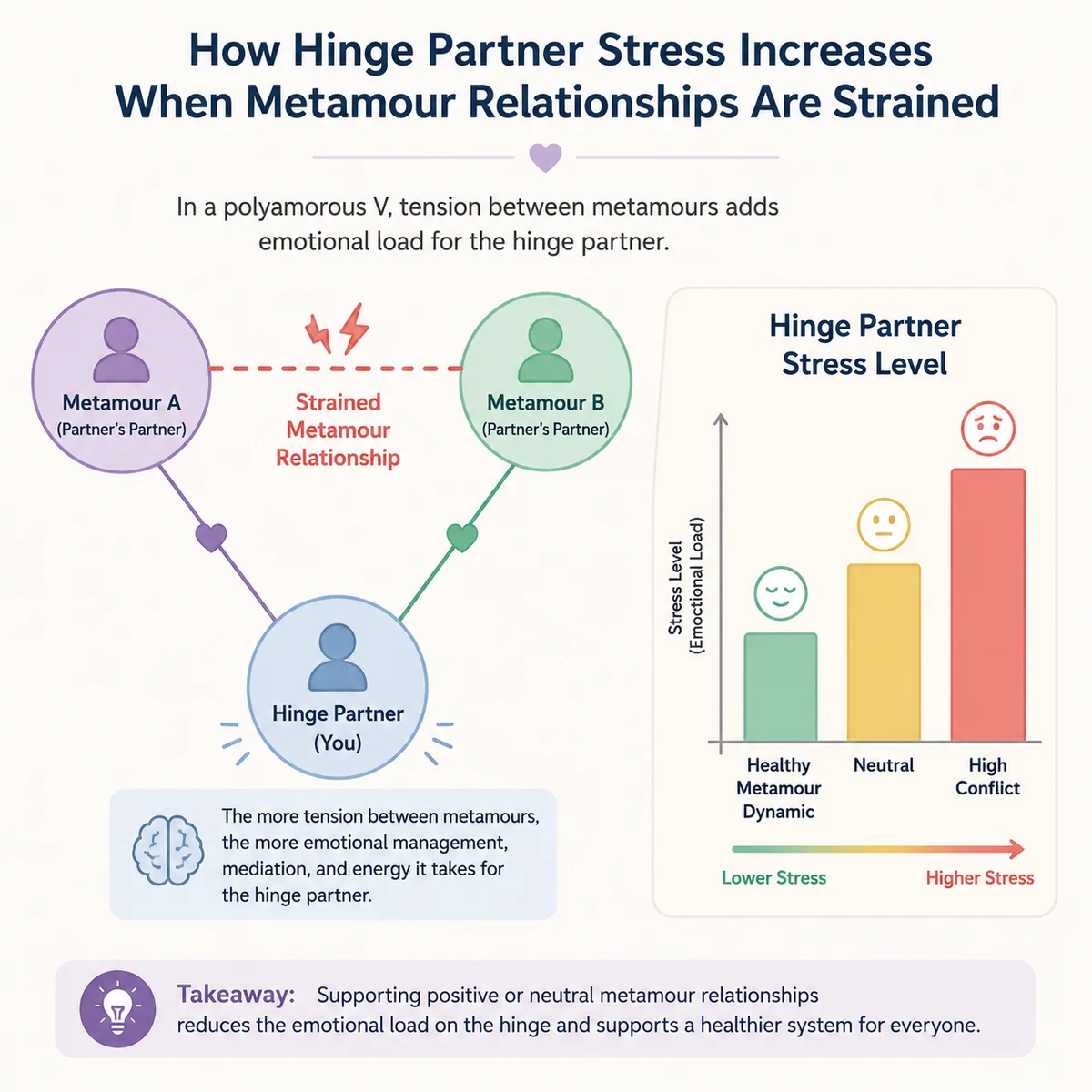
On the flip side, healthy metamour relationships create compounding benefits. When you can coordinate schedules directly with your metamour instead of routing everything through your shared partner, logistical friction drops. When you genuinely like and trust each other, your partner doesn’t have to choose between celebrating one relationship while hiding it from the other. The whole system runs more smoothly, and everyone involved ends up with more emotional energy — not less.
This is where compersion often enters naturally. It’s much easier to feel genuine happiness about your partner’s other connections when you know and respect the person they’re connecting with. Compersion thrives in environments of transparency and goodwill — exactly what a functional metamour relationship provides.
Common Metamour Pitfalls and How to Avoid Them
Most metamour problems fall into a handful of predictable patterns. Recognizing them early makes them far easier to address.
Forced friendship. One of the most damaging mistakes is insisting that metamours must be friends. Some people click naturally; others don’t. Pressuring someone into a friendship they didn’t choose breeds resentment, not connection. Parallel dynamics are valid. “I expect you to be best friends with my other partner” is not a boundary — it’s a demand that erases someone else’s autonomy. Respecting different comfort levels is foundational to healthy ENM negotiation.
Comparison loops. When you know details about your metamour’s relationship with your shared partner — how often they see each other, what activities they do, the nature of their intimacy — it’s nearly impossible not to compare. “Why do they get weekend trips when we only get Tuesday evenings?” Comparison is human, but it becomes destructive when it consumes your mental real estate. The fix isn’t to know less (though that can help temporarily); it’s to advocate for what you need in your own relationship without making the metamour relationship the benchmark.
The messenger trap. Using your shared partner as a go-between for metamour communication is tempting, but it guarantees distortion. Messages get softened, hardened, or lost entirely as they pass through the hinge. If you need to communicate with a metamour — about scheduling, boundaries, or concerns — do it directly. It’s uncomfortable at first, but far less damaging than playing telephone through someone you both care about.
Veto by stealth. Some people never explicitly say “I don’t want you seeing them,” but they make the metamour relationship so difficult — through coldness, exclusion, or constant complaints — that the hinge partner eventually ends the other relationship to stop the pain. This is a veto disguised as a personality conflict, and it’s corrosive to trust. If you have a problem with a metamour, name it directly and work on it together rather than making the environment unlivable.
Building a Healthy Metamour Connection: A Practical Framework
Healthy metamour relationships don’t require friendship, but they do require intentionality. Here’s a framework that works across every point on the spectrum — from parallel to kitchen-table.
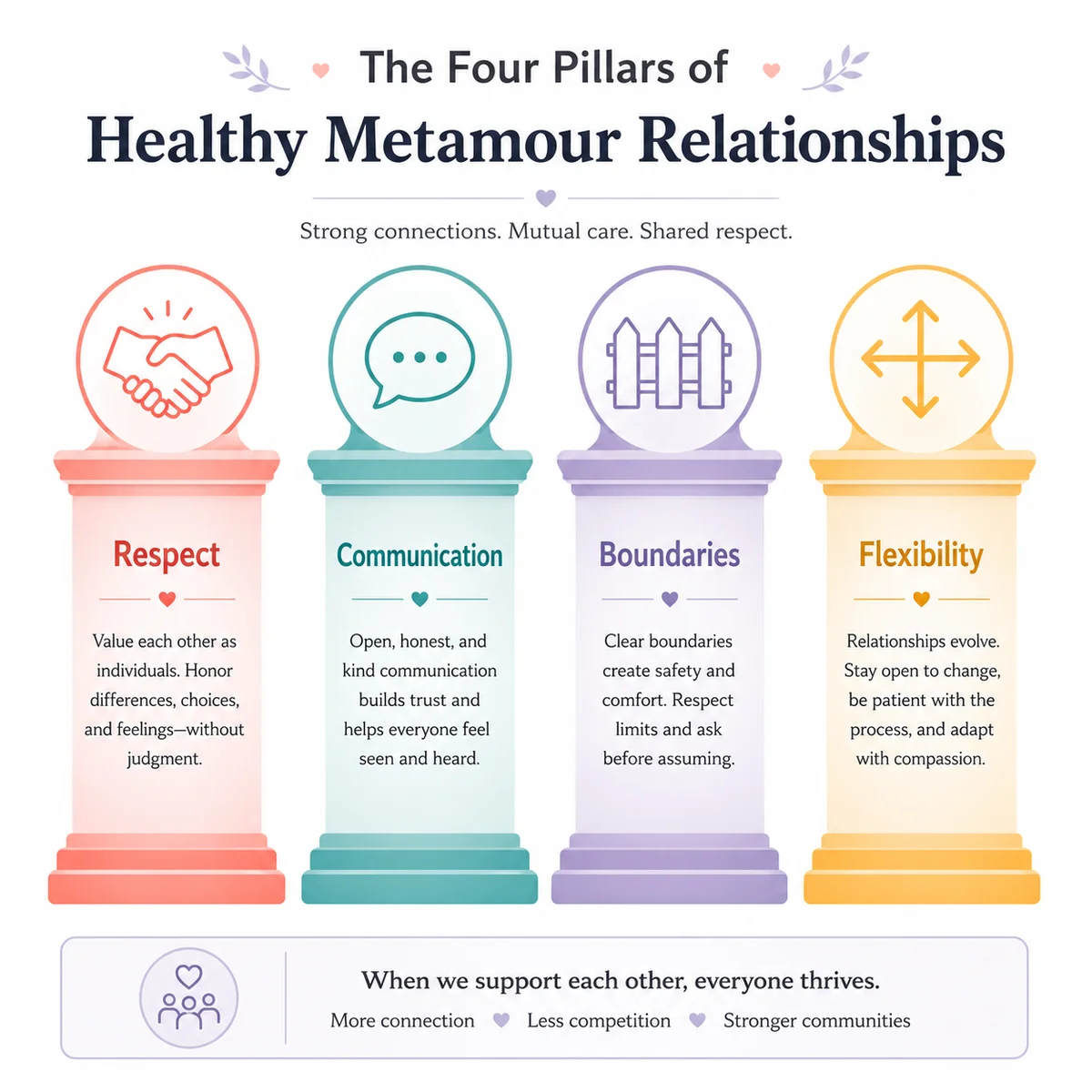
Step 1: Establish your baseline. Before you even meet a metamour, have an honest conversation with your partner about what you each want. Is your ideal parallel, garden-party, or kitchen-table? What are your hard limits? What are you open to exploring over time? Write this down. It’s not a contract, but a shared understanding that prevents assumptions from creating conflict later. This is essentially an extension of the boundaries work you’d do before any ENM arrangement.
Step 2: Create a communication agreement. Even parallel metamours need some baseline communication infrastructure. Who shares what information with whom? What’s the protocol for scheduling changes? How are health and safety updates handled? A simple shared understanding prevents most of the logistical headaches that sour metamour relationships before they’ve had a chance to develop.
Step 3: Respect the relationship you’re not in. You don’t need to like your metamour’s choices, communication style, or personality. You do need to respect that they have a genuine relationship with someone you care about. That means no badmouthing, no undermining, and no competing for the hinge partner’s loyalty. If you have a genuine concern about the relationship’s impact, you raise it with your partner as a concern about your own relationship — not as a critique of the metamour.
Step 4: Let the relationship find its own level. Some metamour relationships start parallel and naturally warm into garden-party or kitchen-table over time. Others start with high hopes for friendship and settle into a comfortable parallel arrangement. Neither is a failure. The goal isn’t a specific outcome — it’s a dynamic that everyone can sustain without draining themselves. Let it evolve without forcing it into a predetermined shape.
When the Metamour Relationship Isn’t Working
Sometimes, despite everyone’s best efforts, a metamour dynamic becomes genuinely untenable. Recognizing the difference between normal adjustment friction and a relationship that’s actively harmful is an essential skill.
Signs that the dynamic has crossed into unhealthy territory include: your metamour consistently disrespects your stated boundaries; you find yourself dreading any mention of their name; the hinge partner is showing clear signs of emotional exhaustion from managing the tension; or the situation is affecting your mental health, work performance, or other relationships. These aren’t communication problems — they’re indicators that the current configuration isn’t viable.
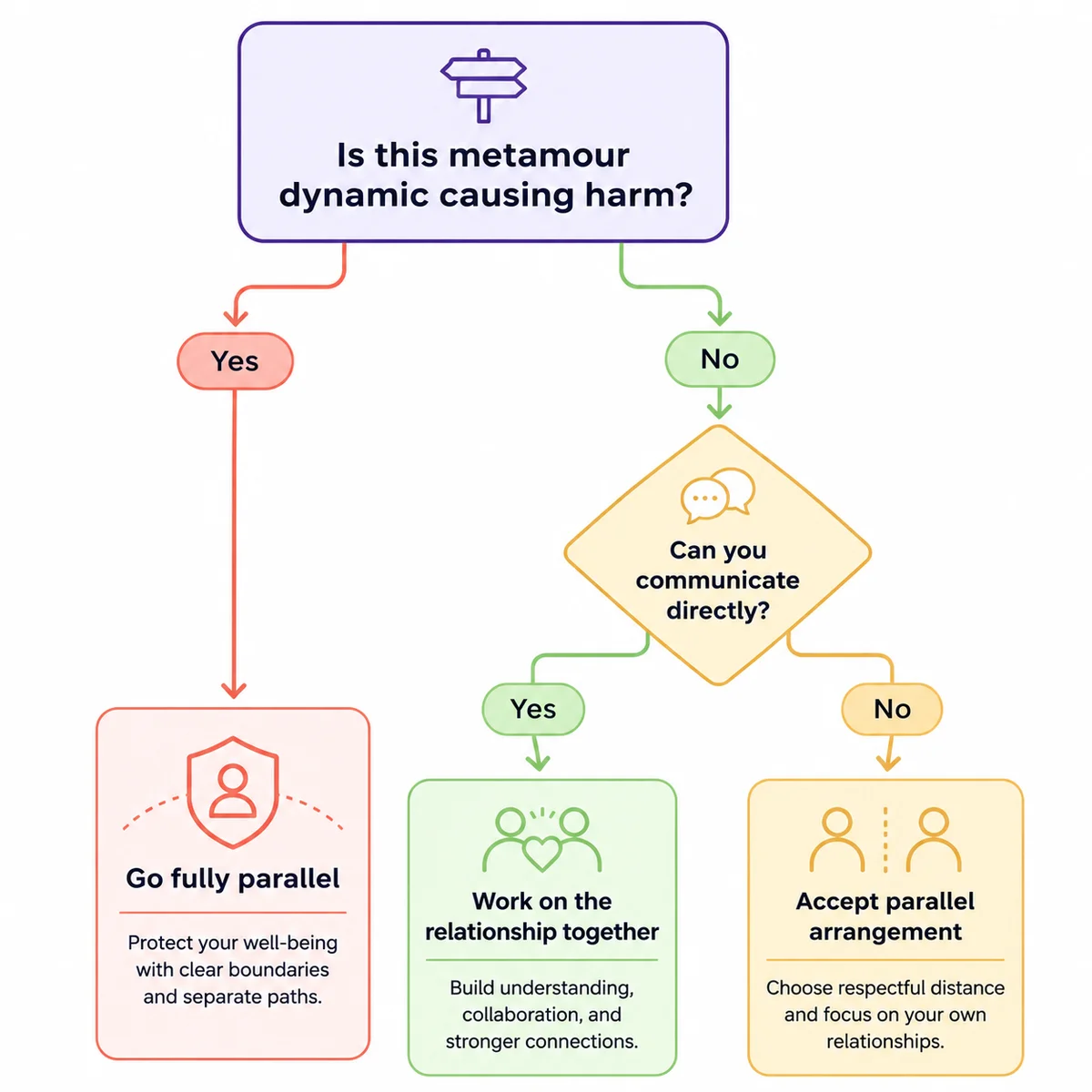
If you reach this point, going fully parallel is a legitimate and often healthy choice. It’s not a failure or a regression — it’s an adjustment to reality. Set clear agreements about information sharing, scheduling, and events. Protect your own emotional space. Your partner may need to develop stronger hinge skills to manage the separation, but that’s their work to do. Your work is to disengage from a dynamic that isn’t serving you without punishing anyone in the process.
In more extreme cases, where a metamour is actively hostile or the situation is causing significant harm, you may need to have a direct conversation with your partner about what you can and cannot sustain. This isn’t giving an ultimatum — it’s stating your reality. “I can’t continue in a configuration where I feel unsafe or constantly undermined” is honest self-advocacy, not manipulation. The emotional aftercare principles that apply after intense threesome experiences apply here too: acknowledge feelings, reconnect with your partner, and make space for processing without rushing to solutions.
Metamour Relationships Over Time
One of the most reassuring things about metamour dynamics is that they almost always get easier with time. The first six months tend to be the hardest — you’re still learning each other’s communication styles, testing boundaries, and figuring out how this whole configuration actually feels versus how you imagined it would feel. After that initial adjustment period, most metamour relationships find a stable equilibrium.
Some of the strongest metamour connections in the ENM community started with awkwardness and uncertainty. What made the difference wasn’t instant chemistry but consistent small choices: responding to texts in a reasonable timeframe, showing up when you said you would, giving each other the benefit of the doubt when miscommunications happened, and treating the metamour relationship as something worth investing in — not just tolerating.
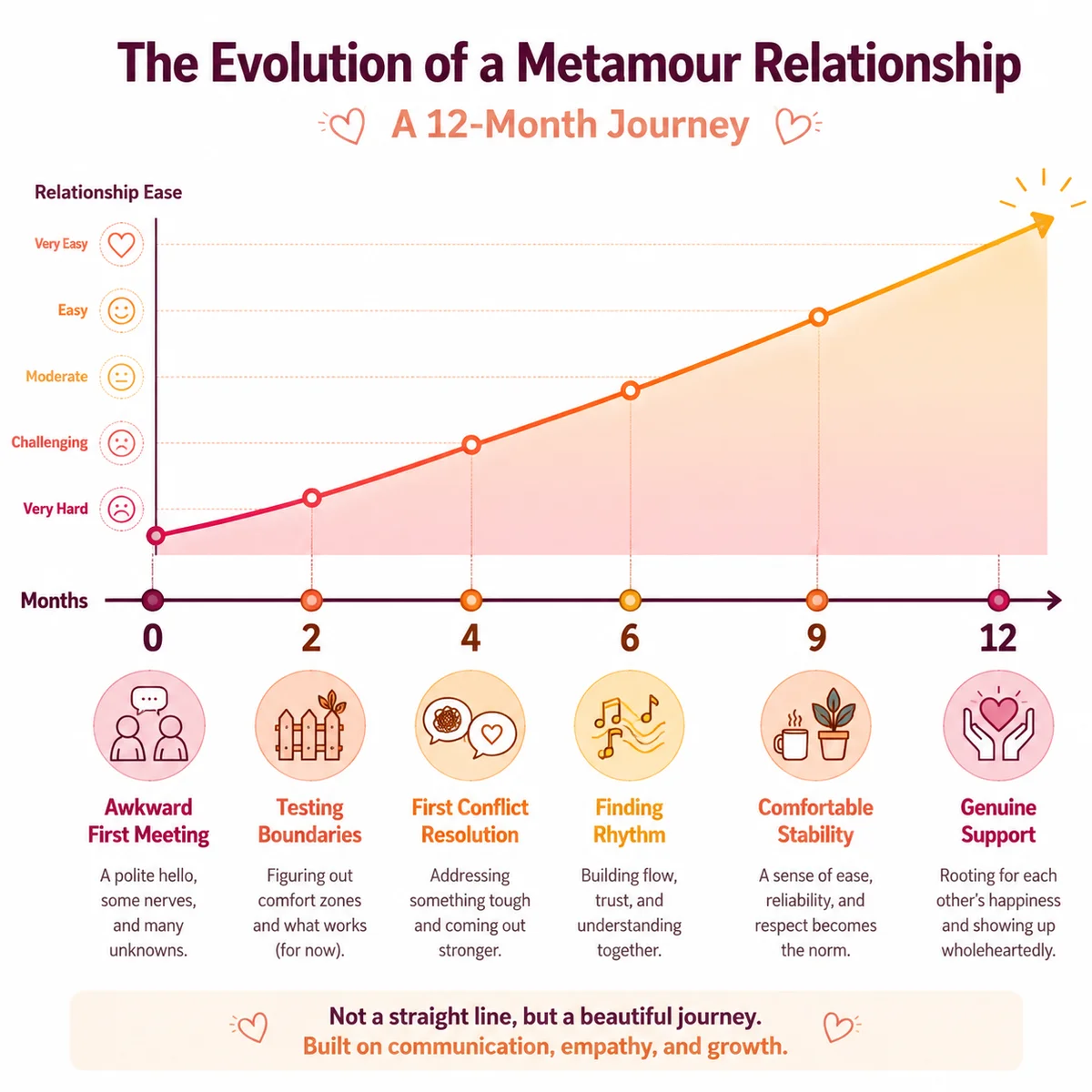
It’s also worth noting that metamour relationships can become genuine sources of support. Many people in long-term ENM arrangements describe their metamours as family — not in the Hallmark-card sense, but in the real sense of people who show up, who understand your life in ways most people don’t, and who share a stake in the happiness of someone you both love. That kind of connection doesn’t require friendship. It requires mutual respect, basic goodwill, and the recognition that you’re both on the same team — even if you’re playing different positions.
If you’re building or deepening a non-monogamous dynamic, investing in your metamour relationships pays dividends that extend far beyond the initial awkwardness. The trust you build before entering new dynamics and the jealousy management skills you develop along the way all feed into making metamour connections work. And when they do work, they make the entire ENM experience richer, more sustainable, and genuinely easier.
This article is part of 3Cupid’s ongoing guide to ethical non-monogamy and threesome dating. Our content is written for adults 18+ exploring consensual, respectful multi-partner dynamics.