If you have spent any time in dating or relationship spaces recently, you have probably heard the term ethical non-monogamy — or ENM for short. It shows up in dating app profiles, relationship podcasts, and dinner table conversations. But what does it actually mean? And more importantly, is it something that might work for you?
Ethical non-monogamy is an umbrella term for relationship structures where people have multiple romantic or sexual partners — with the full knowledge and consent of everyone involved. Unlike cheating or secrecy, ENM is built on transparency, negotiation, and mutual respect. This guide covers the fundamentals: what ENM looks like in practice, the different forms it takes, and what you need to know before exploring it.
Table of Contents
- What Is Ethical Non-Monogamy?
- Common Types of ENM Relationships
- Why People Choose Ethical Non-Monogamy
- The Foundations: Communication, Consent, and Boundaries
- Common Challenges and How to Navigate Them
- Getting Started: First Steps for Couples and Singles
- Myths About ENM — Debunked
- Is ENM Right for You?
What Is Ethical Non-Monogamy?
At its core, ethical non-monogamy means having intimate relationships with more than one person in a way that everyone agrees to and feels good about. The key word is ethical — this is not about sneaking around or bending rules. It is about creating relationship agreements that work for everyone involved.
ENM is not one specific type of relationship. It is a broad category that includes open relationships, polyamory, swinging, relationship anarchy, and many other configurations. What unites them all is the commitment to consent, communication, and honesty. Partners know about each other, boundaries are discussed openly, and no one is being deceived.
Research on non-monogamous relationships has grown significantly. A 2020 study published in the Journal of Sex Research found that approximately one in five adults in the United States has engaged in some form of consensual non-monogamy. It is more common than many people realize — and it works for a wide range of people across ages, genders, and backgrounds.
Common Types of ENM Relationships
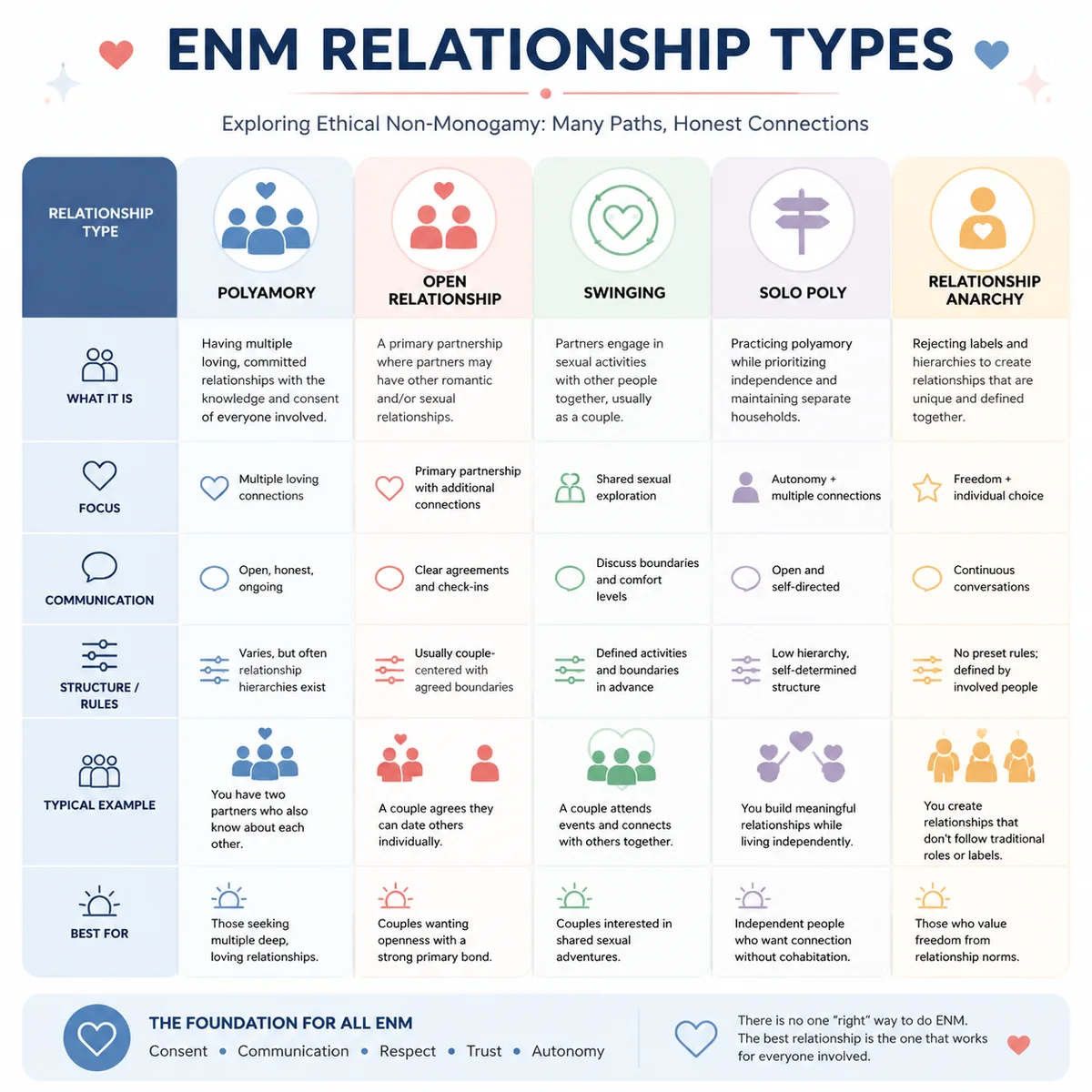
Ethical non-monogamy is not one-size-fits-all. Understanding the different forms can help you figure out what resonates — and what definitely does not. Here are the most common types:
| Type | Description | What Sets It Apart |
|---|---|---|
| Open Relationship | A primary couple allows outside sexual connections | Romantic exclusivity is maintained; sexual openness is negotiated |
| Polyamory | Multiple loving, romantic relationships with consent | Emotional and romantic connections are welcomed, not just physical |
| Swinging | Couples engage in recreational sex with others | Often social and activity-focused; emotional bonds typically stay within the primary couple |
| Relationship Anarchy | No preset hierarchy; each relationship is uniquely defined | Rejects labels and predetermined rules; every connection stands on its own |
| Monogamish | Mostly monogamous with occasional exceptions | Low-frequency outside encounters; primary focus stays on the main partnership |
These categories are not rigid boxes. Many people blend elements from different approaches or shift between them as their needs evolve. What matters is that everyone involved understands and agrees to the structure.
Why People Choose Ethical Non-Monogamy
People come to ENM for vastly different reasons — and there is no single “right” motivation. Understanding why you are drawn to it can help you approach it with clarity.
Some people feel that loving more than one person is simply part of who they are — similar to sexual orientation, it is not a choice but an orientation. Others arrive at ENM through intellectual curiosity or a desire to challenge social norms. Some couples open up because they want to explore different forms of connection while maintaining their primary bond. Still others discover ENM after a period of monogamy that did not fully meet their needs.
What ENM is not: a way to fix a struggling relationship, a compromise to keep a partner from leaving, or a last-ditch effort to save something that is already broken. ENM amplifies whatever is already present in a relationship — if the foundation is strong, it can deepen trust. If the foundation is cracked, ENM will widen those cracks.
The Foundations: Communication, Consent, and Boundaries
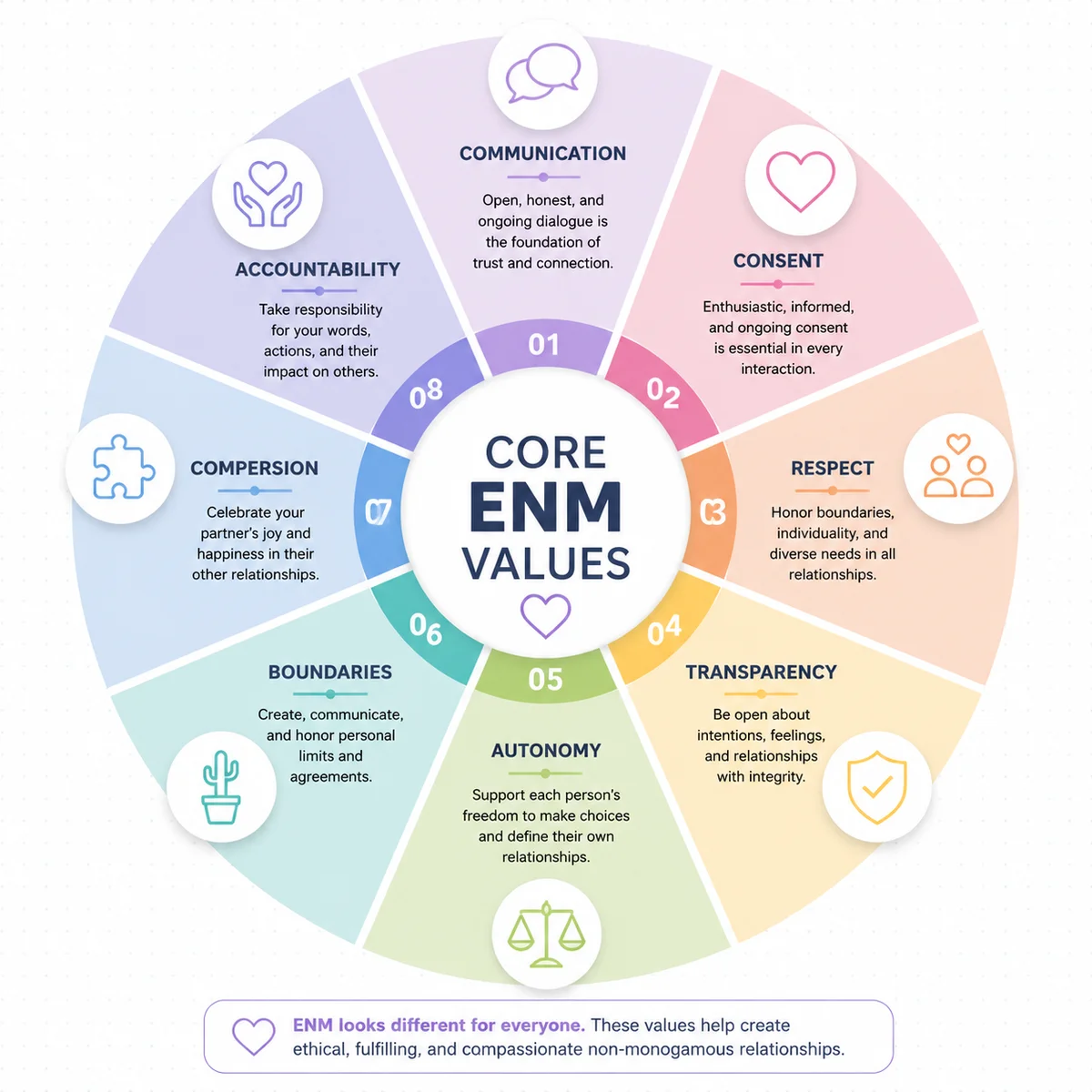
Every sustainable ENM dynamic rests on three pillars. Without them, things fall apart — sometimes quietly, sometimes loudly, but inevitably.
Communication. This goes beyond “talking more.” It means having uncomfortable conversations before they become crises. It means checking in regularly — not just when something feels wrong. It means being honest about your feelings even when that honesty is inconvenient. In ENM, silence is not safety — it is a slow buildup of unresolved tension.
Consent. Consent in ENM means everyone involved genuinely agrees to the arrangement. Not just tolerating it to keep a partner happy. Not “going along with it” while secretly miserable. Enthusiastic consent — where all parties feel empowered to say yes, no, or renegotiate — is the standard.
Boundaries. Boundaries are not walls — they are agreements about what each person needs to feel safe and respected. They might cover physical health practices, time allocation, emotional involvement, privacy about the relationship, and how much detail is shared between partners. Good boundaries are specific, realistic, and revisited regularly.
Common Challenges and How to Navigate Them
ENM is not a friction-free utopia. It comes with its own set of challenges — and knowing what to expect is half the battle. Here are the most common ones and practical ways to handle them:
- Jealousy. Yes, polyamorous and ENM people get jealous. The difference is what they do with it. Instead of treating jealousy as a stop sign, treat it as a signal — something needs attention. Talk about it openly, trace it back to its source (fear of abandonment? insecurity? unmet needs?), and address that root rather than the symptom.
- Time Management. Multiple relationships mean multiple schedules. Time management in polyamorous relationships requires intentional planning. Shared calendars, regular check-ins, and honest capacity assessments are not optional — they are infrastructure.
- New Relationship Energy (NRE). The intoxicating rush of a new connection can make existing partners feel neglected. Managing NRE in ENM means staying aware of the emotional high, consciously nurturing existing relationships, and not making major decisions while infatuated.
- Social Stigma. Not everyone will understand your relationship choices. Prepare for questions, misconceptions, and sometimes outright judgment. Build a support network of people who do get it — online communities, local meetups, or understanding friends make a huge difference.
Getting Started: First Steps for Couples and Singles
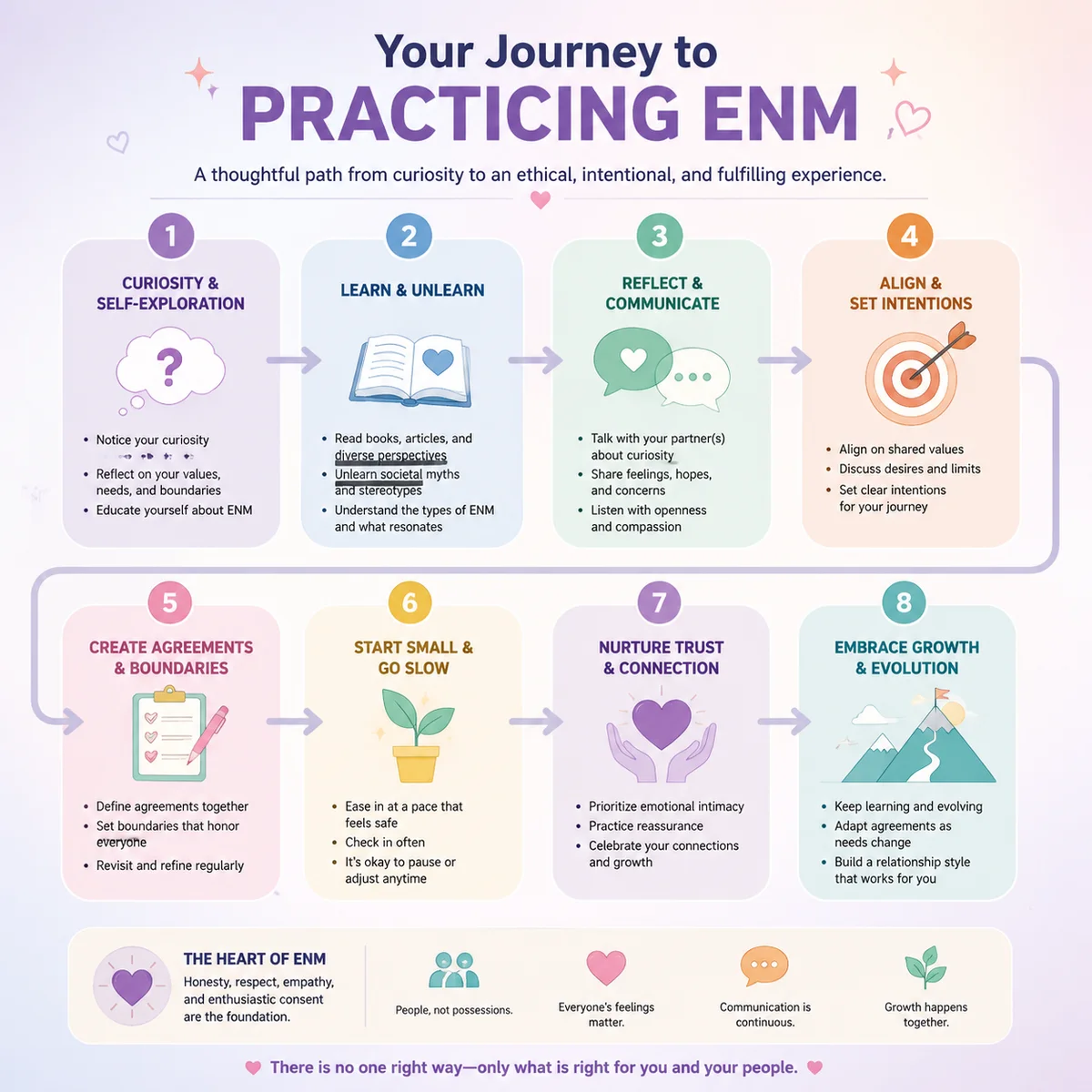
If you are considering ethical non-monogamy, do not rush. The most successful transitions happen slowly, with lots of conversation along the way.
For couples: Start by talking about why you are interested. Read books together — “The Ethical Slut” by Dossie Easton and Janet Hardy, and “Polysecure” by Jessica Fern are excellent starting points. Discuss hypothetical scenarios before anything becomes real. What would bother you? What feels exciting? Where are your hard limits? These conversations are the foundation.
For singles: Understand what you want before you start connecting with others. Are you looking for a primary partnership with ENM as a structure? Do you want to date within ENM communities without a primary anchor? Your clarity protects both you and the people you meet. Platforms like 3Cupid connect people specifically interested in non-traditional relationship structures, which removes a major layer of initial awkwardness.
Myths About ENM — Debunked
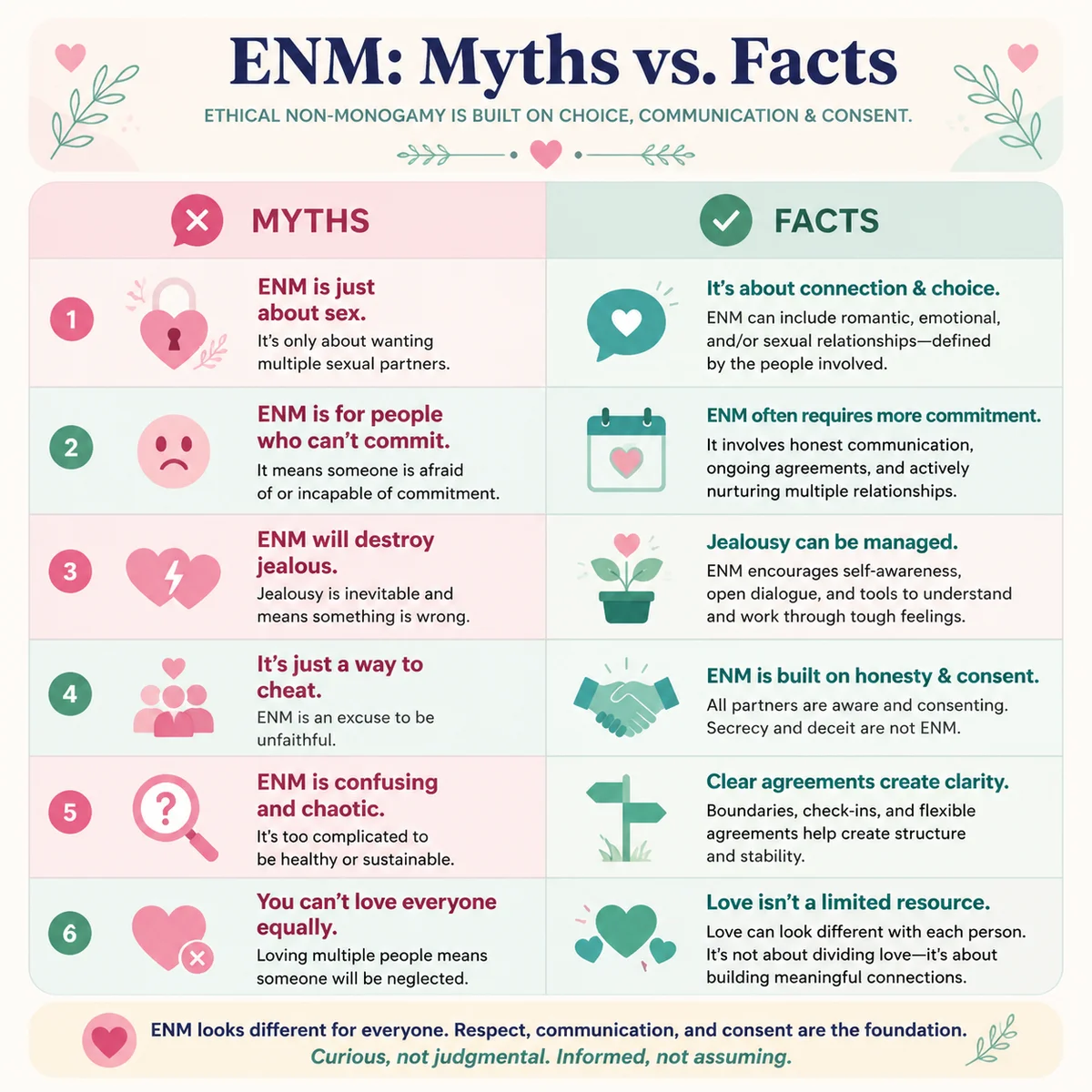
ENM is surrounded by misconceptions that can make people hesitate or judge unfairly. Let us clear up some of the most persistent ones:
| ❌ Myth | ✅ Reality |
|---|---|
| ENM is just cheating with permission | Cheating involves deception. ENM involves transparency and mutual agreement — the two are fundamentally different |
| ENM people cannot commit | Many ENM relationships involve deep, long-term commitments — just not sexual exclusivity |
| ENM is all about sex | While sexual variety is part of it for some, many ENM relationships are built on emotional connection and romantic love |
| Jealousy means ENM is not for you | Jealousy is a normal human emotion. ENM people experience it and learn to work through it constructively |
| ENM is easier than monogamy | ENM requires significantly more communication, emotional awareness, and scheduling effort than most monogamous relationships |
For a deeper dive into how ENM compares with other relationship styles, see our guide on swinging vs polyamory, which breaks down the distinctions between two of the most common non-monogamous approaches.
Is ENM Right for You?
There is no test that gives you a definitive answer, but asking yourself a few honest questions helps:
- Can you handle your partner forming emotional connections with other people?
- Are you willing to invest significant time in communication and emotional processing?
- Do you have the capacity to manage multiple relationships without neglecting any of them?
- Are you pursuing this because you genuinely want it, or because a partner is pressuring you?
If your answers lean toward hesitation on the first three — or reveal external pressure on the last — slow down. ENM works best when it is a choice, not a compromise.
The world of ethical non-monogamy is broad enough to include many different approaches, paces, and preferences. Whether you explore it through reading, conversation, or eventually action, what matters most is that you do it with honesty — toward yourself and toward everyone you connect with. For more on how ENM relates to specific relationship configurations, check out our guide on threesome vs throuple differences and polyamory for beginners.
You can learn more about the psychology behind non-monogamous relationships from VeryWell Mind.
This article was written by the 3Cupid editorial team. 3Cupid is a dating platform connecting open-minded adults for threesome dating, ENM, and polyamorous relationships. All content is intended for readers 18+.