
Figuring out how to split travel costs with partners is unglamorous work that decides whether the trip is remembered fondly. There is no single fair answer, but there are three workable systems, and picking one before you book matters far more than which one you pick.
Here is the short version: split the shared, fixed costs evenly; split personal costs personally; and decide what happens with anything in the grey area between those two categories while you are still at home and nobody is tired.
The rest of this guide is the detail that stops a fair system from drifting into a quiet ledger of grudges.
Table of Contents
- Why Money Gets Louder When You’re Away From Home
- Agree on the Shape of the Trip Before the Numbers
- Three Ways to Split Costs, and Who Each One Fits
- The Line Items People Forget to Budget For
- When Incomes Don’t Match
- Deposits, Cancellations and the Person Who Bails
- Keep the Receipts, Skip the Scorekeeping
- Frequently Asked Questions
Why Money Gets Louder When You’re Away From Home
At home, small money imbalances even out. You pay for dinner, they pay for the cinema, nobody counts. On a trip, every payment is visible, everyone is slightly stressed, and the same small imbalances get remembered in high definition.
Money is also rarely just money in relationships. It stands in for fairness, for being valued, for whether your needs rank as high as someone else’s. That is why a forty-euro disagreement can feel like something much larger. The American Psychological Association’s overview of healthy relationships is a useful reminder that money arguments usually track something underneath the numbers.
So the aim is not to make the maths perfect. It is to make the maths agreed, visible and boring.

Agree on the Shape of the Trip Before the Numbers
You cannot split a budget you have not described. Before anyone opens a spreadsheet, name what kind of trip this is, because the shape determines which costs are shared.
- A shared trip. One destination, one accommodation, most meals and activities together. Nearly everything is a shared cost.
- A parallel trip. Everyone is in the same city but doing different things, meeting for dinners. Only accommodation and those shared meals are common costs.
- A hub trip. One base, with some people taking day trips others skip. The base is shared, the side trips are personal.
Write the shape down. It takes two minutes and it prevents the most common fight, which is two people budgeting for different trips and discovering it at a restaurant.
If you have not settled the trip itself yet, start with our guide to planning a vacation with multiple partners, then come back to the money. The order matters, because the shape of the trip decides almost every number that follows.
If you want the wider context before you get to the trip-specific version, our guide to money boundaries in multi-partner dating covers the principles this all rests on.
Three Ways to Split Costs, and Who Each One Fits
Almost every workable system is a variation on one of three. Choose one for the whole trip rather than switching between them, because mixing methods is where the accounting starts feeling personal.
| Method | How it works | Best for | Where it breaks |
|---|---|---|---|
| Even split of shared costs | Add up accommodation, transport, shared meals and shared activities, divide by heads. Personal spending stays personal. | Groups with similar incomes and similar appetites | When one person’s needs genuinely cost more, or one person opts out of a costly activity |
| Weighted by income | Everyone contributes a percentage of the total roughly in line with what they earn, so the load is comparable rather than identical. | Groups with a real income gap where everyone still wants the same trip | Needs honest income talk, and can quietly turn into one person always paying more |
| Itemised, pay your own | Each person pays for what they actually use. Accommodation split by room or by bed, meals split by what was ordered. | Different budgets, different activity preferences, longer trips | More admin, and it can make a shared trip feel like a series of transactions |
Whichever you choose, decide what counts as shared before the first payment: the rental, obviously, but also the grocery run, the shared taxi, the bottle of wine at the villa, and the activity one person wanted and two people tolerated.
One rule that saves a lot of friction: if it is optional, it is personal. The museum one person insists on and the spa afternoon another person sits out are not shared costs just because they happened on a shared trip.

The Line Items People Forget to Budget For
The gap between the advertised trip price and the actual trip price is where most tension lives. These are the usual suspects.
- Accommodation taxes, resort fees and cleaning charges that appear only at checkout
- Baggage fees, seat selection and airport transfers at both ends
- Groceries and the first-night shop, which always costs more than a week of groceries at home
- Service charges and tips in countries where the custom differs from what you are used to
- Data roaming or a local SIM, plus the charging cables and adaptors nobody packed
- Laundry on trips longer than a week
- The “we are on holiday” tax: second coffees, gelato, a drink that costs triple what it does at home
- A contingency fund of ten to fifteen percent, held by one person and spent only on real emergencies
Naming these in advance does two things. It makes the budget honest, and it gives everyone permission to say “that is not in my ceiling” without it sounding like a complaint about the group.
For the ongoing version of this conversation, financial planning across multiple relationships covers the structures people use once money is entangled beyond a single week away.
When Incomes Don’t Match
This is the case that breaks naive fairness. Splitting evenly sounds neutral and is not: the same 300 euros is a rounding error for one person and a fortnight of skipped lunches for another.
Two approaches tend to work. The first is to set the trip at the level of the smallest budget and add nothing that requires anyone to stretch. The second is to choose the trip the group wants and split it proportionally, so everyone is paying a comparable share of what they actually have.
Both are legitimate. What does not work is setting the trip at the level of the largest budget and splitting evenly, then hoping nobody says anything. Somebody always says something. It is just a question of whether they say it in week two or in the argument three months later.
Watch for the quiet version too. The person who stops suggesting restaurants, who says “you two go ahead” more often as the week goes on, who volunteers to skip the boat trip. That is usually a budget problem wearing a preference costume.
Deposits, Cancellations and the Person Who Bails
Someone will probably pay for something big up front. Usually it is whoever has the card, or whoever is organised, or whoever booked. That is not the same as volunteering to carry the risk, and it should not be treated as though it is.
Before the deposit is paid, answer three questions out loud. What happens if the trip is cancelled by someone else, such as the airline or the host? What happens if one person pulls out, and how much notice counts as fair? And is the deposit refundable to the group or to the person who paid it?
A clean default: non-refundable costs are shared by the group, because the group took the risk together. If one person pulls out late, their share of anything already committed stays theirs unless the group explicitly agrees otherwise. It sounds harsh in the abstract and it is much kinder in practice than a vague assumption that turns into an invoice with feelings attached.
Also decide who is the trip banker. One person holds the shared pot and the receipts. Rotating that job mid-trip is how nobody knows what has been paid.

Keep the Receipts, Skip the Scorekeeping
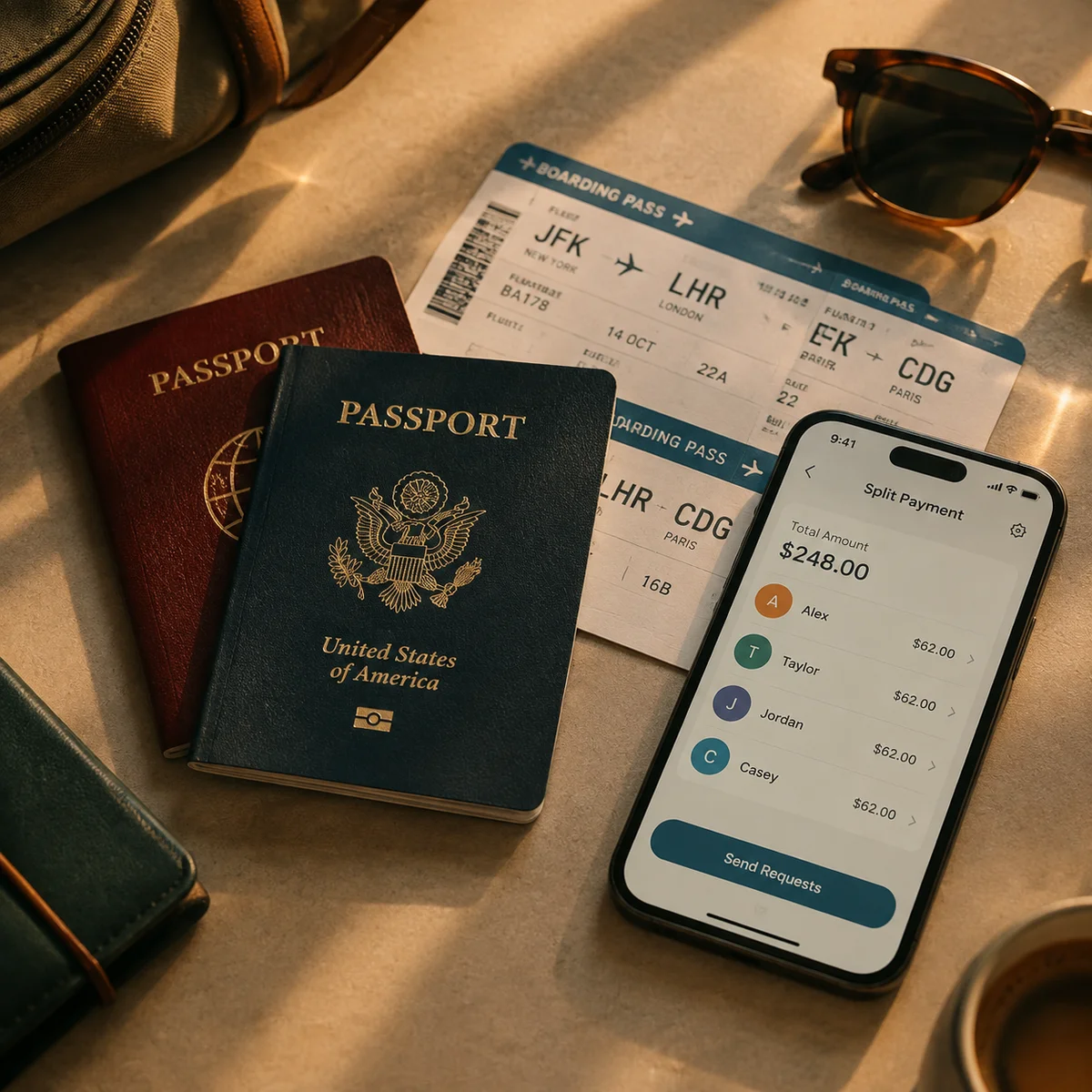
Use one shared note or a split-bill app and log as you go. Not at the end of the trip, when nobody remembers whether that lunch was three people or four, and the reconstruction starts to feel like an accusation.
Then settle up once, on the last full day or within a week of getting home. Let small balances go. If the difference between you is under the price of a coffee, paying it back is more expensive socially than financially.
If the money conversation is the hard part rather than the maths, our piece on raising difficult topics in a check-in will help, and if a previous trip already left a mark, repairing things after a conflict is the one to read next.
How to bring it up without sounding like an accountant
- “Before we book anything, can we agree on the ceiling? I want to make sure I am not quietly the reason this gets expensive.”
- “I can cover the rental now if everyone is comfortable settling their share before we fly. Easier than chasing it in October.”
- “I would rather do the cheap version of this trip with everyone than the nice version where I spend the whole time counting.”
- “Can we log as we go? I am hopeless at remembering who paid for the taxi on Thursday.”
Plain, early and specific. That is the whole technique. Most money problems in multi-partner travel are not about the amount; they are about the fact that nobody said the amount until it was too late to change it.

Frequently Asked Questions
Should we split everything evenly with three or four people?
Even splits work well for genuinely shared costs when incomes are comparable. They work badly when one person’s needs cost more or one person skips an expensive activity. Split the shared base evenly and keep personal spending personal.
What about the person who drinks less, eats less or skips activities?
Personal consumption should be personal. Split the accommodation and transport evenly, then split restaurant bills by what each person actually ordered. It takes an extra minute at the table and prevents a week of quiet accounting.
Is it fair to ask a higher-earning partner to pay more?
It can be, if it is offered or agreed rather than assumed. The trouble starts when the assumption runs in one direction for years. Name it as an arrangement with a shape and a timeframe, not as a background expectation.
How do we handle it when someone cannot pay their share back straight away?
Agree a date before the trip ends, not after. An unspecified debt between people who are also sleeping together is a slow-acting problem. A specific plan, even a modest weekly amount, keeps it from becoming the thing nobody mentions.
Should we use a shared pot or reimburse as we go?
A shared pot works best for trips up to about ten days. Everyone puts in an agreed amount, one person holds it and logs it, and anything left over goes back at the end. Reimbursing as you go generates more admin and more small unpaid balances.
Whichever system you land on, keep it boring. The best outcome is a trip where nobody can remember who paid for what, because it stopped mattering on day one.

A fair split is not the one with the cleverest maths. It is the one everybody agreed to while they still had the option to say no. Describe the trip, pick one method, name the awkward line items, decide what happens if someone drops out, and log as you go.
Then stop counting and go swimming. And if you are still assembling the group you would want to travel with, 3Cupid is built for exactly that.
Editor’s note: This article is general information for adults and is not financial, legal or medical advice. Figures mentioned are illustrative examples rather than recommendations.