
You matched with a couple on a dating platform. The conversation was respectful. You discussed boundaries openly before meeting — what you are comfortable with, what you are not, how you want communication to flow. Then somewhere between the second date and the group chat, the subtle nudges begin. “Are you sure you would not be open to…?” “We were hoping for something a bit more…” “Our last third was fine with…”
When you are the third partner in a unicorn dating dynamic, enforcing your boundaries is not a negotiation tactic — it is a survival skill. It is the difference between a dynamic that respects your autonomy and one that gradually erodes it. And the reality is, even well-meaning couples can push back without realizing the weight of what they are asking.
This guide is for unicorns — bisexual, pansexual, or otherwise non-monogamous singles dating couples — who need practical tools to hold their boundaries firm when the pressure builds. We cover what boundary resistance looks like, why it happens, what to say in the moment, how to assess whether repair is possible, and when leaving is the boundary.
Table of Contents
- Why Couples Push Back on Unicorn Boundaries — and What It Looks Like
- The Psychology Behind Boundary Resistance in Triad Dynamics
- Pre-Date Boundary Setting: Lock It In Before You Meet
- In-the-Moment Boundary Enforcement: What to Say When Pressure Builds
- After the Pushback: Can This Dynamic Be Repaired?
- When Enforcement Is Not Enough: Recognizing When to Walk Away
- Building a Support System as a Solo Third Partner
- Practical Module: Enforcement Scripts and Red Flags Checklist
Why Couples Push Back on Unicorn Boundaries — and What It Looks Like
Boundary pushback rarely arrives as a direct confrontation. It usually starts small — a comment framed as curiosity, a request softened with “no pressure,” a comparison to a previous third partner who “did not mind.” Over time, these micro-pressures accumulate into a pattern that can leave you questioning whether you are being unreasonable for having limits at all.
Common forms of boundary pushback include: asking you to justify a boundary you already stated clearly (“But why not, though?”), reframing a firm limit as a temporary hesitation (“We can revisit this later, right?”), introducing new expectations after you have already met in person, and using the couple’s relationship as leverage (“We are a package deal, so this is how it works for us”). Each of these tactics, whether intentional or unconscious, reflects an underlying assumption that the couple’s preferences carry more weight than yours.
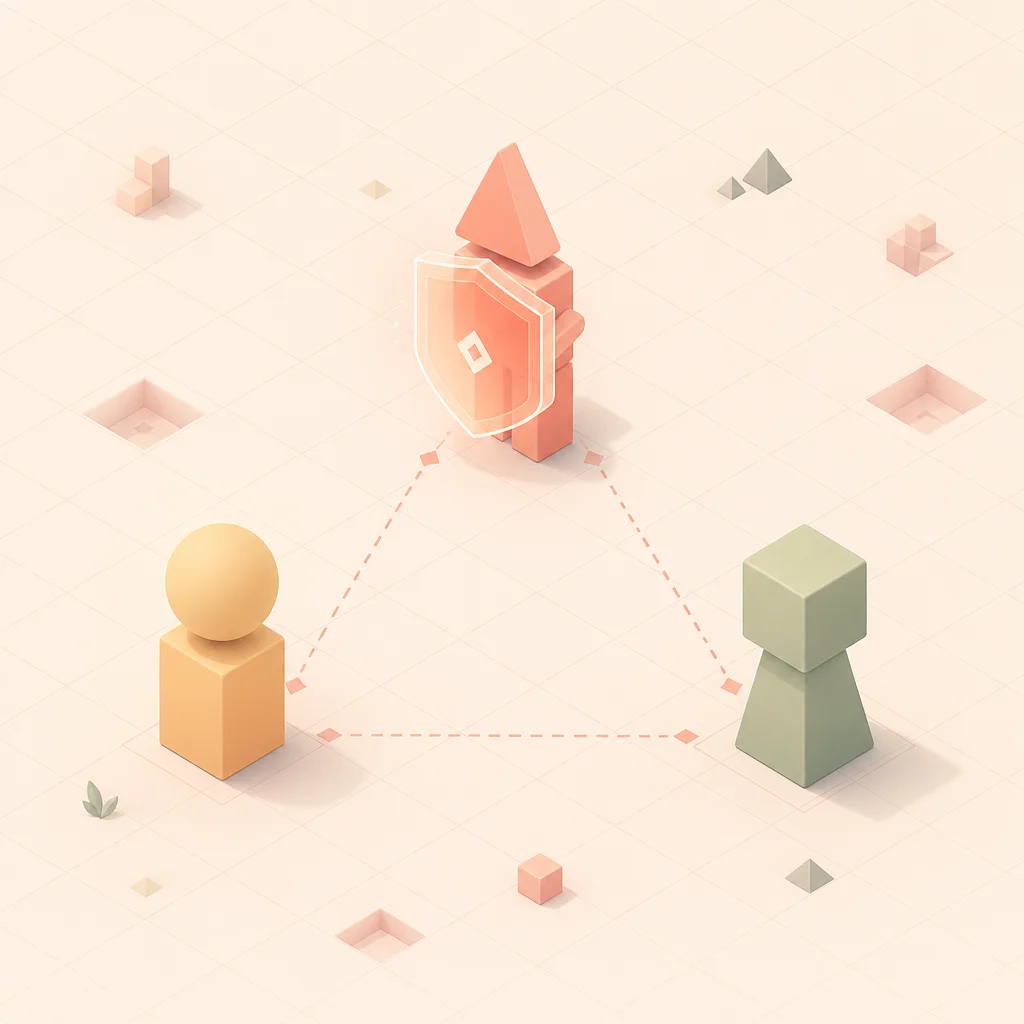
The dynamic is shaped by what researchers and advocates call couple privilege — the unearned advantage that established couples hold in dating spaces, including the assumption that their relationship is primary and the third partner’s needs are secondary. As discussed in our guide on navigating couple privilege, recognizing this structural imbalance is the first step toward countering it.
The Psychology Behind Boundary Resistance in Triad Dynamics
Understanding why couples push back does not excuse the behavior, but it can help you depersonalize it — and that clarity is powerful. Many couples enter unicorn dating with a shared fantasy they have built together before ever meeting a real third person. When a real person arrives with real boundaries, those boundaries can feel like a disruption to the script they have already written.
Psychologically, what is happening is a collision between fantasy and reality. The couple may have spent months imagining a dynamic where everything flows naturally, where everyone wants the same things at the same intensity. Your “no” to a specific activity, a particular communication style, or an overnight expectation does not just feel like a boundary — it feels to them like a rejection of the entire vision they have invested in. That is their issue to work through, not yours to absorb.
There is also a group dynamic at play. In any triad, two people can form a majority opinion faster than one person can articulate a counterpoint. This is not necessarily malicious — it is a structural feature of three-person dynamics. According to relationship researchers writing for Psychology Today, power imbalances in multi-partner arrangements require explicit attention precisely because they are easy to overlook in the daily flow of interaction.

Pre-Date Boundary Setting: Lock It In Before You Meet
The strongest boundaries are set before anyone is in the same room. Once attraction, chemistry, and the social momentum of an in-person meeting enter the picture, the emotional cost of saying no increases. Pre-date boundary setting is about removing ambiguity so there is nothing to “interpret” later.
Be specific. “I am open to most things” is not a boundary — it is an invitation to negotiate. Instead, say: “I am not comfortable with overnight stays until we have met at least three times.” Or: “I want all communication to happen in the group chat, not in separate private messages.” These are observable, enforceable, and leave no room for “I thought you meant…”
Write your boundaries down and share them in writing — a shared document, a pinned message, an email. This is not about being rigid; it is about creating a reference point. When someone later says “I do not remember you saying that,” you have the record. For a deeper framework on why this matters, see our unicorn dating safety guide, which covers pre-meeting protocols in detail.
One underused tactic: ask the couple to articulate their boundaries first. This does two things. It signals that boundaries are mutual, not just rules imposed on you. And it reveals whether they have done any self-reflection at all — if they cannot name a single limit of their own, that is a data point worth noting.
In-the-Moment Boundary Enforcement: What to Say When Pressure Builds
The moment a boundary gets tested is rarely a calm one. You might be mid-conversation in a group chat, sitting across from two people at a bar, or already at someone’s home. The pressure to go along — to not “ruin the mood,” to not be “difficult” — can feel overwhelming. Having prepared language helps you respond without needing to compose perfect words on the spot.
Here are four go-to responses for different situations:
- “That is not something I am open to, and I have been clear about that.” — Direct, calm, references your previous communication. Use when they are revisiting a boundary you have already stated.
- “I hear that you want X. I need you to hear that my answer on this has not changed.” — Acknowledges their desire without conceding. Good for couples who keep circling back.
- “I am feeling pressure to say yes, and that makes me less comfortable, not more.” — Names the dynamic directly. Often stops the pushback because it makes the behavior visible.
- “I need to pause this conversation and check in with myself. I will get back to you.” — Buys you space. A boundary does not need to be defended in real time.
Notice what these scripts have in common: they are about you, not about the couple. They are not accusations. They do not justify or over-explain. They simply hold the line.

After the Pushback: Can This Dynamic Be Repaired?
Not every boundary violation means the dynamic is over. Sometimes couples push back because they genuinely did not understand the seriousness of what you communicated, and a direct conversation brings them back to alignment. The question is: what happens after you enforce the boundary?
Look for these repair signals: they apologize without appending a “but,” they stop pushing immediately, and they ask what you need to feel safe moving forward. These are green flags — signs that the pushback was a misstep rather than a pattern. For more on identifying healthy couple behavior, we have written about green flags when a couple approaches you for unicorn dating.
Red flags in the repair phase include: they dismiss your feelings as an overreaction, they make the conversation about their hurt rather than your boundary, they agree verbally but slide back into the same behavior within days, or they suggest that enforcing boundaries means you “do not trust them.” Trust is built through respecting boundaries, not through bypassing them.
When Enforcement Is Not Enough: Recognizing When to Walk Away
Some dynamics cannot be repaired — not because you did not try, but because the couple is unwilling or unable to see you as an equal participant. Walking away is not a failure of boundary enforcement. It is boundary enforcement at its highest level.
You know it is time to exit when: you find yourself shrinking your needs to avoid conflict, the same boundary gets tested repeatedly despite multiple conversations, you feel dread before checking the group chat, or the couple frames your boundaries as obstacles to their experience. Your well-being is not a negotiation variable — it is the foundation of any ethical dynamic. If a dynamic consistently requires you to choose between your boundaries and your continued participation, the dynamic itself is the problem.

For practical guidance on exiting a dynamic cleanly and safely, we have a companion guide on how to exit a unicorn dating dynamic that no longer serves you, which walks through the logistics, communication, and emotional aftercare of leaving.
Building a Support System as a Solo Third Partner
Dating couples as a single person is uniquely isolating. You do not have a built-in partner to debrief with, and your friends in monogamous relationships may not fully understand the dynamics you are navigating. Building an intentional support system is not optional — it is how you stay grounded when boundary enforcement gets hard.
Seek out ENM and polyamory communities, both online and in-person. Reddit communities like r/polyamory and r/nonmonogamy have threads specifically for solo poly and unicorn-identified people sharing strategies and validation. Local meetup groups, even if they lean more toward polyamory than casual dating, provide face-to-face connection with people who understand the vocabulary of your experience.
Consider finding a “boundary buddy” — another single person in ENM spaces who agrees to be the person you text before and after dates, someone who will remind you of your own stated limits when the chemistry makes them feel flexible. This type of accountability is referenced in broader ENM safety literature, including resources from VeryWell Mind on the importance of external support structures in non-traditional relationship configurations.

Practical Module: Enforcement Scripts and Red Flags Checklist
Save or screenshot this section and keep it accessible before dates and difficult conversations.
Enforcement Scripts — Copy and Adapt
- When they “just want to understand” your boundary for the third time: “I have already explained my reasoning, and the boundary itself has not changed. I need you to accept it rather than continue to analyze it.”
- When they compare you to a previous partner: “I am not your previous third, and what worked for them does not automatically apply to me. My boundaries are my own.”
- When they use the couple’s relationship as justification: “I respect that you are a couple, and I need you to respect that I am an individual. My needs carry the same weight.”
- When the group chat dynamic becomes one-against-two: “I notice I am the only one advocating for my perspective here. Can we pause and reset this conversation with equal airtime?”
Red Flags Checklist — Boundary Erosion Warning Signs
- They respond to a clear “no” by asking for an explanation rather than accepting it
- They frame your boundaries as “rules” while describing their preferences as “needs”
- They bring up new expectations after you have already met in person that were not discussed beforehand
- One partner privately messages you to negotiate something the other partner already agreed was off the table
- They characterize your enforcement as “creating drama” or “being difficult”
- They reference how long they have been looking or how hard it is to find someone — making you feel like a scarce resource rather than a person
- They ask you to keep aspects of the dynamic secret from one partner
- Your stomach tightens when you see a notification from them
If you check three or more of these, the dynamic deserves a serious reassessment.

Being a unicorn means navigating a dating landscape where the structural deck is often stacked against you. That does not make the experience inherently negative — plenty of third partners have fulfilling, respectful, joyful dynamics with couples who do the work. What makes the difference is whether you have the tools to enforce your boundaries and the clarity to recognize when a dynamic is not honoring them. Your boundaries are not obstacles to connection. They are the terms under which connection is safe enough to happen at all.
This article was written by 3Cupid’s editorial team to help singles and couples navigate ethical non-monogamy with clarity, respect, and safety. Looking for a community where boundaries are the starting point, not the afterthought? Join 3Cupid and connect with people who value communication as much as connection.