Boundaries are the difference between a hotwife arrangement that feels thrilling and one that slowly unravels a relationship. When two people agree to explore the hotwife lifestyle, what they’re really agreeing to is a set of rules about what’s okay, what’s off-limits, and what happens when feelings get complicated. Getting those rules clear before anything physical happens isn’t optional — it’s the foundation the whole experience rests on. This guide walks you through the boundaries every couple should talk about, with a template you can start from tonight.
Table of Contents
- Why Hotwife Boundaries Are Different From Cuckold Boundaries
- The Five Areas Every Couple Should Cover
- A Sample Boundary Agreement You Can Start From
- How to Use a Veto Without Wrecking the Mood
- Revisiting Boundaries as the Dynamic Evolves
- Red Flags That a Boundary Is Being Ignored
- Aftercare and Reconnection Boundaries
- Common Questions

Why Hotwife Boundaries Are Different From Cuckold Boundaries
If you’ve read about cuckold dynamics, you’ll notice the boundary conversations sound different here — and that’s on purpose. Cuckold dynamics often build rules around humiliation, power reversal, and degradation, because those are central to the fantasy for many couples. A hotwife arrangement usually doesn’t include any of that.
Instead, hotwife boundaries tend to focus on things like privacy, presence, and partnership. How much does the primary partner want to know? Who chooses the other person? Is the partner there in the room, or hearing about it later? These are collaborative questions about a shared experience, not a script for a scene. That’s why it’s worth setting your boundaries fresh rather than borrowing a template from a different dynamic.

The Five Areas Every Couple Should Cover
Most boundary discussions cluster into five areas. You don’t have to nail all five in one night, but you should touch all of them before anyone meets anyone.
- Disclosure and privacy — what you’ll share with each other, and what stays between the two of you.
- Partner selection — who finds the other person, what you’re each looking for, and whether you both get a say.
- Presence — whether the primary partner is in the room, nearby, or hearing about it afterward.
- Frequency and pacing — how often this happens, and how you’ll slow down if someone needs to.
- Emotional check-ins and aftercare — how you’ll reconnect and tend to each other afterward.
Notice that none of these are rules for the third person. The other person involved gets their own boundaries too, and respecting theirs is just as important as honoring your own. We’ll come back to that.
This is where consensual non-monogamy as a concept matters: boundaries are what keep any non-monogamous arrangement ethical. A short read on the fundamentals helps you see where your own rules fit.

A Sample Boundary Agreement You Can Start From
Templates are useful starting points, not finished products. Read through this, cross out what doesn’t fit, and add what’s missing. The act of editing it together is where the real conversation happens.
- We both give enthusiastic, ongoing consent — either of us can pause or stop anything at any time, no questions asked in the moment.
- Nothing happens unless we’ve both agreed to it beforehand. No surprises.
- We agree on how much detail we share, and we stick to it even if it feels awkward to hold back.
- We choose the other person together, and either of us can veto anyone for any reason.
- We use protection and have a clear agreement about testing and sexual health.
- We schedule a debrief afterward — not to judge, but to check in on how we’re each feeling.
- We keep this private, and we agree on who (if anyone) is allowed to know.
Write it down. It doesn’t have to be a formal contract, but a shared note you can both point back to prevents the “I thought you meant X” arguments later.
How to Use a Veto Without Wrecking the Mood
A veto is one of the healthiest tools in this lifestyle — a simple way for either partner to say “not this one” or “not right now” without needing a big explanation. The challenge is that a veto can sting, especially if the other person was already excited.
The fix is to agree in advance that a veto is never personal and never needs to be justified on the spot. “I’m not comfortable” is a complete sentence. Say it early, say it plainly, and treat it as a team decision rather than one person shutting the other down. The mood recovers a lot faster when a veto feels like a shared pause rather than a rejection.

Revisiting Boundaries as the Dynamic Evolves
Your first boundary list won’t be your last. Feelings change, comfort levels shift, and something that sounded fine in theory can feel completely different once it’s real. That’s normal, and it’s not a sign the arrangement is failing.
Schedule a regular check-in — weekly at first, then less often once things settle. Ask the same simple questions each time: What’s working? What feels harder than you expected? Is there anything we should adjust? Boundaries that get revisited are boundaries that get respected. Boundaries that stay frozen tend to get quietly broken.

Red Flags That a Boundary Is Being Ignored
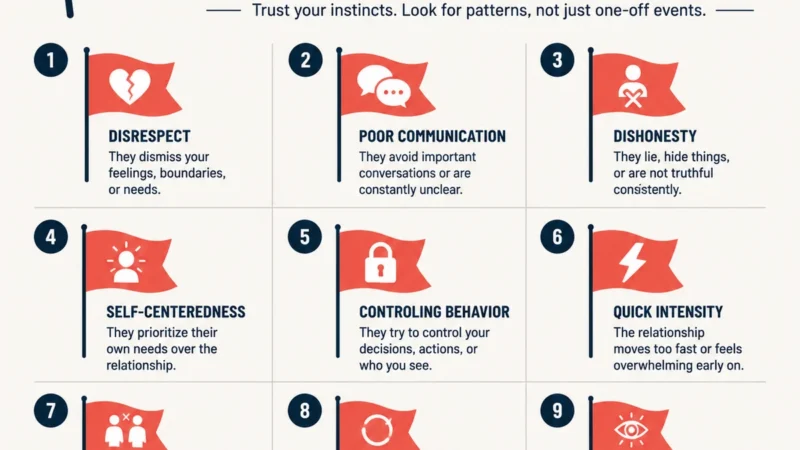
Even with the best intentions, boundaries get tested. Watch for these signs that something is drifting off-course.
- One partner keeps “forgetting” an agreed rule and apologizing afterward.
- Details get shared that you agreed to keep private, even casually.
- A veto gets argued with instead of accepted.
- You feel like you can’t say “I’m not comfortable” without a fight.
- The other person’s boundaries are treated as negotiable or annoying.
If you’re noticing these, slow down before adding more people or more frequency. The right response to a crossed boundary is to stop, talk, and repair — not to push through and hope it smooths over.
Aftercare and Reconnection Boundaries
Aftercare isn’t only for intense kink scenes — it’s essential here too. After any hotwife experience, the primary relationship needs a chance to re-anchor. That might mean time together without phones, a meal, physical affection, or simply an hour to talk through what each of you felt.
Agree on your aftercare ritual before the first experience, not after. When you’re both riding high on adrenaline, “we’ll figure out the aftercare later” tends to become “we never did.” A simple, repeatable ritual — a debrief question, some time together, a check-in the next morning — gives both of you something solid to come back to.

Boundaries aren’t the boring part of the hotwife lifestyle — they’re the part that makes everything else possible. If you and your partner are just starting to talk this through, the best next step is a slow, honest conversation about how to talk to your partner. And if you’re still learning the basics, start with what the hotwife lifestyle actually involves or a plain-English look at wife sharing for couples. When you’re both ready, welcoming spaces built for couples exploring together can make the journey feel a lot less lonely.
Common Questions
Can boundaries change once we’ve started?
Yes — in fact, they should. The only rule is that changes happen during a calm conversation, not in the heat of the moment. Mid-experience, stick to what you already agreed; revise it later when you’re both clear-headed.
Do we need to write our boundaries down?
You don’t have to, but it helps enormously. A short shared note removes the “I thought you meant” confusion that fuels most boundary conflicts. Keep it simple and editable.
What if we disagree on a boundary?
Default to the more cautious position while you talk it through. It’s far easier to loosen a boundary later than to repair trust after pushing past someone’s comfort.