Solo polyamory and threesome dating might seem like they belong to different conversations. Solo polyamory is about maintaining your independence — you’re your own primary partner. Threesome dating often feels built for couples. But the overlap is bigger than most people realize. Solo poly people regularly navigate group dynamics, and they bring something valuable to the table: a clear sense of self that doesn’t depend on anyone else’s relationship structure.
If you’re solo poly and curious about threesomes — or if you’re already in that world and want to do it with more intention — this guide is for you. We’ll cover what solo polyamory actually means in a threesome context, how to handle couple privilege without losing yourself, and the practical tools that keep your autonomy intact while you explore connection with others.
Table of Contents
- What Solo Polyamory Actually Means
- Why Solo Poly People Join Threesomes
- Navigating Couple Privilege as a Solo Person
- Setting Your Own Boundaries and Expectations
- The Emotional Side: Autonomy and Connection
- Practical Tips for Solo Poly Threesome Dating
- Solo Poly Autonomy Checklist
What Solo Polyamory Actually Means
Solo polyamory isn’t “single and looking.” It’s a relationship philosophy where you don’t merge your life infrastructure with any partner — no shared finances, no cohabitation, no assumption that a romantic relationship will escalate toward those things. You can have deep, committed, long-term connections. You just maintain your own center of gravity.
In a threesome context, this matters because it changes your relationship to the couple dynamic. You’re not auditioning to join anyone’s relationship. You’re not hoping to be “promoted” to something more. You’re a whole person entering an experience, not a guest in someone else’s story. This is a fundamentally different position than someone who’s open to becoming part of a throuple — and it deserves its own playbook.
The solo poly approach to solo polyamory threesome dating is, at its core, about approaching group sexual and romantic experiences from a place of fullness rather than lack. You’re not looking for a couple to complete something — you’re looking for an experience that adds to what you already have.

Why Solo Poly People Join Threesomes
The motivations are as varied as the people. Some solo poly folks enjoy the intensity of a group experience without the emotional labor of maintaining a triad. Others appreciate that a threesome with an established couple can be lower-maintenance than dating two individuals separately — the couple has already done their own relationship work (ideally), and you get to show up without carrying the full weight of everyone’s feelings.
There’s also a compatibility angle. Solo poly people tend to be experienced communicators who know their own boundaries. That’s exactly the kind of person many couples want as a third — someone who won’t get swept up in couple drama, who can articulate what they want, and who doesn’t need constant reassurance. If you’ve read our guide on being the third in a threesome, you know that self-awareness is the single most valuable trait a third person can bring.
That said, not every couple is ready for a solo poly third. Some couples are looking for someone who’ll mirror their dynamic — agree to their rules, fit into their schedule, and not ask too many questions. That’s not a match. A healthy dynamic for a solo poly person looks more like: the couple has done their work, everyone’s boundaries are on the table, and the connection is built around mutual enthusiasm rather than accommodation.
Navigating Couple Privilege as a Solo Person
Couple privilege is real, and solo polyamory threesome dating means you’ll encounter it constantly. It shows up in small ways — the couple making decisions without you, assuming their schedule takes priority, expecting you to adapt to their relationship agreements rather than co-creating new ones. It can also show up in bigger ways — being treated as an experience rather than a person, or being dropped the moment one partner feels insecure.
Spotting couple privilege early saves you months of frustration. Pay attention to who’s doing the talking during initial conversations. Does one partner speak for both of them? Do they use “we” statements that assume you’re on the same page with decisions you haven’t been part of? When you express a preference or boundary, do they treat it as a negotiation or as information to work with? These are signals about how much space they’re actually making for you.
Our article on couple privilege in threesome dating breaks this down in detail, but the short version is: a couple that’s done the work will actively create room for your voice. They won’t expect you to be grateful just for being invited. They’ll understand that you’re bringing as much to the table as they are — just in a different configuration.

A practical test: Before committing to anything beyond a first meeting, ask the couple directly: “If one of you decides you’re uncomfortable and wants to stop, what happens to my connection with the other person?” If the answer is an automatic “we’re a package deal, everything stops,” that tells you something about where you stand. It’s not necessarily a dealbreaker — but it’s important information about the ceiling on your involvement.
Setting Your Own Boundaries and Expectations
One of the advantages of solo polyamory is that your boundaries don’t have to go through a committee. You decide what you want, and you communicate it clearly. The challenge is remembering that you have this power when you’re interacting with a couple who already has their own elaborate system of agreements.
Your boundaries are not up for vote. A couple’s rules are their rules — they apply to how they operate as a unit. Your boundaries apply to you, and they’re equally non-negotiable. If you don’t want to be in a group chat, you don’t have to be. If you want solo time with each partner, you can ask for it. If you need to move slower than they’re moving, that’s valid. The fact that there are two of them doesn’t give them more votes on decisions that affect you. This principle is central to ethical unicorn dating — the third person sets the terms of their own participation.
Define what happens after. Are you open to ongoing connection, or is this a one-time experience? Do you want to stay in touch socially? What if one partner wants to continue seeing you and the other doesn’t? These conversations are easier to have before anyone’s clothes are off. They might feel premature, but they’re protective — for you and for them.
Your emotional labor has limits. Some couples, especially newer ones, will process their relationship dynamics through you. They’ll have disagreements that play out in your presence. They’ll ask you to mediate. They’ll expect you to manage their jealousy by reassuring both of them. This is not your job. You can be kind without being a therapist. A simple “this sounds like something the two of you should talk through together” is a complete sentence. Our guide on dating as a single for threesomes covers more strategies for maintaining your boundaries without becoming the couple’s emotional buffer.
The Emotional Side: Autonomy and Connection
Solo polyamory threesome dating can stir up unexpected feelings — and not always the ones you’d predict. The emotional landscape is different when you’re approaching group experiences from a place of independence.
You might feel more, not less. There’s a stereotype that solo poly people are emotionally detached — that independence means not caring deeply. The opposite is often true. When you’re not worried about protecting a primary partnership, you can be fully present with whoever you’re with. That can lead to unexpectedly strong feelings, including toward people you didn’t expect to connect with. Being caught off guard by your own emotions isn’t a failure of your solo poly identity — it’s evidence that you’re showing up authentically.
Loneliness can surface after. A couple goes home together. You go home to your own space — which you love, and which can also feel quiet after an intense shared experience. This isn’t a sign that you’re doing something wrong. It’s a normal human response to contrast. The antidote isn’t clinging harder to the couple; it’s having your own aftercare rituals. A podcast you love. A call with a friend. Your favorite takeout. Treat the post-experience comedown as something you plan for, not something that surprises you.
Compersion can feel complicated. Compersion — finding joy in your partner’s pleasure with others — is often discussed as something couples feel toward each other. But solo poly people feel it too. You might feel genuinely happy watching a couple connect with each other during a threesome, even as you’re also aware that their bond predates and outlasts your involvement. That’s a layered experience, and it’s worth letting yourself feel all the layers without judging any of them.
Practical Tips for Solo Poly Threesome Dating
Here’s what works, drawn from the experiences of solo poly people who’ve been doing this for a while.
Build your own support network. You need people to talk to who aren’t the couple you’re seeing. Friends who understand ENM, a therapist who gets non-monogamy, online communities. When something goes sideways — or when something goes wonderfully — you need outlets that aren’t the people directly involved. This is especially true if you’re also navigating long-distance ENM dynamics, where geographic isolation compounds the need for local support.
Be upfront about being solo poly on your profile. Not every couple will understand what it means, but the ones who do will self-select. A simple line like “I practice solo polyamory — I’m my own primary partner and I’m looking for connections that respect my autonomy” filters out couples who are looking for someone to absorb into their dynamic. It also attracts couples who’ve done enough reading to know what solo poly means, which is already a green flag.
Trust your exit instincts. As a solo poly person, you’re making decisions independently — which means you can leave independently too. If something feels off, if a couple’s dynamic gives you pause, if the communication is already strained before anything physical has happened — you can walk. You don’t owe anyone a threesome just because you’ve been talking for a while. Your autonomy includes the freedom to change your mind, and exercising that freedom is a skill worth practicing.

Consider the long game. Some solo poly people maintain ongoing connections with couples for years. They become a fixture — not a third partner in a triad, but a valued, consistent presence in both people’s lives. This isn’t everyone’s goal, but it’s worth knowing that it’s possible. These arrangements work best when everyone is clear about what it is and isn’t — not a throuple, not a path to something else, just a genuine connection that exists on its own terms.
If you’re looking for a platform where you can be upfront about your solo poly identity and connect with couples who respect it, our complete guide to finding a third walks through the whole process — from profile creation to first meeting.
Solo Poly Autonomy Checklist
Before entering a threesome dynamic with a couple, run through these questions. If the answers feel shaky, trust that instinct.
- My voice matters: The couple includes me in decisions that affect me. They don’t present pre-made agreements as non-negotiable rules.
- I can say no: I feel comfortable declining anything — specific activities, communication styles, or the entire arrangement — without fear of guilt or pressure.
- My time is respected: Scheduling works for all three of us, not just their convenience. Last-minute cancellations are exceptions, not patterns.
- Emotional labor boundaries: I am not the couple’s therapist, mediator, or jealousy processing unit. Their relationship work is their job.
- Aftercare for me: I have a plan for my own post-experience care — whether that’s solo rituals, friend check-ins, or something else — that doesn’t depend on the couple.
- Exit is always available: I can leave at any point without explanation. My autonomy includes changing my mind, and I exercise that right without apology.
- Support system exists: I have people outside this dynamic who understand ENM and can support me — friends, community, therapist.
- Profile reflects reality: My dating profile accurately represents that I’m solo poly, what I’m looking for, and what I’m not.

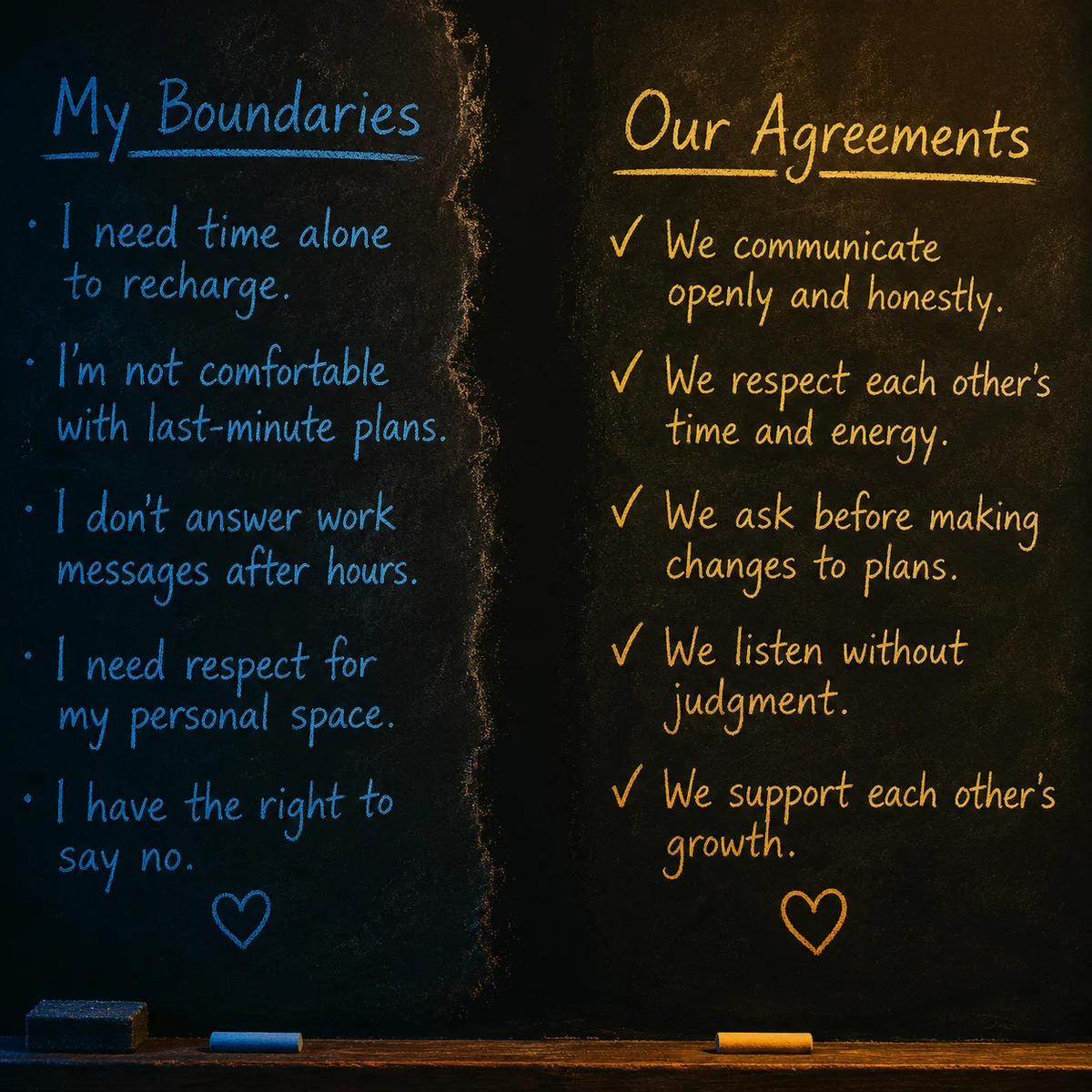
Seeing the same idea from two angles often makes it easier to talk about with a partner — the picture above and the one below are two sides of the same conversation.

This article is part of 3Cupid’s ENM education series. We write about threesome dating, ethical non-monogamy, and relationship communication for adults 18+. All content reflects our commitment to consent, emotional safety, and inclusive perspectives.