
Dating multiple people — or searching for the right connection while maintaining existing relationships — takes real emotional energy. When you’re active in the ENM community, the process of swiping, chatting, meeting, and nurturing connections can quietly drain your reserves until you find yourself dreading what used to feel exciting. That is ENM dating burnout, and it is more common than most people admit.
Burnout in non-monogamous dating looks different from general dating fatigue. It often creeps in after months of balancing multiple conversations, coordinating schedules, and managing the emotional labor that ethical non-monogamy demands. The good news: recognizing the signs early and having a plan makes all the difference. This guide covers how to spot burnout before it derails your relationships, practical steps to recover, and habits that prevent it from returning.
Table of Contents
- Signs You’re Heading Toward ENM Dating Burnout
- Why ENM Dating Is Especially Draining
- The Energy Audit: Where Your Dating Energy Actually Goes
- How to Recover From Dating Burnout
- Prevention Habits That Actually Work
- How to Talk to Partners About Dating Fatigue
- Burnout Self-Assessment Checklist
Signs You’re Heading Toward ENM Dating Burnout
Burnout rarely announces itself. It accumulates in small, easy-to-rationalize ways until one day you realize you have not felt genuinely excited about a new match in weeks. Here are the signals worth paying attention to.
The swipe dread. Opening a dating app used to feel hopeful. Now it feels like a chore you are doing because you “should.” If swiping has become mechanical rather than curious, that is a red flag.
Conversation fatigue. You have five active chats but zero enthusiasm for any of them. You find yourself giving short replies, delaying responses, or feeling irritated by questions that are perfectly reasonable — like “how was your day?”
The scheduling spiral. Your calendar looks like a game of Tetris and the thought of coordinating one more date makes you want to cancel everything and stay home. When planning feels heavier than the actual dates, burnout is already taking hold.
Emotional numbness. You meet someone genuinely interesting and feel… nothing. Or you notice you are going through the motions on dates — asking the right questions, being charming — but emotionally you have checked out.
Resentment toward partners. This one is subtle but significant. You start feeling annoyed that your partner has an easy time finding connections while you struggle, or you resent the time and energy ENM dating demands from your life.
Psychology Today notes that burnout in any domain follows a predictable pattern: emotional exhaustion leads to depersonalization, which leads to reduced sense of accomplishment. In ENM dating, depersonalization shows up as treating potential partners as interchangeable profiles rather than unique people — and when you catch yourself doing that, it is time to pause.
Why ENM Dating Is Especially Draining
Non-monogamous dating carries unique demands that monogamous dating does not. Understanding why the drain happens helps you design a more sustainable approach.
Emotional labor multiplies. In monogamous dating, you manage your own emotions plus one connection at a time. In ENM, you manage your emotions, each partner’s emotions, and the dynamics between partners — what the ENM community often calls “the emotional logistics.” Our guide to the emotional realities of threesome dating explores why this labor is often underestimated.
The never-ending funnel. Unlike monogamous dating where finding “the one” signals an endpoint, ENM dating is often an ongoing process. There is always another profile, another conversation, another possibility — and without boundaries, the funnel never closes.
Stigma adds weight. Explaining your relationship structure to new dates, handling judgment from people who do not get it, and navigating the social complexities of being openly non-monogamous all consume mental energy that monogamous daters do not spend.
New Relationship Energy can mask depletion. NRE — that exhilarating rush when a new connection forms — is a powerful drug. It can make you feel invincible, pushing you to take on more connections than you can sustain. When the NRE fades, the exhaustion hits hard. Read more about managing this in our guide to handling NRE in threesome dating.
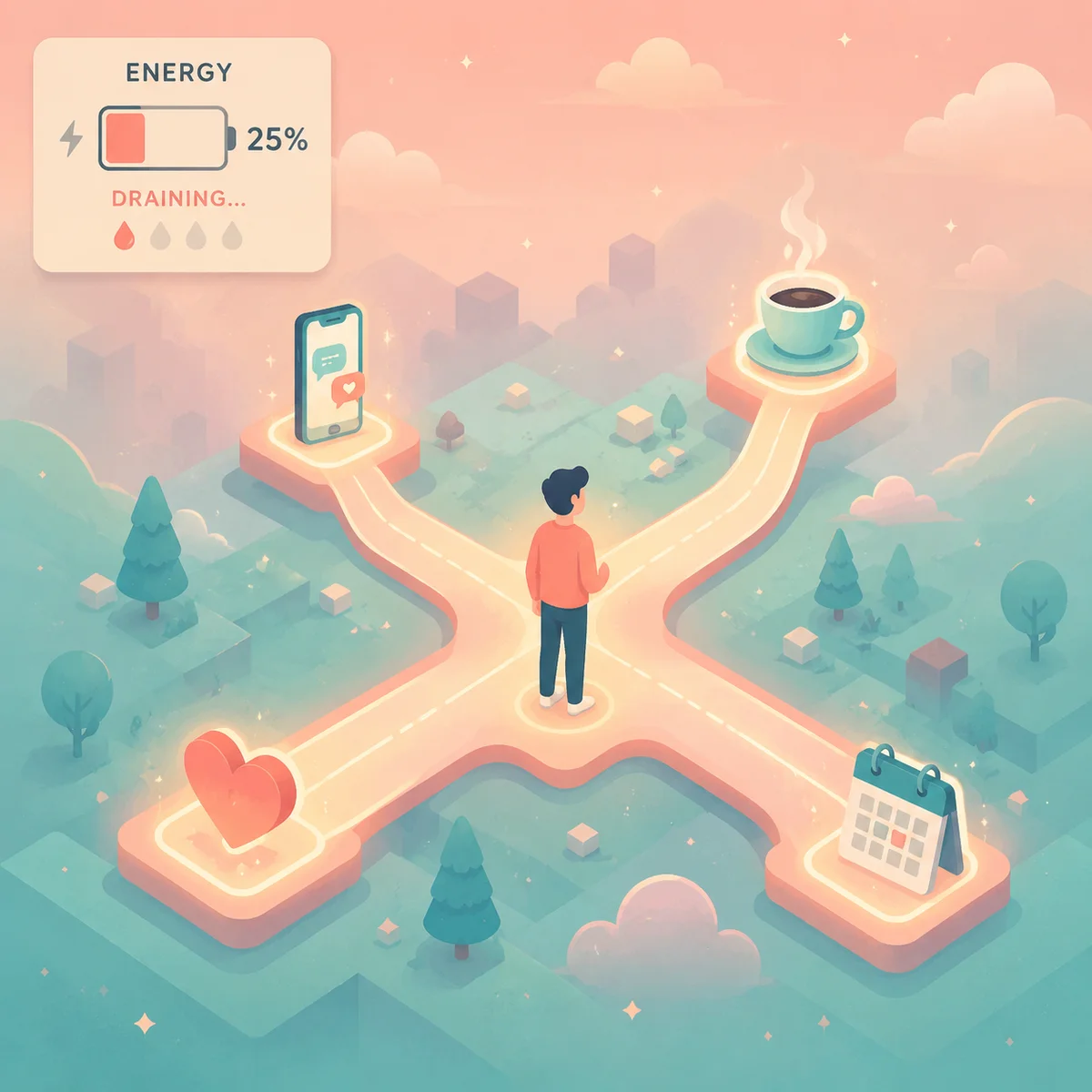
The Energy Audit: Where Your Dating Energy Actually Goes
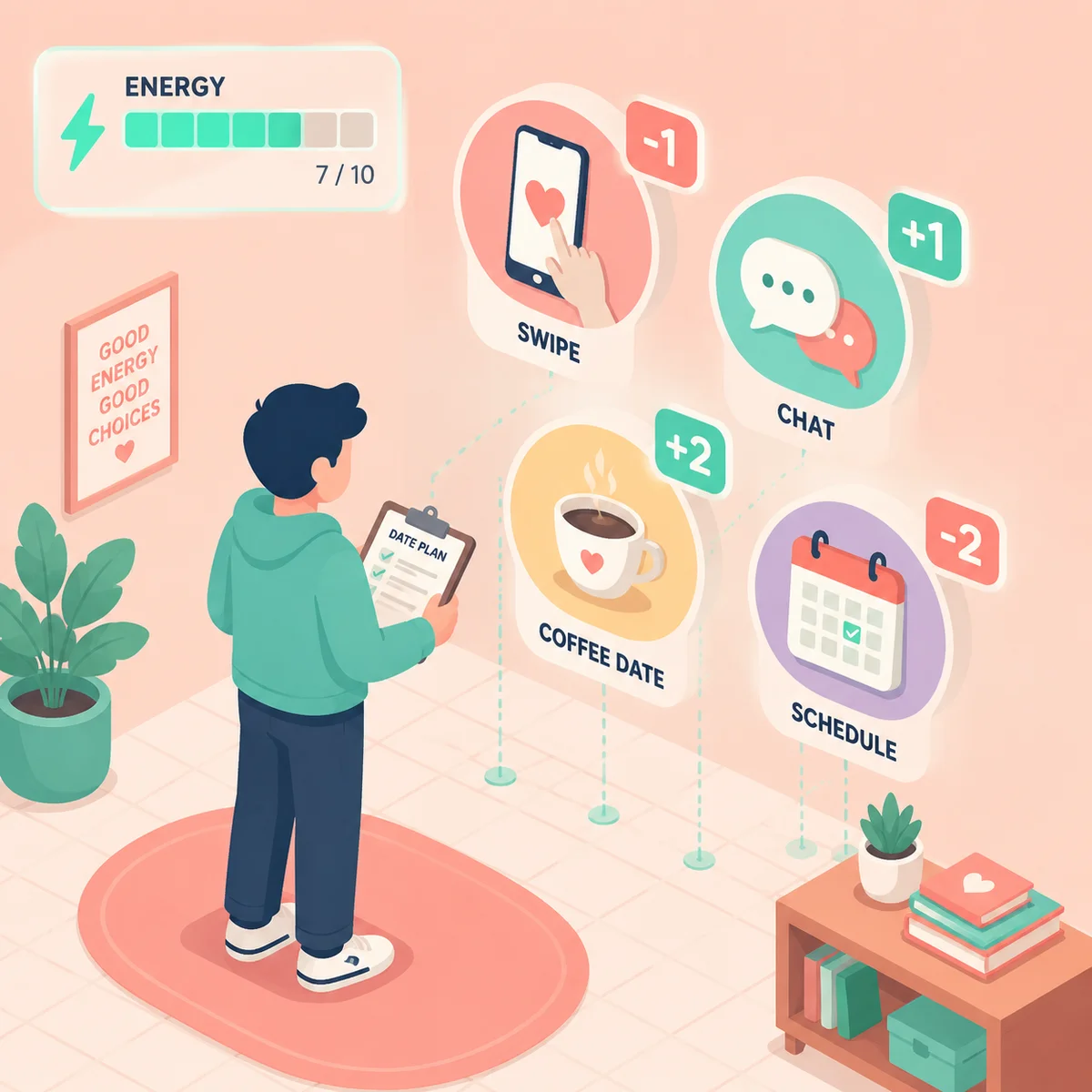
Before you can fix burnout, you need to see where your energy is leaking. An energy audit is a simple exercise: for one week, track every dating-related activity and rate how much energy it gives or takes on a scale of -5 to +5.
Swiping and browsing profiles. For many, this starts as +3 energy (fun, hopeful) but after months without breaks becomes -2 (tedious, repetitive). Track your numbers honestly.
Chatting with new matches. The early conversation phase can be energizing (+4) or draining (-3) depending on match quality and your current emotional state. Pay attention to which conversations lift you and which ones feel like work.
First dates. Even good first dates cost energy — getting ready, traveling, being “on.” Rate the net energy: did the date leave you feeling more full or more empty?
Emotional processing. This is the hidden cost most people overlook. Debriefing dates with your primary partner, processing jealousy, navigating scheduling conflicts — these activities rarely show up on a calendar but consume significant mental bandwidth.
Maintaining existing connections. Healthy relationships require nurturing. When you are drained, even positive relationships can feel like obligations. This is not about the relationship quality — it is about your capacity.
After a week of tracking, patterns emerge. You might discover that you spend 70% of your dating energy on activities that net negative returns. That information alone is liberating. Our article on managing multiple ENM connections offers a more detailed framework for balancing your relational energy.
How to Recover From Dating Burnout
Recovery is not about quitting dating forever. It is about hitting pause long enough to reset, then returning with better systems. Here is a practical recovery protocol.
Step 1: Declare a dating pause. Give yourself a defined break — two weeks is a good starting point. Pause all active searches, pause new conversations, and redirect the mental energy you were spending on dating back to yourself. Communicate the pause to active connections. Most people in the ENM community understand and respect this — and the ones who do not are telling you something useful.
Step 2: Audit what remains. During the pause, which existing connections still feel good? Which ones feel like obligations? You do not need to end relationships during a pause, but noticing the difference is valuable data.
Step 3: Reconnect with non-dating sources of joy. Burnout often happens because dating has crowded out other fulfilling activities. Reclaim time for hobbies, friendships, exercise, and solo activities that have nothing to do with romance or attraction.
Step 4: Process the emotional residue. If recent dating experiences left you frustrated, rejected, or disappointed, that weight does not disappear just because you pause. Journaling, talking with a trusted friend, or working with an ENM-affirming therapist can help you process what built up. Dealing with rejection in particular deserves attention — our guide on handling rejection in threesome dating covers specific strategies.
Step 5: Return with a cap. When you feel ready, ease back in with a clear limit. Maybe that means one active conversation at a time, or one date per week, or only dating on specific days. The cap is not permanent — it is a calibration tool.

Prevention Habits That Actually Work
Recovering from burnout is one thing. Preventing it from cycling back every few months is another. These habits, adapted from what works in the broader ENM community, create a sustainable dating practice.
Set a connection ceiling. Most people have a maximum number of active romantic or sexual connections they can sustain without depleting themselves. That number is different for everyone — it might be two, three, or five. The key is knowing yours and respecting it, even when an exciting new person appears. If you are already at your ceiling, adding someone means either letting something go or accepting that you will operate in deficit mode.
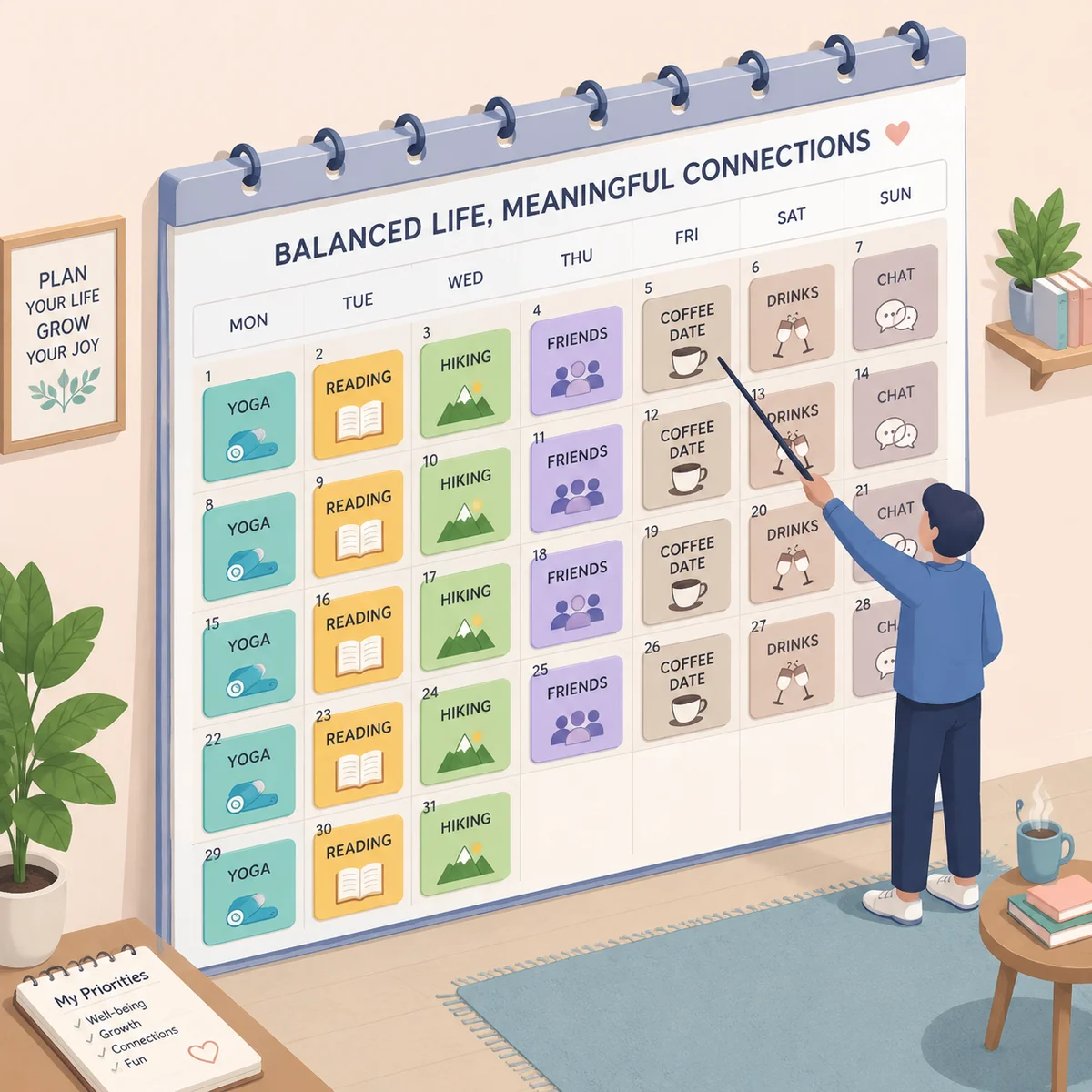
Schedule non-dating time as aggressively as dating time. Many ENM daters schedule dates meticulously but leave self-care and solo time as “whatever is left over.” Reverse this. Block time for yourself first, then schedule dates around it. When you protect your own space, you show up better for everyone else.
Practice the “hell yes or no” filter. If a potential connection is not a clear “yes,” it is a “no.” Ambivalence drains energy faster than rejection. Give yourself permission to pass on maybes — there will always be more profiles, more events, more possibilities. This is especially important when you are already managing multiple connections, as discussed in our guide on maintaining throuple relationships.
Do regular relationship energy check-ins. Once a month, take 15 minutes to ask yourself: which connections are giving me energy, which are neutral, and which are costing me more than they return? This is not about scorekeeping — it is about noticing patterns before they become problems.
How to Talk to Partners About Dating Fatigue
Telling partners you are burned out can feel vulnerable. You might worry they will interpret your fatigue as a reflection on them, or that they will feel pressured to change their own dating patterns. Here is how to navigate these conversations.
Frame it as capacity, not blame. Say “I have realized I am running low on dating energy and need to scale back for a few weeks” rather than “I am exhausted from all the dating we have been doing.” The first statement is about you; the second can sound like accusation.
Be specific about what changes. Partners need clarity. Are you pausing new searches? Scaling back date frequency? Taking a complete break? The more specific you are, the less room there is for partners to fill the gaps with anxious assumptions.
Reassure what is stable. If your existing relationship is not changing — if you are still fully present for your partner while taking a break from searching — say that explicitly. Burnout conversations go better when partners know what is not at risk.
Invite collaboration. Ask your partner: “How does this land for you? Is there anything you would want me to know from your side?” This keeps the conversation two-way and prevents it from becoming a unilateral announcement.
These communication approaches align with the principles we cover in depth in our threesome aftercare guide — the same skills of checking in, reassuring, and processing together apply here.

Burnout Self-Assessment Checklist
Use this checklist monthly to catch burnout before it takes hold. Answer honestly — there are no wrong answers, only useful data.
- Energy check: When you open a dating app, do you feel curious or obligated?
- Conversation quality: Are most of your active chats energizing or draining?
- Date anticipation: Before a date, do you feel excited or relieved when it gets canceled?
- Post-date feeling: After dates, do you generally feel more full or more empty?
- Novelty vs routine: Does meeting new people still feel like an adventure or a task?
- Non-dating life: Have you cancelled or skipped non-dating activities (hobbies, friend time) because of dating demands?
- Sleep and rest: Has dating-related late-night chatting or overthinking affected your sleep?
- Emotional bandwidth: Do you have enough emotional space for your existing partners, or do you feel stretched thin?
- Joy check: When was the last time dating made you genuinely laugh or smile — not performatively, but authentically?
Scoring guide: If you answered negatively to 3 or more of these questions, you are likely in early-stage burnout. If 5 or more, a pause is probably overdue. There is no shame in either result — recognizing the pattern is the win.
ENM dating should add to your life, not drain it. When the balance tips toward depletion, listening to that signal is not weakness — it is wisdom. Whether you are monogamous-curious, actively non-monogamous, or somewhere in between, the healthiest dating practice is one you can sustain. If you are looking for a space where you can explore ENM connections at your own pace, you will find it right here at 3Cupid.