
Love languages in polyamory take the same five categories you probably already know — words of affirmation, quality time, physical touch, acts of service, and receiving gifts — and stretch them across more than one relationship at once. In a monogamous dynamic, you only have to learn how one partner gives and receives love. In polyamory or any form of ethical non-monogamy (ENM), you are often juggling two, three, or more people who each feel loved in completely different ways. That is not a flaw in the system. It is simply the reality of loving multiple people well. This guide covers what changes, how each love language shows up across your connections, and how to keep everyone feeling seen without burning yourself out in the process.
Table of Contents
- What Are the Five Love Languages?
- Why Love Languages Work Differently in Polyamory
- How Each Love Language Translates in Non-Monogamy
- When Love Languages Collide
- A Love Language Check-In Script
- Common Mistakes With Love Languages in Polyamory
- Small Acts, Multiple Directions
What Are the Five Love Languages?
Gary Chapman popularized the idea that people tend to give and receive love through five main channels. Words of affirmation means you feel loved through spoken or written appreciation. Quality time means you feel loved through focused, undivided attention. Physical touch means affection like hand-holding and hugs carry the most weight for you. Acts of service means someone lightening your load — running an errand, cooking a meal — reads as love. And receiving gifts means thoughtful tokens, however small, make you feel remembered.
Most people have one or two dominant languages, with the others still mattering on a smaller scale. The framework is widely used, and it has also drawn fair criticism for being a bit too tidy — real people rarely fit a single box. Treat it as a starting vocabulary for talking about care, not a personality test. You can read a fuller breakdown of the five categories in this Psychology Today guide to the five love languages.

The five channels are easy to picture. What gets trickier is applying them when the number of relationships in your life is greater than one.
Why Love Languages Work Differently in Polyamory
In monogamy, the practical question is usually “what makes my one partner feel loved?” In polyamory, the question multiplies. A partner who thrives on quality time may feel neglected the week you are deep in new relationship energy (NRE) with someone else. A partner whose language is physical touch may feel the distance most sharply when a new connection is still long-distance or mostly emotional. None of this means your love is distributed wrong — it means each relationship runs on its own frequency, and you are the translator between them.
There is also a resource reality. Time and energy are finite, and different love languages cost different amounts of each. Quality time asks for your calendar. Acts of service ask for your effort. Words of affirmation ask for your attention and presence of mind. When you are supporting several partners, being honest about what you can actually sustain matters more than promising all five languages to everyone.
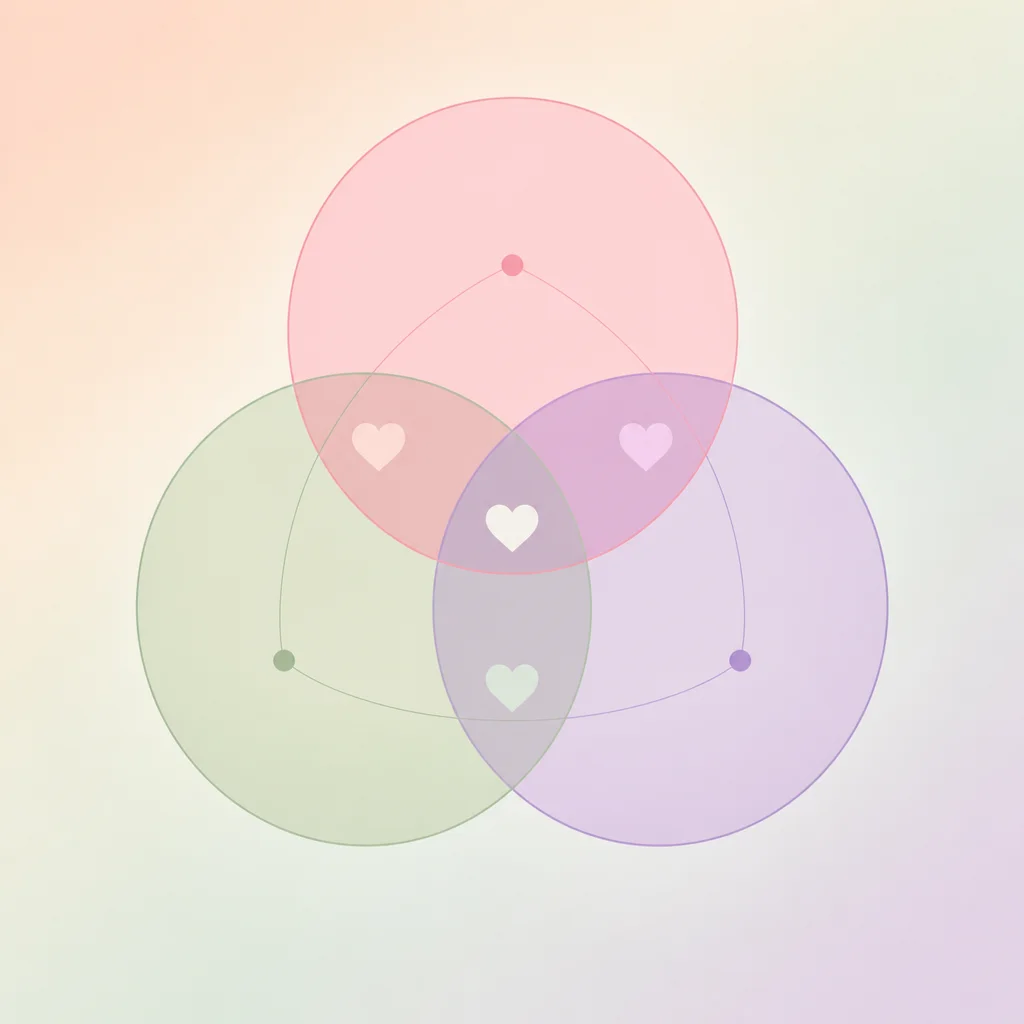
Overlapping connections mean the same small gesture can land differently with different people. The same good-morning text might be deeply meaningful to a words-of-affirmation partner and nearly invisible to a quality-time partner who would rather have twenty undistracted minutes on a call.
How Each Love Language Translates in Non-Monogamy
Each of the five languages has a specific shape when more than one partner is involved. Here is how to think about them one at a time.
Words of Affirmation
A short, specific note — “I noticed how patient you were during that hard conversation” — tends to land far better than generic praise. With multiple partners, small frequent affirmations keep each connection warm without demanding a grand gesture every time.
Quality Time
For this partner, put the phone down and be fully present. Scheduling matters: a standing weekly window feels more secure than vague “we should hang out soon.” Quality time partners often feel the NRE shift first, so a little consistency goes a long way.
Physical Touch
This is about non-sexual affection as much as anything — a hand on the back, sitting close, a long hug. Touch is one of the languages most affected by distance and by how much physical contact a given dynamic allows, so check in about what comfort looks like for each person.
Acts of Service
Practical help reads as love here. In ENM, that might look like handling a chore so a partner can get to a date, or picking up something they forgot. The key is doing it without being asked and without keeping score.
Receiving Gifts
Thoughtful trinkets, a small treat, or something you picked up because it reminded you of them — the value is in the noticing, not the price. For partners who don’t share this language, gifts can feel confusing, which is exactly why you ask rather than assume.

No two partners rank these five the same way, and their ranking can shift over time or with life stress. Treat your read on each person as a working note, not a fixed label.
When Love Languages Collide
A common pattern: you are a words-of-affirmation person dating someone who shows love through acts of service. You keep waiting for the praise that never comes, while they are quietly doing your dishes and wondering why you don’t seem to notice. Neither of you is unloving — you are both broadcasting on a channel the other isn’t tuned to. In polyamory this mismatch can happen across several relationships at once, and it is easy to read the quietest mismatch as “they don’t care as much.”
The fix is almost always translation, not more effort. Effort aimed at the wrong language gets exhausting and produces resentment. Effort aimed at the right one — even a small amount — lands powerfully. When you feel underappreciated, pause and ask whether the love is present but arriving in a language you don’t naturally register.

One useful habit: name your languages out loud. “I feel most loved when someone makes time for me, so quality time is my big one.” A single clear sentence saves weeks of guessing.
A Love Language Check-In Script
You don’t need a formal meeting to use this. A ten-minute check-in every month or two keeps everyone’s languages current. Here is a low-pressure script you can adapt:
- “What’s one small thing that made you feel loved this month?”
- “What’s one thing you wish happened more often?”
- “Have your top two love languages changed at all lately?”
- “Is there a way I’ve been showing love that isn’t landing? Be honest.”
- “What’s one thing we could each do differently this coming month?”
The last question is the important one — it turns the conversation from reflection into a concrete, shared commitment. If you are juggling several partners, run a lighter version of this with each, on whatever cadence feels sustainable.
Common Mistakes With Love Languages in Polyamory
The first mistake is assuming everyone speaks your language. It feels generous — “I’m treating them the way I’d want to be treated” — but it quietly ignores what the other person actually wants. The second is treating love languages as a fixed personality type. People shift, especially under stress, after big transitions, or when a new relationship changes the emotional landscape.
The third is weaponizing the framework: “you just don’t speak my love language” can become a way to dismiss a real concern. Love languages explain how to aim your care, not how to win an argument. And the fourth is forgetting that loving multiple people well is a bandwidth question. Trying to be everything to everyone in all five languages usually ends in exhaustion. Sustainable polyamory is about honest capacity, and you can read more about managing that capacity in our guide to polyamory for beginners.
If the mismatch is causing friction, it usually points back to communication, not compatibility. You can find a deeper toolkit in our piece on navigating different communication styles in polyamory.
Small Acts, Multiple Directions
Loving more than one person does not require grand gestures in every direction. It requires attention to what each person actually receives. A five-minute voice note for the words-of-affirmation partner. An undistracted coffee for the quality-time partner. A quick errand for the acts-of-service partner. These are small, but aimed correctly, they carry more weight than a big display aimed wrong.

Love languages in polyamory are ultimately a tool for care, and care is what holds non-monogamy together. When each of your partners can name how they feel loved — and trusts that you are actually listening — the whole network gets steadier. That foundation is also where compersion tends to grow, and it is the same attention that makes ethical non-monogamy work in the first place. If you are new to all of this, our ethical non-monogamy 101 guide is a good place to start.
Ready to put these ideas into practice? Our step-by-step guide to navigating different love languages in ENM walks you through a five-step system for translating care across partners.
This article is intended for adults 18+ and is offered for general information. Healthy non-monogamy rests on clear communication, mutual respect, and enthusiastic consent between all partners.