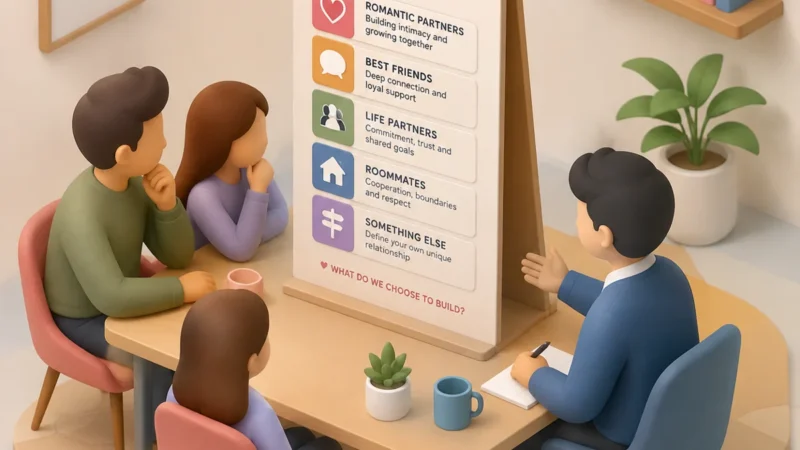
Different love languages in ENM are not a problem to fix — they are a normal part of dating more than one person. You might be an acts-of-service person while one partner needs words of affirmation and another needs quality time. Nothing about that means the relationships are mismatched. It means you need a system for translating care across languages so everyone actually feels it. This guide walks you through that system in five practical steps, with a translation cheat sheet you can start using today.
Table of Contents
- Why You Don’t Need the Same Love Language
- Step 1: Name Your Own Love Language
- Step 2: Ask Instead of Assuming
- Step 3: Build a Translation Cheat Sheet
- Step 4: When Someone Still Feels Unloved
- Step 5: Make It a Living Conversation
Why You Don’t Need the Same Love Language
There is a persistent myth that compatible partners should share a love language. In reality, plenty of happy relationships are built by people who speak entirely different ones. What matters is not matching — it is the willingness to learn the other person’s language and make a genuine effort in it. In ENM, where you are doing this across several relationships, that willingness is the whole game.

The relief here is real: you do not have to be naturally fluent in every partner’s language. You just have to be willing to become conversational. A little deliberate effort in the right direction consistently outperforms a lot of scattered effort in the wrong one.
Step 1: Name Your Own Love Language
Before you can ask anyone else how they feel loved, you need to know it for yourself. Think back to the moments you felt most appreciated in past relationships. What was the other person doing? Was it a compliment, a favor, a gift, focused time, or physical closeness? The pattern that keeps showing up is usually your primary language.

It also helps to notice what you complain about. If you find yourself saying “they never make time for me,” quality time is likely doing the heavy lifting for you. If it is “they never say anything nice,” words of affirmation probably is. Your frustrations are a reliable map to your languages.
A quick way to sharpen your read is to review the five categories and rank them from most to least resonant. The framework is not a diagnostic — plenty of people feel loved through a blend of two or three languages — but ranking them gives you a clearer starting point for the conversations ahead. You can find a concise walkthrough of each category in this Verywell Mind guide to the five love languages. Once you can name your own top one or two, the next step is inviting your partners to do the same.
Step 2: Ask Instead of Assuming
The most common mistake is assuming your partner’s language based on yours — or based on a guess about their personality. The fix is a direct question: “What’s something small I do that makes you feel most loved?” Or, even simpler, “Of the five love languages, which one or two matter most to you right now?”
Ask early and ask again over time. A partner’s answer can shift after a move, a job change, a breakup elsewhere in the network, or a stretch of distance. Treat their answer as current information, not a permanent contract. If you want a structured way to gather this kind of information from a new partner, our guide to creating a relationship user manual pairs well with this step.

Step 3: Build a Translation Cheat Sheet
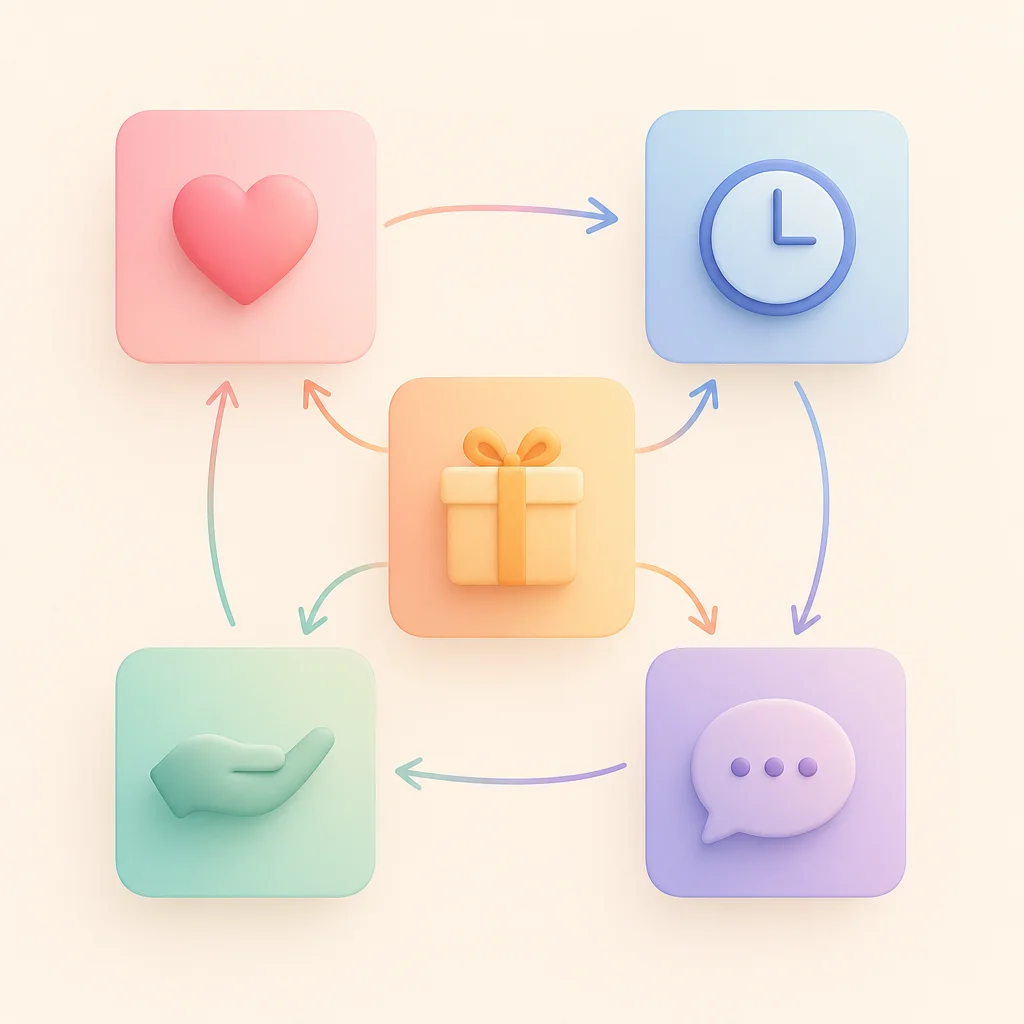
Once you know each partner’s language, write down one or two concrete actions per person. The cheat sheet turns good intentions into specific moves. Here is a starter template:
| Love Language | What It Can Look Like in ENM |
|---|---|
| Words of Affirmation | A specific, sincere compliment or a short appreciative text |
| Quality Time | A phone-down coffee date or a dedicated evening with no multitasking |
| Physical Touch | A long hug, sitting close, or other non-sexual affection they enjoy |
| Acts of Service | Handling a chore or errand without being asked, with no scorekeeping |
| Receiving Gifts | A small, thoughtful token picked up because it reminded you of them |
Keep it short — two or three lines per partner is plenty. The point is to make the right move obvious in the moment, not to create a spreadsheet of obligations.
If scheduling is part of the challenge — fitting quality time for several partners into a real week — our guide to time management in polyamorous relationships is a useful companion.
Step 4: When Someone Still Feels Unloved
Sometimes you do the work and a partner still says they don’t feel loved. Resist the urge to get defensive. The gap usually comes from one of three places: your effort is aimed at the wrong language, the effort is too small or too rare to register, or the person is carrying something else — stress, insecurity, or an unspoken need — that no love-language gesture alone will fix.

The move is curiosity, not self-protection. “Help me understand — what would feeling loved look like for you this week?” gets you further than “but I already did X.” Sometimes the answer reveals a need that lives outside the love-language framework entirely, and that is worth hearing too.
A practical way to close the gap is to shrink the request. Instead of asking a partner to describe their ideal relationship, ask for one concrete, repeatable gesture: “If I did one small thing each week, what should it be?” A single specific answer — “a ten-minute call before bed” or “a text when you land safely” — is far easier to deliver consistently than a vague promise to “show more love.” Small and reliable beats large and occasional almost every time.
Step 5: Make It a Living Conversation
Love languages are not a one-time quiz result. Fold them into your regular check-ins so the information stays fresh. A simple monthly question — “what made you feel loved recently, and what would you like more of?” — keeps everyone’s preferences current without turning it into a formal review.

This matters even more during periods of change, like the early rush of new relationship energy or a temporary long-distance stretch. When you keep the conversation alive, different love languages in ENM stop being a source of friction and become what they actually are: a chance to learn each person you love a little more precisely.
If communication itself is where you get stuck, start with our guide to navigating different communication styles in polyamory, then loop back here. And if this is your first time exploring non-monogamy, the ethical non-monogamy 101 guide covers the fundamentals.
For the big-picture view of how all five languages work in non-monogamy, start with our guide to love languages in polyamory.
This article is intended for adults 18+ and is offered for general information. Healthy non-monogamy rests on clear communication, mutual respect, and enthusiastic consent between all partners.