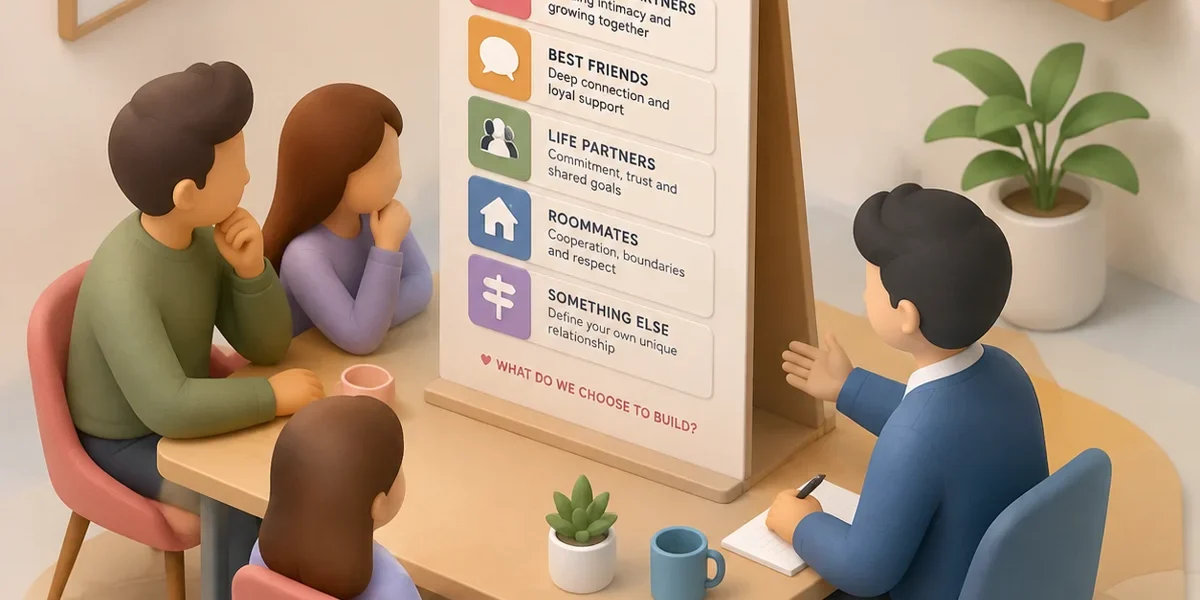
A relationship menu is a simple tool for negotiating a non-monogamous dynamic without the conversation turning into a debate about who’s right. You list the ingredients of a relationship — time, touch, sex, money, living arrangements, and so on — and each person marks what they want, what they don’t, and what they’re still figuring out.
Then you compare. What you’re really doing is turning a vague, high-stakes conversation (“where is this going?”) into a series of small, concrete choices you can actually talk through. Here’s a step-by-step way to use a relationship menu to negotiate your ENM dynamic.
Table of Contents
- Why Negotiate With a Menu Instead of Just Talking
- Step 1: Set the Table — Choose Your Categories
- Step 2: Mark Your Yes, No, and Maybe
- Step 3: Compare Notes Without Arguing
- Step 4: Revisit the Menu on a Schedule
- Common Mistakes to Avoid
- Final Thoughts

Why Negotiate With a Menu Instead of Just Talking
Big relationship conversations fail for a predictable reason: everyone is answering a slightly different question. One person means “how often do you want to see me,” while the other hears “are we getting serious.” A menu fixes that by making the topics concrete and separate. You’re no longer arguing about the relationship as one giant blob; you’re comparing notes on a list of named ingredients.
For threesome and ENM dynamics, this matters even more. A couple and a potential third each arrive with their own unspoken assumptions. The menu surfaces them before anyone gets attached to a version of the relationship that was never actually on the table.
There’s another quiet benefit: a menu depersonalizes disagreement. Saying “we have different answers on the finances row” feels very different from saying “you’re wrong about money.” When the difference lives on a grid, it’s easier to treat it as a puzzle to solve together rather than a verdict on the relationship.
Step 1: Set the Table — Choose Your Categories
Start with a short list of categories that matter to you. You don’t need an exhaustive grid — six to eight categories is plenty for a first pass. Common ones include time and attention, physical affection, sexual connection and safer-sex agreements, cohabitation, finances, future planning, and how you present the relationship to other people.
If you’re coming from a monogamous background, this step alone can feel radical: you’re deciding what a relationship includes, rather than accepting the default bundle. For the background on where this idea comes from, our guide to the relationship smorgasbord explains the concept in full.
Step 2: Mark Your Yes, No, and Maybe
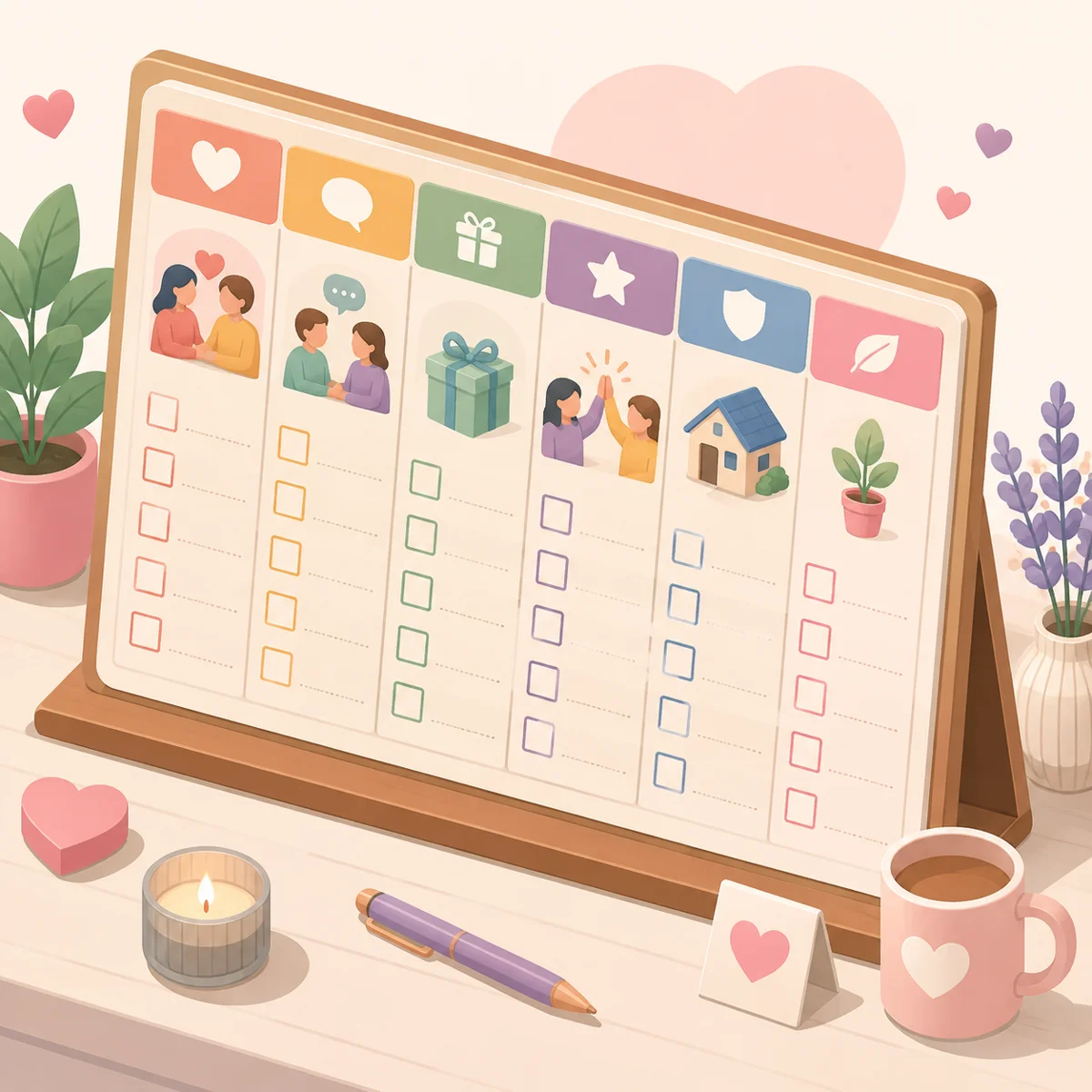
Each person fills out their own copy privately, marking every category as yes (I want this), no (I don’t want this), or maybe (I’m open, but it depends). Resist the urge to fill it out together or to peek at each other’s answers. The whole value is getting your honest, un-influenced preferences down first.
The “maybe” column matters. Most real preferences aren’t a clean yes or no — they’re conditional. “Maybe I want to cohabit, but only after we’ve dated a year” is a perfectly good answer, and it’s information your partners need.
Here’s why the gaps are useful: one person might mark “sexual connection with others” as yes, while their partner marks it maybe. That gap is exactly where to focus the conversation — rather than discovering the mismatch months later, after feelings are already involved.
Step 3: Compare Notes Without Arguing
Now you come together and compare. Go category by category, one at a time. Where you agree, great — that’s a shared ingredient. Where you differ, don’t jump to persuading. Instead, ask what’s behind the answer: “What would make this a yes for you?” or “What worries you about this one?”

The goal of this step is understanding, not agreement. A mismatch on, say, cohabitation doesn’t have to be a crisis — it can simply mean that ingredient isn’t part of this relationship. Many ENM dynamics are built from a smaller, clearly-chosen set of shared ingredients rather than a full overlap. If there’s a power imbalance at play, for example when a couple is negotiating with a single third partner, name it; our guide to navigating couple privilege can help you keep the conversation fair.
A few phrasings make this step smoother:
- “Tell me more about what ‘yes’ looks like for you on this one.”
- “What would need to be true for this to feel okay?”
- “It sounds like we want different things here — can we leave this category off for now and revisit it?”
- “I marked maybe because I’m not sure how it would work in practice.”
Step 4: Revisit the Menu on a Schedule
A relationship menu is a snapshot, not a contract. What you want at month one often shifts by month six. Set a light cadence for revisiting — every few months, or whenever something significant changes, like a new partner entering the picture or a schedule shift.
The same menu that worked for a casual threesome arrangement can guide a conversation about whether that arrangement is deepening. If you and your partners decide you want to step away from the default relationship script entirely, our guide on stepping off the relationship escalator pairs well with the menu approach.
Revisiting doesn’t have to be formal. A ten-minute check-in over coffee works as well as a scheduled sit-down. What matters is that the menu stays alive — a living record of what you each want, not a document you filled out once and filed away.
Common Mistakes to Avoid
A few traps show up again and again. Watch for these:
| Do | Don’t |
|---|---|
| Fill out your own menu before seeing anyone else’s. | Use the menu to pressure someone into a yes. |
| Treat “maybe” as a valid answer worth exploring. | Assume a shared category means the same thing to both of you. |
| Ask what’s behind a no before reacting. | Treat the menu as a binding contract instead of a snapshot. |
| Revisit the menu on a schedule. | Skip the safer-sex and safety categories to keep things “light.” |
The menu is a conversation aid, not a weapon. If you find yourself using it to argue someone into agreement, step back — that’s the opposite of its purpose.

Final Thoughts
A relationship menu won’t make negotiation effortless, but it will make it clear. You’ll spend less time circling the same vague argument and more time making small, real choices you can actually keep.
If you’re ready to put these ideas into practice with people who share the same values, you can meet like-minded adults right here at 3Cupid. Start with the menu, then build something that’s genuinely yours.

Editor’s note: This guide is written for adults (18+) exploring non-monogamous relationship structures. It reflects general educational information, not professional advice. Build your relationship with honesty, consent, and care.