
A RADAR check-in is a structured, recurring conversation designed to keep a relationship — or several — healthy by making room for honest communication before small issues turn into big ones. The name is an acronym for Review, Agree, Discuss, Action Points, and Reconnect, and the method was popularized by the Multiamory podcast as a maintenance tool for relationships of any shape. In practice, a RADAR check-in is a monthly sit-down where you review what has happened since the last one, agree on what to talk about, discuss each topic, turn problems into concrete action points, and then deliberately reconnect. For people practicing ethical non-monogamy (ENM) or polyamory — where multiple relationships multiply the moving parts — this single habit is one of the most effective ways to keep every connection grounded.
Table of Contents
- What a RADAR Check-In Actually Is
- Where the RADAR Framework Comes From
- The Five Steps, Explained
- Why ENM Relationships Benefit the Most
- What a RADAR Check-In Is Not
- A Sample RADAR Agenda
- Getting Started With Your First RADAR
What a RADAR Check-In Actually Is
At its simplest, a RADAR check-in is a scheduled conversation with a clear structure. You agree on a time, sit down without phones, and walk through the same five steps every time. The structure is the point: because the format is predictable, difficult topics feel less like an ambush and more like an item on a shared agenda. Both of you know what is coming, and that predictability is what makes honesty feel safe.

The check-in is not a couples therapy session, and it is not reserved for when something is wrong. It works best when it happens on a regular rhythm — monthly is the most common — even during calm stretches. When the habit already exists, a problem that would otherwise simmer for weeks simply becomes a bullet point at the next meeting.
Where the RADAR Framework Comes From
The RADAR format comes from the Multiamory podcast, a long-running show about non-monogamy, communication, and relationships. The hosts developed it as a practical answer to a familiar problem: most couples only talk about serious issues when they are already frustrated, which is exactly when the conversation goes worst. By moving those conversations onto a standing schedule, RADAR aims to catch concerns while they are still small and manageable.
You can read the original step-by-step breakdown and download a free template on the Multiamory RADAR page. What makes the framework travel well beyond polyamory is that it is domain-agnostic: it does not assume how many partners you have, what your relationship structure looks like, or what your specific topics are. You bring the agenda, and RADAR brings the container.

The Five Steps, Explained
Every RADAR check-in moves through the same five phases, in order. Here is what each one actually looks like in practice.
1. Review
Start by recapping the time since your last check-in — the facts only, no processing yet. What happened? New dates, arguments, schedule changes, stresses at work. If you have done a RADAR before, this is also when you look back at the action points you agreed on and ask whether they happened. Reviewing without diving into feelings keeps the opening calm and gives the conversation a shared starting point.
2. Agree the Agenda
Next, decide together what you will actually discuss. RADAR recommends a set list of recurring topics — quality time, sex and intimacy, health, other partners, disagreements, money, work, travel, family, and household — and suggests touching each one even if nothing feels wrong there. You can drop topics that do not apply and add ones that do. Agreeing on the agenda up front prevents the conversation from being hijacked by whichever topic is loudest.
3. Discuss
Now you work through the agenda. This is the heart of the check-in, and it can run the emotional range — from laughing together to sitting with something painful. The goal is honesty paired with compassion and active listening. If things get heated, it is completely fine to pause, cool off, and come back. You are not trying to solve everything in one sitting; you are trying to hear each other clearly.
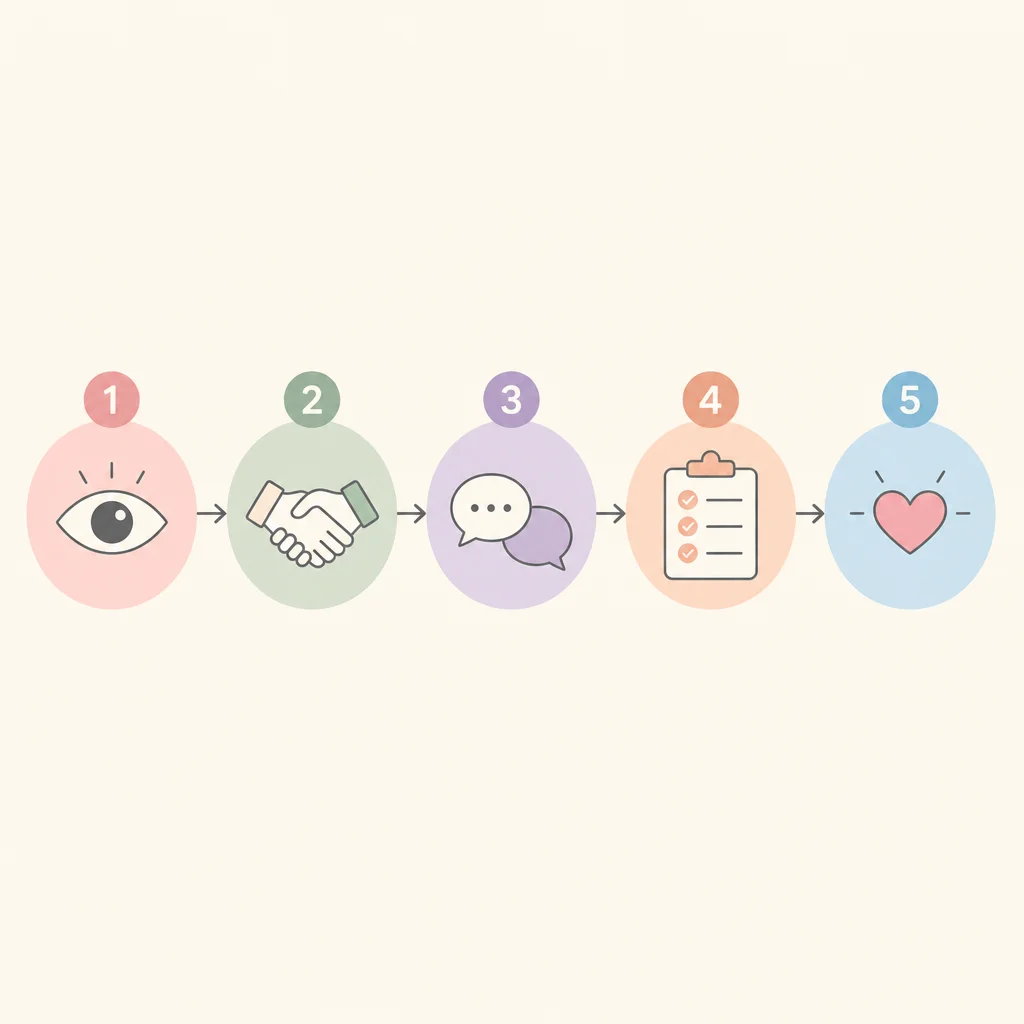
4. Action Points
As you discuss, turn problems into small, concrete, achievable commitments. “We argued about chores” becomes “this month, one of us plans and cooks while the other handles dishes, and we will revisit it next check-in.” Not every topic needs an action point, but the ones that do should be specific enough that you can tell next month whether they happened. This is the step that separates a nice talk from actual change.
5. Reconnect
You made it to the end — now close on a positive note. Take turns appreciating each other with specific compliments, or shift into something you enjoy doing together, whether that is a hug, a walk, or simply a few unhurried minutes. Ending with reconnection is not fluff; it is what makes the next check-in feel like something to look forward to rather than something to dread.
Why ENM Relationships Benefit the Most
Non-monogamy adds moving parts. More partners mean more schedules to coordinate, more boundaries to honor, more moments of jealousy or insecurity to process, and more small misunderstandings that can quietly accumulate. A RADAR check-in gives each relationship a dedicated, recurring space to surface all of that before it festers — and it does so without requiring anyone to bring things up awkwardly in the moment.

The check-in also protects the time you spend together. When you know there is a standing container for hard topics, the rest of your time can be just for connection, rather than every dinner carrying the risk of turning into a relationship meeting. If you are new to scheduling this kind of maintenance, our guide to scheduling regular ENM relationship check-ins walks through the logistics, and our piece on tackling difficult topics in a check-in helps when the agenda gets heavy.
What a RADAR Check-In Is Not
Because the name is specific, it helps to be clear about what a RADAR check-in is and is not. The distinction keeps the format from being asked to do too much.
| A RADAR check-in is… | A RADAR check-in is not… |
|---|---|
| A scheduled, recurring conversation | A crisis-only intervention when things break |
| A shared agenda you both agree on | One partner’s list of complaints |
| A place to turn problems into action points | A debate to be won |
| A habit that runs even when things are fine | Proof that the relationship is failing |
| A conversation that ends with reconnection | A substitute for therapy or mediation |

One of the most useful reframes: a check-in is maintenance, not repair. You do not wait for the car to break down before changing the oil. The same logic applies to relationships, and it is the reason a standing RADAR check-in keeps working month after month.
A Sample RADAR Agenda
If you are not sure what to put on the agenda, start with the recurring topics Multiamory recommends and adapt from there. A typical list looks like this:
- Quality time — are we getting enough, and does it feel good?
- Sex and intimacy — is everyone’s needs being discussed openly?
- Health — physical and emotional, including testing and sleep and stress.
- Other partners — how are other connections feeling, without comparison or scorekeeping?
- Disagreements — anything unresolved that we should revisit calmly?
- Money and household — logistics, chores, and shared responsibilities.
- Anything else — the catch-all for whatever did not fit above.
The exact list matters less than the habit of touching each area consistently. If one of these topics keeps producing action points, that is useful signal about where to put more attention. For help turning the agreements you reach into something durable, our guide to creating a polyamory relationship agreement is a natural next step.
Getting Started With Your First RADAR
You do not need a perfect setup to begin. Pick a date, put it on the calendar, and agree to try the five steps just once. Keep the first one shorter — forty-five minutes is plenty — and resist the urge to solve everything in a single sitting. The first RADAR check-in is mostly about building the muscle and proving to yourselves that honest conversation can feel safe.

Over time, the check-in stops being an event and becomes part of the rhythm of the relationship. That is exactly when it does its best work: catching small things early, keeping every partner feeling heard, and leaving more of your shared time free for the good stuff. A RADAR check-in is, at heart, a small ritual with an outsized return. If you are ready to learn the hands-on version, our companion guide to running a RADAR check-in step by step takes you through the mechanics in detail.
This article is intended for adults 18+ and is offered for general information. Healthy non-monogamy rests on clear communication, mutual respect, and enthusiastic consent between all partners.