
Table of Contents
- What Is NRE and Why Does It Hit So Hard in Threesome Dating?
- Signs NRE Is Starting to Affect Your Primary Relationship
- The NRE Timeline: What Couples Can Expect
- How Couples Can Manage NRE Together: A Practical Checklist
- What the Third Partner Needs to Know About NRE
- When NRE Turns Into Something More Serious
- Turning NRE Into a Relationship Strength
New Relationship Energy — NRE for short — is that intoxicating cocktail of excitement, curiosity, and dopamine that floods your brain when you connect with someone new. It’s the reason you can’t stop checking your phone, why every message feels electric, and why the new person seems to do no wrong. In threesome dating, NRE doesn’t happen in a vacuum. It happens right in front of your existing partner — and managing new relationship energy effectively is what separates couples who grow from the experience from couples who get destabilized by it.
What Is NRE and Why Does It Hit So Hard in Threesome Dating?
NRE isn’t a flaw. It’s biology. Your brain is doing exactly what evolution programmed it to do: locking in on a novel connection with laser focus. According to Psychology Today, NRE typically lasts anywhere from six months to two years, and its chemical signature — elevated dopamine and oxytocin — mirrors what neuroscientists observe in the early stages of any romantic attachment.
The problem specific to threesome dating? One moment you’re a couple exploring together; the next, one of you is glowing with excitement about someone else while the other watches from the sidelines, wondering where they fit into this new equation. This is the NRE paradox: the same energy that makes threesome dating exciting can also make it destabilizing. Managing new relationship energy isn’t about suppressing the excitement — it’s about handling it in a way that strengthens your primary bond rather than eroding it.

Signs NRE Is Starting to Affect Your Primary Relationship
NRE doesn’t announce itself. It seeps in. One day you’re both on the same page, and a few weeks later, small fissures start appearing. You find yourself comparing — not consciously, maybe, but the thought arrives: “the third is so much more adventurous” or “my partner never looks at me that way anymore.” Comparison is NRE’s favorite weapon — it takes the novelty high of the new person and weaponizes it against the familiar comfort of your primary relationship.
Your communication patterns shift too. You used to debrief everything together — now you’re holding back, either because you don’t want to sound jealous or because you don’t want to dampen your partner’s obvious happiness. Silence in a relationship that used to talk about everything is a red flag, and we’ve written about the emotional realities most people ignore when they start this journey. Physical affection between you and your primary partner may also change — less frequent, or somehow different, more routine. NRE can make years of intimacy feel stale by comparison, even when nothing has actually changed between you.

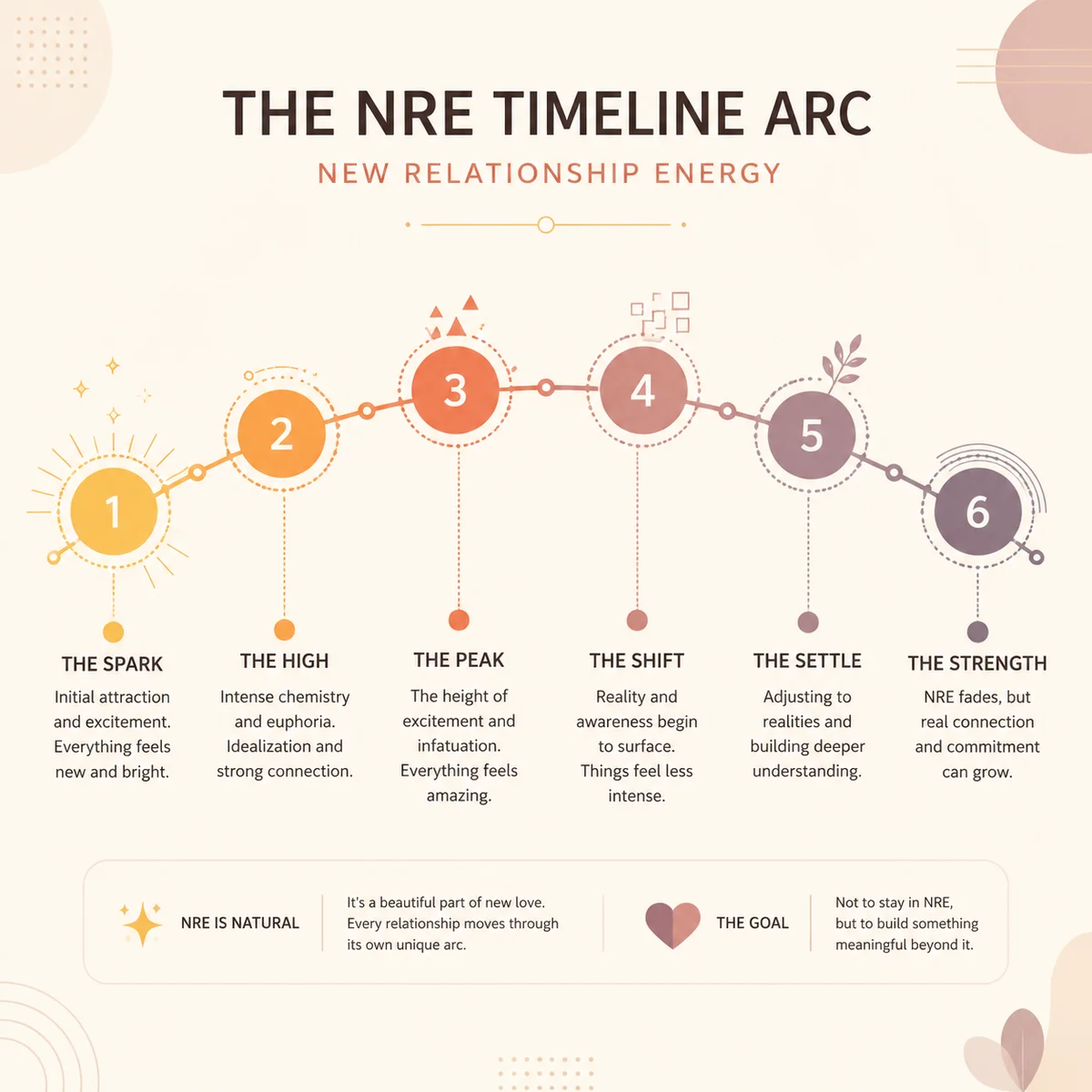
The NRE Timeline: What Couples Can Expect
NRE follows a predictable arc. Knowing what’s coming makes it easier to navigate. Weeks 1-2 are the honeymoon phase — everything feels electric, messages fly back and forth, and your brain is chemically biased toward idealization. This is genuinely fun, but it’s also when you’re least capable of objective judgment. If this is when you’re negotiating boundaries with the third partner, you’ll need our threesome negotiation guide to keep things grounded.
Weeks 3-6 bring the settling phase. The initial intensity levels off slightly and patterns emerge. Maybe one partner feels the NRE stronger than the other. This is when managing new relationship energy actually begins — when the novelty high is still present but no longer masking practical concerns. Months 2-6 are the integration or separation phase. NRE either integrates into a sustainable dynamic or it creates a fork in the road. Months 6+ bring the reality phase — NRE naturally fades, and what’s left is the real relationships, with all three people fully visible, flaws included. This timeline isn’t rigid, but it’s a useful mental model. If you know you’re in Week 2, you can remind yourself: “My brain is chemically biased right now. I need to slow down on big decisions.”

How Couples Can Manage NRE Together: A Practical Checklist
Managing new relationship energy in threesome dating isn’t about killing the excitement. It’s about keeping one foot grounded while the other explores. Here’s a practical framework couples can use:
The NRE Management Checklist
Daily (during active NRE):
□ Check in with your primary partner about how you’re both feeling — not just logistics
□ Maintain at least one non-threesome-related connection ritual (morning coffee, evening walk, a show you watch together)
□ Notice when you’re excited about the third and consciously redirect some of that energy toward your partner
Weekly:
□ Schedule a 20-minute “NRE temperature check” — no phones, no defensiveness
□ Ask explicitly: “Is there anything about the current dynamic that’s making you feel less connected to me?”
□ Plan at least one date that has nothing to do with the third — just the two of you
Monthly:
□ Revisit your original boundaries — NRE has a way of making people agree to things they wouldn’t have three weeks ago
□ Check whether the NRE is shared or one-sided — asymmetry needs to be addressed before it calcifies into resentment
□ Have a three-way conversation about where things are heading — the third deserves clarity too
Red flags that mean pause and reassess:
□ You’re hiding messages or meetups from your primary partner
□ You feel defensive when your partner asks reasonable questions about the third
□ You’re fantasizing about leaving your primary relationship for the third
□ The phrase “you’re just jealous” has entered your vocabulary
This checklist isn’t about policing each other. It’s about making NRE management a shared project rather than a solo struggle. When both partners commit to the same framework, it transforms “I’m worried about how excited you are” into “we’re navigating this excitement together.” For couples who struggle with this balance, our article on catching feelings for your third partner offers a deeper exploration of what happens when NRE crosses into emotional territory.
What the Third Partner Needs to Know About NRE
NRE isn’t just a couple’s problem. The third partner is living inside someone else’s NRE — and that comes with its own set of challenges. For singles dating couples: you might be receiving an overwhelming amount of attention that feels amazing. But ask yourself: is this person connecting with me, or are they connecting with the feeling I give them? The difference matters. NRE-driven attention feels genuine in the moment but it’s chemically inflated — when the NRE fades, as it eventually does, the dynamic can shift dramatically.
As a third, protect yourself by asking couples directly how they handle NRE and what their track record looks like. Pay attention to how the couple treats each other during NRE — not just how they treat you. Maintain your own life, friends, and dating options rather than letting the couple’s NRE become your entire social world. And trust patterns over promises — if their communication is already inconsistent two weeks in, it won’t improve when the NRE wears off. Being someone’s NRE object can feel intoxicating. Being someone’s genuinely valued partner — after the chemical high settles — is what actually lasts.
When NRE Turns Into Something More Serious
There’s a line between NRE and something deeper, and it’s worth knowing where that line sits. NRE is about novelty, intensity, and idealization. Real emotional connection is about consistency, vulnerability, and seeing someone clearly — flaws included. Here’s a litmus test: if you removed the physical and romantic component entirely, would you still want this person in your life? If the answer is yes — and it stays yes after three months — you’re dealing with something beyond NRE.
This distinction matters because it shapes what happens next. Genuine connection that outlasts NRE can evolve into arrangements like polyamory or ongoing threesome dynamics. Our guide to compersion in threesome dating explores what it looks like when couples genuinely celebrate each other’s connections rather than just tolerating them. But NRE that’s mistaken for deeper connection leads to painful outcomes: couples who break up to pursue the third, only to discover the connection was chemically inflated. Singles who invest emotionally in a couple, only to be discarded when the NRE wears off. Neither outcome is inevitable — but both become more likely when nobody names what’s actually happening.
Turning NRE Into a Relationship Strength
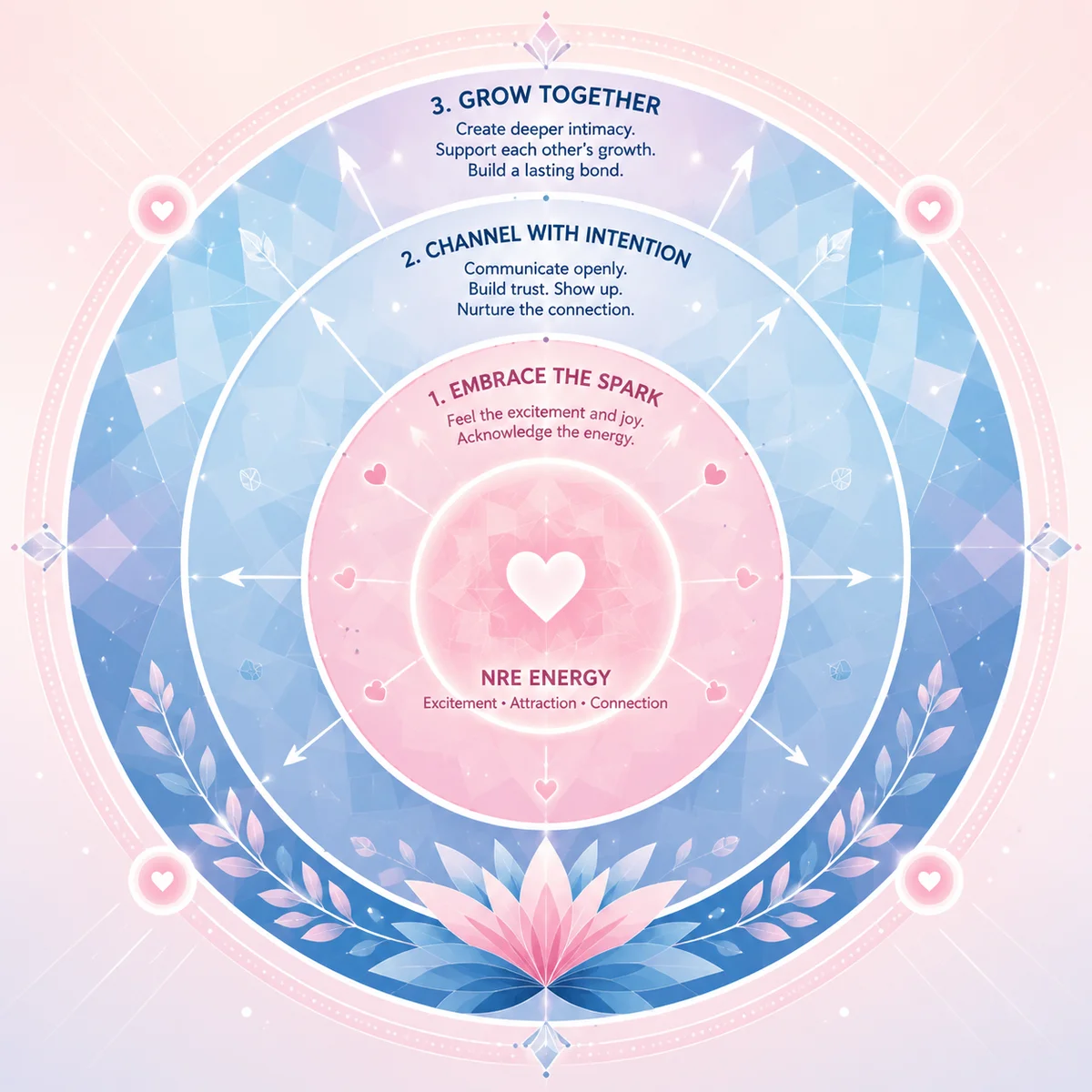
The couples who navigate NRE best don’t try to suppress it — they channel it. When you come home buzzing from a great experience with your third, redirect some of that energy toward your primary partner. Tell them about it. Bring that excitement into the couple dynamic rather than keeping it compartmentalized. The goal isn’t to pretend the NRE doesn’t exist — it’s to make it something you share rather than something that divides you.
Let NRE teach you about what you value. What specifically excites you about the third? Their sense of adventure? Their emotional availability? Those qualities aren’t a criticism of your primary partner — they’re data about what you respond to. Share that data constructively. Practice aftercare that addresses NRE specifically — our threesome aftercare guide covers reconnection practices that counterbalance the NRE effect. When handled well, managing new relationship energy together isn’t just damage control — it’s a trust-building exercise. Couples who survive NRE together often report feeling more honest, more resilient, and more confident in their bond than they did before.
New Relationship Energy is one of the most powerful forces in threesome dating — and one of the least discussed. It can make you feel more alive than you’ve felt in years; it can also quietly destabilize a relationship that was solid before the third person entered the picture. The difference isn’t whether you feel NRE. It’s whether you manage it together or let it manage you. If you’re exploring threesome dating and want to do it with the emotional awareness this article describes, 3Cupid is built for couples and singles who value communication, consent, and genuine connection over rushed experiences. Join us here.
Editor’s note: This article draws on established relationship psychology research regarding New Relationship Energy in consensual non-monogamy. Individual experiences vary. If NRE is creating significant distress in your relationship, consider consulting a therapist familiar with ENM and polyamory frameworks.