If jealousy is the emotion everyone expects in cuckold dating, compersion is the one that transforms the entire experience. Compersion in cuckold dynamics is the feeling of genuine happiness or pleasure you experience when you see your partner enjoying a connection with someone else. It is not the absence of jealousy — it is a distinct positive emotion that can coexist alongside other feelings, and for many couples, it is the emotional core that makes cuckold dating meaningful rather than merely exciting.
This article explores what compersion actually is, how it functions within cuckold dynamics specifically, and — most importantly — how couples can cultivate it intentionally rather than waiting for it to arrive on its own.
Table of Contents
- What Compersion Actually Is
- Why Compersion Matters in Cuckold Dynamics
- Jealousy vs Compersion: They Can Coexist
- How to Cultivate Compersion Intentionally
- Practical Compersion-Building Exercises
- The Link Between Compersion and Trust
- Compersion as a Relationship Skill
What Compersion Actually Is
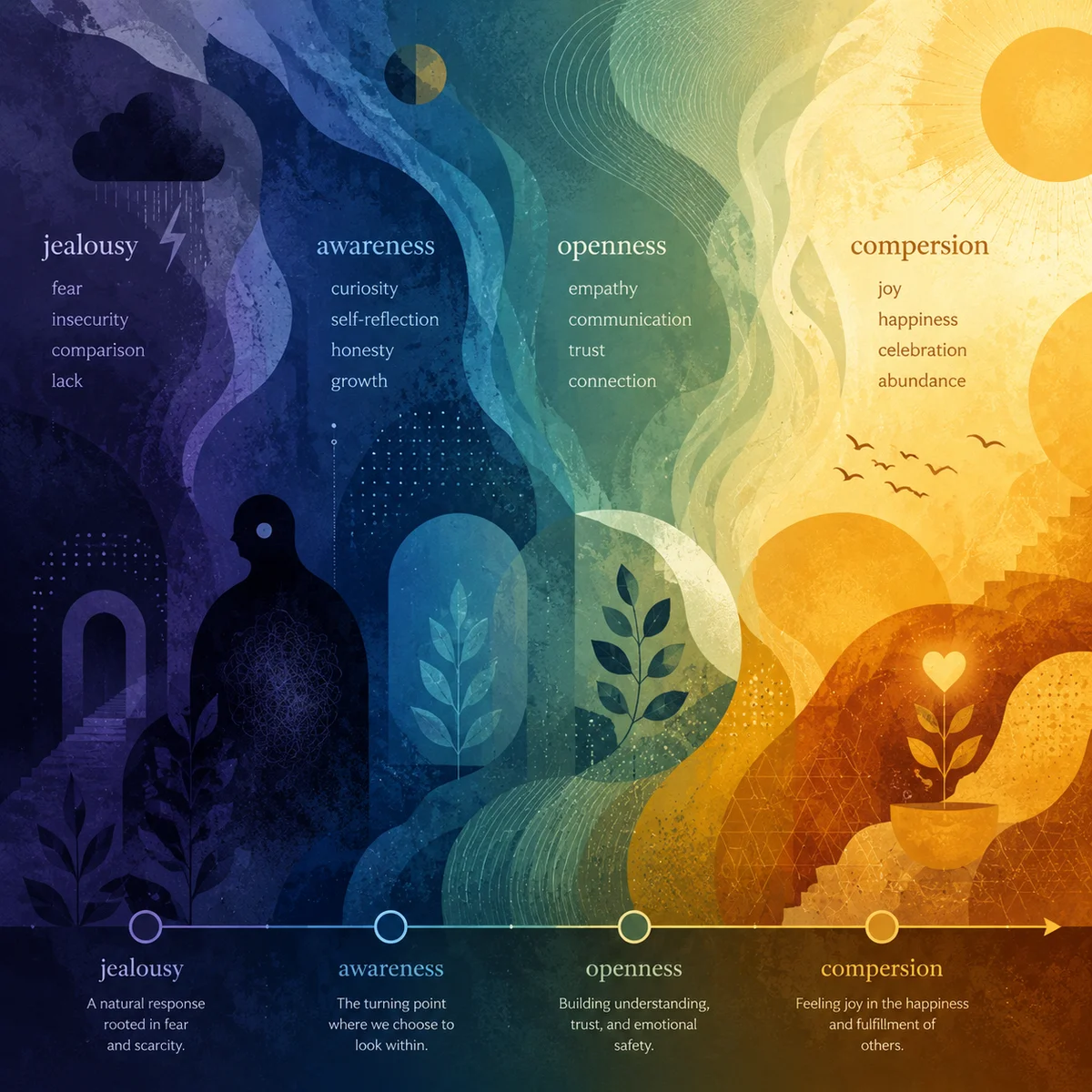
Compersion is often described as “the opposite of jealousy,” but that framing is too simplistic. Jealousy is a fear-based response to a perceived threat. Compersion is a joy-based response to a partner’s positive experience. You can feel both in the same hour — even in the same moment.
The term originated in polyamory communities but has gained broader recognition as more people explore consensual non-monogamy. Psychology Today’s research on cuckolding psychology notes that compersion is not just a nice-to-have emotional bonus — it is often the mechanism that allows couples to sustain non-monogamous dynamics without accumulating emotional damage.
In practical terms, compersion might look like:
- Feeling a warm sense of happiness when you see your partner enjoying themselves with someone else
- Looking forward to hearing about your partner’s experience afterward — not with anxiety, but with genuine curiosity
- Feeling proud of your partner’s confidence and desirability rather than threatened by it
- Experiencing the dynamic as something you are doing together, even if you are not the one directly connecting with the third person

Why Compersion Matters in Cuckold Dynamics
In cuckold dating, the emotional structure is different from other forms of non-monogamy. One partner is engaging with a third person while the other partner witnesses or knows about it. The witnessing partner is not a passive observer — they are an active participant in the emotional and psychological dimension of the experience.
Without compersion, this structure can feel like exclusion. With compersion, it feels like shared participation in something meaningful. The difference is not semantic — it is the difference between a dynamic that builds intimacy and one that creates distance.
Our guide on the psychology behind cuckold fantasies explores the research on why some people are drawn to this dynamic, and compersion consistently emerges as a key factor. When the witnessing partner can access genuine joy in their partner’s pleasure — rather than simply tolerating it or managing jealousy around it — the entire experience shifts from “something we survived” to “something that brought us closer.”

Jealousy vs Compersion: They Can Coexist
One of the most liberating realizations for couples new to cuckold dating is that compersion does not require the absence of jealousy. These are not mutually exclusive emotions — they operate on different tracks. You can feel a pang of insecurity and still, underneath it, feel genuinely happy for your partner.
Think of it like this: you can be nervous about a job interview and still feel proud of yourself for going after the opportunity. You can miss your partner when they travel and still be glad they are having an adventure. Emotional complexity is a feature of healthy relationships, not a bug.
What matters is the ratio over time. If jealousy consistently overwhelms compersion, the dynamic needs adjustment — more communication, different boundaries, or perhaps a pause. If compersion gradually grows while jealousy becomes more manageable, you are on the right track.
For more on navigating jealousy specifically, our guide to handling jealousy in cuckold dating provides detailed strategies that complement the compersion-building approach discussed here.

How to Cultivate Compersion Intentionally
Some people seem to experience compersion naturally. For others, it takes practice. The good news is that compersion is a skill you can build — not a personality trait you either have or do not. Here is how to cultivate it intentionally within your cuckold dynamic:
Reframe the narrative. Instead of thinking “my partner is with someone else,” try “we are exploring something together, and I am supporting my partner’s experience.” The first frame centers loss. The second centers collaboration. The language you use in your own head shapes the emotions that follow.
Focus on what you gain. What does this dynamic bring to your relationship? Increased communication? Deeper trust? A sense of adventure you share? Make a list. When jealousy surfaces, return to it.
Ask to hear the positive parts. After an experience, ask your partner what they enjoyed — not in a comparative way (“was it better than with me?”), but in a celebratory way (“I am glad you had that experience”). Hearing your partner’s genuine happiness can be a powerful compersion trigger.
Celebrate together afterward. Make the post-experience ritual something you both look forward to. Whether it is a special meal, a night of reconnection, or simply a long conversation, frame the aftermath as a shared celebration rather than an emotional cleanup operation.

Practical Compersion-Building Exercises
These exercises are designed for couples who want to actively develop compersion. Start with the first one and work through them gradually — do not try to do everything at once.
| Exercise | How to Do It | When to Use |
|---|---|---|
| Gratitude Sharing | Each partner shares one thing they appreciated about how the other handled a recent cuckold experience. Be specific — not “you were great” but “I really appreciated how you checked in with me afterward.” | Within 24 hours of any experience |
| Joy Journaling | The witnessing partner writes down moments during the experience when they felt pride, excitement, or happiness for their partner — even fleeting ones. Read it to your partner later. | During or immediately after an experience |
| Positive Visualization | Before an upcoming experience, spend 5 minutes together visualizing a positive outcome. Picture your partner enjoying themselves, picture yourself feeling genuinely happy for them, picture the reconnection afterward. | Day before or morning of a planned experience |
| Compersion Conversation | Set aside 20 minutes where the witnessing partner asks the participating partner questions about their experience — from a place of genuine curiosity and warmth. What was the best moment? What surprised you? What did you learn about yourself? | A few days after an experience, once initial emotions have settled |
| Shared Celebration Ritual | Create a small ritual you do together after each experience — a specific meal, a walk, a toast. Something that says “we did this together, and we are good.” | Within 48 hours of any experience |
The Link Between Compersion and Trust
Compersion does not grow in a vacuum. It grows in soil that has been prepared with trust, communication, and emotional safety. If you are struggling to access compersion, the first question to ask is not “what is wrong with me?” but “what does our foundation look like right now?”
Trust in cuckold dynamics means several specific things:
- Trust that boundaries will be respected. If you have agreed on certain limits, you need to believe — based on consistent evidence — that those limits will be honored.
- Trust that your partner will return to you emotionally. Physical return is not the same as emotional return. You need to know that after the experience, your partner will be present, attentive, and reaffirming of your bond.
- Trust that your feelings will be treated with respect. If jealousy or insecurity surfaces, you need to know your partner will respond with care, not dismissal or frustration.
If you are working on building that foundation, our guide to building trust in cuckold relationships offers a structured approach. Trust and compersion reinforce each other: the more you trust, the easier compersion becomes; the more compersion you experience, the more trust deepens.

Compersion as a Relationship Skill
Here is the thing about compersion that most beginner guides do not tell you: it is not just about cuckold dating. The capacity to feel genuine happiness for your partner’s positive experiences — even when those experiences do not directly involve you — is a relationship skill that extends far beyond any single dynamic.
Couples who develop compersion report that it changes how they relate to each other in all areas — career successes, personal achievements, friendships, hobbies. When you train yourself to experience your partner’s joy as your own, the entire relationship becomes more expansive and less zero-sum.
If you are interested in exploring how compersion fits into the broader emotional landscape of non-monogamy, our article on the emotional side of cuckold dating provides a comprehensive look at the full spectrum of feelings you may encounter on this journey.
Cuckold dating, approached with emotional maturity and a commitment to mutual care, can be one of the most profound ways to expand what love and connection mean in your relationship. Compersion is not the destination — it is the lens that makes the whole journey worth taking.
Editor’s note: This article is part of 3Cupid’s Cuckold Dating educational series. All content is written for an 18+ audience and emphasizes consent, communication, and emotional safety.