
When you first enter the world of polyamory, you quickly realize there is no single way to “do” it right. Some polyamorous people host weekly dinners where everyone — partners, partners’ partners, and maybe even partners’ partners’ partners — gather around one table. Others prefer to keep their relationships in separate lanes, with minimal overlap between the people they date. These two approaches have names: kitchen table polyamory and parallel polyamory. Understanding the difference can help you figure out what kind of polyamorous network you actually want to build — and that is a conversation worth having early.
Neither style is “more evolved” or “more authentic” than the other. They are simply different ways of organizing the social fabric of multiple relationships. What works beautifully for one polycule might feel suffocating or isolating for another. The key is knowing your own needs, your partners’ needs, and being honest about where they overlap — and where they do not.
Table of Contents
- What Is Kitchen Table Polyamory?
- What Is Parallel Polyamory?
- Key Differences at a Glance
- The Pros and Cons of Each Approach
- How to Decide Which Style Works for You
- Can You Mix Both Approaches?
- Common Challenges and How to Navigate Them
- What the Community Says
What Is Kitchen Table Polyamory?
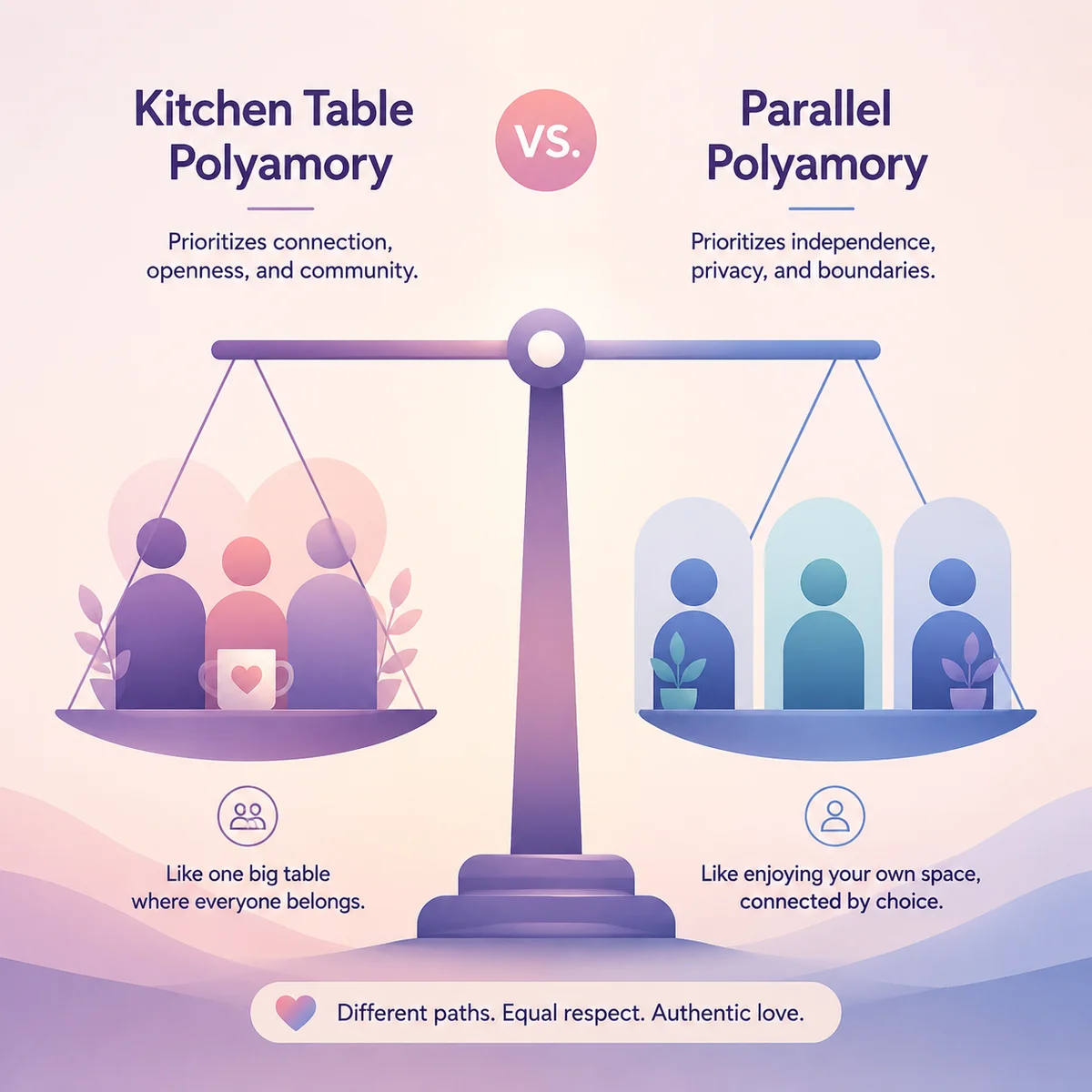
Kitchen table polyamory (KTP) describes a polyamorous dynamic where everyone involved is comfortable enough to sit around the same kitchen table — literally or metaphorically. Partners and metamours (your partner’s other partners) interact regularly, share meals, attend events together, and form a connected community. The idea is that while not everyone is romantically or sexually involved with everyone else, there is a baseline of mutual warmth and familiarity.
The term was popularized in online polyamory communities and has become something of a gold standard for many practitioners. Supporters of KTP often describe it as a natural extension of the values that drew them to polyamory in the first place: openness, community, and deconstructing the idea that love is a scarce resource. When it works, KTP can feel like having an extended chosen family — people who genuinely care about each other’s well-being beyond the lines of specific romantic entanglements.
That said, kitchen table polyamory is not about forcing closeness. It is about creating an environment where closeness can develop organically. Nobody should be pressured into weekly game nights with their metamour if that feels uncomfortable. The “kitchen table” is an invitation, not a summons.

What Is Parallel Polyamory?
Parallel polyamory sits on the other end of the spectrum. In this model, relationships run alongside each other with minimal interaction. You know your partner has other partners, and they know about you, but you rarely — if ever — spend time together. Communication might flow through the shared partner rather than directly between metamours. Each relationship occupies its own emotional and logistical space.
For some people, parallel polyamory is simply a preference. They value autonomy and privacy, and they see no reason why romantic love should automatically come with a built-in social circle. For others, it is a practical necessity — perhaps a metamour relationship has been strained in the past, or schedules and geography make regular group interaction unrealistic.
Parallel polyamory is not about secrecy or shame. It is about recognizing that you can respect someone’s importance in your partner’s life without needing to be friends with them yourself. As one Psychology Today article on polyamory dynamics notes, healthy polyamory does not require everyone to be best friends — it requires everyone to feel safe and respected.

Key Differences at a Glance
To make the distinction clearer, here is a side-by-side comparison of how kitchen table and parallel polyamory differ across several practical dimensions:
| Dimension | Kitchen Table Polyamory | Parallel Polyamory |
|---|---|---|
| Metamour interaction | Regular, often social or familial | Minimal to none |
| Communication flow | Direct and multi-directional | Through the shared partner |
| Group activities | Common (dinners, holidays, trips) | Rare or non-existent |
| Emotional investment | Moderate to high across network | Focused on individual relationships |
| Conflict resolution | May involve group discussion | Handled within each dyad |
| Privacy level | Lower — more shared context | Higher — more compartmentalized |
| Time commitment | Higher (group events + 1:1 time) | Lower (1:1 time only) |
The Pros and Cons of Each Approach
Kitchen Table Polyamory: The Bright Side and the Challenges
When kitchen table polyamory works well, it can be deeply rewarding. You gain a built-in support network. Scheduling becomes easier because everyone is on the same page — and sometimes literally sharing a shared calendar. Holidays and special occasions feel fuller when the whole polycule can celebrate together. There is also a transparency that can reduce anxiety: when you know and trust your metamours, the unknown becomes less scary.
But KTP has real challenges. It requires a significant time investment — not just in your partners but in your partners’ partners. Personality clashes can create friction that ripples through the entire network. And the pressure to “get along” can sometimes silence legitimate discomforts. If one person in the network is unhappy with the arrangement, the whole table can feel unstable.
Parallel Polyamory: Autonomy and Its Trade-offs
Parallel polyamory offers clear benefits. Each relationship gets undivided attention during its dedicated time. There is less social fatigue from managing multiple overlapping dynamics. Privacy is preserved, and you do not have to navigate a metamour’s bad day or personal drama unless it directly affects you through your shared partner. For people who are introverted or have limited social energy, parallel polyamory can be a sustainable way to maintain multiple romantic connections.
The downsides are equally real. A rigidly parallel structure can make scheduling a logistical puzzle — your partner becomes the sole conduit for calendar coordination, and that can be exhausting for them. In a crisis, a parallel network may feel less resilient because there are fewer people to lean on. And there is a risk that “parallel” slides into “don’t ask, don’t tell,” which can undermine the honesty that ethical non-monogamy depends on.
How to Decide Which Style Works for You
Figuring out whether kitchen table or parallel polyamory suits you better starts with honest self-reflection. Ask yourself a few core questions: How much social energy do you have after work, family, and existing relationships? Do you tend to feel more secure when you know your metamours personally, or does distance actually reduce your anxiety? What does your current or prospective partner prefer — and how much overlap is there between your visions?
It is also worth noting that this is rarely a binary choice. Most polyamorous people exist somewhere on a spectrum between pure KTP and strict parallel. You might practice kitchen table with one metamour and parallel with another. Your preferences can also shift over time — a metamour who starts as a parallel figure might become a close friend years later, or vice versa. The goal is not to pick a label and stick to it forever, but to stay attuned to what actually feels good for everyone involved.
For a deeper dive into the foundations of polyamorous relationship structures, our polyamory beginner’s guide walks through the core concepts that underpin both KTP and parallel approaches.
Can You Mix Both Approaches?
Absolutely — and in practice, most polycules do. You might have a warm, kitchen-table dynamic with one metamour while maintaining a cordial-but-distant parallel relationship with another. What matters is that each dynamic is negotiated clearly and revisited regularly. What started as parallel might naturally warm into something closer; what started as kitchen table might need to pull back if boundaries are being crossed.
The skill that makes all of this work — regardless of which style you lean toward — is clear communication. If you are new to navigating these conversations, our guide to ethical non-monogamy fundamentals covers the communication frameworks that successful polyamorous relationships are built on.
Common Challenges and How to Navigate Them
Regardless of which model you choose, certain challenges tend to surface. One common issue is mismatched expectations — one person wants kitchen table closeness while the other needs parallel distance. This is not necessarily a dealbreaker, but it does require negotiation. The person wanting more closeness needs to accept that pushing too hard can backfire, while the person wanting distance needs to understand that total avoidance can feel like rejection to a partner who values community.
Another frequent challenge is when a new partner enters an established polycule with a different preferred style. If you have been practicing kitchen table for years and a new partner wants strict parallel, that shift can feel jarring. The key is to treat this as a conversation, not a crisis. What are the specific concerns behind the preference? Is there room for gradual adjustment? What does the shared partner need in the middle of this negotiation?
Time and energy management also deserve attention. Kitchen table polyamory in particular can expand your social calendar dramatically — and if you are already balancing multiple relationships, a career, and perhaps parenting, the additional commitment of group events can become overwhelming. Our article on time management in polyamorous relationships offers practical strategies for keeping your calendar — and your energy — sustainable.

What the Community Says
Across polyamory forums and discussion spaces, the kitchen-table-vs-parallel debate is one of the most frequently revisited topics — and for good reason. It touches on fundamental questions about what polyamory means to different people. Some practitioners describe KTP as the ideal they strive for but acknowledge it is hard work. Others describe parallel polyamory as the only sustainable option for their mental health and energy levels.
The most consistent piece of advice from experienced community members is this: do not let anyone else define what “real polyamory” looks like for you. A kitchen table setup is not more evolved, and a parallel setup is not more independent. What matters is that everyone involved has consented to the structure, feels heard, and has the freedom to revisit the arrangement as relationships grow and change.
If you are building a polyamorous network and want to understand how different relationship structures can work together — including how to navigate the spaces where metamours interact — our guide to understanding your polycule explains the broader picture of how these connections fit together.
This article is part of 3Cupid’s Polyamory & ENM series, designed to help you build relationships that are ethical, fulfilling, and true to who you are. Whether you are exploring polyamory for the first time or deepening an established practice, you can find a welcoming community at 3Cupid.