Table of Contents
- What “Hinge” Actually Means in Polyamory
- Hinge vs Metamour: Clearing Up the Confusion
- Where Hinges Show Up: Vee and Triad Structures
- The Emotional Load Hinges Carry (and Why It’s Often Invisible)
- Why the Hinge Role Deserves Its Own Name
- What a Healthy Hinge Dynamic Looks Like
- A Quick Hinge Self-Check
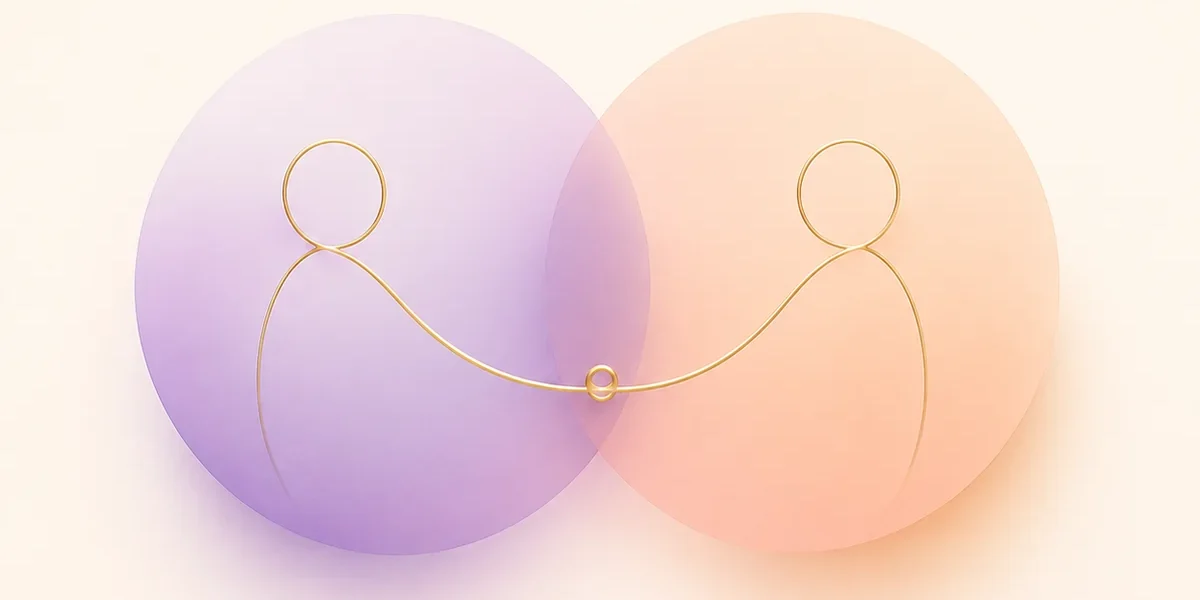
A hinge partner is the person who connects two metamours in a V-shaped (or “vee”) polyamorous relationship. They’re dating both people, and their partners aren’t dating each other. That makes the hinge the shared point — the pivot that holds the structure together.
If you’ve ever described yourself as “the middle of the V,” you already know the role, even if you didn’t have the word for it. The hinge is the only person who has a direct relationship with both partners, which means they carry a unique kind of emotional and logistical labor.
This beginner’s guide explains what a hinge partner does, how the role differs from being a metamour, and what makes the position both valuable and challenging. Whether you’re new to polyamory or you’ve been navigating it for a while, understanding the hinge role helps you support the people in it — or recognize when you’re in it yourself.
What “Hinge” Actually Means in Polyamory
The term “hinge” comes from the shape of the relationship: two arms meeting at a center point. In a vee (V) structure, Person A dates Person B, and Person A also dates Person C. Person A is the hinge. Persons B and C are metamours — they’re connected through A, but they don’t date each other (or, sometimes, don’t even talk directly).
The hinge isn’t just a label. It describes a specific position with specific responsibilities:
• Managing two separate relationships that may have different needs, rhythms, and boundaries
• Being the primary point of communication between metamours
• Balancing time, energy, and emotional availability across both partnerships
• Sometimes translating between two people’s communication styles
The word is neutral. It doesn’t mean “primary” or “more important” — it just means “the person at the joint.” Plenty of hinges are deliberately non-hierarchical and treat both relationships as equally valid. Our primer on how to practice non-hierarchical polyamory goes deeper on that.

The visual is simple: a V, with one person at the joint. The work is not simple, because the joint is the place where everything either flows or breaks.
Hinge vs Metamour: Clearing Up the Confusion
People new to polyamory often mix these terms up, but they describe two different positions.
A hinge partner is the person dating both members of a vee. A metamour is the partner of your partner — the person your partner is dating, who you are not dating yourself. Our guide to metamours in polyamory covers that side of the relationship in detail.
To put it simply:
• If you’re dating two people who don’t date each other, you’re the hinge.
• If your partner is dating someone else, that someone else is your metamour.
In a triad (three people all dating each other), there’s no hinge — everyone is equally connected to everyone else. The hinge term only applies to vee and similar asymmetric structures.
The distinction matters because metamours and hinges face very different challenges. Metamours often wrestle with whether to meet, how to relate, and what level of contact feels right. Hinges wrestle with how to hold two relationships without bleeding one into the other. How those dynamics play out depends a lot on whether you’re practicing kitchen table vs parallel polyamory, and how each metamour prefers to engage.

If you’ve ever tried to explain your relationship map to a friend and watched their eyes glaze over, you already know the labels matter. Naming the role is half the work.
Where Hinges Show Up: Vee and Triad Structures
Hinges are most visible in vee relationships, but they can show up in other configurations too.
• Vee (V): Two partners connected through one shared partner. The classic hinge setup.
• N-shaped or Z-shaped: More complex networks where one person may act as a hinge between two metamours who are themselves connected through other links.
• Asymmetric quads: Some four-person configurations have one person dating three others who aren’t all dating each other. That person is a hinge in multiple directions.
In a closed triad (a “triangle”), there’s no hinge. Everyone dates everyone. If one person leaves, the remaining two may become a vee — and one of them may suddenly find themselves in the hinge role they didn’t sign up for.
Hinges can also be temporary. A relationship that starts as a triad may shift into a vee if one connection ends. Recognizing when you’ve become a hinge — and what that means — is part of navigating polyamory long-term. People in adjacent roles, like a nesting partner, often have to renegotiate boundaries when the structure around them changes.
The Emotional Load Hinges Carry (and Why It’s Often Invisible)
Here’s the part most beginner guides skip: the hinge role involves a lot of invisible work.
You’re the only person who knows both relationships in full detail. You hear Partner B’s anxieties about Partner C. You see Partner C’s schedule conflict with Partner B’s date night. You’re the one who has to remember that Partner B doesn’t like surprise sleepovers, and Partner C needs a heads-up before any big change.
That kind of information brokering is tiring. Polyamory communities sometimes call it “emotional labor” or “relational logistics.” When it’s not acknowledged, the hinge can start to feel like a project manager instead of a partner.
Common invisible loads include:
• Translating between different communication styles
• Tracking two people’s boundaries and making sure both feel respected
• Managing jealousy or insecurity triggers for both partners
• Scheduling time so neither partner feels like the afterthought
• Being the “shock absorber” when metamours clash

If you’re a hinge and you’re exhausted, it’s not because you’re bad at polyamory. It’s because the role asks a lot, and most people don’t see the work.
Why the Hinge Role Deserves Its Own Name
Calling someone a hinge isn’t just vocabulary. It makes a structural reality visible.
When we name a role, we can talk about it. “Being a hinge” is easier to discuss in therapy, with a partner, or in a polyamory support group than “the person in the middle of my weird situation.” Naming the role also helps new poly folks understand what they’re signing up for — before they end up in the position by accident.
There’s another reason the name matters. Hinges are sometimes blamed for things that aren’t their fault. If two metamours don’t get along, the hinge gets pressure from both sides. If one partner wants more time and the other wants more spontaneity, the hinge becomes the negotiator. Having a word for the role makes it easier to ask for support, set boundaries, and refuse to be the default problem-solver.
What a Healthy Hinge Dynamic Looks Like
A healthy hinge relationship isn’t perfect, but it has a few recognizable features:
• Each partner has their own independent relationship with the hinge, not just a shared one
• The hinge isn’t expected to mediate every metamour conflict
• Both partners get meaningful time, attention, and emotional presence
• Boundaries belong to each person — the hinge doesn’t “enforce” someone else’s limits
• Metamours are free to relate (or not relate) on their own terms
Equally important: a healthy hinge knows they can ask for help. They can say “I’m overwhelmed” or “I need a night off from coordinating.” The role isn’t a performance — it’s a real position held by a real person with real limits.
If you’re a hinge and you recognize some of these patterns missing from your dynamic, that’s information. It’s not a verdict. It’s a starting point for a conversation with your partners about what support you actually need. For a hands-on walkthrough, our companion guide, How to Be a Good Hinge Partner in Polyamory, covers the daily practices that make the role sustainable.

The point of naming the role isn’t to add a label. It’s to make invisible work visible, and visible work easier to share.
A Quick Hinge Self-Check
Not sure if the hinge role fits your situation? Answer these seven questions honestly.
1. Are you dating two people who don’t date each other?
2. Are you the only point of contact between your two partners?
3. Do you carry the schedule, the emotional updates, and the boundary check-ins?
4. Have you ever felt like a messenger instead of a partner?
5. Do both your partners rely on you to interpret each other’s needs?
6. When conflict arises between your partners, do they come to you first?
7. Do you sometimes forget that you, too, deserve care and attention?
If you answered yes to four or more, you’re in a hinge role — and you may benefit from naming it out loud. Saying “I’m the hinge here, and I need support” is one of the most clarifying sentences in polyamory. For more on the role, Psychology Today’s polyamory overview is a good grounding read on how poly structures work in practice.
Naming the role is the first step. The second is asking for what you need — from both partners, and from yourself.
This article is for educational purposes and is meant for adults 18+. Every poly structure is unique, and what works for one person may not work for another. If you’re exploring how to be a hinge partner and want to read more, you’ll find beginner-to-advanced guides on polyamory, ENM, and ethical non-monogamy right here at 3Cupid.