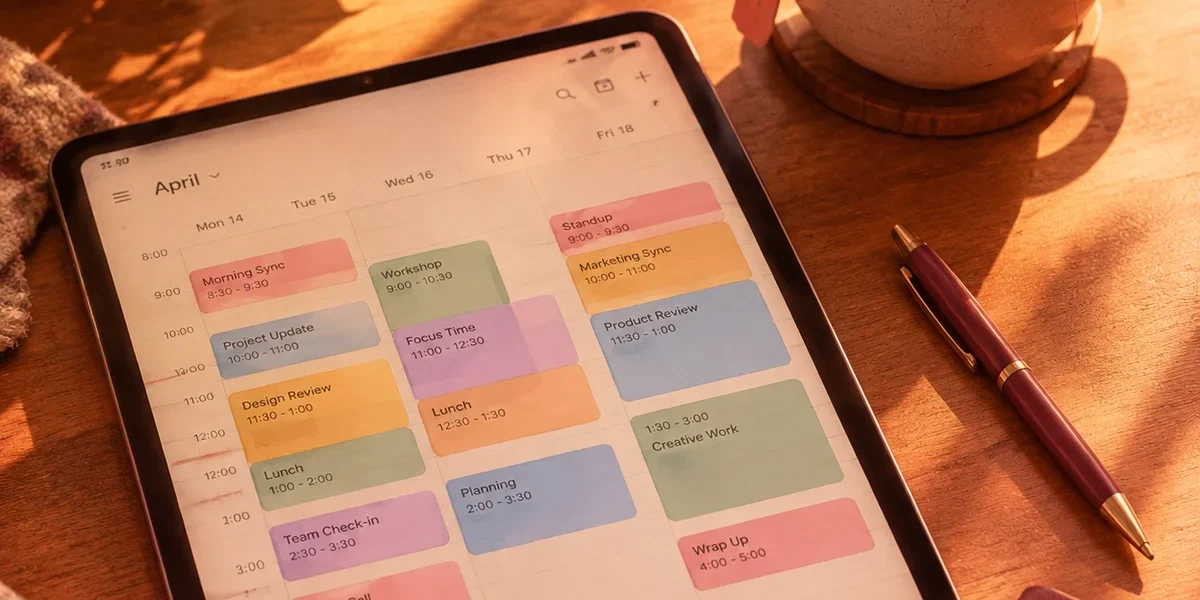
Time zone scheduling with multiple partners is the practical half of cross-zone polyamory: how you actually put four people in three time zones onto one calendar without losing your mind. This guide gives you a method. Map the overlap first, build a weekly rhythm so you are not renegotiating every day, sort time into three tiers so you know what is protected and what is flexible, and set up async touchpoints for the partners you cannot reach live. If you are still deciding whether a cross-zone relationship is workable at all, read long-distance polyamory across time zones first; this article assumes you have decided to try.
Table of Contents
- Start With One Clock, Not Six
- Map the Overlap Before You Plan Anything
- Build a Weekly Rhythm, Not Daily Negotiations
- The Three Tiers of Time
- Async Touchpoints for Unreachable Partners
- When the Calendar Becomes the Relationship
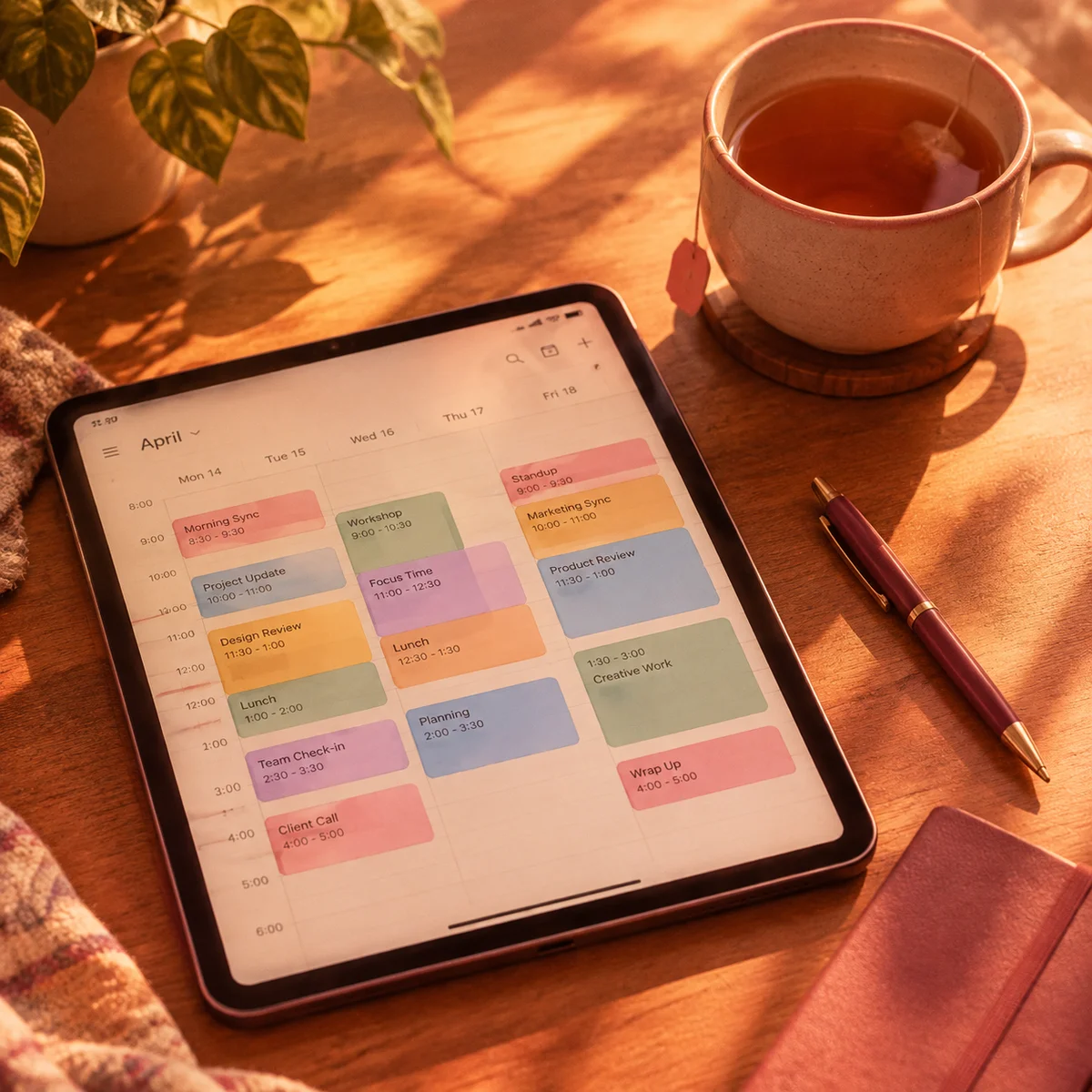
- A Weekly Template You Can Copy Today
- FAQ
Start With One Clock, Not Six
The most common scheduling failure in cross-zone polyamory is not lack of time. It is that every person is doing mental conversion in a different direction and everyone is slightly wrong. Fix the reference frame before you fix anything else.
Pick one home time zone for the shared calendar and label it everywhere. Every person then knows to convert once, in one direction, from their own zone into the reference. Add a second clock widget on your phone for each partner’s zone. It sounds trivial; it eliminates a category of missed calls that people otherwise attribute to carelessness. Carelessness is rarely the real cause. The broader research on relationship maintenance, such as the American Psychological Association’s healthy relationships material, keeps landing on predictability and repair, and a shared clock is the cheapest form of predictability there is.
Map the Overlap Before You Plan Anything
Before scheduling a single call, write down the actual waking overlap with each partner. Not the time difference, the overlap. A nine-hour gap between two people who both keep 9-to-6 hours and sleep eight hours can leave under an hour of shared waking time on weekdays.
Do this as a simple grid: rows are partners, columns are hours in your reference zone, and you shade the blocks where both of you are plausibly awake and not working. Most people are shocked by how small the shaded area is. That grid then tells you what is realistic. If you have 40 minutes of overlap on a Tuesday, do not schedule a 90-minute emotional conversation into it.
- Use real bedtimes, not aspirational ones. If you are in bed by 11 most nights, do not map overlap to 1 a.m.
- Separate weekday from weekend. These are different grids and almost everyone forgets the second one.
- Include commute and wind-down. Technically awake is not the same as available.
- Redo it twice a year. Jobs, daylight saving, and sleep habits all move.

Build a Weekly Rhythm, Not Daily Negotiations
Negotiating contact day by day is exhausting and it quietly favors whoever asks first. A standing weekly rhythm removes most of the decisions and, more importantly, makes the pattern reliable enough that people stop feeling like they are competing for scraps.
Assign each partner a default slot rather than a day-by-day claim. Monday evening is a call with Sam. Wednesday is async only. Saturday morning is the long video with Alex. Then treat the default as the plan and only speak up when it needs to change. This inverts the usual dynamic: instead of everyone requesting time and hoping, the time already exists and gets cancelled only with reason.
Keep one slot per week that belongs to you alone, and one that is genuinely unscheduled. The unscheduled one absorbs the repairs, the bad days, and the unexpected good news. If every block is spoken for, the first real crisis has nowhere to go. This is the same principle behind scheduling regular ENM check-ins, applied to a calendar that spans continents.
The Three Tiers of Time
Not all scheduled time carries the same weight. Sorting it into tiers makes trade-offs obvious and stops you from cancelling the important thing because the urgent thing shouted louder.
| Tier | What lives here | Cancellation rule |
|---|---|---|
| Anchored | Standing calls with each partner, nesting partner nights, sleep, work | Cancelled only for real emergencies, and rescheduled within the same week |
| Flexible | Group calls, social plans, errands together over video, metamour hangouts | Can move within the week without much damage |
| Overflow | Optional co-working calls, late-night chats, extra voice notes | Falls away first when life gets busy, and nobody reads that as rejection |
The tier that saves relationships is Overflow. When it is named in advance, a busy week does not feel like abandonment. You are not cancelling on each other; you are dropping to tier three, and everyone knew that was a possibility. People who skip this step end up having the same fight every month about whether someone is pulling away.

Async Touchpoints for Unreachable Partners
Some partners you simply cannot reach live on a weekday. That does not mean no contact. It means choosing formats that do not require both people awake.
- A standing voice note. Sixty seconds when you wake up, so they get a real voice at the start of their day. Low effort, high warmth.
- A shared album with no obligation. Both people dump photos in. Commenting is optional, which is exactly why it survives busy weeks.
- A slow thread. One message chain treated as a conversation that spans days rather than minutes.
- A Sunday summary. A short written recap of the week plus what is coming up. This one is unglamorous and extremely effective for partners who feel out of the loop.
- A shared document for decisions. Visit dates, cost splits, anything that otherwise lives in a thread nobody can find.
The trap is letting async become the only channel for emotional content. Hard feelings, conflict, and anything requiring tone should wait for a live window. Use async to say that you want one, not to have it. Couples dealing with very different paces often get value from working through different communication styles as a companion to this. Background reading on how non-monogamous relationships are actually structured, including Psychology Today’s polyamory overview, can also help normalize how much coordination is normal.

When the Calendar Becomes the Relationship
There is a predictable failure mode where the logistics eat the connection. You spend your one live hour planning the next visit, splitting costs, and confirming times, and afterwards both of you feel oddly unsatisfied without knowing why.
The fix is structural rather than motivational. Give logistics its own recurring slot, separate from connection time. Fifteen minutes of admin, ideally async or on a different day, so the Tuesday call can just be a call. Second, cap planning talk in live windows: if it comes up, say it, then move it to the admin slot. Third, watch for the sign that you have crossed over, which is when you look forward to the call less than you used to and cannot point to a conflict.
Also watch the reverse problem: someone using the calendar as proof of care. A fully booked shared calendar is not the same as emotional intimacy, and for partners whose needs run more toward spontaneity, an over-structured schedule can feel suffocating rather than reassuring. Ask rather than assume.
A Weekly Template You Can Copy Today
Here is a blank rhythm that works for a polycule spanning two or three time zones. Adjust the days, keep the structure.
- Monday — admin slot, 20 minutes, async-friendly. Visit dates, money, anything logistical.
- Tuesday — standing live call with Partner A, anchored.
- Wednesday — async only. Voice notes, shared album, no expectation of live contact.
- Thursday — standing live call with Partner B, anchored.
- Friday — open slot. This is where repairs and surprises go.
- Saturday — longer video window, flexible, can include metamours or group time.
- Sunday — solo reset, plus the weekly summary posted to whoever wants it.
Two rules make it hold. First, anchored slots get rescheduled within the same week if they must move, never simply dropped. Second, review the whole template monthly rather than tweaking it constantly. A structure that changes every three days is not a structure. If you want a format for that monthly conversation, running a RADAR check-in translates well to video.

FAQ
How do I schedule when one partner has a rigid job and another is freelance?
Run the calendar in the rigid person’s zone and treat their working hours as fixed walls. Then give the freelance partner the flexibility tax explicitly, and rotate the awkward slots on a monthly basis so it is visible and shared rather than assumed.
What if a partner always cancels the standing call?
Say it once, plainly, and ask whether the slot is wrong rather than whether they care. Often the time is genuinely bad and nobody wanted to complain. If the pattern continues after you change the slot, that is a different and more useful conversation.
Should metamours share a calendar too?
Only for things that genuinely involve everyone, like a group call or a shared visit. Full visibility into each other’s one-on-one time is a lot, and many polycules are happier with parallel calendars and one shared layer for group logistics.
How far ahead should we book cross-zone visits?
Far enough that flights are affordable and everyone can plan around work, which usually means six to ten weeks. Any further out and the date starts feeling like a threat rather than something to look forward to.

A calendar will not make anyone love you, but a bad one will absolutely make people feel unloved. Sort the structure once, review it monthly, and spend the freed-up attention on the actual relationships. If you are putting together a polycule that refuses to fit in one time zone, you can find people doing the same thing right here at 3Cupid — start here.
Editor’s note: This article offers general information for adults and is not a substitute for professional advice. Every relationship is different; use what fits and leave the rest.