Table of Contents
- Why Time Feels Harder in Polyamory
- The Fairness Myth: Equal Time vs Equitable Attention
- Building a Calendar System That Works
- Quality Over Quantity: Making Hours Count
- Why Self-Time Belongs on Your Polyamory Calendar
- The Polyamory Time Audit: A Practical Exercise
- What to Do When Time Feels Chronically Unbalanced
Why Time Feels Harder in Polyamory
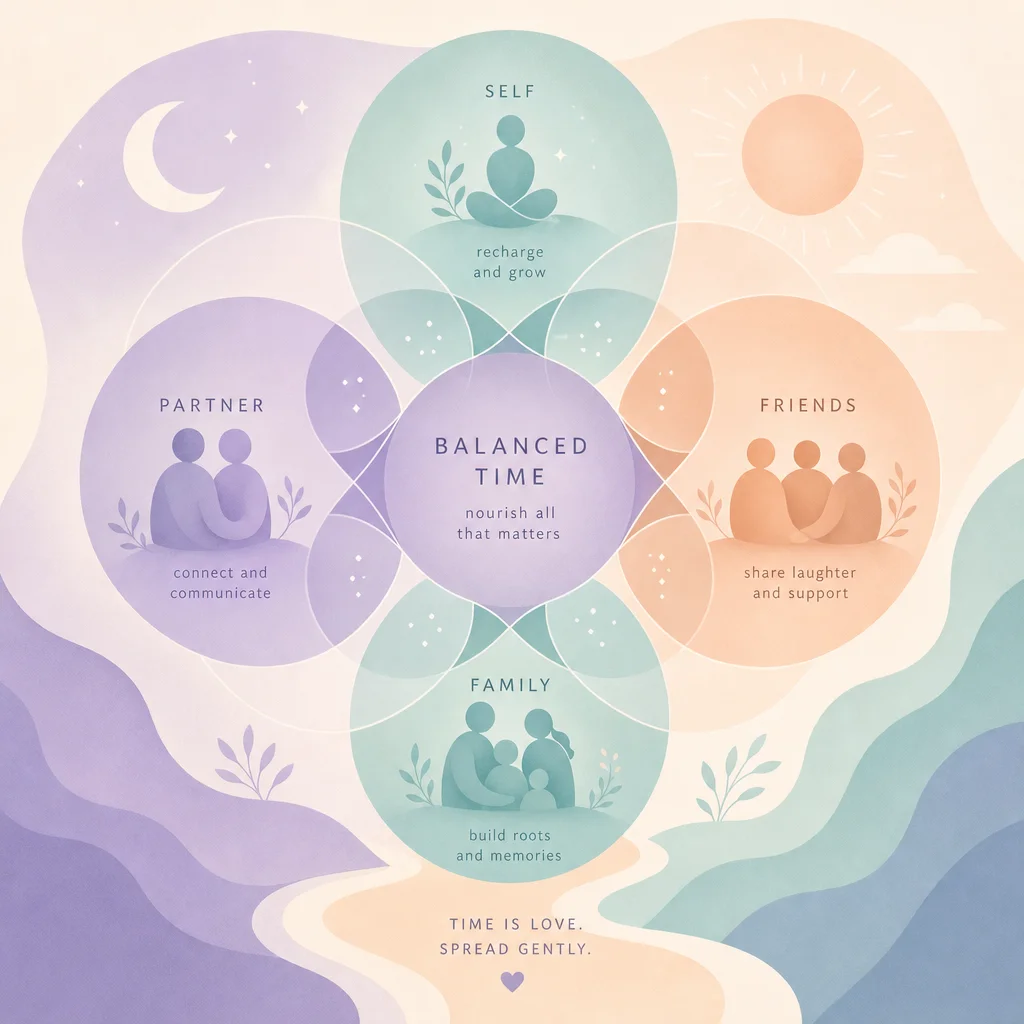
In monogamous relationships, time is mostly assumed. You live together or see each other on a predictable rhythm, and most of your romantic bandwidth flows through one channel. In polyamory, time becomes an active, ongoing negotiation. Every week is a puzzle with more pieces than the board can hold. The question is not just “who gets Friday night?” — it is “who gets my present, rested, emotionally available self, and when?”
Polyamory time management is not really about calendars. It is about attention, energy, and the emotional labor of showing up fully for multiple people who all deserve a version of you that is not running on fumes. If you treat it as a logistics problem, you will burn out. If you treat it as a relationship skill, you will build something sustainable.
The research on time allocation in non-monogamous relationships is still emerging, but what exists points to a clear pattern: the couples who thrive are not the ones with the most free time. They are the ones who communicate about time proactively rather than reactively. A Psychology Today series on polyamory highlights that scheduling conflicts are among the top three sources of tension in multi-partner relationships — right alongside jealousy and mismatched expectations.
The Fairness Myth: Equal Time vs Equitable Attention
One of the fastest ways to exhaust yourself in polyamory is to chase equal time across all relationships. Equal time is a mirage — it assumes every relationship needs the same quantity of hours to feel nourished, which is rarely true. A nesting partner you see every evening might need less scheduled date time than a long-distance partner who gets one weekend a month. A newer connection might need more check-in conversations than a decade-long partnership built on deep trust.
Shift the goal from “equal hours” to “equitable attention.” Equitable means each relationship gets what it needs to feel secure and connected — not what another relationship gets. This requires actually asking each partner what their minimum need is, rather than guessing. The answer might surprise you. Some partners need three evenings a week. Some need one focused weekend day and daily good-morning texts. The point is to stop assuming and start asking.
Your polyamory structure also shapes time expectations. In kitchen table dynamics, group time might offset some one-on-one scheduling pressure. In parallel polyamory, every connection requires its own dedicated window. Neither is better — they just create different time equations, and you need to solve the right one for your actual configuration.
Building a Calendar System That Works
A shared digital calendar is table stakes. Google Calendar, TimeTree, or a specialized app — the tool matters less than the practice. What actually makes a polyamory calendar system work:
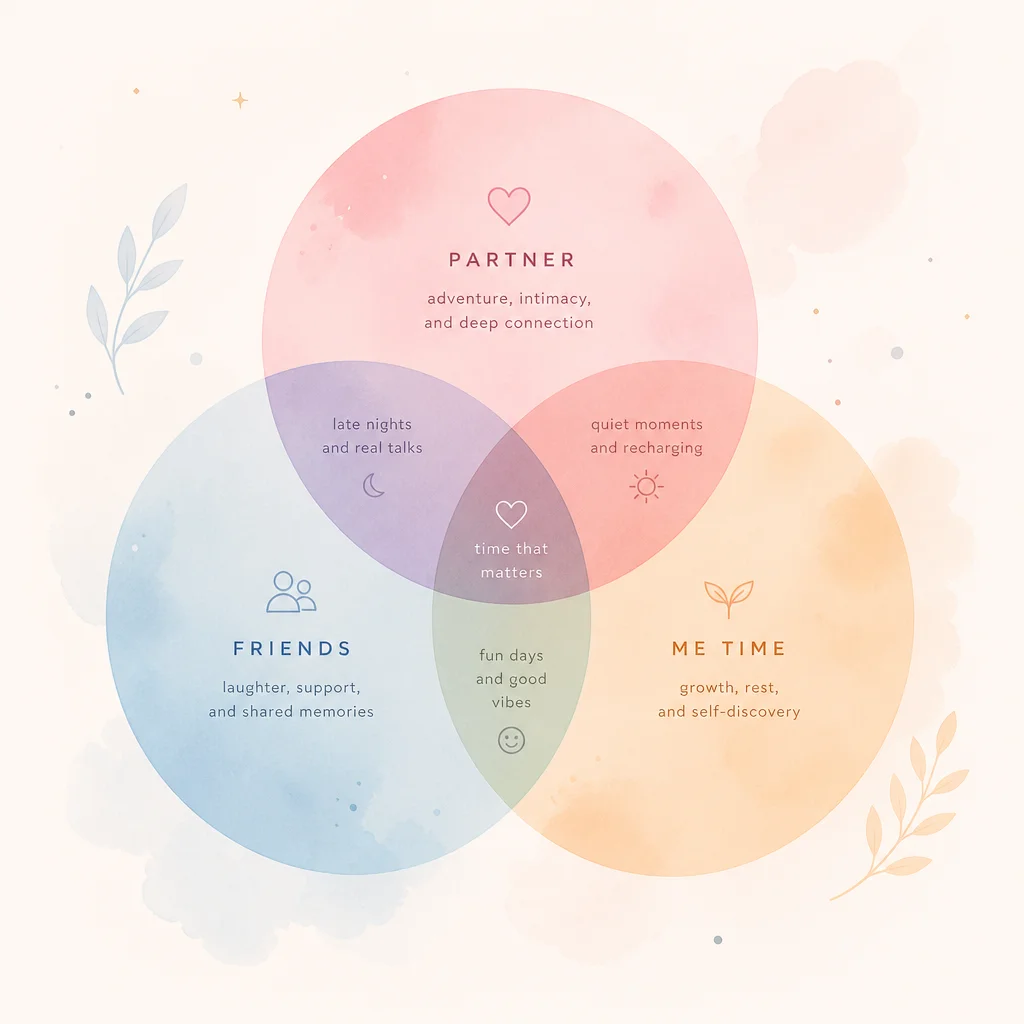
Color-code by person, not by activity. Each partner gets their own color. At a glance, you can see whether the week skews heavily toward one person and whether anyone is underrepresented. This visual feedback is more honest than your memory.
Schedule the non-negotiable first. Before you fill the calendar with dates, block out sleep, solo recharge time, exercise, and non-romantic friendships. These are the infrastructure that keeps you functional. If they disappear from the calendar first, they disappear from your life.
Plan at least a week ahead, ideally two. Spontaneity is romantic, but in polyamory it often means someone gets left out. A weekly Sunday planning session — whether solo or with nesting partners — prevents the Thursday scramble where someone feels like an afterthought.
Build in buffer time between dates. Transitioning from one partner’s emotional space to another’s is not instantaneous. A 30-minute gap between dates — to decompress, reset, and arrive present — makes the difference between showing up as yourself and showing up as a relay runner passing a baton.
Quality Over Quantity: Making Hours Count
Two hours of phone-down, eye-contact, genuinely present time is worth more than six hours of distracted cohabitation with one eye on notifications. In polyamory, where total hours are inherently divided, the quality of each hour becomes proportionally more important.
Define what “quality time” means to each partner. For one person, it might be cooking dinner together with music playing. For another, it might be a long walk with no agenda. For a third, it might be parallel activities in the same room — both reading, but feeling connected through proximity. If you assume quality time looks the same across relationships, you will pour hours into activities that do not actually fill anyone’s tank.
One practical rule: when you are with one partner, the other partners’ notifications go silent. Not vibrate. Silent. Your attention is either divided or it is not, and partners can always tell the difference. This is not about hiding anything. It is about the basic respect of showing up fully where you are. If you are new to managing new relationship energy in polyamory, device boundaries become even more critical — NRE makes the phone feel magnetic, and you need deliberate friction to resist its pull.
Why Self-Time Belongs on Your Polyamory Calendar
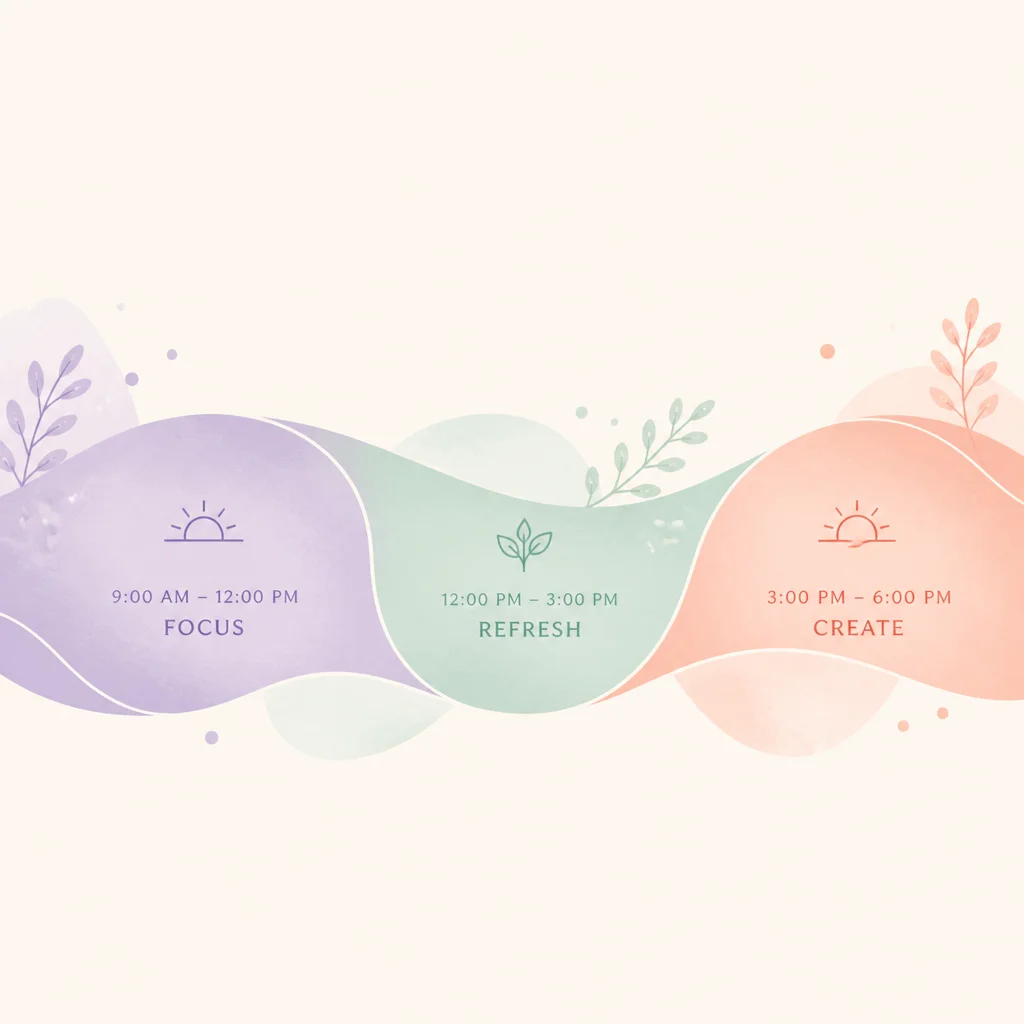
The most common polyamory time management mistake is treating solo time as the leftover space between partner commitments. It should be the opposite. Self-time is the foundation that makes partner time sustainable. Without it, you are performing connection rather than experiencing it.
Solo time includes: sleep, exercise, hobbies that belong to you alone, time with non-romantic friends, and genuinely unstructured empty space where nobody needs anything from you. If your calendar has no blocks labeled “me,” you are over-leveraged, and the crash is not a matter of if but when.
Some polyamorous people find it helpful to think of themselves as one of their own partners. You have a relationship with yourself that needs scheduled attention, just like your relationships with others. That reframe is not self-indulgent — it is structural. A person who never spends quality time with themselves eventually runs out of self to offer anyone else.
The Polyamory Time Audit: A Practical Exercise
Once a month, do a time audit. Pull up your calendar for the past four weeks and tally the following categories. Be honest — this is for you, not for anyone else’s approval.
- Partner A intentional time — phone-down, focused hours, not including passive cohabitation.
- Partner B intentional time — same definition.
- Partner C (and beyond) intentional time.
- Solo recharge time — genuinely free hours, not commuting or chores.
- Non-romantic friendship time.
- Work and obligations.
- Sleep.
Now ask yourself: does the distribution match what each relationship needs? Is anyone consistently at the bottom? Is solo time a rounding error? Is sleep adequate? The goal is not a perfect pie chart. The goal is noticing patterns before they become resentments.
If you find consistent imbalance — one partner getting a quarter of the time another gets but wanting more — the conversation moves from “we have a problem” to “here is what the data shows, let us figure out a solution together.” Data depersonalizes the issue. It is harder to argue with four weeks of calendar receipts than with a vague feeling of neglect.
What to Do When Time Feels Chronically Unbalanced
Sometimes the imbalance is not a scheduling failure — it is a capacity failure. You have more relationships than you have hours, and no amount of calendar Tetris will fix that. Recognizing this is not a moral failing. It is honesty.
If you consistently cannot meet a partner’s minimum time needs, you have a few options, none of them comfortable: renegotiate what the relationship looks like (de-escalate), accept that the relationship might need to end, or radically restructure your life to free up more time. The one option that does not work is promising to do better while changing nothing — that erodes trust faster than an honest “I cannot give you what you need right now.”
Polyamory is not about how many people you can fit into your life. It is about how well you can show up for the people who are already there. If you are spread so thin that everyone is getting a tired, distracted, half-present version of you, having more partners is not a success metric. It is a distribution problem. Fewer relationships, held more deeply, beat more relationships held on life support every time.
Time management in polyamory ultimately comes down to one question: do your actions match your values? If you say a partner matters but your calendar tells a different story, the calendar is the truth. Adjust it until the story aligns.
Editor’s note: This article is part of 3Cupid’s series on polyamory relationship skills. For more on keeping your connections healthy, read our guide on navigating new relationship energy in polyamory — because NRE and time management are two sides of the same coin. You might also find value in understanding different polyamory relationship structures and how they shape your time commitments.