Dating a nonbinary partner in ENM is not a special case. It is an ordinary relationship with one extra requirement: you stop letting gender do the work of explaining who someone is.
Nonbinary is an umbrella. It covers people whose gender sits outside the man / woman binary, people whose gender lands somewhere between, people whose gender moves over time, and people who simply do not experience gender as a category that fits. Two nonbinary people can want completely different things from the same word.
What makes these relationships work is not expertise. It is consistency. The couples and singles who get this right are not the ones who memorized a vocabulary list. They are the ones who ask, write the answer down, and do not make their partner re-explain themselves every few months.
Table of Contents
- What Nonbinary Means (And What It Does Not)
- Pronouns: Ask Once, Then Get It Right
- How Gender Assumptions Sneak Into Group Dating
- Dysphoria, Touch, and Negotiating Intimacy
- Disclosure and Outness Belong to Them
- What Nonbinary Partners Need From Couples
- When a Partner’s Identity Shifts Mid-Relationship
- FAQ
What Nonbinary Means (And What It Does Not)
The most useful thing to understand is that nonbinary is not a third gender with a fixed rulebook. It is a description of how someone relates to gender, and the details belong to that person.
Practically, that means you cannot infer anything from the label alone. Not pronouns. Not how they feel about their body. Not who they are attracted to. Not whether they want any kind of medical care related to gender. Those are four separate conversations, and your partner gets to answer them at their own pace, or not at all.
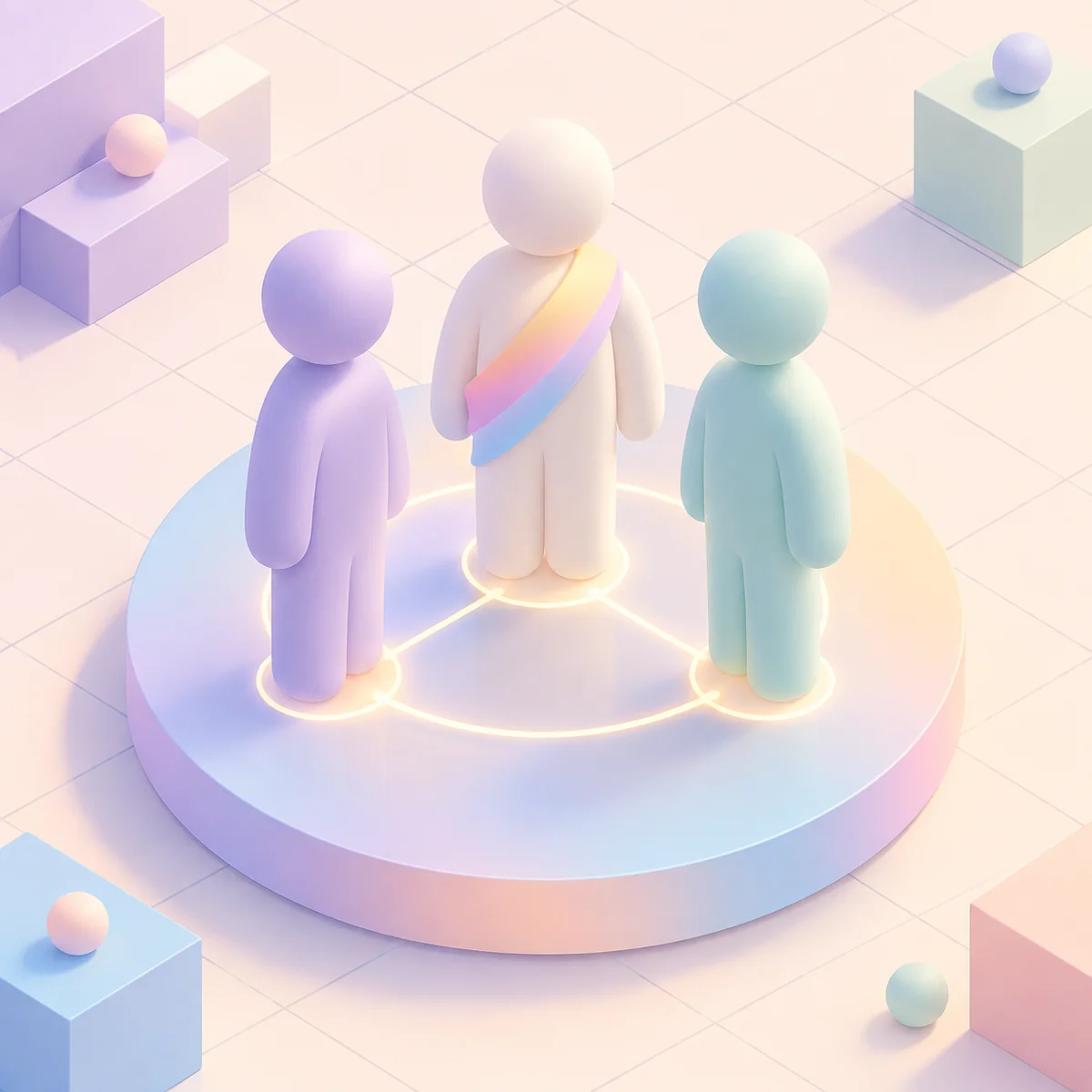
Here is what it also does not mean. It does not mean your partner is a neutral, lower-risk option for a couple looking to add someone. Nonbinary people get slotted into that role constantly: the person who supposedly will not trigger anyone’s jealousy because they are not competing on the same axis. That is not neutrality. That is being cast in somebody else’s script.
Not every relationship involving a nonbinary person is a romantic one either. Some of the closest, longest-lasting bonds in these circles are queerplatonic, and they deserve the same respect as anything with a label you recognize.
For a plain-language overview of gender identity terms, the American Psychological Association’s LGBTQ+ topic hub is a solid place to start.
Pronouns: Ask Once, Then Get It Right
Pronouns are the most-discussed part of this and the least complicated. Ask early, ask in private, and treat the answer as information rather than an invitation to debate.
You will get it wrong sometimes, especially at the start. When you do, the useful response takes about four seconds: correct yourself, move on, fix it in your notes. A long emotional apology puts your discomfort back at the center of the room and hands your partner the job of reassuring you for their own misgendering.
Pronoun and name hygiene checklist
- Ask for name and pronouns together, and use both consistently from that point on
- Put their pronouns in your phone contact, not only in your memory
- Practice when they are not in the room, so the correct form is the familiar one
- Correct other people on their behalf whenever you can do it without risking their safety
- Do not ask them to explain their pronouns to a third person you could simply inform yourself
- If they use more than one set, ask which they prefer in which setting
- Never adopt a pronoun set they did not offer you, even as a compliment
- Re-check once or twice a year; the language people use for themselves changes
One nuance worth knowing. Plenty of nonbinary people use she, or he, or she and they. Defaulting to they/them for someone who asked for she is not the careful choice, it is just the wrong one. Follow the person, not the pattern you read about.
How Gender Assumptions Sneak Into Group Dating
One on one, assumptions stay mostly invisible. Add a third person and they get loud, because group dynamics run on shortcuts about who does what to whom.
| The shortcut | Why it lands badly | Try this instead |
|---|---|---|
| Treating them as the bridge between two partners | It turns a person into a function, the component that makes the couple’s arrangement operate | Ask what they want, and accept “I only want to date one of you” as a complete answer |
| Assuming any body is fine because they are nonbinary | Gender identity says nothing about comfort with touch, clothing, or particular body parts | Negotiate touch specifically, the way you would with anyone, and before clothes come off |
| Assuming they are the more experienced one | It is a stereotype doing a job: it lets everyone else avoid naming what they actually want | Describe in plain words what you hope happens, and let them respond to that |
| Assuming they do not need aftercare | Nonbinary people get cast as the low-maintenance one, and that role gets tiring fast | Build the check-in and the wind-down into the plan before the date, not after someone goes quiet |
| Treating the couple as the real unit and them as the addition | That is couple privilege, and it surfaces fastest where gender is already in play | Say out loud what happens to them if your plans change, before they agree to anything |

None of this requires you to be perfect. It requires you to notice the shortcut you were about to take and ask a question instead of assuming.
If you want a wider view of the same territory, our guide to LGBTQ+ threesome dating covers safety and community layers that overlap heavily with this one.
Dysphoria, Touch, and Negotiating Intimacy
Some nonbinary people experience distress when their body, or the way it is being read, does not match their sense of themselves. Not all do. For those who do, ordinary dating logistics become load-bearing in a way that surprises partners: lighting, mirrors, which clothes stay on, which words get used out loud.
You do not need to guess any of it. You need a structure that makes naming things cheap.
A five-step negotiation sequence
- Before: ask one specific question, such as “is there anything about how I touch or talk about your body that I should know?”
- Agree on words for body parts before you need them; mid-moment is the worst possible time to improvise
- Agree on a pause word that means “change something,” not “everything stops”
- Set the room: lighting, mirrors, clothing, who is where. Comfort is mostly logistics
- Afterwards: ask once, “was there a moment you wanted to redirect and did not?” Then let the answer stand
When they tell you something was uncomfortable, the useful response is thank you, plus a change in behaviour. Detailed curiosity about someone’s dysphoria is rarely welcome from a person they are dating. Wait until they offer.
Disclosure and Outness Belong to Them
Being nonbinary is information your partner owns. They decide who hears it, when, and in what words. That includes people you would normally tell everything to: your other partners, your closest friends, your family.
Non-monogamy adds a wrinkle here. More partners means more people who might be told, which means more chances to out someone by accident. A partner who is completely open with you may be private at work, or with their relatives, or in their town.
Red flags that mean you have already crossed a line
- You mentioned their gender to someone “because they already knew about us”
- You still use an old name or old pronouns in front of people from before
- You shared details about their body or their medical decisions with a metamour without asking
- You described their gender to another partner as a phase
- You pushed them toward being more open because it would make your relationship easier to explain
If you are unsure whether something is yours to share, ask. Four seconds of “is this something you are comfortable with me mentioning?” prevents most of the damage.
The same privacy logic shows up in every other disclosure decision you will make together, including the ones we wrote about in coming out at work when you are non-monogamous. If legal recognition or workplace protection is part of the picture, the ACLU’s overview of LGBTQ+ rights explains what is and is not covered where you live.
What Nonbinary Partners Need From Couples
Ask nonbinary people what made a non-monogamous dynamic actually work with a couple and the same handful of things come back every time. None of them are exotic, and all of them are easy to skip when you are both excited.
Equal standing comes first. Not “we are the couple and you are our guest,” but a real say in what happens, when, and how often. Second, being seen as a whole person who has a gender, rather than a convenient shape that fills a gap in someone else’s arrangement.
Three scripts you can use this week
- Opening the conversation: “Before we go further, what do you want this to look like if it goes well? Not what we are hoping for, what you are hoping for.”
- Backing them up in a group: “They go by this name and these pronouns. If you slip, just correct yourself and keep going, no speech needed.”
- Repairing a miss: “I used the wrong pronoun earlier and I noticed. I have fixed it in my phone. Anything you want me to do differently?”
Third, predictability. Scheduled time, clear agreements, and follow-through matter more to most people than grand gestures. Fourth, room to change their mind: about the dynamic, about their own identity, about what they want from either of you.
If you need a starting framework for those agreements, the basics are the same ones laid out in our threesome ground rules guide.
Worth reading alongside this: Psychology Today’s overview of polyamory covers the wider relationship-structure questions that sit underneath everything in this article.
When a Partner’s Identity Shifts Mid-Relationship
Sometimes someone realizes they are nonbinary while already in a relationship, or already in a triad. That is not a bait and switch. Gender understanding tends to arrive late and in pieces, often well after a person is an adult with a whole relationship history.
What it does mean is a renegotiation. Names, pronouns, how you introduce them, physical intimacy, and possibly your own identity as a couple all get revisited. Some partners discover their own orientation was more flexible than they had assumed. Others realize they were attached to a version of their partner that no longer exists, and that is a real loss worth being honest about rather than polite about.

The workable version of this is boring. Keep talking, keep dating each other, and do not treat the change as either a crisis or a favour you performed. If you find yourself grieving, get support from someone who is not the person you are grieving about.
FAQ
Do I have to use they/them for every nonbinary person?
No. Ask. Plenty of nonbinary people use she, or he, or more than one set. Using the wrong one out of caution is still using the wrong one.
Is it okay to ask my partner what nonbinary means to them?
Yes, once, and with the understanding that a short answer is a complete answer. They are not obliged to deliver a lecture to someone they are dating.
My partner is nonbinary. Am I still straight, gay, or lesbian?
Possibly, and possibly not. Some people find a new word fits better; others keep the old one because it describes their own history accurately. That is your question to sit with, not theirs to solve.
How do I introduce them without making it strange?
Name and pronouns, in the same breath you would use for anyone: “this is Sam, they/them.” Then keep talking about whatever you were talking about. The less you linger on it, the less strange it becomes.
None of this is exotic. Dating a nonbinary partner in ENM asks for what good non-monogamy always asks for: ask clearly, write it down, and let people be who they keep telling you they are. If you would rather meet people who already understand that, you can start browsing right here at 3Cupid.
Related reading: identity labels shift for everyone in these dynamics, not only for nonbinary people. Our piece on keeping your own sense of self in ENM goes deeper on that.
Editorial note: this article offers general information for adults and is not medical, legal, or mental health advice. Gender identity, dysphoria, and disclosure are personal and vary widely; for anything that affects your health, safety, or legal standing, talk to a qualified professional in your area.