Table of Contents
- What a Choir Concert Week Actually Contains
- Extra Rehearsals and the Week They Take
- The Programme, the Name List and Being Seen
- Backstage, Dressing Rooms and Boundaries
- Seats, Plus-Ones and Who Sits Where
- Photographs, Recordings and Consent in the Room
- The Curtain Call and the Reception Afterwards
- The Next Morning: A Short Debrief
A choir concert with multiple partners is a small event with an unusual amount of administration hiding in it. One person has been rehearsing all term. One or two others have bought tickets. There is a printed programme, a seating plan, a curtain call, somebody’s phone recording the last chorus, and a reception afterwards where an introduction can say rather more than intended. None of it is dramatic. All of it is worth ten minutes of thought.
This is the short-view half. It follows the forty-eight hours around one performance: the extra rehearsals, the programme, backstage, the seats, photographs and recordings, the applause, the reception, and the ordinary conversation the next morning. The long view – choosing a group, dues, rosters and the weekly slot – is the other article, because a season and a single evening need different decisions.
One framing note. This assumes adults, a voluntary amateur ensemble and a public performance that anyone may attend. It is general information for adults, not professional advice. The office on women’s health has plain material on consent and pressure in relationships; the relevant idea here is that a pleasant evening can still put somebody on the spot, and a little structure is what keeps it pleasant for everyone.
What a Choir Concert Week Actually Contains
People picture the evening. The singer pictures the fortnight before it. A concert week usually means one or two longer rehearsals, a run-through in the actual venue, a call time an hour or more before the audience arrives, and a level of attention that leaves little room for anything else. If you are the partner who is not singing, knowing that is the difference between being understanding and being quietly irritated on a Wednesday.
- Ten days out: an extra rehearsal appears and the term calendar shifts.
- The day before: a run-through in the venue and a call time that eats the early evening.
- Concert day, two hours before: the singer is with the ensemble, not with guests.
- Fifteen minutes before: guests find their own seats; the singer is backstage.
- The performance itself: nobody is available for a conversation.
- Afterwards: a reception, photographs, and a slow drift toward the door.
- The next morning: the only real chance to talk about any of it.
That final line is the one people miss. There is almost no usable conversation on the night itself. The singer is wired, the guests have been waiting, and a reception is a room full of other people’s names. Planning the debrief for the next morning is not avoidance; it is the only sensible slot. Couples who debrief after a threesome and people who process a swing experience together both land on the same practical rule: say what happened, say how you are, and leave interpretation for later.
The American Psychological Association has a clear page on how stress shapes attention; a performance narrows attention in exactly that way. Treat the singer’s pre-concert quiet as a scheduling fact, not a mood about you.

Extra Rehearsals and the Week They Take
An extra rehearsal is not a date that got cancelled. It is a term the whole ensemble agreed to months ago, and it arrives with a fortnight’s notice at most. If your household runs a shared calendar, put it on the calendar when it is announced and stop re-litigating it. Scheduling regular check-ins is useful here for the same reason it is useful for any recurring commitment: one standing slot prevents a fortnight of small renegotiations.
There is a second version of this: the partner who is not in the group can feel like an audience member in their own week. Three conversations about call times, a programme on the kitchen table, and a singer who is thinking about a difficult entry can make a household feel like a support crew. That is not anybody’s fault, and it is worth one plain sentence: ‘I know this week is mostly logistics, and I would like Thursday to be ours.’ Pacing a newer connection and not tying your value to being chosen are the longer reading if this lands closer to home than expected.
Do not fill the gap with interpretation. A quiet singer on the day of a concert is concentrating, not withdrawing. Difficult topics in a check-in uses the same discipline at relationship scale: describe what you observed before you decide what it meant.

The Programme, the Name List and Being Seen
A printed programme is a small public document. It carries the singer’s full name, often a section or a solo credit, and it stays in a drawer or a photograph long after the evening. For most people that is entirely unremarkable. For someone whose relationship structure is not public at work or in a family circle, a name in print next to a partner’s name in a thank-you list can travel further than intended.
The thank-you list is the part to look at. Programmes often credit partners, sponsors and helpers, and a well-meaning singer may have written something like ‘thanks to my two for holding everything together’. That is affectionate and also a public statement, made on someone else’s behalf. Ask before it goes to print. The same rule applies to a caption on a group photograph: social media privacy and what to do when an image is shared without consent both start from the idea that identifying someone is their decision, not the poster’s.
The Electronic Frontier Foundation has accessible material on privacy in semi-public spaces. The practical version is short: check the programme draft, check the thank-you list, and check whether any of your guests are named anywhere. Practical privacy habits in non-monogamous dating cover the same instinct in a different setting.
| Where a name appears | Who it touches | What to do |
|---|---|---|
| The singer list in the printed programme | The singer, and anyone who searches their name | Check the spelling and decide together whether that is fine |
| A thank-you or dedication line | Partners who did not write it | Ask each person before anything is printed |
| A caption on a group photograph | Everyone in the frame and their wider circles | Ask, and leave people out on request |
| A rehearsal roster or contact sheet | Names and sometimes phone numbers | Never add a partner’s details to it |
None of this asks anyone to be closeted or out. It asks that the choice belongs to the person whose name it is. Being outed as non-monogamous is the harder end of the same line, and a ten-second check before print is a cheap way to stay away from it.

Backstage, Dressing Rooms and Boundaries
Backstage is a working space shared by the whole ensemble. It is not a green room for guests, and the hour before a performance is not a social slot. If you are singing, your partners know this from the call time; if you are a guest, the kindest thing you can do is arrive, find your seat and leave the singer to their section until the lights come up.
That boundary is worth stating because it is so easy to read as exclusion. It is not. A dressing area is a room where forty adults change clothes, warm up and manage nerves, and a partner wandering in with a bunch of flowers creates a small scene nobody asked for. Going out in public as a threesome and going out with two partners both make the wider point: a group setting has its own shape, and affection is not a reason to reshape it.
There is a practical consent line underneath it. Some groups use a shared changing area, some have a screen or a separate room, and nobody’s body is a topic for comment – including a compliment – before a performance. Enthusiastic consent is the general frame; the local version is simply: ask where to wait, and do not comment on anyone’s appearance on their way to a stage.
If a guest has access needs, sort them with the venue in advance rather than at the door. Step-free routes, a seat near an exit and a quiet place to wait are venue questions, and the public-setting guide covers the wider version for group outings.
Seats, Plus-Ones and Who Sits Where
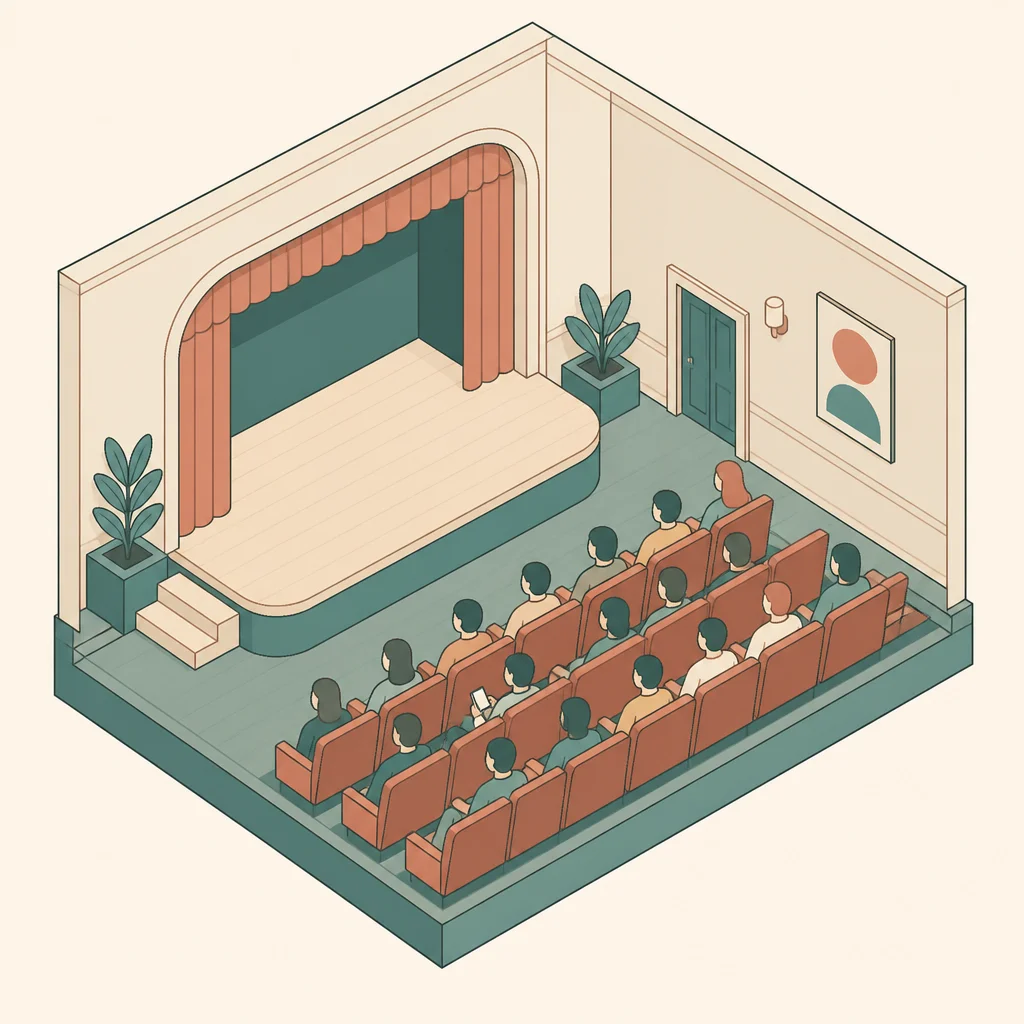
Ticketing turns out to be the most relationship-shaped part of the evening. Two partners attending means two seats, and two seats in one row are a small public arrangement that somebody will read. That is fine. What is not fine is discovering the arrangement when you get there.
Agree it in one message. Who is coming, whether they want to sit together, whether either of them would rather be independent, and whether anyone is bringing a guest of their own. Then let it be. A seating plan is a logistics decision, and repeating it three times turns it into a statement about rank. Aligning expectations beforehand is the general skill; here it is a two-line text.
| The arrangement | What it tends to look like | What to say in advance |
|---|---|---|
| Two partners in adjacent seats | A visible, unremarkable pair in the audience | I have two seats together in row C, is that comfortable for both of you? |
| Two partners in different rows | Two independent evenings that happen to share a hall | I have one seat near the front and one further back, tell me which you would prefer |
| One partner attends, one does not | A completely ordinary asymmetry | There is a ticket if you want it, and no pressure either way |
| A partner brings their own guest | A wider audience than the singer expected | Let me know headcount so I can sort tickets and the reception |
Notice the third row. One partner coming and one not is not a ranking, and the quickest way to make it feel like one is to over-explain it. Self-worth that does not depend on being chosen and asking for reassurance cleanly are the useful reading if a spare ticket reliably turns into a difficult evening. There is no obligation to attend a choir concert, and there is no message in staying home.
The reception is the same question standing up. Introductions will happen, and somebody will ask who is who. Have a short, boring sentence ready and let people draw their own conclusions: ‘this is Alex, and this is Sam, they both came to hear the choir.’ Going out with two partners covers the longer version of that moment.

Photographs, Recordings and Consent in the Room
Phones come out at the end of almost every amateur concert. That is normal, and it is also the point where a private evening becomes a set of portable images. Three separate consent questions sit inside one raised phone: the ensemble’s rules on recording, the other audience members in the frame, and the people you came with who may not want to be identifiable anywhere.
Check the ensemble’s policy first. Some groups allow private recordings and ask that nothing is posted; some prohibit recording entirely for rights or licensing reasons; some stream the concert themselves. Then ask your own guests, privately, before you point a camera at their row. Sending photos to a new partner and choosing ENM dating profile photos are about images you control; this is the opposite case, where the image is of someone else and the decision is theirs.
- I am going to take one photo of the curtain call – are you happy to be in it?
- The choir has asked that recordings stay private, so I will not post this anywhere.
- Would you rather I cropped you out of the group shot?
- I will send you the photo before I do anything else with it.
- No need to explain; I will leave the camera down.
If an image does end up somewhere it should not, the response is practical rather than dramatic. When an image is shared without consent walks through the first steps, and StopNCII is the reference point for getting an identifying or intimate image taken down. The American Psychological Association also has an accessible overview of digital communication and social media; the useful point here is that a photo posted at eleven at night is much harder to retrieve than one that was never taken.
One more ordinary boundary: do not record a singer without telling them, even as a nice surprise. A performance is work, and a surprise recording of somebody’s voice is not a gift by default.
The Curtain Call and the Reception Afterwards
The applause is the easy part. The twenty minutes afterwards are not, because the singer is still with the ensemble and the guests are now in a room of strangers with a name badge problem. Decide in advance whether you are meeting at the door, at the refreshments table, or simply going home separately. A vague ‘we will find each other’ is how two people spend twenty minutes scanning a crowded hall.
If there is a reception, agree how long you are staying. ‘Twenty minutes, one drink, then we go’ is a complete plan, and it gives everyone an exit that is not a mood. Nights out in bars and clubs and hosting a dinner with several partners both describe the same small truth: a group event needs a stated ending, or it ends by somebody getting tired first.
Introductions deserve one sentence, not a speech. You are not obliged to explain anyone’s place in your life to a fellow singer’s cousin, and a short ‘this is Sam, we came together’ is enough. Basic ground rules and first-timer etiquette are the general references; the local version is to keep it brief and let the next person change the subject.
Then go home. The singer has been concentrating since four o’clock and the guests have been waiting since seven. A long debrief in a noisy hall is the least useful version of a debrief, and the couple’s guide to debriefing is explicit about picking the right moment.
The Next Morning: A Short Debrief
The conversation worth having is the next morning, over something ordinary. It is short, and it is not a performance review. Three questions do most of the work: did anything about the evening feel uncomfortable, is there anything in the photographs or programme you want changed, and would we do this again the same way.
- Did any moment in the evening put you on the spot, however slightly?
- Is there a name, caption or photograph you would rather not have out there?
- Was the seating and the introduction comfortable for everyone?
- Did the extra rehearsals land harder than we expected?
- If there is another concert, what would we change by one notch?
Keep it factual. The same habit that helps after a first meet – what to do after a coffee date – works here: write what happened before you explain what it meant. A guest who left early, a photo taken from the wrong angle, an introduction that came out clumsy are three ordinary events, and turning them into a story about anyone’s priorities is the one thing worth avoiding. Difficult topics in a check-in and the radar format both use that order.
If something genuinely did go wrong – a name printed without permission, a photograph posted after a clear no – that is its own conversation with a practical first step, not a debate about intentions. Repair after a conflict is the right clock for it, and it is separate from the ordinary debrief. Fix the thing, then let the day go back to being a day.
Do both partners have to come to a choir concert?
No. An invitation is not an obligation, and staying home carries no message. Say plainly that there is a ticket if they want one, and leave the decision with them.
Can I record the performance on my phone?
Check the ensemble’s policy first – some allow private recordings, some prohibit them, some stream the concert themselves. Then ask the people in your row before you include them.
How should I introduce two partners at the reception?
Keep it short and factual: a name and ‘we came together’ is enough. You do not owe a room of strangers an account of your relationships, and a brief introduction is easier for everyone than an over-explained one.
What if a photo of us gets posted without asking?
Treat it as a practical problem, not a drama. Ask for it to come down, and use the guidance in when an image is shared without consent or the StopNCII service if it is identifying and intimate.
The short version: a choir concert with multiple partners is an evening of small public decisions – a printed name, two seats, one photograph, one introduction – and every one of them is easier in advance than in a crowded hall.
Handle those four and the music can be the whole point again. The singer gets to sing, the guests get to listen, and nobody spends the reception working out what anything meant. Joining a community choir in non-monogamy is the longer view of the same group; this is just the fortnight at the end of a term.
A choir concert is not a test of a relationship. It is ninety minutes in a room with other people, and the only thing that makes it go well is deciding beforehand how names, seats and photographs will work – then letting the evening be ordinary.
Editor’s note: this article is general information for adults and is not legal, medical or therapeutic advice. Venues, publishing practices, recording rules and privacy needs differ widely; follow your ensemble’s rules, follow local law, and use the arrangements that fit your own relationships. More practical guides like this one are right here at 3Cupid.