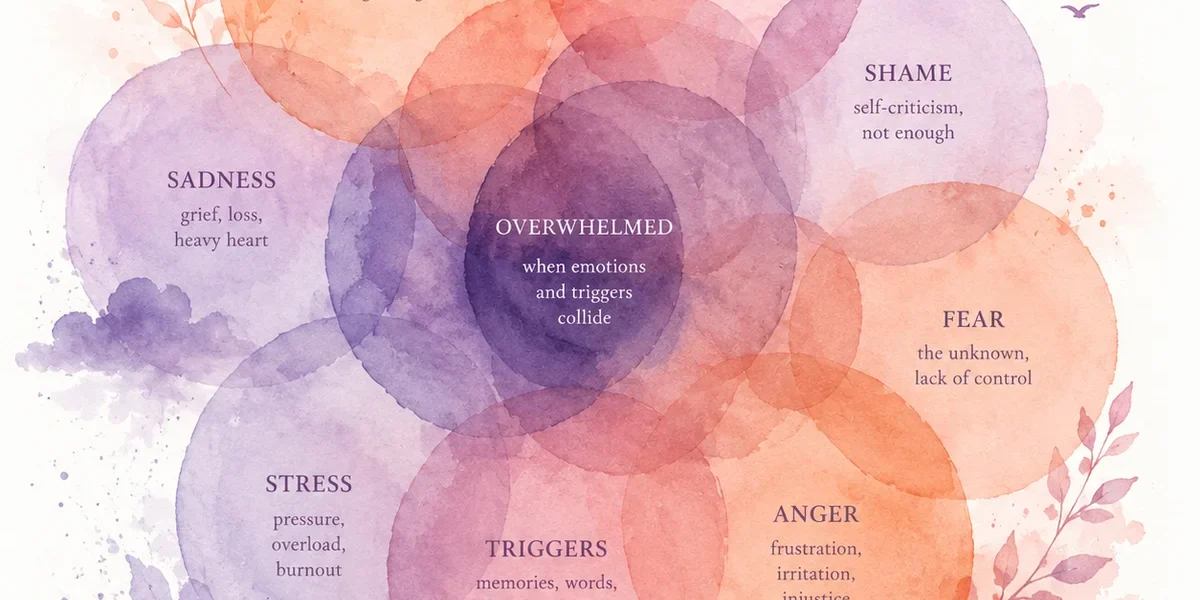
You planned the evening carefully. You talked through boundaries. You chose someone you both felt comfortable with. And then, twenty minutes in, something small happened — a look, a touch, a laugh that lingered a second too long — and suddenly your chest tightened and your mind started racing. If this sounds familiar, you have just met an emotional trigger in threesome dating. Triggers are not signs that you are bad at non-monogamy. They are not proof your relationship is too fragile for this. They are simply moments where something in the present taps into something from your past — and your nervous system reacts before your rational brain can catch up.
This article is about understanding those moments: what triggers actually are in a threesome context, why they show up when you least expect them, and most importantly, what you can do — in the moment and over time — to handle them in ways that build connection instead of damaging it. We will also connect this to the emotional spectrum between jealousy and compersion, which we explored in our companion piece on jealousy vs compersion in threesome dating. Triggers are often the engine underneath both of those feelings.
What Are Emotional Triggers in a Threesome Context?
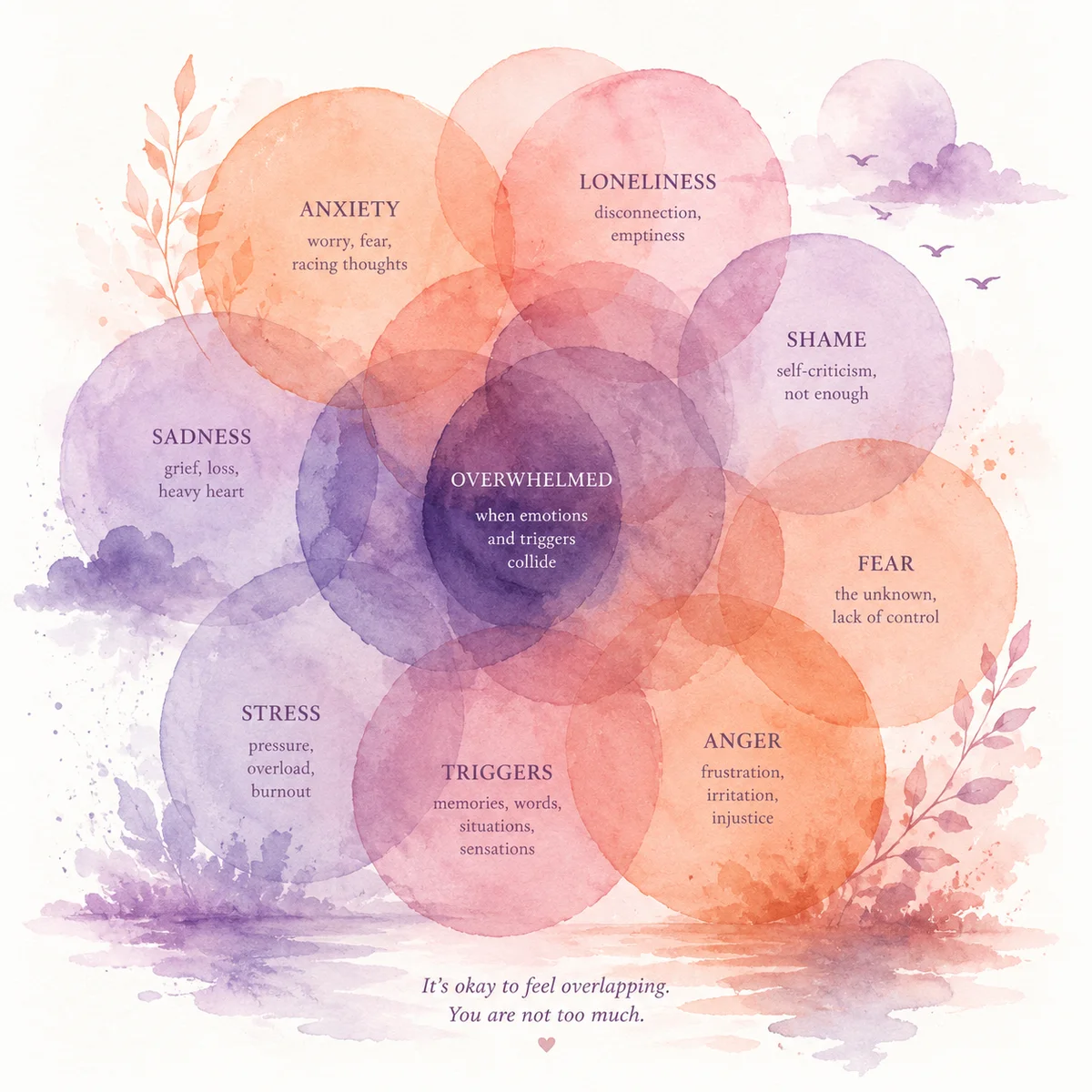
An emotional trigger is any stimulus — a sight, sound, word, or situation — that activates an intense emotional reaction disproportionate to what is actually happening. In everyday life, it might be a song that reminds you of an ex or a tone of voice that echoes a critical parent. In a threesome, triggers get supercharged because you are in a vulnerable, heightened state where multiple people’s emotions are intersecting in real time.
Psychologists studying attachment and emotional regulation note that triggers are not random. They follow patterns tied to your personal history, your attachment style, and your core fears about relationships. According to research on relationship psychology covered by Psychology Today, understanding your triggers is less about “fixing” yourself and more about recognizing that your reactions are data — data about what matters to you, what scares you, and where you still carry unhealed experiences.
In a threesome, a trigger might look like: your partner putting their hand on the third’s leg and you suddenly feeling invisible, even though you were literally just included in conversation. Or the third partner laughing at your partner’s joke in a way that makes you feel boring by comparison. Or noticing that your partner made eye contact with them during a moment that felt private to you. None of these are necessarily problems — but they can feel catastrophic in the moment because they activate deeper fears about being replaced, being undesirable, or losing primacy.

The Most Common Threesome Triggers Most People Do Not See Coming
Some triggers are obvious: watching your partner kiss someone else, hearing sounds of pleasure you did not cause, seeing your partner’s face soften in a way you thought was reserved for you. But the ones that catch people off guard are often subtler. Here are the triggers that experienced threesome participants say they wish someone had warned them about:
The inside joke trigger. When your partner and the third share a reference or laugh about something you were not part of, it can feel like being locked out of a room you were just standing in. This is not about the joke — it is about the sudden realization that they have a dynamic you are not in.
The “they are better at this” trigger. Maybe the third is more confident, more experienced, or simply more at ease than you feel. The trigger is not their competence — it is the story your brain spins: “I am being compared and I am losing.” For more on these emotional realities, our guide on what most people ignore about threesome emotions covers the gap between expectation and experience in detail.
The aftercare disparity trigger. After the experience, your partner might seem energized while you feel depleted — or vice versa. When your emotional states diverge sharply after a shared experience, it can feel like you were in two completely different rooms. This disconnect is a common post-threesome trigger that our guide to threesome aftercare addresses with specific reconnection strategies.
The attachment style collision. If you have an anxious attachment style and your partner leans avoidant, a threesome can activate both patterns simultaneously — you seeking reassurance while they pull away to process. Understanding how attachment styles affect threesome dynamics can help you recognize these patterns before they escalate.
Why Your Triggers Are Actually Information, Not Weakness
The most damaging belief about emotional triggers in threesome dating is that having them means you are not cut out for it. This could not be further from the truth. Triggers are not character flaws — they are your nervous system’s way of saying “something here reminds me of something that hurt before, and I need you to pay attention.”
Think of triggers as an internal alarm system. When a smoke detector goes off because you burned toast, the alarm is doing its job — even though there is no fire. You do not throw away the smoke detector. You clear the air and recognize that the system is working. Your emotional triggers work the same way. The intensity of the reaction tells you something about the depth of what is being touched, not about your fitness for non-monogamy.
One of the most useful reframes comes from people who have been practicing ethical non-monogamy for years: triggers are not problems to eliminate. They are teachers that show up repeatedly until you learn what they are trying to tell you. The person who feels triggered when their partner whispers to someone else is not “too jealous for this.” They might be someone who has a history of being excluded from important information in relationships. The trigger is not about the whisper — it is about the exclusion pattern. And that is something you can work with.

How to Identify Your Personal Trigger Patterns
Most people think they know their triggers. In reality, most people know their obvious triggers while their most disruptive ones operate below conscious awareness. Identifying your pattern requires looking at data over time, not just reacting to individual moments.
Start by keeping a simple trigger log after any threesome or ENM dating experience. Write down three things: what happened (just facts), what you felt in your body (tight chest, heat in face, stomach drop), and what story your brain immediately told you about it (“they prefer them,” “I am being excluded,” “this was a mistake”). After three or four experiences, patterns will emerge that you would never notice in the moment. Maybe you consistently get triggered around the twenty-minute mark. Maybe it always involves nonverbal communication rather than verbal. Maybe it only happens with partners of a specific gender or personality type.
Once you have identified a pattern, the next question is not “how do I stop feeling this?” but “what is this pattern protecting me from?” Triggers almost always have a protective function — they are trying to shield you from a feared outcome. The person triggered by exclusion is trying to protect themselves from abandonment. The person triggered by comparison is trying to protect their sense of worth. Understanding the protective function does not eliminate the trigger, but it strips away the shame and replaces it with curiosity. And curiosity is something you can discuss with a partner — shame is much harder to voice. For a deeper framework on these emotional conversations, see our guide to negotiating threesome expectations beforehand.

What to Do in the Moment When a Trigger Fires
You are in the middle of a threesome — or a date leading up to one — and a trigger fires. Your heart rate spikes. Your thoughts race. Your impulse might be to shut down, lash out, or flee the room. None of those are ideal. Here is a step-by-step protocol for managing triggers in real time:
Step 1: Name it silently. Inside your head, say: “I am triggered right now. This is a trigger, not a catastrophe.” The simple act of labeling the experience as a trigger — rather than as “proof my relationship is falling apart” — creates distance between you and the reaction. It buys you seconds, and seconds matter.
Step 2: Ground your body. Press your feet into the floor. Feel the texture of whatever you are sitting on. Take one slow breath that is longer on the exhale than the inhale. Your nervous system is in fight-or-flight mode, and no amount of rational thinking will talk it down. You have to speak its language: physical sensation.
Step 3: Use a prearranged signal. Before any threesome experience, agree on a subtle signal with your partner — a hand squeeze, a specific phrase, a bathroom break code — that means “I need a moment.” This is not a veto or a stop signal. It is simply “I am having a reaction and I need to pause.” Couples who use signals like this report significantly better outcomes than those who try to power through triggers in silence, as discussed in our complete boundaries checklist for threesomes.
Step 4: Decide whether to stay or step away. Sometimes taking five minutes in the bathroom to breathe and reset is all you need. Sometimes you need to end the experience early. Neither is a failure. What matters is making a conscious choice rather than reacting impulsively or — worse — pretending everything is fine while resentment builds.
Talking About Triggers Without Making It Your Partner’s Problem
One of the trickiest parts of managing emotional triggers in threesome dating is communicating about them afterward without making your partner feel blamed or responsible. If you say “I got triggered when you touched them like that,” your partner may hear “you did something wrong” — even if that is not what you meant.
The most effective framework separates three things: what happened (observable), what you felt (internal), and what you are asking for (future-focused). For example: “When you put your hand on their back during dinner, I noticed my chest got tight and I felt a surge of insecurity. I know you did not do anything wrong — this is my reaction, not your mistake. What would help me next time is if we could check in with eye contact a couple of times during the evening so I feel connected even when you are engaging with someone else.”
This format accomplishes several things at once: it owns the reaction without blaming, it provides specific actionable information instead of vague complaints, and it invites collaboration rather than defensiveness. For more on navigating these conversations within the broader emotional landscape, our article on understanding jealousy versus compersion in threesome contexts offers additional communication frameworks that complement what we have discussed here.
The most important thing to remember is that triggers are not relationship-ending events — they are relationship-deepening opportunities, if both people approach them with curiosity instead of defensiveness. Every time you navigate a trigger together and come out the other side still connected, you are proving to each other (and to yourselves) that your relationship can handle difficult emotions. Over time, that proof accumulates into something stronger than any single trigger could undo. For the foundation that makes all of this possible, revisit our pillar guide on finding a third partner safely while keeping your relationship strong.

Practical Module: Your Trigger Mapping Worksheet
This worksheet is designed to be used over time — ideally after two or three threesome or ENM dating experiences. Do not try to fill it all out after one event. Triggers reveal themselves through patterns, not single incidents.
Part A: Trigger Inventory
For each experience, answer these three questions in a private journal or notes app. Be honest — nobody else needs to see this.
- What specific moment caused the strongest emotional reaction? (Describe it factually: “My partner whispered something to the third that I could not hear.”)
- What physical sensation did I notice first? (Chest tightness, heat in face, stomach drop, urge to leave, sudden fatigue.)
- What was the story my brain told me about that moment? (“They are sharing something private without me,” “I am the odd one out,” “They have a better connection than we do.”)
Part B: Pattern Recognition
After filling out Part A for three or more experiences, look across your answers and ask:
- Is there a recurring theme? (Exclusion? Comparison? Loss of control? Abandonment?)
- Does the trigger tend to happen at a specific point in the experience? (Beginning, middle, after, during a specific activity?)
- Does this trigger remind me of a pattern from other relationships — including non-romantic ones? (Feeling left out as a child? Being compared to a sibling? A past partner who cheated?)
- What is this trigger trying to protect me from? (Name the feared outcome specifically: “I am afraid of being replaced as my partner’s primary emotional connection.”)
Part C: Action Plan for Next Time
Based on what you have identified, write down two or three concrete things you can do differently next time. Examples: “I will tell my partner before the date that I might need a five-minute check-in halfway through.” Or: “When I feel the exclusion trigger, I will physically touch my partner’s arm to reconnect before my brain spirals.” Or: “I will remind myself before we start that my partner choosing to be here with me is evidence that I am not being replaced.”
Revisit this worksheet every few months. What triggered you intensely six months ago might barely register today — or it might have been replaced by a new pattern you have not yet named. Emotional work in non-monogamy is never finished; it just gets more interesting.
Your emotional triggers in threesome dating are not signs that you are doing something wrong. They are signs that you are doing something vulnerable — and vulnerability, handled with honesty and care, is where the deepest connection lives. At 3Cupid, we believe that understanding yourself is the most important preparation for any threesome experience, and we have built a community where people who take that work seriously can find each other.