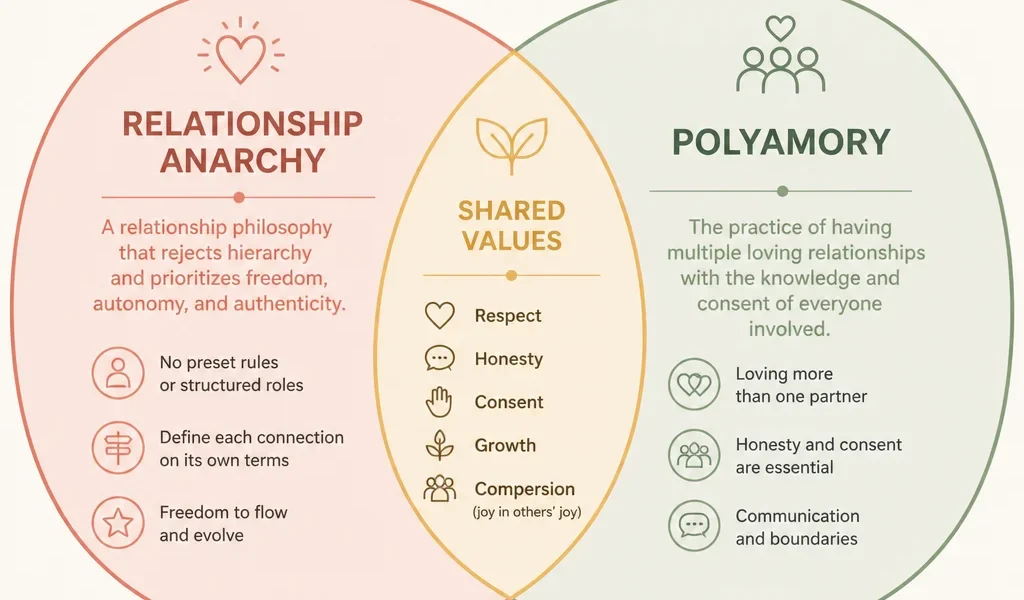
People often use “relationship anarchy” and “polyamory” as if they meant the same thing, but they describe two different ideas. Polyamory is a relationship style: having multiple romantic or sexual partners with everyone’s knowledge and consent. Relationship anarchy is a broader philosophy that questions hierarchy across all your relationships — romantic, sexual, and platonic. You can be both at once, just one, or neither. This guide breaks down the difference between relationship anarchy vs polyamory so you can figure out which framework, if either, matches how you actually love.
Table of Contents
- The Short Answer
- Definitions, Side by Side
- Where They Overlap
- Where They Diverge
- Relationship Anarchy vs Polyamory: A Practical Comparison
- Which One Fits You?
- The Takeaway
The Short Answer
Polyamory answers the question “how many partners am I allowed to have?” with “as many as everyone agrees to.” Relationship anarchy answers a different question — “why should a romantic partner automatically matter more than my best friend?” — with “they should not, unless you decide they do.” In practice, polyamory expands the number of romantic relationships you can have; relationship anarchy flattens the hierarchy between all of them.
Picture two different people. Maya has two romantic partners and a clear sense that one is her life anchor while the other is a newer, lighter connection. That is polyamory with hierarchy. Jae, meanwhile, has one romantic partner, a best friend they share finances with, and a housemate they consider family — and none of these automatically outranks the others. That is relationship anarchy. Same city, same openness to multiple important people, but two very different ways of arranging them.
Definitions, Side by Side
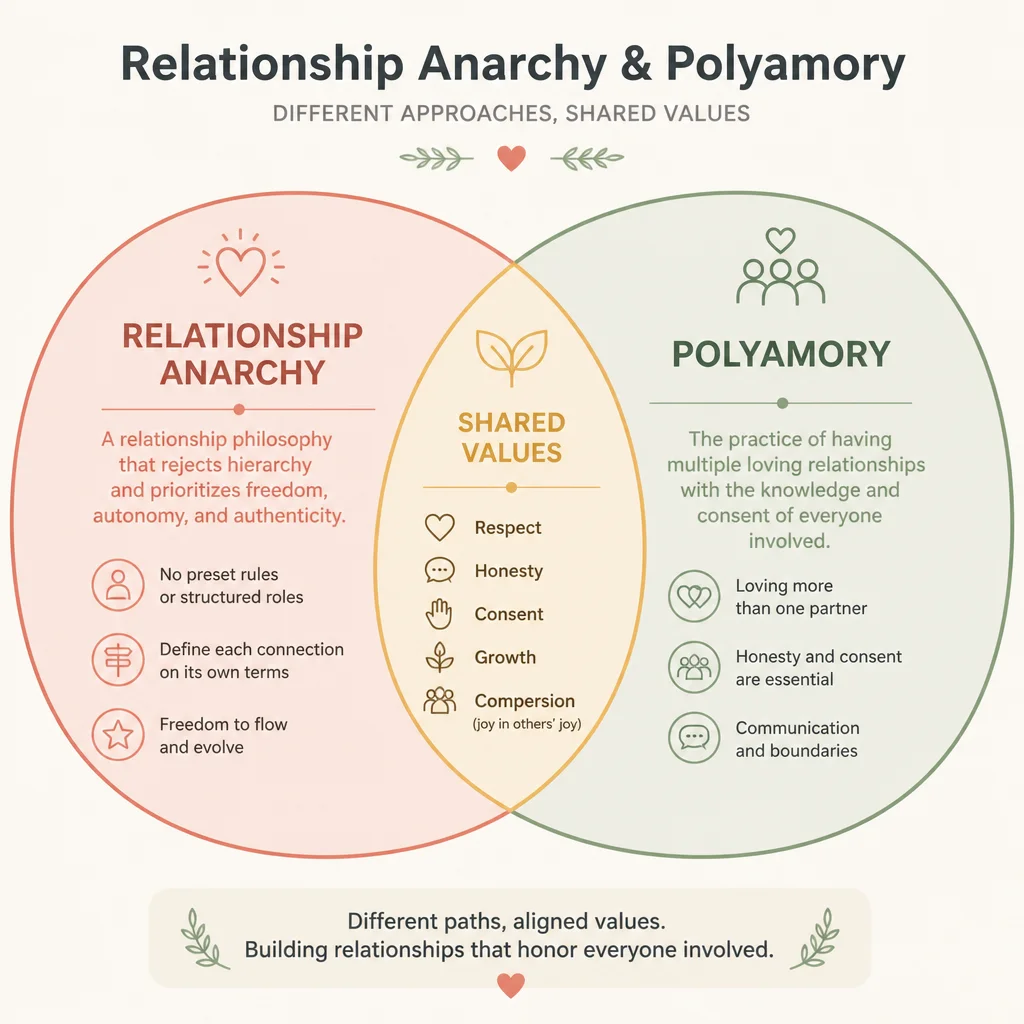
Polyamory is a form of ethical non-monogamy built around multiple loving relationships. It often, though not always, includes hierarchy — a “primary” partner, a nesting partner, or an anchor partner who holds a special place. The focus is romantic and sexual love with more than one person.
Relationship anarchy is a philosophy, not a relationship configuration. It says no relationship type is inherently more valuable than another. Romance, sex, and friendship all get to be negotiated on equal footing, and nothing is assumed just because a relationship has a certain label.
One useful way to hold the two apart: polyamory is something you do, while relationship anarchy is a set of values you hold. You can practice polyamory without ever questioning hierarchy, and you can hold relationship-anarchist values while having zero romantic partners or many.
Where They Overlap
Both relationship anarchy and polyamory reject compulsory monogamy — the idea that one romantic partner is the only acceptable default. Both center consent and honest communication. Both encourage people to step off the relationship escalator and question why certain milestones are treated as automatic.
In fact, relationship anarchy grew out of the same broader ethical non-monogamy movement as polyamory. Plenty of people describe themselves as both: polyamorous because they love more than one person, and relationship anarchists because they refuse to rank those people. For a research-informed look at how mainstream psychology views the variety of relationship structures people build, Psychology Today is a steady, accessible starting point.
Both also share a practical habit: they treat jealousy not as a failure but as information. Instead of trying to squash the feeling, you talk about what triggered it and what you need. That habit matters more than whichever label you use.
Where They Diverge
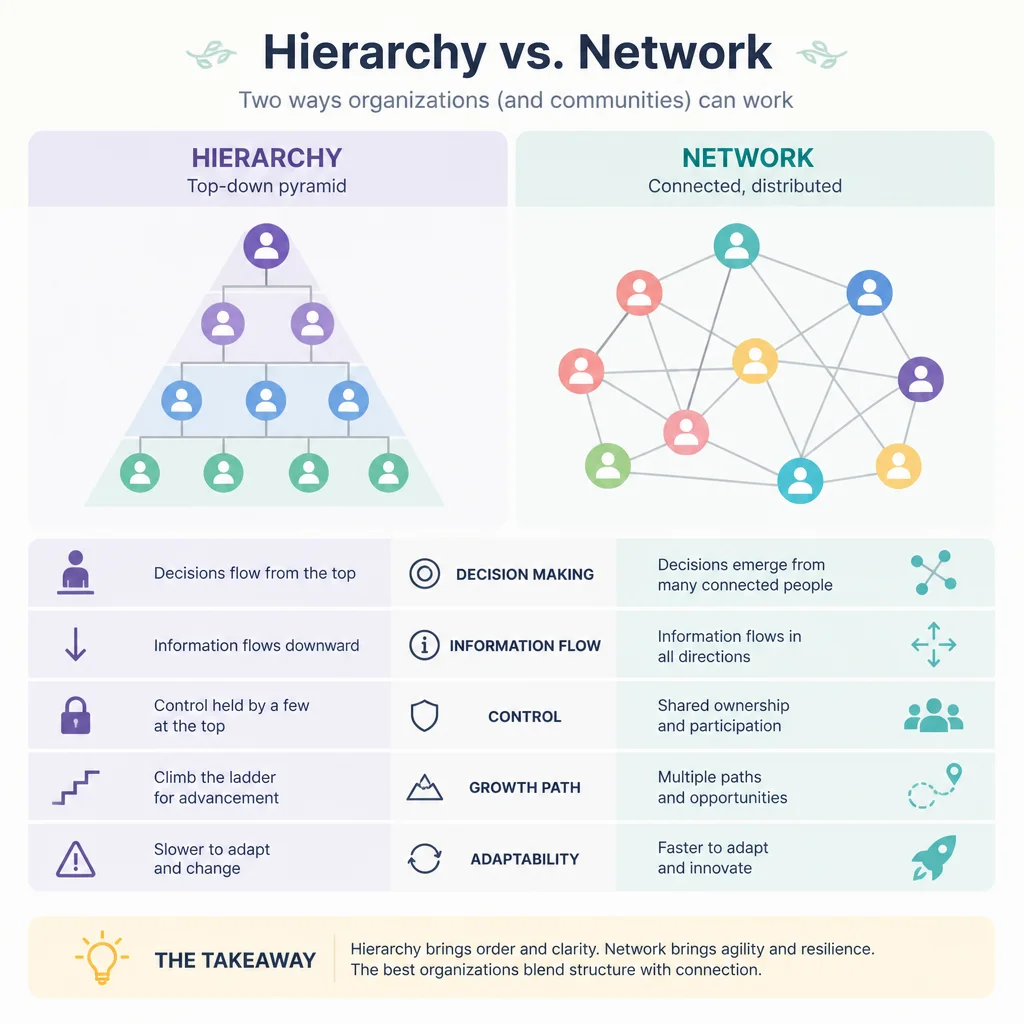
The biggest difference is hierarchy. Polyamory tolerates it — primary partners, secondary partners, and so on. Relationship anarchy rejects it. Under RA, there is no default ranking to fall back on; every relationship’s importance is negotiated individually.
The second difference is scope. Polyamory is about romantic and sexual relationships. Relationship anarchy covers everything — your friendships, your family, your community, your casual connections. A relationship anarchist might have no romantic partners at all and still practice RA fully through how they treat their friends.

The third difference is the role of labels. Polyamory leans on labels like “partner” and “metamour” to organize relationships. Relationship anarchy treats labels as optional descriptions you can use or drop as they fit.
The difference also shows up when things get hard. In hierarchical polyamory, a disagreement about time or priorities is often settled by deferring to the primary relationship. In relationship anarchy, there is no default tiebreaker — which can feel harder in the moment, because you have to negotiate rather than point to a rule. Some people find that exhausting; others find it refreshingly honest.
Relationship Anarchy vs Polyamory: A Practical Comparison
Here is the same comparison, compressed into a table you can scan in a few seconds.
| Dimension | Polyamory | Relationship Anarchy |
|---|---|---|
| Core focus | Multiple romantic and sexual relationships | All relationships on equal footing |
| Hierarchy | Often present (primary/secondary) | Rejected by default |
| Scope | Romantic and sexual | Romantic, platonic, and everything in between |
| Labels | Common and useful | Optional |
| Structure | Agreements between partners | Communication over preset rules |
| Question it answers | “How many partners?” | “Why rank anyone at all?” |
Which One Fits You?
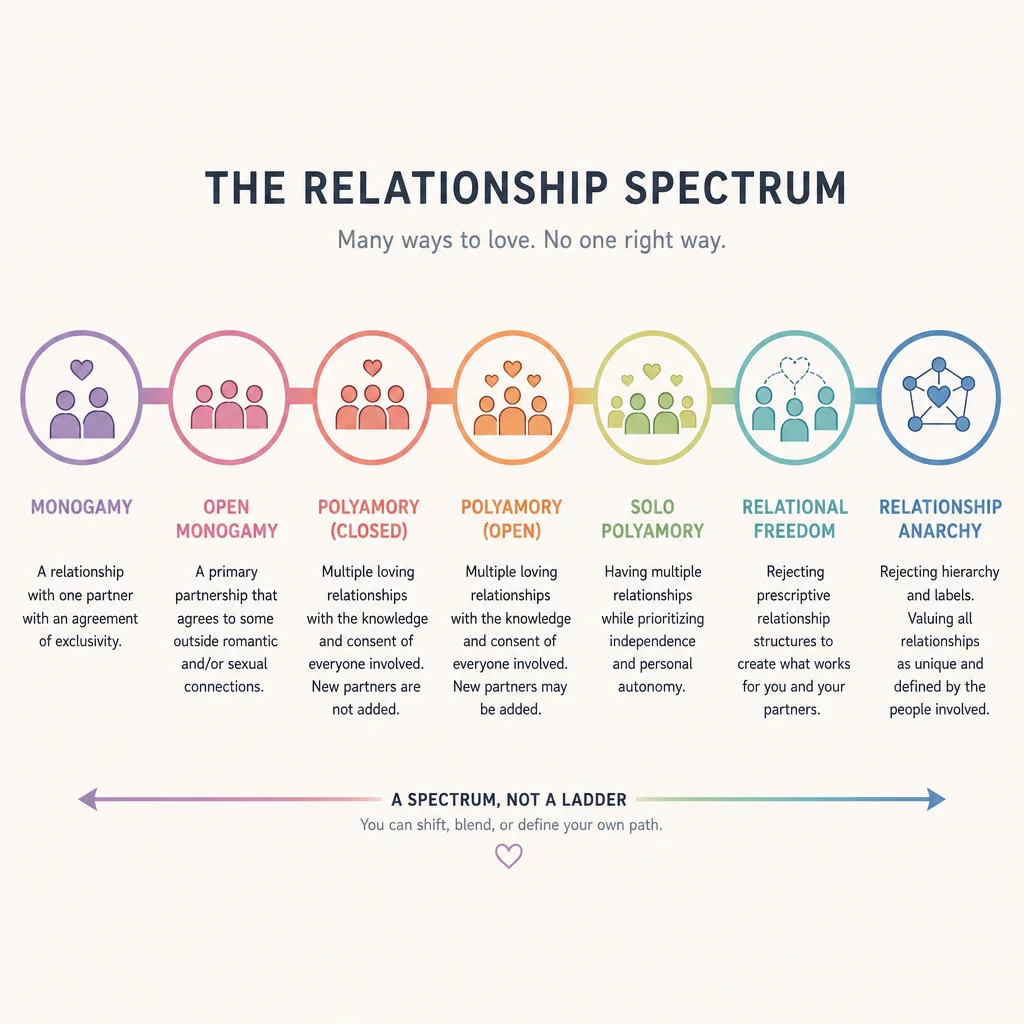
Ask yourself a couple of honest questions. Do you mainly want the freedom to love more than one person romantically? Polyamory might be your starting point. Or do you want to rethink why romance gets a special seat at the table in the first place? That pull leans toward relationship anarchy.
- If the idea of a “primary partner” feels natural, you may lean polyamorous.
- If you flinch at ranking a friend below a lover, you may lean toward relationship anarchy.
- If both sound right, you can absolutely be both — many people are.
You do not have to choose today, or ever. A low-stakes way to explore the idea is to stop using the word “just” before “friends.” Notice how often you say “we’re just friends,” and ask what that word is doing. If dropping it feels like a relief, that is a signal toward relationship anarchy. If you only want the freedom to love more people romantically and are happy keeping a clear center, polyamory will feel more comfortable.
If you want to talk it through with a partner, a gentle opener sounds like this: “I’m trying to figure out how I think about hierarchy. Do you feel like we have an automatic ranking between our relationship and other important people, or do you want to build it from scratch?” The answer you both give will tell you more than any label would.

The Takeaway
If you are coming from a monogamous background, both of these terms can sound like a big leap. Start small. Read, talk to people who actually live these ways, and notice which parts make you feel calm versus anxious. You are not signing a contract; you are clarifying your values. Many people find they borrow a little from both, and that is completely valid.
Neither relationship anarchy nor polyamory is “better” — the difference between relationship anarchy vs polyamory comes down to which question you are trying to answer. What both share is a commitment to honesty, consent, and building relationships on purpose rather than on autopilot. If you are curious where you fall, start by reading more about relationship anarchy for beginners and the relationship smorgasbord, then have an honest conversation with yourself about what you actually want.

This article is part of 3Cupid’s ongoing series on ethical non-monogamy and relationship structures. It is written for adult readers and reflects our commitment to consent, communication, and emotional safety in every kind of connection.