Table of Contents
- Why a Road Trip With Multiple Partners Feels Different
- Who Sits Where, and How Often to Rotate
- Driving Shifts, Fatigue and Sharing the Wheel
- Planning Stops So Nobody Feels Trapped
- Fuel, Food and the Split Nobody Agrees On Later
- Staying Reachable Without Sharing Everything
- Exit Options: Booking a Trip You Can Leave
- Frequently Asked Questions
A road trip with multiple partners is a compression exercise. Three or four people, one vehicle, eight hours, and nowhere else to be. Here is the short version: the trip is decided by three things you can settle in advance, which are who sits where and for how long, when the car stops, and what happens if somebody wants out. Get those right and the rest is scenery.
This is for a throuple, a couple plus a guest, or a small polycule doing a long drive together. It covers seating rotation, driver fatigue, stop planning, money, location sharing and the exit plan. It is general information for adults, and it assumes everyone behind the wheel is legally able to drive and insured where you are driving.
One framing note before the detail. A car is a small room that nobody can leave at speed. That is not a reason to avoid the trip. It is a reason to give the trip more structure than a flight or a weekend at home would need. Most of what follows is simply a way of making sure nobody has to manufacture a polite reason to need some air.
Why a Road Trip With Multiple Partners Feels Different
The specific difference is not the distance, it is the absence of an exit. At a holiday rental somebody can go into another room. On a plane everyone is strapped in but nobody is expected to be interesting for nine hours. In a car, three people are close together, facing the same direction, sharing a destination and largely unable to change the arrangement.
That has three consequences. Small irritations have nowhere to go, so they are either swallowed or aired in front of everybody. The people who are not driving have nothing to do with their attention except the other people. And any disagreement about route, timing or money has an audience for the rest of the day. None of this is a reason to cancel. It is the reason to plan the boring parts explicitly, so the interesting parts have room.

It is also worth saying what road trips get right. A long drive is one of the better ways to spend time with more than one partner, precisely because nobody has to make eye contact or sustain a conversation. Some of the best hours are the silent ones, with a podcast on and the window down. The plan exists to protect those hours, not to fill them.
If the group has not travelled together before, start smaller than your ambition suggests. One long day with an overnight at the end is a reasonable first outing. A week of driving with four bookings already made is a plan that only works if everyone already knows how everyone else travels, and most groups do not yet.
Who Sits Where, and How Often to Rotate
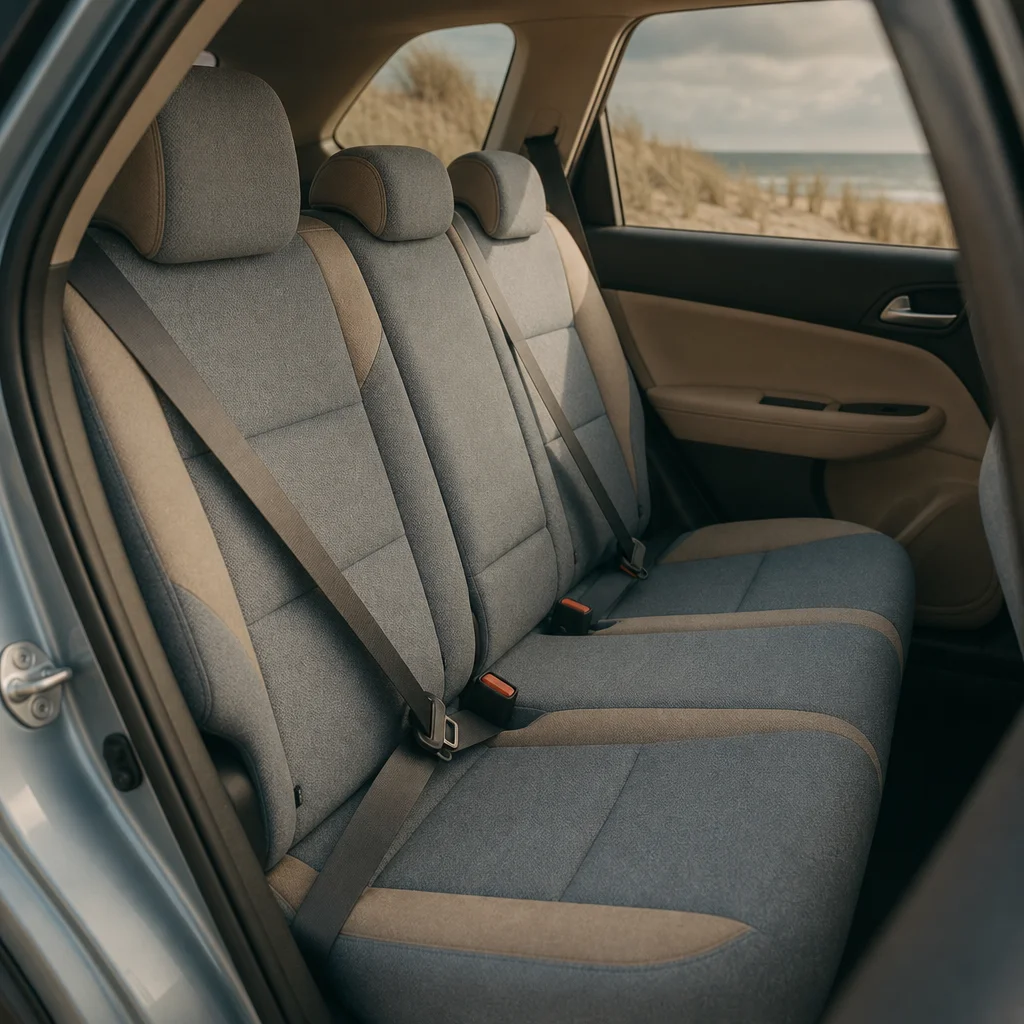
Seating is the first decision and the one most likely to be quietly resented. Whoever has the front seat gets legroom, a view, and usually control of the audio. Whoever has the middle rear seat gets none of those things. Across eight hours that is not a small difference, and it is not one people forget.
The simplest fair system is rotation by leg rather than by hour: the front passenger changes at every substantial stop, and the middle seat rotates with it. Write it down if you want it to actually happen, because the default is always that the established couple sits together and the third person sits behind them. That default is noticed even when nobody says a word about it.
| Arrangement | When it works | What it costs |
|---|---|---|
| Fixed seating, established pair in front | Short trips, or one driver who genuinely needs help navigating | The third person becomes a passenger of passengers, and it reads as a hierarchy |
| Rotation at every major stop | Anything over about three hours | Slightly fussy, and somebody has to remember whose turn it is |
| Rotation by day | Multi-day trips in the same vehicle | One person can draw the short straw for a whole day |
| Nobody sits in the middle | Two plus one where the third is a guest | Only works with a bench seat and good humour, and you still rotate |
Two people’s luggage does not fit around three people’s legs either. Agree the boot and footwell allocation before you load: one bag each in the boot, one small bag each at their feet, and nothing loose in the cabin that can become a projectile or a footrest dispute. If the trip includes a guest rather than an established trio, dating and travelling as a couple has more on making a third person a participant rather than an accessory to somebody else’s holiday.
And one small thing that prevents a surprising amount of friction: everybody gets a say in the first hour of audio, and the front passenger chooses while the driver holds a veto. That is a system that works. Not agreeing anything at all is how you end up with four hours of one person’s music that nobody else wanted to hear.
Driving Shifts, Fatigue and Sharing the Wheel
If more than one person can drive, the trip gets substantially easier. If only one person can, the trip needs to be shorter, slower and more honest about tiredness, and the non-drivers need to pick up more of the navigation, the money and the logistics.
Sleep debt is the part people underestimate. Driving tired is genuinely dangerous, and the driver is usually the worst judge of it, because feeling fine is part of the problem rather than evidence against it. The American Psychological Association’s pages on sleep are a plain reference for why that happens; the practical version is that you should plan around the driver’s worst day rather than their best one.
- Stints of around two hours, with at least fifteen minutes out of the car.
- Swap at fuel stops even when everyone feels fine, because it is easier than negotiating later.
- Anybody, including a passenger, can call a stop. No reason required and no discussion.
- One overnight stop for each long day rather than pushing through the evening.
- The person who is not driving navigates, and the navigator does not also manage music, snacks and the group chat.
That third point carries more weight than the numbers do. A driver who has to justify being tired will keep driving, and a passenger who has to build a case for stopping will not bother. Saying once, before departure, that anyone can call it removes the negotiation from the moment when it matters.
On the passenger side: the front passenger has a real job, which is navigating and staying awake. Do not let it quietly expand into also managing everything else. And if somebody is nervous about a specific route, about night driving or about the weather, say it before departure rather than offering a running commentary from the back seat. If driving anxiety or general travel stress is a live issue in the group, the APA on stress is a reasonable place to start the conversation from.

Planning Stops So Nobody Feels Trapped
Stops are the pressure valve of the entire trip. Without them the car is a sealed unit for eight hours. With them it is a series of two-hour segments that anybody can survive. Plan them roughly and let them flex, but know roughly where they are before you set off.
The rhythm that suits most groups is a short stop every ninety minutes to two hours for fuel, toilets and stretching, plus one longer stop of forty-five minutes or more for actual food. Three people need more toilets than two people, and somebody will always need an extra one. Budget for it rather than apologising for it.
It also helps to give one stop a purpose beyond the service station. A viewpoint, a roadside attraction nobody needs, a town with a decent bakery. It gives the day a shape, and it gives anyone who needs to pull somebody aside a natural setting in which to do it. A walk is a far better place for a difficult sentence than a car seat is.
If you have ever planned an evening out with two partners, the same logic applies in miniature: somebody will be the one who is ready to leave first, and it is much easier if that has been agreed in advance. On a driving day the equivalent questions are simple ones. Which stop is the last one? What time do we actually want to arrive? And who decides if we are running late?

Fuel, Food and the Split Nobody Agrees On Later
Money on a road trip goes wrong in a particular way. It is spent continuously, in small amounts, by different people, and none of it is written down until day three, by which point it has become a mood rather than a number.
The fix is one person, one note, one shared app, anything that makes the running total visible while it is happening. Fuel, charging, tolls, parking, food, and the extra night nobody planned on. It does not have to be precise. It does have to be contemporaneous, because reconstructing it from memory on the last evening is exactly where these arguments live.
On the split itself: equal shares is simplest, proportional to income is kinder when incomes differ sharply, and ‘the person who drove pays less’ is a quiet way of undervaluing the driving. Pick one before the first fuel stop. Splitting travel costs with several partners covers this in more depth, and it is worth settling the same way you would for a longer shared holiday, because the underlying habit is identical.
Two specific things to say out loud. Who pays if the car needs something unexpected: a tyre, a night’s lodging because the drive ran long, a parking charge nobody saw. And whether the vehicle owner is charging for the vehicle at all. Treating the car as a free contribution is a common and quiet source of resentment, and it is much cheaper to name it in advance than to discover it afterwards.
Staying Reachable Without Sharing Everything
Being reachable on a long drive is a group decision that is easy to get wrong in both directions. Share too little and nobody can find anybody. Share too much and every movement becomes everybody else’s business for the whole trip, including the people who are not in the car.
There is a simple floor that most groups are comfortable with: everyone in the vehicle can reach everyone else in the vehicle, and one person outside the trip knows the route and the expected arrival time. That is ordinary travel safety, and it is a different question from continuous location sharing.
Continuous sharing is its own decision, and partners often want different things from it. One partner may share location routinely and be genuinely puzzled that another finds it claustrophobic. Both positions are reasonable. Settle it before you go, in the same conversation you would have at home, and let the answer differ between relationships. The fuller argument sits in location sharing in non-monogamy, and the device-level side in phone privacy for non-monogamous people. If what you are sharing involves apps or accounts and not just a map pin, the Electronic Frontier Foundation on location privacy is worth five minutes before you switch anything on.
One more, specific to driving: agree that nobody is expected to answer a message while the car is moving, and that a slow reply on a driving day is not a signal about anything. That single sentence prevents a remarkable amount of escalation, particularly for anyone who finds silence meaningful. If that taps into something larger, managing anxious attachment in polyamory is the useful read, and so is the long-distance version of the same problem.
Exit Options: Booking a Trip You Can Leave
Every long trip needs a way out that is not a rupture. This is the section that most improves a group trip and the one people most often skip, because raising it before departure feels pessimistic. It is not pessimistic. It is the thing that lets everybody say yes cheaply in the first place.
The structural version: book lodging that can be changed, keep the keys reachable by more than one person, and find out what the rail, coach or hire-car options are along the route. If the trip is one car in the middle of nowhere with a non-refundable booking at the end, the cost of leaving is very high, and a high exit cost changes how freely people agreed to come at all.
The interpersonal version is simpler and more important. Say it before you leave: if anybody wants to cut the trip short, or wants a night in a separate room, or wants to fly home, they can say so and it will be treated as information rather than as a verdict on the trip. Then, when somebody does say it, respond that way.
Practical details that make it real. Separate rooms on at least one night of any multi-night drive. A shared understanding of who covers the cost of a changed plan. And an agreement that the person who wants to leave is not automatically the person who caused the problem. If something does go wrong, repairing things after a conflict in non-monogamy is the useful read afterwards, and rules, boundaries and agreements is the useful read beforehand.
Finally, it helps to understand what actually makes people want the exit. It is rarely one large event. It is usually hours of low-grade lack of control: not choosing the audio, not choosing the stops, not choosing the temperature, being the third person in a conversation built for two. Fixing those small things back in the seating and stops sections does more for the trip than any amount of goodwill at the end of it. For the group-dynamics version of the same idea, navigating polycule conflict without taking sides is worth an hour, and keeping a sense of yourself while travelling with partners is worth ten minutes.
Frequently Asked Questions
How long a drive is too long for a first trip with three people?
Four to five hours of actual driving is a reasonable ceiling. Past that, the people who already get on well will still be fine and the people who do not will have run out of ways to be polite. Add an overnight rather than adding hours.
Should the established pair sit together or should we rotate?
Rotate on anything over about three hours. Sitting together is not in itself a statement, but never rotating does start to read as one, and it is almost always the third person who notices first.
What if only one of us can drive?
Then the trip is shorter, slower and has more stops, and everyone else takes on more of the navigation, the money and the logistics. It is also worth saying out loud that one person carrying all of the driving is carrying a real burden, not doing everybody a favour.
How should we split fuel and food on a group drive?
Equally, unless someone proposed the trip and offered to cover part of it, or incomes differ enough that equal feels unfair. Pick one before the first stop and keep the running total as it happens rather than at the end.
Is it reasonable to want a separate room on some nights?
Yes, and it is one of the cheapest things you can build into a multi-night drive. A door that closes for one night in four is what keeps the other three nights relaxed, and it should not need a justification attached to it.
Editor’s note: this is general information for adults and not driving, legal or medical guidance. Licensing, insurance and road rules vary by country and state, and fatigue affects people differently. Check what applies where you are driving, and build the plan around the most tired driver rather than the most confident one.
A road trip with multiple partners is mostly logistics wearing a holiday costume. Rotation, stops, a visible running total and a cheap way out cover almost all of it, and the rest is the reason you went: a long road, a good playlist, and nobody having to be interesting for hours at a time. For what happens once you have parked at the other end, camping with multiple partners is the companion piece, and non-monogamy in a rural area covers the version of this where the nearest anything is a long way away. You will find people planning trips like this right here at 3Cupid.