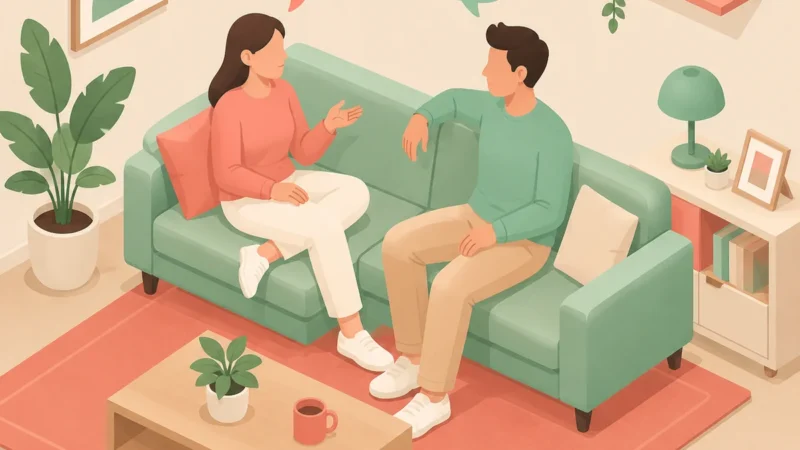
You’ve had a few great dates. The chemistry felt real. You were starting to picture where this might go — and then, silence. No text back. No explanation. Just a profile that’s either deleted or permanently offline. Being ghosted by a third partner — third partner ghosting in ENM dating, specifically — hits differently than a standard dating fade-out. It involves three people’s expectations, a couple’s dynamic, and often a sense of shared rejection that can ripple through your relationship.
Ghosting is frustrating in any context. In ENM, it can feel especially disorienting because so much emotional labor goes into the vetting process — the conversations, the boundary negotiations, the vulnerability of inviting someone into an intimate space. When that person disappears without a word, it’s not just a bruised ego. It’s the loss of an investment. This guide is about processing that loss, protecting your relationship through it, and adjusting your approach so ghosting doesn’t derail your confidence or your ENM journey.
Table of Contents
- Why Ghosting Happens — Especially in ENM
- The Ripple Effect: How Ghosting Impacts Couples
- What to Do Right After It Happens
- Having the Conversation with Your Partner
- Protecting Yourself: Signs and Screening
- When Ghosting Becomes a Pattern
- Moving Forward Without Hardening
Why Ghosting Happens — Especially in ENM
Ghosting isn’t unique to non-monogamous dating, but ENM creates specific conditions that make it more likely. Understanding these isn’t about justifying the behavior — it’s about depersonalizing it so you don’t carry the weight of someone else’s inability to communicate.
One major factor: the third partner is often in a more vulnerable position. They’re entering an existing relationship with its own history, rules, and emotional gravity. If they start feeling like the “add-on” rather than an equal participant, they may exit silently because having that conversation feels harder than disappearing. This doesn’t make ghosting okay, but it contextualizes it. Our piece on the emotional realities of threesome dating goes deeper into why these dynamics create unique pressure points for everyone involved.
Other common reasons include:
- Cold feet about ENM itself. Some people intellectually want to try non-monogamy but panic when it becomes real. The ghosting isn’t about you — it’s about their own unresolved ambivalence.
- Feeling like the “experiment.” If a single third senses they’re being used to test a couple’s openness rather than being genuinely desired, they’ll often bail without a word.
- Discomfort with the couple dynamic. Unequal power, unclear expectations, or subtle couple-privilege behaviors can make a third feel they’d rather not engage than have an awkward conversation about it.
- External life factors. Sometimes people just get overwhelmed — a job change, a mental health dip, a family crisis — and non-monogamous dating is the first thing they drop.
Psychology Today notes that ghosting is often a conflict-avoidance strategy rather than a malicious act. The ghoster anticipates an uncomfortable conversation and chooses silence instead. It’s immature, but it’s usually about them — not about you.

The Ripple Effect: How Ghosting Impacts Couples
When you’re dating as a couple and your shared third partner ghosts, the impact hits both of you — but often in different ways. One partner might feel rejected and take it personally. The other might feel frustrated or even relieved, creating a mismatch in emotional response that can itself become a source of tension.
Common ripple effects:
- Blame spirals: “You pushed too hard.” “You weren’t enthusiastic enough.” Couples sometimes turn the ghosting into a referendum on each other’s behavior, which compounds the hurt.
- The “who was more into them” comparison: If one partner was more invested in the third, they may feel a sharper loss — and the other partner may struggle to understand why it matters so much.
- Questioning the whole project: A bad ghosting experience can make either partner wonder whether non-monogamy is worth it. “If this is what it’s like, why are we doing it?”
- Relief mixed with guilt: If one partner was having doubts about the third, they might feel relieved — and then guilty about feeling relieved while their partner is hurting.
None of these reactions are wrong. They’re just different, and naming them is the first step to processing them together rather than letting them fester separately. If you’re already navigating emotional fatigue from the dating process itself, our guide on preventing ENM dating burnout can help you recognize when ghosting is piling onto an already-depleted emotional reserve.

What to Do Right After It Happens
In the immediate aftermath, your instinct might be to text again, check their profile, ask mutual contacts, or spiral into self-blame. Here’s what actually helps:
- Send one final message — or don’t. If you want closure, one brief, dignified message is fine: “Hey, haven’t heard from you in a while. Hope everything’s okay. If you’re not feeling it anymore, no hard feelings — just let us know.” After that, stop. Chasing someone who’s already checked out only extends the pain.
- Set a time limit on “waiting mode.” Give yourself 48 hours to wonder, check, and obsess. After that, consciously decide: “They’re not coming back. I’m moving on.” The brain processes ambiguous loss differently than clear endings — giving yourself a deadline creates the clarity the ghoster didn’t.
- Don’t make it a detective project. Resist the urge to dig through their social media, ask friends of friends, or create theories about what happened. You’re almost certainly not going to find an answer that makes you feel better, and the search itself keeps you stuck.
- Name what you lost — specifically. Was it the person, or the idea of what could have been? Often the sharper grief is for the potential: the plans you’d started making, the dynamic you were excited about. Separating the person from the potential helps you process both.
Learning to handle rejection in any dating context builds resilience that transfers across your ENM experiences. Our guide on handling rejection in threesome dating offers additional strategies for keeping rejection from becoming an identity-level story.
Having the Conversation with Your Partner
This is the part where couples either grow closer or drift apart. The goal isn’t to assign blame — it’s to acknowledge what happened and check in on how each of you is doing.
Here’s a script you can adapt:
“So [name] seems to have disappeared. I’m feeling [disappointed / confused / rejected / relieved] about it. What about you? I want to make sure we’re okay — ghosting sucks, and I don’t want it to become a thing between us.”
Notice what this script does: it names your own feeling without assuming your partner’s, it asks for their experience, and it explicitly frames the ghosting as something that happened to both of you rather than something one of you caused. That reframing is protection against the blame spiral.
Key principles for this conversation:
- Let feelings differ. If one of you is devastated and the other is unbothered, both responses are valid. The goal is understanding, not matching emotional intensity.
- Don’t compare investment. “You were way more into them than I was” is a landmine. Stay on your own side of the fence.
- Reaffirm your primary connection. However you define your relationship structure, ghosting is a good moment to say explicitly: “We’re solid. This doesn’t change us.”
After you’ve talked, consider doing something reconnecting — not as a “fix,” but as a reminder. A date night, a walk, anything that’s just the two of you. Our threesome aftercare guide includes reconnection rituals that work equally well after a ghosting experience as they do after a physical encounter.

Protecting Yourself: Signs and Screening
You can’t prevent ghosting entirely — it’s a risk built into modern dating, ENM or otherwise. But you can screen for patterns that make it more likely, and you can structure your own approach to reduce the emotional cost when it does happen.
Here’s what to watch for in early interactions:
| Green Flag (Lower Risk) | Yellow Flag (Moderate Risk) | Red Flag (Higher Risk) |
|---|---|---|
| Responds consistently, even if briefly | Inconsistent texting patterns | Disappears for days, then reappears without explanation |
| Asks questions about both partners | Only engages with one partner | Seems uncomfortable discussing the couple dynamic |
| Has had ENM experience or has clearly thought about it | “I’ve always been curious” with no follow-up questions | New to ENM and seems to be treating it as an experiment |
| Initiates conversations about boundaries | Agrees to everything without adding anything | Avoids boundary discussions entirely |
| Has a stable presence (consistent profile, reasonable availability) | Vague about availability or life circumstances | Profile disappears and reappears, or changes frequently |
Beyond screening, adjust your own approach:
- Pace your emotional investment. Excitement is natural. Over-attachment before you’ve met in person — or met more than once — sets you up for a harder fall. Remind yourself: “I like this person. I don’t know them yet.”
- Spread your connections. If all your ENM energy is pinned on one possible third, ghosting feels catastrophic. Maintaining multiple conversations — even casual ones — distributes the risk and makes any single disappearance less destabilizing.
- Check in explicitly. After a few dates, it’s fair to ask: “How are you feeling about how this is going? Any hesitations?” Some people will ghost anyway. But some will use the opening to say “I’m having second thoughts” — which is infinitely better than silence.
If you’re looking for partners in spaces where communication and respect are part of the culture, finding a third through a platform that prioritizes safety changes the baseline. When both parties are invested in the process — not just the outcome — ghosting becomes less likely.

When Ghosting Becomes a Pattern
One ghosting is bad luck. Repeated ghosting — especially when it follows a similar script each time — is worth examining. Not to blame yourself, but to identify whether something in your approach is inadvertently selecting for people who are more likely to disappear.
Questions to ask yourselves as a couple:
- Are we moving too fast? If you’re proposing meeting up within the first few messages, or moving to physical intimacy very quickly, you might be attracting people who are in it for the novelty and will bail once the novelty fades — or once the reality sets in.
- Are we clear about what we want? Ambiguity attracts people who are ambiguous. If your profile and early conversations don’t clearly communicate your intentions, you’re more likely to match with people who aren’t sure they want this.
- Are we treating the third as a full person? If your conversations focus exclusively on the sexual experience and never on who they are as a human — their interests, their life, their own goals — people will feel interchangeable. And interchangeable people don’t owe you a goodbye.
- Are we selecting for ENM experience? Dating someone who’s never done non-monogamy before carries higher ghosting risk, not because they’re bad people, but because the gap between fantasy and reality can be jarring. Screening for even minimal ENM experience reduces the odds.
Sometimes the pattern isn’t about you at all — it’s about the platforms you’re using, the demographic you’re targeting, or just a run of bad luck. But if you’ve had three or more promising connections end in ghosting within a few months, it’s worth a honest audit. Not self-flagellation — just calibration.

If you’re feeling burned out by the pattern — not just by one ghosting but by the accumulation — it might be time for a deliberate pause. Our article on ENM dating burnout covers how to recognize when you’re running on empty and what a healthy reset looks like.
Moving Forward Without Hardening
The hardest part of being ghosted isn’t the disappearance itself. It’s what comes after: the temptation to armor up, to approach new connections with suspicion, to hold back emotionally “just in case.” That’s a reasonable protective instinct. But it’s also a recipe for never fully connecting again.
Here’s a healthier framework:
- Stay open, but stay paced. You don’t have to choose between complete vulnerability and complete shutdown. The middle path is staying genuinely curious and warm while allowing trust to build over time — through consistent actions, not just promising words.
- Keep the ghosting in proportion. One person’s inability to communicate doesn’t say anything about your worth, your relationship, or your ENM journey. It says something about that person. Don’t give one ghost the power to haunt your future connections.
- Learn, then let go. Extract whatever lesson the experience offers — a screening tweak, a pacing adjustment — and then consciously release the rest. Rumination isn’t processing; it’s just pain on repeat.
- Remember why you’re doing this. You didn’t start exploring ENM to collect ghosting stories. You started because you wanted connection, exploration, growth — or some combination of those things. That desire hasn’t changed. The path just has some bumps.
Ghosting is common. It’s also survivable. The goal isn’t to eliminate the risk — that’s not possible. The goal is to build enough resilience that when it happens, it stings for a few days instead of derailing you for weeks. That resilience comes from solid communication with your partner, realistic expectations about modern dating, and a commitment to not letting other people’s avoidance become your emotional baggage.
And when you’re ready to put yourself back out there — because the right connection is worth the risk of a few wrong ones — you’ll find people who show up, communicate, and don’t disappear at 3Cupid. The best connections start with the best intentions on both sides.

This article was written drawing on community experiences and current relationship psychology research. It reflects 3Cupid’s commitment to honest, practical guidance for everyone navigating non-monogamous dating.