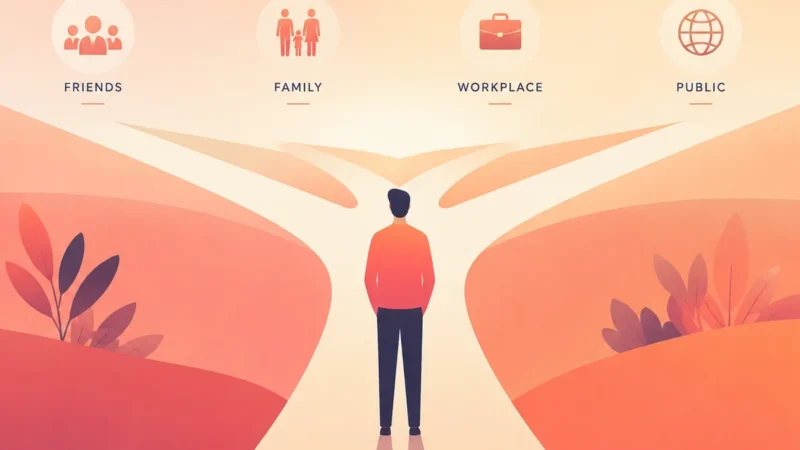
Most conversations about threesome dating focus on logistics — how to find partners, how to set boundaries, how to communicate. But there is a quieter challenge that often goes unaddressed: what happens when people outside your arrangement find out. Friends grow distant. Family members make assumptions. Coworkers gossip. Threesome dating stigma is not just an abstract social force — it shapes who you tell, how you date, and whether you feel safe being honest about your life.
This article is not going to tell you to “just be proud” or “ignore what others think.” Real stigma has real consequences — professional, familial, social. The goal here is to help you navigate it thoughtfully, protect your wellbeing, and make choices that honor both your relationships and your peace of mind.
Table of Contents
- Where the Stigma Actually Comes From
- How Stigma Shapes Your Choices Without You Noticing
- Deciding Who to Tell — and Who Not To
- The Internal Work: Separating Shame from Stigma
- Building a Support System That Gets It
- Responding to Judgment Without Losing Your Cool
Where the Stigma Actually Comes From
Social stigma around non-monogamous relationships does not appear out of nowhere. It is built on layers of cultural assumptions that most people absorb without ever examining. The default model — one partner, one relationship, one life path — is so deeply embedded in media, law, religion, and family structures that anything outside it reads as a deviation rather than a legitimate alternative.
When it comes to threesome dating specifically, the stigma carries an additional charge. Mainstream culture tends to sexualize threesomes while simultaneously treating the people who participate in them as less serious, less committed, or less capable of “real” intimacy. The same person who jokes about threesomes at a party might quietly judge someone who actually has one. That gap — between cultural fascination and cultural acceptance — is where stigma does its hardest work.
It is worth noting that this stigma does not fall evenly. Women in non-monogamous arrangements face sharper judgment than men. LGBTQ+ individuals navigate layered stigmas that compound each other. Single people joining a couple face assumptions about their intentions that couples do not have to manage. Acknowledging these differences is not about ranking suffering — it is about understanding that threesome dating stigma operates intersectionally, and each person’s experience of it will be shaped by who they are beyond their relationship structure.

How Stigma Shapes Your Choices Without You Noticing
One of the trickiest things about social stigma is that you do not need to experience overt discrimination for it to affect your life. The anticipation of judgment — the “what if they find out?” — is often enough to change behavior. You might avoid holding hands in public with a third partner even when you want to. You might downplay the significance of a connection that genuinely matters. You might preemptively edit yourself out of conversations, events, and social circles before anyone has had a chance to react.
Researchers studying minority stress have documented this pattern across many contexts: the psychological cost of constantly scanning your environment for potential rejection is substantial. Even when actual rejection never materializes, the vigilance itself is draining. What makes it especially challenging in the context of threesome dating is that many of the people experiencing it are new to being in a stigmatized category — they may not have built up the coping resources or community support that help buffer against this kind of stress.
A practical first step is simply noticing when you are making a choice based on fear of judgment rather than genuine preference. Ask yourself: “If nobody in my life would ever find out, would I make the same decision?” If the answer is no, you are responding to stigma, not to your own values. That awareness alone does not make the stigma disappear, but it does return agency to you — you get to decide when to protect yourself and when to assert your life on your own terms.
VeryWell Mind discusses how minority stress — the chronic strain of navigating a stigmatized identity — can affect mental health over time, noting that social support and community connection are among the strongest protective factors (VeryWell Mind). This research reinforces what many people in the ENM community already know intuitively: the stigma itself is often more damaging than anything intrinsic to the relationship structure.

Deciding Who to Tell — and Who Not To
Disclosure is not an all-or-nothing proposition. You do not owe everyone in your life the same level of transparency, and the decision to share (or not share) your relationship structure is a strategic one — not a moral one. Some people in your life have earned the right to know you fully. Others have not. And some relationships — with employers, with certain family members, with acquaintances — carry risks that simply are not worth taking.
Before deciding to disclose, consider three questions: First, what is your goal in sharing — is it to deepen a connection, to stop hiding, or to educate? Second, what is the worst realistic outcome if the person reacts poorly, and can you live with it? Third, do you have enough support elsewhere in your life to absorb a negative reaction if it happens? If you are disclosing your ENM status while dating, the calculus shifts slightly — here, transparency earlier in the process is usually wise because it sets expectations before emotional investment grows.
There is no shame in choosing not to disclose. Discretion is not dishonesty. The key distinction is whether you are making the choice from a place of strategic self-protection (healthy) or from a place of internalized shame (something to work on). Both can coexist, but being honest with yourself about which one is driving the decision matters enormously for your long-term wellbeing.

The Internal Work: Separating Shame from Stigma
Here is a distinction that matters: stigma is external — it is the judgment, exclusion, and assumptions that come from other people. Shame is internal — it is the voice inside your own head that has absorbed those external messages and started repeating them back to you. The two are related, but they are not the same, and they require different responses.
External stigma calls for boundaries, strategic disclosure, and building alternative communities. Internal shame calls for something harder: unlearning. Recognizing that the discomfort you feel about your own desires may not be coming from you at all — it may be borrowed from a culture that never gave you permission to want what you want. Working through internalized shame in ENM dating is a process, not a switch you flip. It involves noticing the shame narrative when it appears — “people like me are broken,” “this is not what healthy people do” — and gently countering it with your own lived experience: “I am not broken. What I am doing is consensual, communicative, and meaningful to me.”
One practical exercise: write down the three messages about non-monogamy you absorbed growing up — from family, religion, media, or peers. Then, next to each one, write what you now believe to be true based on your actual experience. The gap between those two columns is the space where shame lives. Shrinking that gap is the work.

Building a Support System That Gets It
One of the most effective buffers against stigma is community. When you have people in your life who understand your relationship structure — or at minimum, accept it without judgment — the weight of external disapproval becomes significantly lighter. The challenge, of course, is finding those people, especially if your existing social circle is mostly conventional.
Start by looking where like-minded people already gather. ENM and polyamory meetups — both online and in-person — can be lifelines. Reddit communities like r/nonmonogamy and r/polyamory offer spaces to read other people’s experiences and realize you are far from alone. Local LGBTQ+ centers and sex-positive community groups often welcome people in non-traditional relationship structures regardless of sexual orientation. The point is not to replace your entire social circle, but to ensure that at least some of the people who know you also know your whole life — not just the parts that fit neatly into conventional expectations.
If in-person community is not accessible — whether due to geography, privacy concerns, or timing — online communities can still provide significant validation. The key is to engage actively, not just lurk. Sharing your own experience, even anonymously, helps build the sense that you are part of something rather than an isolated case.

Responding to Judgment Without Losing Your Cool
Sooner or later, someone will say something dismissive, invasive, or outright hostile about your dating life. How you respond in that moment can either protect your peace or drain it. Having a few go-to responses prepared ahead of time removes the pressure of improvising under emotional stress.
- The Boundary Setter: “I appreciate your concern, but my relationships are not up for discussion.” Simple, firm, no opening for debate.
- The Redirect: “That is a private part of my life, and I prefer to keep it that way. How is your work going?” Moves the conversation along without confrontation.
- The Calm Educator: “I understand it might seem unfamiliar. Happy to answer genuine questions if you are curious, but I am not looking for approval.” Offers connection while holding your ground.
- The Disengage: “I can tell this is not a productive conversation right now. Let us talk about something else.” Exits gracefully when the other person is not engaging in good faith.
Notice that none of these responses involves defending, justifying, or convincing. You do not owe anyone a comprehensive defense of your relationship structure. The goal is not to win an argument — it is to protect your energy while maintaining whatever level of relationship you choose to keep with that person.

Navigating threesome dating stigma is not about becoming immune to other people’s opinions. It is about building enough internal stability and external support that you can encounter judgment without being knocked off course. Some people in your life will get it. Some will not. Some will come around slowly. And some relationships will naturally fade as you stop contorting yourself to fit expectations you never agreed to. That is not loss. That is alignment.
If you are working through the internal side of this — the shame that stigma leaves behind — our guide on handling internalized shame in ENM dating offers a deeper framework. And for a look at how external dynamics intersect with emotional wellbeing, our article on power dynamics in threesome dating explores the structures that can either support or undermine genuine equality in your connections.
Editor’s note: This article is part of our series on emotional wellbeing in non-traditional relationships. Content is reviewed and updated regularly to reflect current conversations in the ENM community.