
Table of Contents
- What to Expect When You Walk In
- The Unspoken Rules of Swinging Club Etiquette
- How to Approach Other Couples and Singles
- Consent Is the Only Language That Matters
- What to Wear (and What Not to Wear)
- How to Exit Gracefully
- First-Timer’s Do’s and Don’ts Checklist
What to Expect When You Walk In
Walking into a swinging club for the first time can feel intimidating. You might expect something out of a movie — but the reality is usually far more understated. Most clubs feel closer to an upscale cocktail lounge than anything else. You’ll check in at the front desk (yes, membership and ID are standard), get a tour from a host, and find the atmosphere surprisingly social rather than charged.
The layout typically has distinct zones: a social area with a bar and seating, a dance floor, and private or semi-private play areas further in. Nobody is going to pressure you to do anything. In fact, the cardinal rule of swinging club etiquette is that watching and socializing are perfectly acceptable — many first-timers spend their entire first visit just observing and chatting. According to research on consensual non-monogamy, the social bonding aspect is often what keeps people returning, not just the play.

One thing that surprises most new visitors: how normal everyone seems. You’ll meet people from all walks of life — nurses, teachers, engineers, entrepreneurs — who happen to share an interest in the lifestyle. The common thread isn’t age, body type, or profession. It’s that everyone here has done the work of communicating with their partner about what they want.
The Unspoken Rules of Swinging Club Etiquette
Every community has its norms, and lifestyle clubs are no different. Here are the unwritten rules that seasoned club-goers wish someone had told them before their first night.
Never interrupt a conversation. If two people (or a couple and a single) are deep in discussion, wait for a natural pause. Hovering nearby with a drink is fine; jumping in mid-sentence is not. This sounds basic, but nerves can make people forget.
Closed doors mean do not disturb. If a playroom door is closed or its curtain drawn, keep walking. If it’s open or partially open, you can watch quietly — but only enter if explicitly invited. Some clubs have specific “open door” policies, so ask the host during your tour.
Phones stay in the locker or car. This might be the most enforced rule in any lifestyle club. Privacy is sacrosanct. Photos, videos, and even texting in shared spaces are universally frowned upon. Most clubs provide lockers — use them. If you need to check your phone, step outside.

“No” is a complete sentence — and “maybe” means no. Nobody owes you an explanation. If someone declines an invitation, you smile, say “no problem,” and move on. Pushing or asking “why not” is the fastest way to get flagged by club staff. Likewise, if someone says “maybe” or “we’re just here to watch tonight,” that’s a soft no. Respect it immediately.
Hygiene is a form of respect. Clubs almost always have showers, and using them before entering play areas is standard practice. Bring a small bag with toiletries, a change of clothes, and condoms — even if the club provides them, having your own preferred brand shows thoughtfulness.
How to Approach Other Couples and Singles
If you’ve ever been to a networking event, you already understand the rhythm: you make eye contact, smile, start a low-stakes conversation, and see if there’s chemistry. The difference at a lifestyle club is that everyone knows why they’re there, which can actually make the social dance less awkward.
The best opener is genuinely simple: “Hi, is this your first time here too?” or “We’re new — any tips?” These work because they’re honest and disarming. You’re not pretending to be a veteran when you’re not. Couples who have been in the lifestyle for years often enjoy warmly welcoming newcomers — it’s part of the community culture.
Avoid approaching a couple where one partner is clearly less engaged. If one person is talking animatedly with you while the other stares at their drink, that’s a signal. The healthiest interactions happen when both people in a couple are equally present and interested. Pay attention to body language, not just words.

If you hit it off with another couple, the next step isn’t an immediate invitation to a playroom. It’s usually “Would you like to join us for a drink at our table?” or “We’ll be by the dance floor later if you’d like to find us.” Low-pressure, open-ended, with everyone keeping full agency.
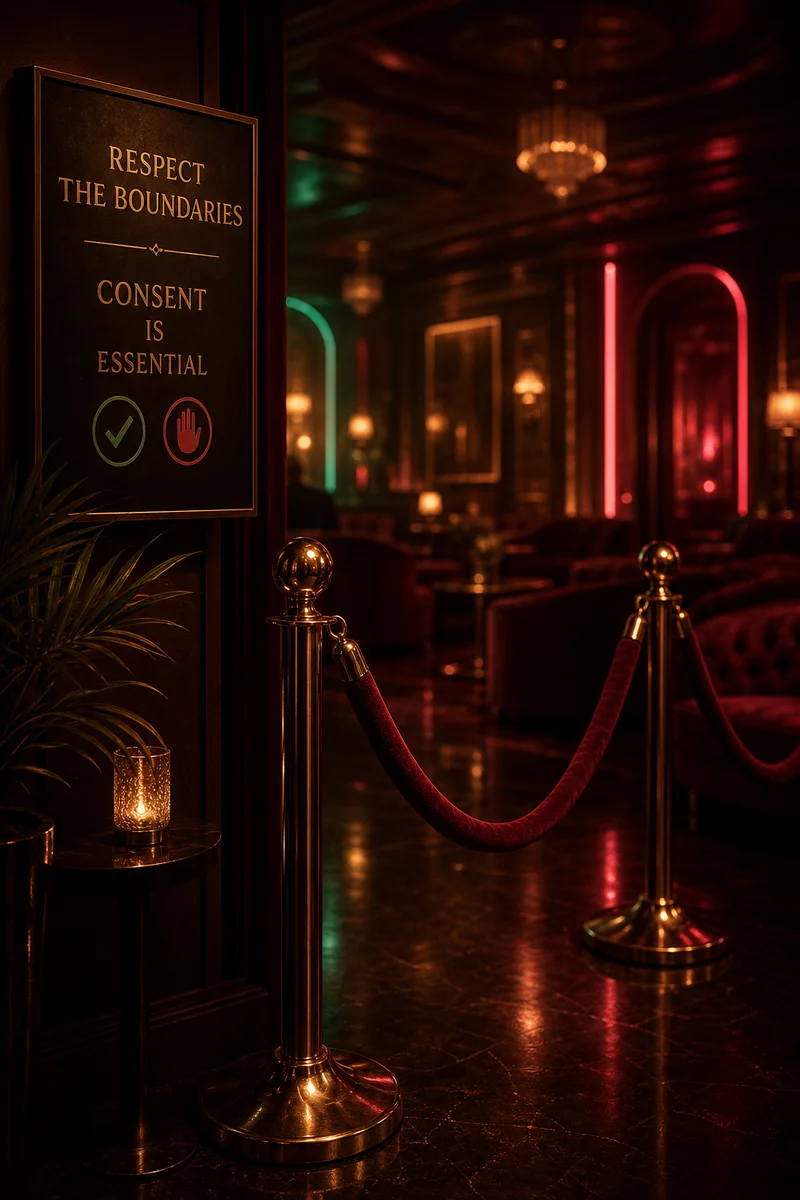
Consent Is the Only Language That Matters
Lifestyle clubs operate on a model of enthusiastic consent that goes far beyond what you’d encounter in a typical bar. Every interaction — from a hand on a shoulder to joining a playroom — requires an explicit, verbal “yes.” Assumptions are the enemy.
Here’s the language you’ll hear (and should use): “Would you like to dance?” not “Let’s dance.” “Is it okay if I touch you here?” not a silent reach. “Are you comfortable with me joining?” not stepping in uninvited. This may feel formal at first, but it creates a container of safety that lets everyone relax into the experience.
Consent can be withdrawn at any moment — and that’s not just allowed, it’s normalized. If you’re in the middle of something and one person says “I need a break” or “let’s slow down,” the only correct response is “of course.” No sulking, no bargaining, no guilt. Clubs that fail to enforce this don’t stay in business long. Understanding consent as an ongoing conversation rather than a one-time checkbox is essential to the lifestyle, not just a formality.
What to Wear (and What Not to Wear)
Most clubs enforce a dress code, and it’s usually stricter than you’d guess. The general rule: dress like you’re going to a high-end cocktail bar or a theater opening. For women, that often means a cocktail dress, heels or dressy flats, and put-together styling. For men, collared shirts, dress shoes, and well-fitted trousers are the minimum — jeans and sneakers will get you turned away at the door at many venues.
Many clubs have themed nights — “All White,” “Masquerade,” “Little Black Dress” — and participating is part of the fun. Check the club’s website or social media for the theme before you go. Bringing a small overnight bag with a change of clothes and footwear is also practical; after a few hours, those heels or stiff dress shoes might lose their appeal.
What you wear underneath matters too. Lingerie or nice undergarments are the norm if you plan to use the play areas, and some clubs have areas where people change into robes or more revealing outfits later in the evening. The key is to match the club’s vibe: if you’re unsure, overdress slightly — you can always take off a jacket, but you can’t conjure one out of thin air.

How to Exit Gracefully
Knowing how to leave is as important as knowing how to arrive. Whether you’re leaving at the end of a fun night or deciding mid-evening that the scene isn’t for you, there are ways to do it that preserve everyone’s comfort.
If you’re leaving early because it’s not your scene: You don’t owe anyone an elaborate explanation. A simple “We’re going to call it a night — thanks for the conversation” to anyone you’ve been chatting with is plenty. Nobody will take it personally. Couples leave clubs after an hour all the time; it’s not a failure, it’s a data point.
If you’ve been playing with others and the evening is winding down: A warm “We had a really lovely time with you tonight” goes a long way. You don’t need to exchange numbers or make plans for next time unless you genuinely want to. If you do want to stay in touch, many clubs have a system for exchanging contact info that respects privacy — ask the front desk.
The post-club debrief with your partner is essential. This is when you process what happened, share what you enjoyed and what felt off, and reconnect as a couple. Our guide on how to process a swinging experience together walks through a structured debrief that keeps communication open without turning into an interrogation. This ritual is what separates couples who thrive in the lifestyle from those who burn out.
First-Timer’s Do’s and Don’ts Checklist
Here’s a quick-reference checklist to keep in your pocket (mentally, since phones stay in the locker) for your first swinging club visit.
| ✅ Do | ❌ Don’t |
|---|---|
| Arrive early to get the tour and settle in | Show up late and rush through orientation |
| Stick to your partner like a team — you’re a unit tonight | Wander off separately without checking in |
| Watch and observe before participating | Jump into play areas without understanding the norms |
| Use explicit verbal consent for every step | Assume silence or body language equals agreement |
| Shower before entering play spaces | Skip hygiene — it’s noticed immediately |
| Have a pre-agreed signal with your partner for “let’s leave” | Stay when one of you is uncomfortable |
| Thank the host and staff on your way out | Ghost the people you spent the evening talking to |
| Debrief with your partner the next morning | Rush into processing while emotions are still high |

If you’re still in the research phase and haven’t yet found a club or community to visit, start with our guide to finding your swinging community, which covers how to locate clubs, events, and online spaces that match your comfort level. And if the emotional side of things feels like the bigger unknown, understanding post-swinging emotional dynamics can help you prepare for what happens after the night ends — because that’s often where the real growth happens.
This article is part of our Swinging Event Preparation series. For a practical guide on what to pack and how to prepare before your first club visit, read our companion piece: How to Prepare Before Your First Swinging Event or Club Visit.