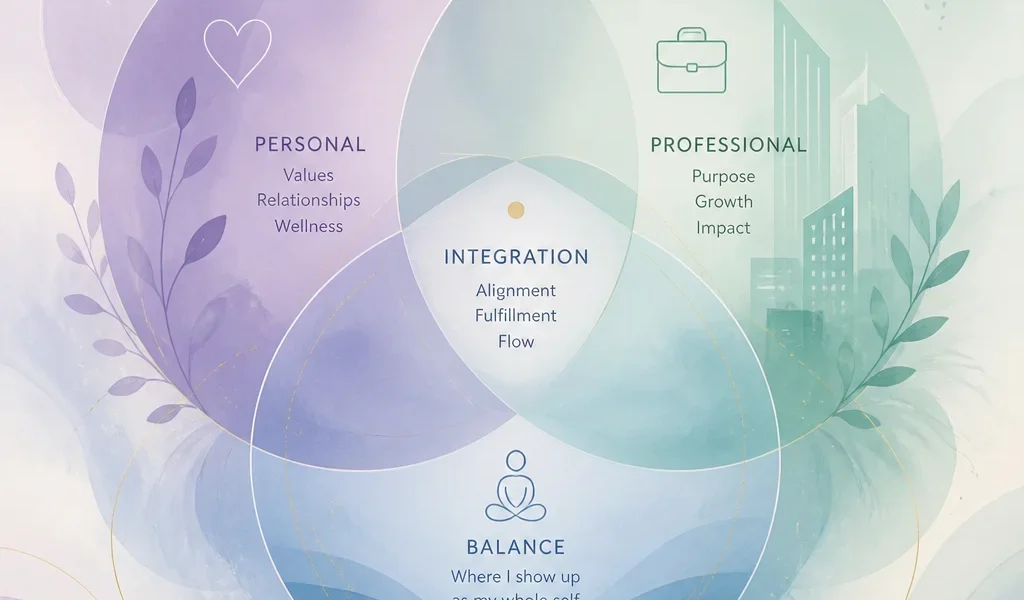
Polyamory changes how you relate to people. What is less discussed is how it changes your relationship with your career. When you are dating multiple people, the boundary between personal and professional life becomes more complex — not because polyamory is inherently unprofessional, but because most workplace cultures were designed around monogamous assumptions. Navigating polyamory and career boundaries requires intentional strategy, not secrecy.
This is not about hiding who you are. It is about making deliberate choices about what you share, when, and with whom — the same skill you already use to manage privacy in dozens of other areas of your life. The goal is not to live a double life. It is to protect your career while staying authentic to your relationship values.
Table of Contents
- Where Polyamory and Professional Life Overlap
- Deciding What to Share at Work — and What to Keep Private
- Managing Your Calendar Across Partners and Career
- When Partners’ Careers Intersect with Yours
- Handling Coworkers Who Discover Your Relationship Style
- Protecting Your Career While Staying True to Yourself
Where Polyamory and Professional Life Overlap
The overlap between polyamory and career shows up in concrete, everyday ways. Your partner’s name appears on your emergency contact form, but you have two partners. A coworker asks what you did over the weekend, and your honest answer involves time with two different people. A work trip overlaps with a partner’s birthday, and now you need to coordinate across relationship and professional calendars simultaneously.
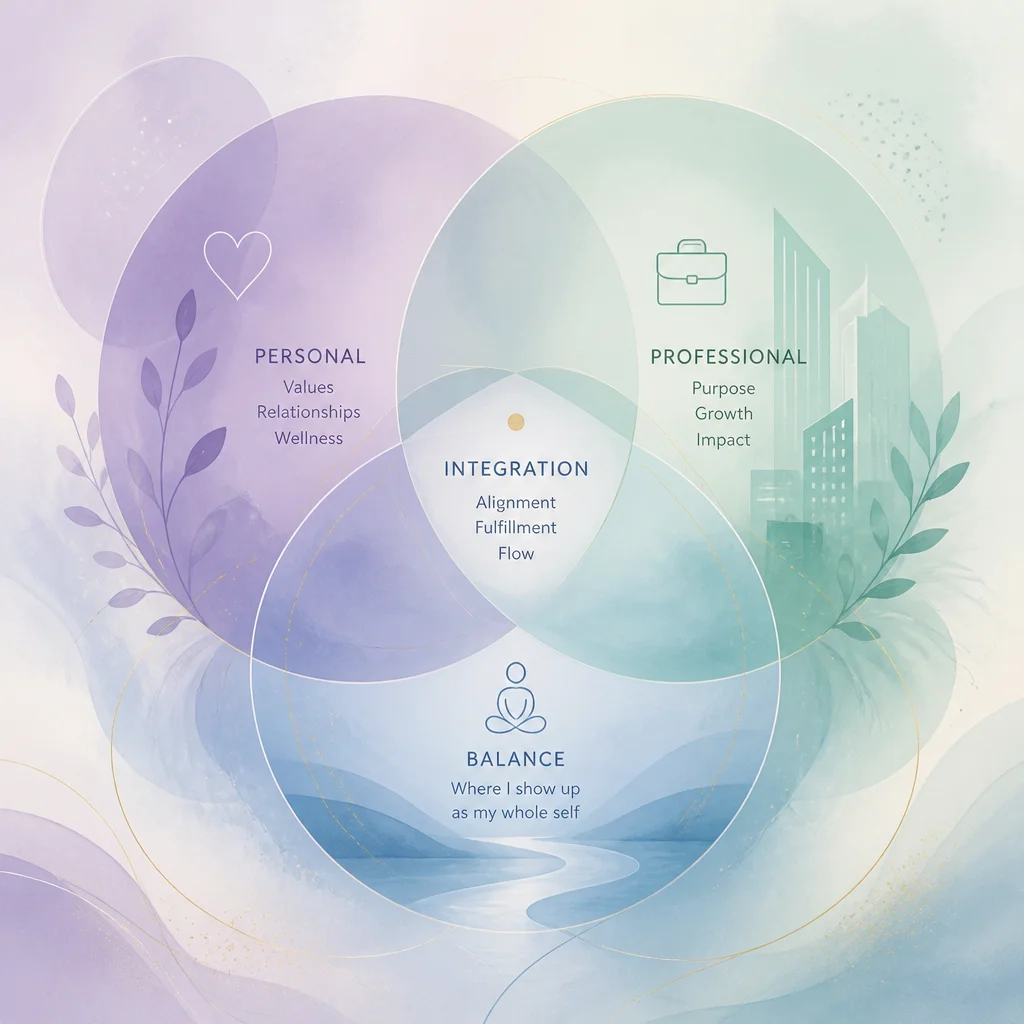
These moments are not crises, but they are friction points that monogamous colleagues never encounter. The friction does not come from polyamory itself — it comes from workplace norms that assume a single-partner model. Recognizing this is the first step. You are not doing anything wrong by having multiple relationships. You are simply operating in a system that was not designed with your life in mind.
For broader context on how polyamory intersects with social and professional settings, we have covered this in our guide on navigating polyamory in social and work settings. The current article goes deeper into the career-specific boundary work.
Deciding What to Share at Work — and What to Keep Private
There is a spectrum of disclosure at work, and you get to choose where you land. At one end: complete openness, where colleagues know the full structure of your relationships. At the other: complete privacy, where you never mention any partner by name. Most polyamorous professionals exist somewhere in the middle, and that middle shifts depending on the colleague, the context, and the workplace culture.

Questions to help you decide your disclosure level:
- What is your workplace culture around personal life disclosure in general — not just relationships, but family structure, health, religion?
- Is there legal protection for relationship status in your jurisdiction? (In most places, marital status is protected; polyamorous relationship structure typically is not.)
- Do you work in a field where “culture fit” matters and personal life is informally discussed?
- Are you in a position of authority where your personal life could be used to undermine your credibility?
- Do you have colleagues you genuinely trust, or is the environment competitive?
Many polyamorous professionals use neutral language as a practical tool. “My partner” (singular, when referring to whoever is relevant in context) is not dishonest — it is boundary-maintaining. You are not obligated to provide an organizational chart of your love life to earn professional respect.
Managing Your Calendar Across Partners and Career
Calendar management is where polyamory-career boundaries live or die. When you have two partners, a demanding job, and hopefully some time for yourself, your calendar is not just a scheduling tool — it is a boundary enforcement mechanism. Research on work-life integration, as discussed by VeryWell Mind, consistently shows that intentional boundary-setting is the strongest predictor of sustainable balance across life domains.

Use a single calendar system for everything. This sounds counterintuitive if you want separation, but fragmented calendars lead to double-booking and last-minute cancellations — which damage both professional reputation and relationship trust. A unified calendar with color-coding (work commitments in blue, partner A in green, partner B in purple, solo time in yellow) lets you see conflicts before they happen.
Block “transition time” between work and relationship mode. Going straight from a tense client meeting to a date where you are supposed to be present and warm is a recipe for emotional whiplash. Schedule 30-60 minutes of buffer time — a walk, a shower, a few minutes of quiet — between professional obligations and relationship time. Partners will notice the difference in your presence.
Time management is a real skill in polyamory, and we have a dedicated guide on polyamory time management that covers scheduling strategies in depth.

When Partners’ Careers Intersect with Yours
Your partners have careers too, and sometimes those careers intersect with yours in ways that create boundary challenges. One partner works in the same industry. Another partner is a client or vendor. A metamour applies for a job at your company.
When professional and polyamorous networks overlap, the stakes of disclosure rise. A relationship dynamic that stays private in your personal life might become professionally relevant if it involves someone in your industry.
Guidelines for partner-career intersections:

- Avoid dating within your immediate reporting chain. This applies regardless of relationship structure — the power dynamic makes it ethically risky.
- If a partner works in your industry, agree on what is shareable. Some couples are comfortable with professional colleagues knowing they date; others prefer complete separation. Align on this early.
- Be careful with LinkedIn and public professional profiles. If your relationship structures are visible in your personal social media but you keep them private at work, audit what is publicly accessible.
Handling Coworkers Who Discover Your Relationship Style
Sooner or later, someone at work will put pieces together. Maybe they saw you at a restaurant with one partner and later heard you mention another partner’s name. Maybe a mutual acquaintance lets something slip. Maybe you chose to be selectively open with a trusted colleague, and the information traveled further than you intended.
How you handle this depends on who discovered what and in what context. A few principles:
- Do not over-explain. If a coworker makes a comment that suggests they know, a simple “Yes, I am in a non-traditional relationship structure” is enough. You do not owe anyone a polyamory 101 lesson during work hours.
- Redirect to work. If someone wants to make your personal life the subject of office conversation, a calm “I prefer to keep my personal life separate from work — let us focus on the project” sets a clear boundary without defensiveness.
- Document if it becomes harassment. If a coworker’s reaction crosses into mockery, exclusion, or interference with your work, document it. While polyamory itself may not be a protected class, workplace harassment policies typically cover any behavior that creates a hostile environment.
- Know your allies. Identify at least one person at work — even if not in your department — who knows and supports you. Having even one ally reduces the isolation of managing this alone.
Protecting Your Career While Staying True to Yourself
The balance between professional protection and personal authenticity is not a one-time decision. It is an ongoing calibration that shifts as your career advances, your relationships evolve, and workplace cultures change.

Authenticity does not require full disclosure. You can be genuine at work — warm, engaged, present — without sharing the structural details of your relationships. Your integrity is not measured by how much of your personal life you reveal. It is measured by whether your words and actions align with your values.
Build your professional reputation on your work, not your personal life. The strongest career protection for any polyamorous professional is being undeniably good at what you do. When your work speaks for itself, your relationship structure becomes less interesting as a topic of judgment.
Consider the long game. Workplace cultures evolve. The colleagues who might judge you today may not be in your career five years from now. Making short-term disclosure decisions based on long-term career goals is usually wiser than the reverse.
For a foundational understanding of the relationship models that exist outside monogamy, our polyamory for beginners guide provides essential context that can also help you explain your relationship structure to curious but respectful colleagues.
Professional Boundary Decision Matrix
Use this framework to make disclosure and boundary decisions in specific professional scenarios:
- Scenario: “What did you do this weekend?” → Response: Share activities, not relationship structures. “I went hiking and caught up on reading” is honest and complete.
- Scenario: Emergency contact form only has one slot. → Action: List one partner and ensure other partners have alternate emergency resources. Consider carrying a medical ID with full information.
- Scenario: Plus-one work event. → Decision: Rotate partners or attend solo. Be consistent with how you present this to avoid the appearance of hiding something.
- Scenario: Partner works at a competitor. → Action: Establish clear information boundaries. Do not discuss work specifics with that partner, same as you would with any relationship.
- Scenario: Boss asks directly about your personal life. → Decision: Assess intent. If genuinely supportive, a brief “I practice ethical non-monogamy — happy to answer respectful questions” sets a confident tone. If the intent feels invasive, “I prefer to keep my personal and professional boundaries distinct” is appropriate.
- Scenario: Colleague makes a judgmental comment about non-monogamy. → Action: You are not obligated to educate or defend. A neutral “People build relationships in different ways” followed by a topic change preserves your energy and your professional standing.
Navigating polyamory and career boundaries is not about perfect solutions. It is about thoughtful tradeoffs. Every polyamorous professional makes choices about what to share, when to protect, and how to balance. The goal is not to eliminate all tension between these two important parts of your life — it is to manage that tension with the same intelligence and care you bring to your relationships themselves.
Editor’s note: This article was written by the 3Cupid editorial team. 3Cupid is a dating platform for adults interested in ethical non-monogamy, threesome dating, and polyamory. Our content provides practical relationship guidance — not explicit material. For more on how to build a strong ENM foundation, see our ENM 101 guide and our resource on maintaining your sense of self in polyamory.