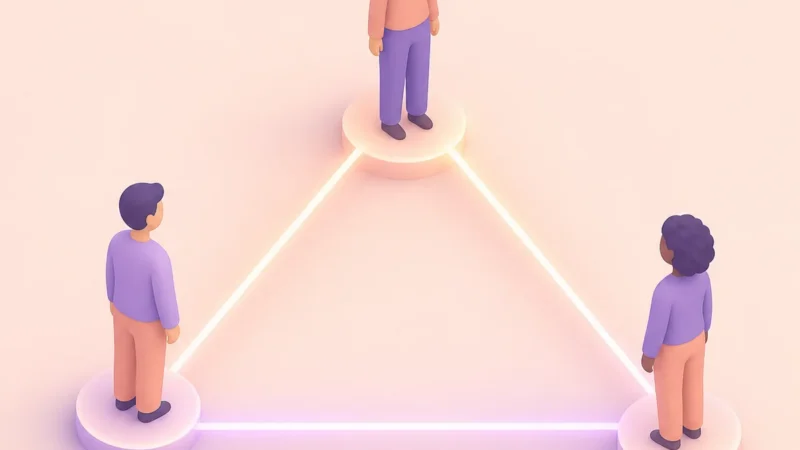
You agreed to the threesome. You talked it through. You set your boundaries. Then the moment comes — and suddenly you’re measuring yourself against the third partner in ways you didn’t expect. Their body, their confidence, the way they seem to move through the experience so effortlessly. And you? You feel like you’re shrinking.
Comparing yourself to a threesome partner is one of the most common emotional experiences people have — and also one of the least discussed. The silence around it makes it feel like something is wrong with you, when in reality, comparison is a predictable human response to a situation that deliberately places you alongside someone new in an intimate setting. This article unpacks why it happens and, more importantly, what you can do about it.

Table of Contents
- Why Comparison Happens in Group Intimacy
- The Three Types of Comparison That Show Up
- What Your Brain Is Actually Doing
- Practical Strategies to Interrupt the Comparison Spiral
- How to Talk to Your Partner About What You’re Feeling
- Building Self-Worth That Doesn’t Depend on Comparison
- When Comparison Is Actually a Signal Worth Listening To
Why Comparison Happens in Group Intimacy
Comparison isn’t a character flaw — it’s a cognitive shortcut your brain uses to assess social standing. In everyday life, you compare yourself to coworkers, friends, and strangers constantly, usually without even noticing. But during a threesome, the comparison volume gets turned up to maximum because the context is uniquely vulnerable: you’re physically exposed, emotionally raw, and sharing an experience that most people associate with exclusivity.

There’s also the simple fact that threesomes insert a new person into a dynamic that already exists between you and your partner. Even when everyone is welcoming and inclusive, your brain registers the third person as a source of social evaluation. “How do I measure up?” becomes an almost automatic question. Recognizing this as a normal neurological response — not evidence of weakness — is the first step toward dealing with it productively.
Psychologists who study social comparison theory note that people compare themselves most intensely when the comparison target is similar to them in some relevant way. In a threesome context, that similarity — being of the same gender, being in the same room, sharing the same partner — creates a perfect storm for the comparison instinct to activate.
The Three Types of Comparison That Show Up
When people talk about comparing themselves to a threesome partner, they’re usually referring to one of three distinct categories. Naming which one you’re experiencing makes it easier to address.
Physical comparison is the most visible and often the most painful. You notice differences in body shape, size, fitness level, or specific features. Maybe the third partner has a flatter stomach, broader shoulders, or an appearance that matches conventional attractiveness standards more closely than yours does. These observations can trigger body image spirals that have nothing to do with how your partner actually sees you.
Confidence comparison is more subtle but can cut deeper. The third partner seems more at ease, more expressive, more comfortable in their own skin. While you’re in your head analyzing every move, they appear to be fully present. What you may not realize: many people perform confidence in intimate settings specifically because they’re nervous. What looks like ease is often practiced composure.

Connection comparison is the fear that your partner seems more into the third person than they are into you — that the chemistry you’re witnessing means you’re being replaced or outshone. This type of comparison is the most relationship-threatening because it stops being about self-image and starts being about trust. It often masks a deeper need for reassurance that has nothing to do with the threesome itself.
What Your Brain Is Actually Doing (and Why It’s Not Your Fault)
Your brain on comparison is your brain in threat-detection mode. The amygdala — the part responsible for processing emotional responses — activates when you perceive a potential threat to your relationship security or self-image. This isn’t rational deliberation; it’s a physiological reaction that happens faster than conscious thought. Your body might tense, your breathing might shallow, and your mind might flood with critical self-talk before you’ve even decided to go there.
Understanding this is freeing because it reframes comparison as biological, not characterological. You’re not insecure or weak for comparing yourself to a threesome partner — you’re experiencing a neurochemical cascade that evolved to keep you alert to social threats. The goal isn’t to eliminate this response (impossible) but to recognize it for what it is and choose a different response.
Research on social comparison, including work published in outlets like Psychology Today, shows that upward comparison — measuring yourself against someone you perceive as better off — is the most common form of social comparison and one of the strongest predictors of decreased self-esteem. The key insight is that comparison alone doesn’t cause harm; it’s the rumination that follows — the replaying, the catastrophizing, the what-if spiraling.
Practical Strategies to Interrupt the Comparison Spiral
When you catch yourself comparing, you need a go-to interruption strategy. Here are four that work in the moment and in the aftermath.
1. Name it out loud (internally). Simply thinking “I’m comparing right now” creates a small gap between the feeling and your reaction to it. This technique — called cognitive defusion in acceptance and commitment therapy — reduces the emotional charge of the thought by treating it as an event in your mind rather than a fact about reality.
2. Shift from “they are” to “I feel.” Instead of “they’re more attractive than me,” try “I’m feeling less attractive right now.” The first statement treats comparison as objective truth; the second treats it as a temporary emotional state. Emotions pass. Facts you tell yourself stick around.

3. Use your partner as an anchor. If your partner is present and the dynamic allows, a brief moment of eye contact or a small touch can pull you out of your head and back into the room. You don’t need to have a conversation — just reconnect with the actual person you’re with, not the story about comparison you’re writing in your mind.
4. Breathe through it. It sounds too simple to matter, but controlled breathing activates the parasympathetic nervous system and signals to your amygdala that the threat has passed. A slow four-count inhale and six-count exhale, repeated three times, can reset your physiological state enough to regain perspective.
If you find yourself cycling through comparison thoughts in the days following the experience, it can also help to approach the feeling with curiosity rather than judgment. Ask yourself: what specifically am I comparing? Where did I learn that this particular trait matters? Whose standard am I measuring myself against?
How to Talk to Your Partner About What You’re Feeling
Bringing up comparison feelings with your partner is hard. It can feel like admitting weakness, or worse, like you’re criticizing the experience they enjoyed. But keeping it to yourself almost guarantees the feelings will fester — and your partner can probably tell something is off anyway.
The most effective way to start this conversation is with “I” statements that own the feeling without projecting blame. Try something like: “I noticed I was comparing myself to [name] during our time together, and those feelings have stuck with me. I’m not asking you to fix anything — I just wanted you to know what’s going on in my head.” This framing does three things: it names the issue, it clarifies that you’re not attacking the experience, and it lowers the pressure on your partner to solve the problem immediately.
If your partner responds with reassurance, let yourself receive it. One of the hardest parts of comparison is that it can make reassurance feel hollow — like your partner is just being nice. But unless you have concrete evidence otherwise, trust what they tell you. Their experience of you is not the same as your experience of yourself.

For couples who find comparison becomes a recurring theme, the skills covered in understanding jealousy in non-monogamous relationships overlap significantly — many comparison spirals are actually jealousy wearing a different outfit. Recognizing the pattern can help you address the root rather than the symptom.
Building Self-Worth That Doesn’t Depend on Comparison
Comparison loses its power when your sense of self isn’t riding on being “better than” someone else. But building that kind of self-worth takes practice — it’s not something you decide to have and then suddenly possess.
Start by noticing what you brought to the experience rather than what you lacked. Did you communicate clearly beforehand? Did you check in with your partner? Did you show up authentically rather than performing? These contributions matter far more to the quality of a threesome than any physical attribute, even if they’re less visible to the comparison-minded brain.
It also helps to expand your definition of what makes someone desirable beyond physical appearance. Someone can be drawn to your energy, your humor, your attentiveness, the specific way you touch them, the trust you’ve built together — none of which shows up in a side-by-side comparison of bodies. The third partner doesn’t have your history with your partner, your inside jokes, or the intimacy scaffold that only time can build.
This connects to the broader work of building confidence for ENM dating, which emphasizes that confidence in non-monogamous contexts comes from knowing your value isn’t relative — it’s intrinsic. The third partner isn’t your competition because the goal isn’t to win; the goal is a positive shared experience.
When Comparison Is Actually a Signal Worth Listening To
Not all comparison is irrational. Sometimes the voice that says “something feels off here” is pointing at a legitimate concern. The trick is distinguishing between distorted self-criticism and genuine intuitive signals.
Ask yourself these questions: Did your partner actually treat you differently during the experience? Did they check in with you? Did they prioritize the third partner’s experience over your comfort? If the answers point to a real imbalance — not just your perception of one — then comparison may be alerting you to a relationship dynamic that needs attention, not just a self-esteem wobble.
Comparison becomes useful when it moves you toward action rather than rumination. If you notice you always feel diminished around a particular type of third partner, that’s information about what dynamics work for you and which ones don’t. You can use that data to make different choices next time — a different type of person, a different pace, or a conversation with your partner about what you need to feel secure.

Learning to handle rejection in ENM dating builds the same psychological muscle: the ability to experience a difficult feeling without letting it define you. Comparison and rejection are cousins — both trigger the same social-threat response, and both can be processed with many of the same tools.
Comparison Interruption Scripts: What to Tell Yourself in the Moment
When the comparison spiral starts, having a pre-loaded phrase can stop it before it gains momentum. Here are scripts to try — pick the one that feels most natural and have it ready:
- “My brain is doing its comparison thing again. This is biology, not truth.”
- “I am here. I am enough. I don’t need to be the most anything.”
- “My partner chose to be here with me. That’s the data that matters.”
- “Comparison is a feeling, not a fact. Feelings pass.”
- “What if I spent this energy on enjoying myself instead of evaluating myself?”
- “The third partner is not my mirror. Their strengths don’t reflect my weaknesses.”
If comparison becomes a pattern that affects your willingness to explore group intimacy, working with a therapist who understands non-monogamous relationships can be transformative. You don’t have to figure this out alone — and the fact that you’re reading this means you’re already doing the work.
If you’re also struggling with feelings of not being enough, processing feelings of inadequacy after a threesome offers a step-by-step guide to recovering your sense of self in the days following the experience.
Editor’s note: This article is part of 3Cupid’s ongoing series on emotional well-being in non-monogamous dating. All content is intended for readers 18+ and reflects our commitment to informed, respectful exploration of relationship diversity.