Knowing what a RADAR check-in is and actually running one are two different things. The good news: the format is simple enough that you can run a RADAR check-in well on your first try if you set it up deliberately. This guide walks you through the mechanics — how to set the container, work the five steps, pick your topics, and handle the hard moments — so the conversation feels structured rather than awkward, and actually leaves you closer afterward.
Table of Contents
- Set the Container First
- Work Through the Five Steps
- The Topics to Cover Every Time
- Scripts for the Hard Conversations
- Common Mistakes That Sabotage a Check-In
- After the Check-In
Set the Container First
The container is everything: when, where, and how you meet shapes what you are willing to say. Pick a time when neither of you is rushed or exhausted, and a place that feels neutral and private. Agree on a rough length — forty-five minutes to an hour is a good default — so neither of you is watching the clock or afraid the conversation will never end.
Put the phones away, or at least face down and silenced. If you have children or a busy household, choose a time when you are unlikely to be interrupted. A drink and a comfortable seat help too. These small choices signal to each other that this conversation matters, and they remove most of the friction that turns a check-in into an argument before it even starts.
Run a RADAR Check-In in Five Steps
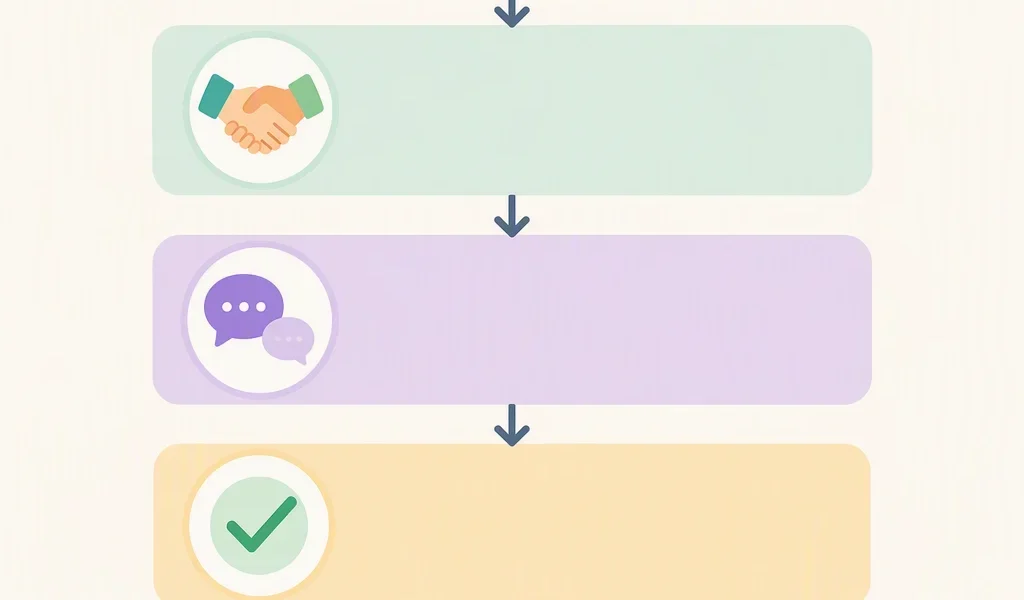
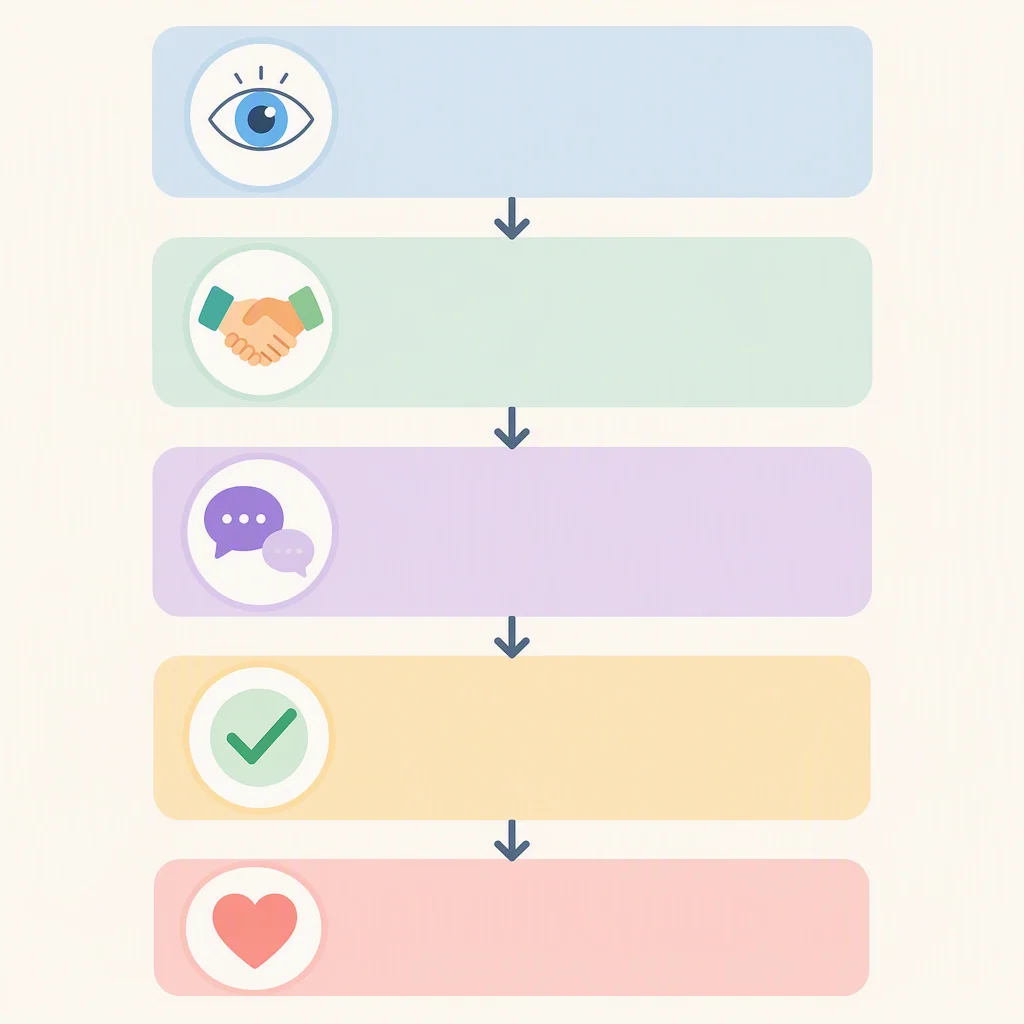
Once the container is set, move through the five RADAR steps in order. Resist the urge to skip ahead to the discussion — the first two steps are what keep the conversation from collapsing into a free-for-all.
1. Review the Past Period
Go over what has happened since your last check-in, sticking to facts. If this is your first one, review the past month. If you have action points from before, check in on them honestly — accomplished, half-done, or dropped — without blame. The tone here is “here is what has been going on,” not “here is everything you did wrong.”
2. Agree on the Agenda
Decide together what you will discuss. Using the recurring topic list keeps this quick: you are agreeing on scope, not yet diving into content. If one of you knows there is a difficult topic to raise, name it here so it gets its own space rather than ambushing the other person mid-conversation.
3. Discuss Each Topic
Now talk, one topic at a time, with the goal of understanding rather than winning. Use active listening — reflect back what you heard before responding. If emotions spike, pause and breathe; you can always come back to a topic next check-in. The discussion phase is not where every issue gets resolved, it is where every issue finally gets said out loud. For a broader look at how communication shows up across non-monogamous relationships, this Psychology Today overview of polyamory is a useful companion.

4. Agree on Action Points
For anything that needs change, write down a specific, small commitment. The best action points are observable and dated: “we will have a phone-free dinner together once a week” is better than “we should spend more time together.” If a topic has no obvious action, that is fine — not every discussion needs a deliverable.
5. Reconnect
Close by appreciating each other with one or two specific, sincere compliments, or by doing something that feels good together. This step is non-negotiable: it tells your nervous system the hard conversation is over and the connection is intact. Ending warm is what makes you both willing to do this again next month.
The Topics to Cover Every Time
The default RADAR agenda covers the areas that most commonly drift or cause friction in a relationship. Touching each one — even briefly, even when things feel fine — is the point. Problems hide in the topics you never get around to mentioning.
- Quality time — how much and how good it feels
- Sex and intimacy — needs, changes, and anything left unsaid
- Health — physical and emotional, including sleep, stress, and testing
- Other partners — how other connections are going, without comparison
- Disagreements — unresolved friction worth revisiting calmly
- Money, work, travel, family, and household — the logistics of a shared life

Customize freely. A solo-poly person might drop “household” and add “personal goals.” A couple opening up for the first time might add “boundaries with new dates.” The list is a starting point, not a rule. What matters is that you cover the same set each time so nothing gets silently dropped.
Scripts for the Hard Conversations
The hardest part of any check-in is saying the difficult thing. Having a phrase ready lowers the barrier. Here are a few openings you can adapt:
- “I’ve noticed I’ve been feeling insecure lately, and I want to talk about it before it grows.”
- “When you canceled our last two plans, I felt unimportant. Can we figure out a fix together?”
- “I’m struggling with jealousy around your new connection, and I’d like us to problem-solve it.”
- “Something about our last argument is still sitting with me. Can I share it now?”
- “I want to check in on our boundaries and whether anything needs updating.”
Notice the shape: name the feeling, describe the trigger without blame, and invite collaboration. That formula keeps the conversation on the problem instead of on who is at fault. If communication styles are part of the friction, our guide to navigating different communication styles in polyamory offers more tools.

Common Mistakes That Sabotage a Check-In
Even with good intentions, a few habits reliably derail the process. Watch for these.
| Do | Don’t |
|---|---|
| Schedule it in advance and treat it as a real commitment | Spring it on your partner out of nowhere |
| Stick to one topic at a time | Dump a backlog of grievances all at once |
| Use “I” statements about your own feelings | Use “you always” and “you never” accusations |
| Pause and cool off when emotions spike | Push through while triggered and regret it later |
| End with appreciation and reconnection | Wrap up on the hardest topic and walk away |

The most common failure is treating the check-in as a place to win. If either of you is keeping score, the container breaks. Remind yourselves going in: this is maintenance, not a courtroom. The goal is a healthier relationship, not a verdict.
After the Check-In
The check-in does not end when you stand up from the table. The action points you agreed on need follow-through, or the whole exercise becomes talk with no teeth. Write them down somewhere you will both see them — a shared note or even the calendar — and glance at them between check-ins. If scheduling the follow-through is itself a struggle, our guide to time management in polyamorous relationships can help.

Between check-ins, let the hard conversations stay in their container. You do not have to relitigate the tough topics every evening; knowing there is a standing space for them is precisely what frees up the rest of your time together. And if your relationship has a hierarchy or nesting structure, the same check-in works there too — our piece on relationship hierarchy in non-monogamous dating explains how to adapt the rhythm to different relationship shapes.
Run a RADAR check-in once and it is just a meeting. Run it monthly and it becomes the quiet infrastructure that keeps a relationship honest, current, and close. If you want the big-picture view of what the method is and where it comes from, start with our guide to what a RADAR check-in is.
This article is intended for adults 18+ and is offered for general information. Healthy non-monogamy rests on clear communication, mutual respect, and enthusiastic consent between all partners.