There is a very specific kind of relief in coming home, dropping your bag by the door, and not having to translate anything. You mention that your partner is staying over on Thursday and nobody asks which partner. That is what non-monogamous roommates offer, and it is worth more than most people expect before they have it.
This guide is about the practical side of it: where to find housemates who already speak your language, which rules actually need writing down, how to handle overnight guests without building quiet resentment, and what to do when the arrangement stops working. None of it requires you to be anyone’s best friend. It requires you to be clear up front, which is a smaller and far more reliable job.
Table of Contents
- What Non-Monogamous Roommates Actually Fix
- Where to Find ENM-Friendly Housemates
- The House Rules That Matter Most
- Overnight Guests Without the Resentment
- Sound, Schedules, and Shared Walls
- Money, Names on the Lease, and the Exit Plan
- When a Roommate Turns Out to Be Judgmental
- FAQ: Living With Non-Monogamous Roommates
What Non-Monogamous Roommates Actually Fix
The obvious benefit is not having to explain yourself. The bigger one is that a whole category of small friction never shows up. Nobody asks why there are two toothbrushes in the bathroom. Nobody reads a Wednesday-night visitor as a crisis. Nobody quietly decides you are the unreliable one because you keep odd hours. You get your energy back, and energy is the thing non-monogamous people run out of first.
Be honest with yourself about the shape of it, though. Some people want a house where everyone knows everyone and Sunday dinner happens by accident. Others want polite distance and a clean kitchen. Both work; mixing them is where it goes wrong. If you have strong feelings about which one you are, the kitchen table vs parallel polyamory distinction is a useful shorthand to bring to the first house meeting, and solo polyamory and relationship anarchy covers the version where your home is deliberately yours alone.
Shared housing also does not fix loneliness on its own. A house full of people who are merely tolerant is not the same as a house full of people who are glad you are there. If that is the feeling you are chasing, loneliness in polyamory is worth reading alongside this.
Where to Find ENM-Friendly Housemates
Generic flatshare listings can work, but the ones that do tend to be specific. A listing that says “queer and ENM-friendly household, two cats, quiet after eleven” will filter out most of the people who would have been a poor fit, and it will do that filtering before you spend an evening interviewing them. Vagueness in a listing gets you volume, not quality.
Local community is still the strongest channel. People who show up consistently at a monthly gathering are people whose behaviour you have already observed under mild stress, which is more than any interview gives you. If your city has one, start there; if it does not, finding ENM community in a new city walks through building it, and organising an ENM meetup is the fastest version I know of. Larger events work too — your first non-monogamy conference tends to produce at least three housing conversations you did not plan on having.
Two screening questions do most of the work. First: what does a good Tuesday night look like for you at home? Second: what is the last thing a roommate did that annoyed you? The first tells you about pace and the second tells you about tolerance, and neither has a wrong answer — you are only checking for compatibility. If someone cannot answer the second one at all, that is its own answer.
The House Rules That Matter Most
Almost every shared-house blowup I have heard about traces back to one of four things: guests, noise, shared spaces, and money. Everything else can be settled at eleven at night with a text.
Write the four down before anyone signs anything, and write them as defaults rather than laws. A default is something that holds unless somebody asks; a law is something that has to be broken before anyone talks. Defaults get discussed, laws get resented. The American Psychological Association’s overview of healthy relationships is a decent shared reference if you want language for why this matters, and Psychology Today has a plain page on relationships that covers the same ground in everyday terms.
| Rule | Why it matters | A workable default |
|---|---|---|
| Guest notice | Removes the surprise that people actually react to | A heads-up in the house chat by the evening before |
| Quiet hours | Protects sleep, which protects everything else | Quiet from 11pm on weeknights, 1am weekends |
| Overnight frequency | Turns a feeling into a number you can discuss | Up to three nights a week per person, more by asking |
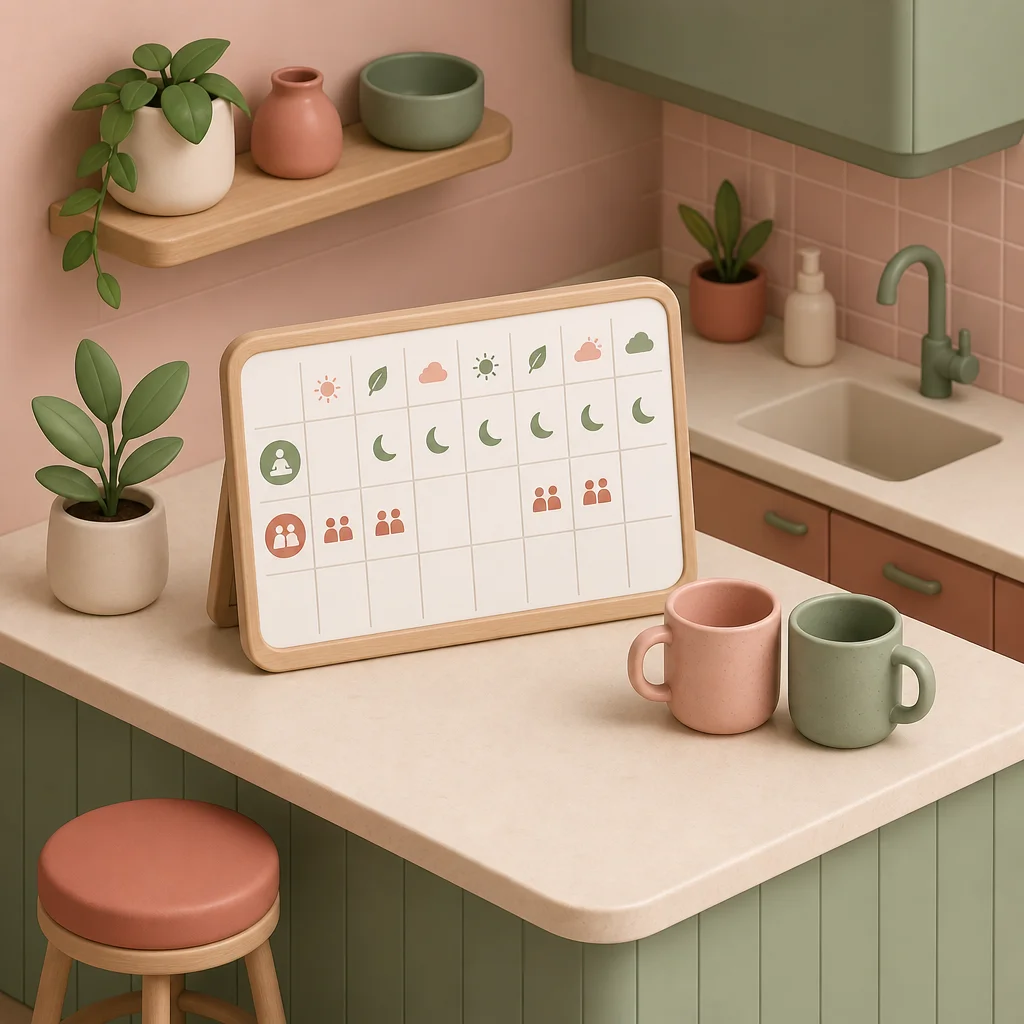
| Shared space booking | Stops two people planning the same sofa on the same night | A shared calendar, first to claim holds |
If your household runs on very different communication styles, agree on the channel as well as the content. Some people will never read a whiteboard and some people will never scroll back through a group chat; navigating different communication styles goes deeper on that, and a regular radar check-in gives everyone a standing place to raise the small stuff before it hardens.
Overnight Guests Without the Resentment
Guests are where good arrangements quietly fall apart. Not because anyone is unreasonable, but because the cost is uneven. The person with a partner who lives forty minutes away hosts almost every time, and after two months the person who never hosts starts to feel like they are paying for a party they were not invited to. Nobody says it. Then somebody says it badly.
The fix is to make hosting legible and bounded. Here is a short version you can adapt:
- Say who, roughly when, and how long — a name and a window is enough, a biography is not.
- Keep the first visit short. A guest who leaves before breakfast on visit one gets invited back more easily.
- Common areas stay common. A guest parked on the sofa for six hours is a different load than a guest who is in a bedroom.
- Guests do not get a key, a code, or a parking spot without a separate conversation.
- If you host more than your share, offer something concrete back — a week of dishes, the bigger grocery run.
- Nobody is obligated to socialise. A nod in the hallway is a complete interaction.
One more, and it is the one people forget: the person hosting is responsible for their guest the entire time. If your guest leaves the kitchen a wreck, it is not your guest’s mess to fix, it is yours. Say that out loud on day one and most of the friction never starts.
For the safety side of bringing new people into a home you share — especially if you have not met them in person yet — first meetup safety is the checklist to run first, and social media privacy in non-monogamy covers what your housemates can reasonably expect you not to post about them.
Sound, Schedules, and Shared Walls
Thin walls are the least glamorous and most common source of tension in shared housing, and they are worth planning around rather than hoping about. Before signing, walk the flat at eight in the evening rather than two in the afternoon, run the tap in the bathroom, and stand in the bedroom while someone talks in the living room. You will learn more in five minutes than in five weeks of living there.
Practical fixes are cheap and they stack: a rug under the shared-wall bed, a door sweep, a white-noise machine in the room that faces the street, and a house agreement that the washing machine does not run after ten. None of these are romantic. All of them remove a recurring reason for irritation, which is basically what a good household is made of.
There is a cultural fix too, and it costs nothing. The sentence “I am going to take the living room for a couple of hours around eight” prevents a great deal of silent annoyance. Claiming a shared space out loud is not rude; it is how adults with complicated time management across several relationships keep from colliding.

Money, Names on the Lease, and the Exit Plan
Talk about money before you talk about feelings, because money is the part that ends up in writing anyway. Who is on the lease, who is on the utilities, what happens to the deposit, and what the notice period is — those four answers determine how hard it is to leave, and you want to know that before you need to.
The most common trap is the single-lease household where one person is legally on the hook for everyone. It is fine when things are good and it is a genuine problem when they are not. If you go that route, write a simple house agreement on top of it: how rent is split, who covers a shortfall, and how long someone has to find a replacement before the others can. It does not have to be a legal document to be useful; it has to exist.
Then write the exit plan while everyone still likes each other. Thirty days notice, deposit returned within two weeks of the walkthrough, replacement found jointly, nobody’s partner counted as a resident until the group agrees. If you have moved cities with partners before, relocating with multiple partners covers the larger version of the same problem, and pets in polyamory is the section people forget until the dog is standing in the hallway.

When a Roommate Turns Out to Be Judgmental
Sometimes the person who seemed easygoing at the interview turns out to be quietly uncomfortable with the whole arrangement. It usually shows up sideways: a comment about the parade of people, a sudden concern about security, an unusual interest in who slept where. The instinct is to explain your entire philosophy in one sitting. Resist it.
Start with the smallest true version of the thing, and start with logistics rather than identity. “I want to make sure the guest situation feels fair to you — is there something specific that is bothering you?” gets you information. A twenty-minute defence of ethical non-monogamy gets you a roommate who nods and changes nothing.
If it escalates into comments about your character, that is a different situation, and red flags in polyamory covers the difference between discomfort and contempt. You are allowed to finish a lease and leave. You are also allowed to decide that a house is not the place to work this out, and to keep your personal life out of it from then on.
Most of the time it does not come to that. Most of the time a clear house agreement, a shared calendar and one honest conversation is the entire difference between a flat you tolerate and a home you are glad to walk into. If you are still deciding whether to say anything at all to the people you live with, talking to your roommate about non-monogamy goes through that decision specifically — and if you are looking for non-monogamous roommates to share the place with in the first place, there are plenty of us right here at 3Cupid.
Editorial note: This article is general relationship and housing information for adults. It is not legal or medical advice. Tenancy rules vary by location, so check your local regulations or speak with a qualified professional before signing anything.
FAQ: Living With Non-Monogamous Roommates
Do I have to tell my roommates I am non-monogamous?
No. You owe them logistics, not your relationship history. What they reasonably need is the practical shape of it: roughly how often someone stays over, whether a guest will ever be in shared spaces, and how to reach you. The identity label is optional and entirely yours to offer.
How many overnights per week is reasonable?
Three nights a week is a common default and it works because it is a number, not a feeling. If your actual pattern is heavier, the fix is to say so early rather than to creep past it quietly. Whatever you agree, write it down while the household is still friendly.
Should my partners be on the lease?
Usually not, and often your lease will not allow it. A partner who stays three nights a week is a guest, not a tenant, and keeping that line clear protects everyone — including the partner, who probably does not want liability for a flat they did not choose.
What if the two of us want different things from the house?
Name it before you sign, not after. One person wanting a chosen-family household and the other wanting polite distance is not a small mismatch, and no amount of goodwill fixes it. It is much cheaper to keep looking for another month.
Is it safer to live only with other non-monogamous people?
It is more comfortable, which is a real benefit. It is not automatically safer — a shared-values household can still have someone who treats consent casually. Use the same screening you would use anywhere, and keep your own exit plan regardless of who signs the lease.