
Ask people in non-monogamous communities what caused their worst logistical fight and you will hear about calendars, holidays, and someone’s mother. Ask what caused the most painful one and you will often hear about a dog. Animals do not understand relationship structures, they do not read group chats, and they cannot consent to being moved between houses every other week.
Here is the short version. Pets in polyamory run into trouble when ownership is assumed rather than written down. The fix is boring and effective: one named legal owner, one named backup caregiver, a schedule built around the animal’s actual tolerance for change rather than around human fairness, and a documented plan for the day a household splits. This guide walks through all four.
It is written for adults with more than one partner, for people dating someone who shares a home with other adults, and for anyone who has ever discovered mid-breakup that nobody knows whose name is on the microchip registration.
Table of Contents
- Why Pets in Polyamory Complicate Simple Decisions
- Decide Legal Ownership Before You Merge Anything
- Custody Schedules That Work for the Animal
- When a New Partner Enters the Picture
- Money, Vet Decisions and Emergency Consent
- Breakups, Move-Outs and the Rehoming Question
- A Pet Agreement You Can Copy
- Frequently Asked Questions

Why Pets in Polyamory Complicate Simple Decisions
In most legal systems, a dog or a cat is property. That is an ugly word for a family member, but it is the framework a court will use if things go badly. Property has an owner. When three adults have all been buying the food, walking the dog and paying the vet bills, there is no obvious owner, which means there is also no obvious answer. The relationship that ends up deciding is often whichever one is calmest on the worst day, not whichever one is most fair.
There is also an attachment problem that has nothing to do with paperwork. A dog bonded to two people in different houses experiences every handover as a small loss. Cats, who are territorial rather than pack-oriented, often experience a move between homes as a genuine threat. The human instinct to split time evenly comes from a place of fairness and lands on the animal as instability.
And then there is the layer nobody plans for: metamours. Your pet may end up being cared for by someone you have never met, or by a partner’s partner, purely because they were the one with a free afternoon. If you want that to go well, it helps to have a decent relationship with the people in the wider network, which is its own project. Our guide to what a metamour actually is covers the groundwork.
The research on human-animal bonds is unambiguous about one thing: these relationships carry real emotional weight for the humans involved. The American Psychological Association treats the human-animal bond as a genuine psychological relationship, not a hobby. That weight is exactly why the paperwork matters.
Decide Legal Ownership Before You Merge Anything
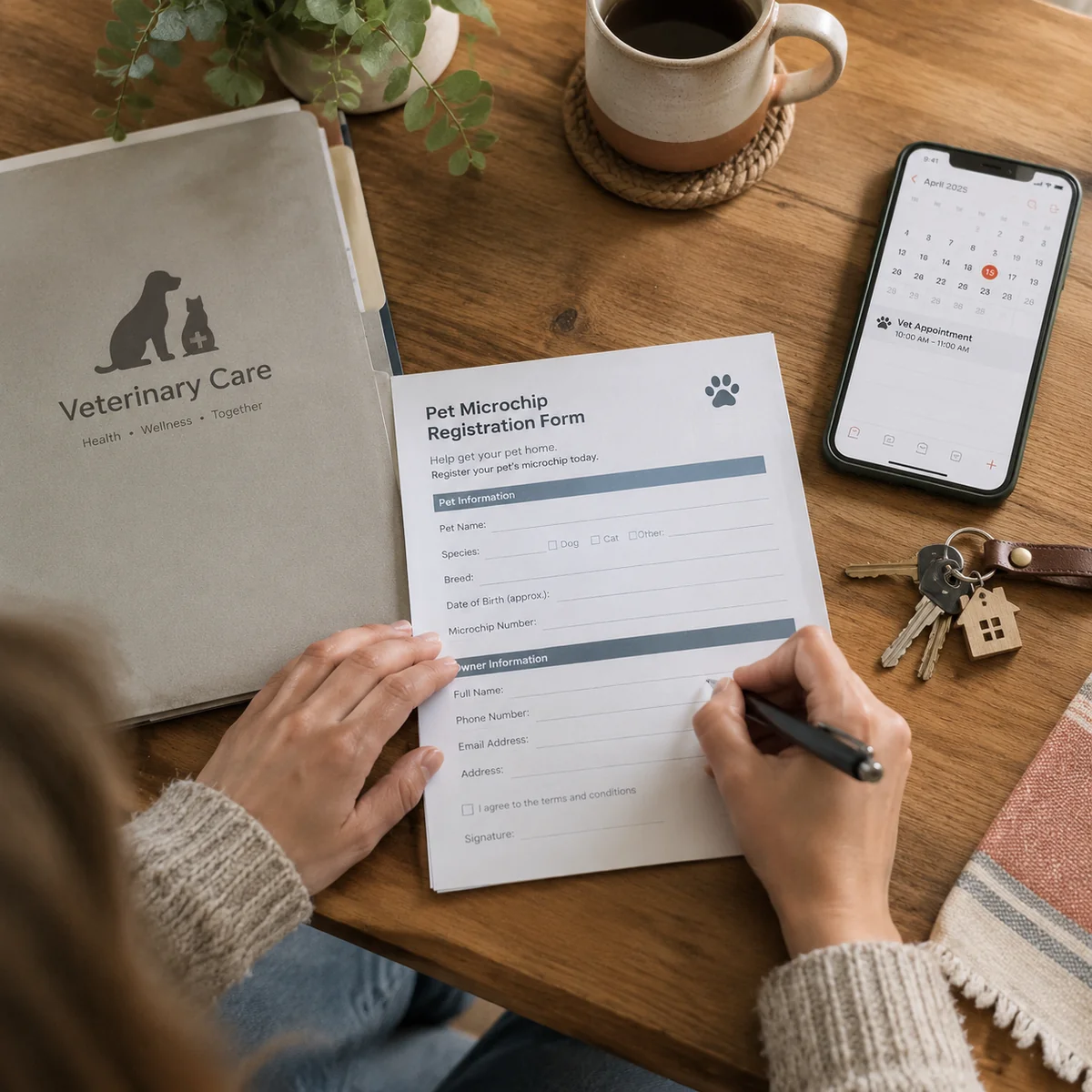
The single most useful decision you can make is naming one legal owner. Not because the other adults do not matter, but because ambiguity is what turns a sad breakup into a legal one. One name on the adoption contract, the microchip registration and the vet account. Everyone else can and should be named as authorised caregivers in a separate written document.
This is uncomfortable to raise when a relationship is going well, which is precisely why it should be raised then. The conversation is not “this dog is mine and not yours.” It is “if something happens to me, or if we split, this is the name the vet and the microchip company will look for, so let us make sure it is the right one.”
- Adoption or purchase paperwork, with one name clearly recorded
- Microchip registry contact details, current and in one adult’s name
- Vet practice account: who is the registered client and who may book appointments
- Pet insurance policy, including who pays the premium and who is the beneficiary
- A written caregiver authorisation naming at least one other adult, updated annually
- A line in your will or estate documents about the animal, since pets cannot inherit directly
If two adults genuinely cannot choose, joint ownership is possible, but go in with eyes open: joint ownership means joint liability, and it means either person can usually make decisions the other disagrees with. Some practices will not release an animal to a non-registered person at all, regardless of what your household agreement says. Call your vet and ask before you rely on it.
The same logic applies to the home itself. If you are merging households, the animal arrangements belong in the same document as rent, chores and guests. Our walkthrough for living together in polyamory has a structure you can add a pet clause to.

Custody Schedules That Work for the Animal
Human fairness says split evenly. Animal welfare says minimise disruption. Those two goals are not the same, and the animal should win the tie. A dog who loves people and new places can often handle a week-on, week-off rhythm. A cat who has lived in one flat for six years generally cannot, and forcing it produces the exact behaviours people then blame on the cat: hiding, refusing the litter tray, over-grooming.
The model that works for most polycules with a cat is a fixed home base plus visits. The cat stays put. Humans move. For dogs, a home base with generous visiting also beats a strict rotation, because the dog keeps one primary territory while still getting the other household’s company.
| Schedule model | Suits | Watch out for |
|---|---|---|
| Fixed home base plus visits | Cats, senior dogs, anxious animals of any species | The non-resident adult can drift into feeling like a guest rather than a co-carer |
| Week-on, week-off | Confident, social dogs; two homes with similar layouts | Handover days spike stress; feeding and medication routines slip unless written down |
| Weekdays with one adult, weekends with another | Dogs whose needs track work schedules | Vet and grooming appointments end up unequally shared and resentment builds quietly |
| Long-stay rotation of three or four weeks | Animals with strong bonds in both homes | Requires both homes to be fully equipped, which doubles the cost |
| Travel-with-partner arrangement | Animals already comfortable in cars and new spaces | Hard on the animal if the human’s travel is irregular or last-minute |
Whatever you pick, write the feeding times, the medication doses and the walk routine into a note on the fridge rather than trusting memory. Most preventable pet emergencies in shared households are double-feedings or missed doses during a handover week, not dramatic accidents.
If your schedule already feels tight before an animal is involved, adding one will expose it. Time management across multiple relationships is worth revisiting before you commit to a shared dog.
When a New Partner Enters the Picture
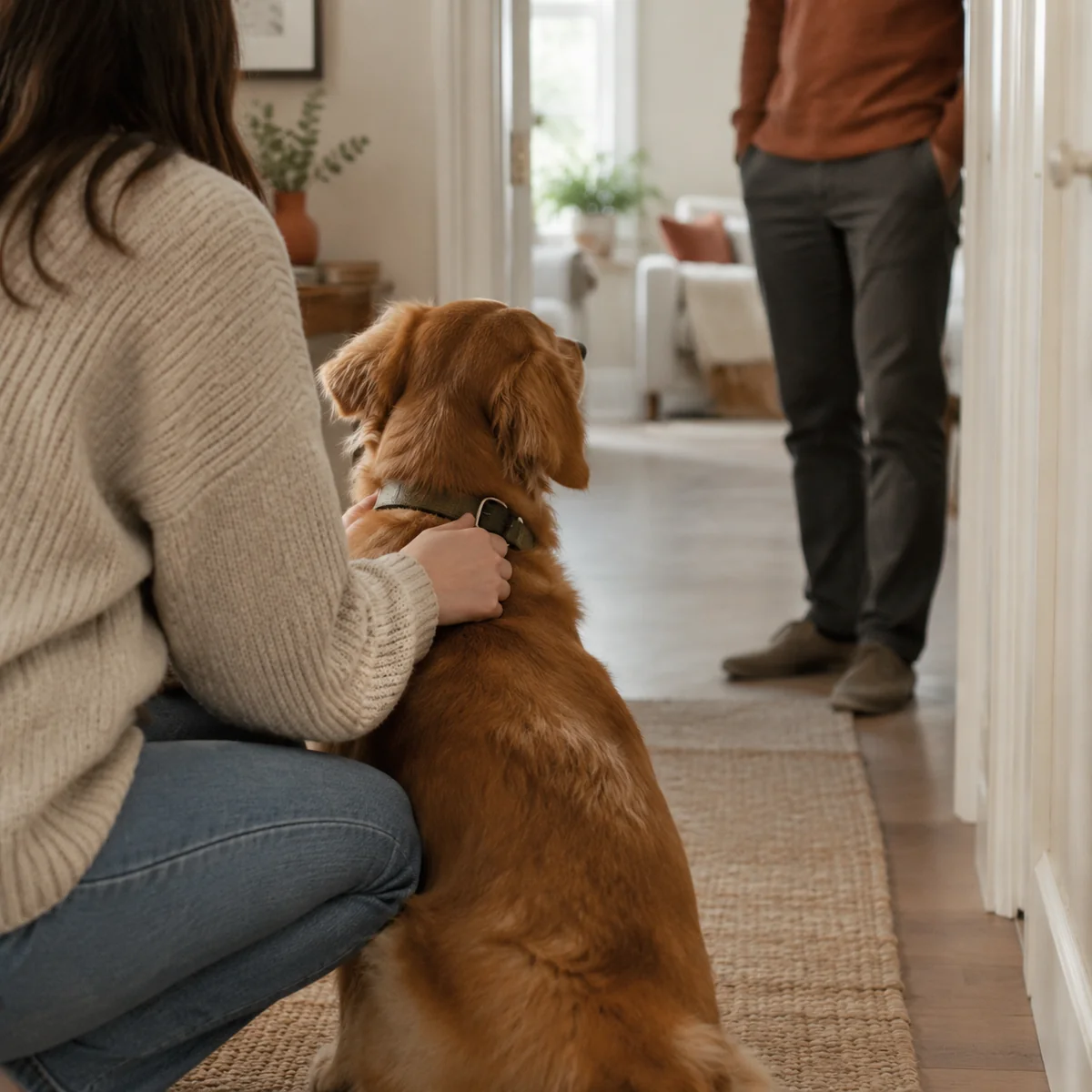
A new partner is a stranger to your animal, and your animal’s opinion of them will shape how often you can actually see each other. Take it slowly. The practical mechanics of how to introduce a partner to your pet deserve their own full walkthrough, but the relationship-level points belong here.
First: resist the urge to make your pet like your partner. Animals read pressure. A dog who is repeatedly pushed toward someone new can form a negative association with that person that takes months to undo, and a cat will simply stop coming out when they visit, which reads as rejection to the human and as common sense to the cat.
Second: watch your own jealousy in both directions. It is genuinely unsettling to realise your dog greets a new partner with more enthusiasm than they greet you, and it is equally unsettling to be the new partner being barked at every time you arrive. Neither is a verdict on the relationship. If the feeling is sharp and persistent, working through jealousy is the useful frame.
Third: be honest about allergies and fear early. A partner who is quietly terrified of dogs will not say so on date three, and hiding it costs you six months of awkward visits. This is a logistics conversation, not a romantic one. If someone in the network has a health condition that affects what is possible, navigating chronic illness in ENM has language for it.

Money, Vet Decisions and Emergency Consent
A routine year with a medium-sized dog costs real money: food, preventatives, grooming, insurance or savings, and at least one unplanned vet visit. Multiply that by the number of adults who assume someone else is covering it and you have the most common source of resentment in shared pet arrangements. Decide the split in advance and write the number down.
- Who pays the routine costs: one person, or a fixed split recorded somewhere both can see
- What counts as an emergency expense, and the spending threshold one adult can approve alone
- Whether you carry pet insurance or keep a dedicated savings buffer instead
- A signed vet authorisation letting a named partner collect the animal and consent to treatment
- Who is reachable during working hours, and who the practice should call second
- What happens if one adult’s income changes and they can no longer pay their share
That fourth item is the one people skip and later regret. Without a written authorisation, many practices will stabilise an animal but will not proceed with significant treatment on the word of someone who is not the registered client. Ask your practice for their own form; most have one. If your finances are already interwoven with partners, financial planning in polyamorous relationships is the wider context.
For baseline care standards, the American Veterinary Medical Association’s owner resources are a solid, non-commercial reference point to agree on together, so nobody is arguing from a blog post.

Breakups, Move-Outs and the Rehoming Question
When a household splits, the animal usually goes with the legal owner, and that is the outcome your paperwork has already determined. If the non-owner adult has been the primary caregiver for two years, this can feel like a kidnapping even though it is legally unremarkable. Naming a backup caregiver and recording actual care hours alongside ownership is the only real protection, and it is much easier to establish before a breakup than during one.
Sometimes the honest answer is that nobody can keep the animal. Two adults moving into smaller places, a job relocation, a new baby with severe allergies, a dog whose separation anxiety has become unmanageable in a house that is empty more often than before. Rehoming is a painful and legitimate option, and doing it thoughtfully, through a breed rescue or a shelter that knows the animal, is far kinder than a year of improvised arrangements that quietly fail.
If children are attached to the animal, the explanation should be simple, true and short. Grown-ups sometimes over-explain and accidentally imply the pet chose to leave. For the wider family fallout, what to expect when divorce and non-monogamy overlap and supporting a partner through a polyamorous breakup both cover ground that applies here too.
A Pet Agreement You Can Copy
This is a practical module, not a legal document. Adapt it, date it, and have every adult in the household sign it. One page is plenty.
- Animal: name, species, age, microchip number, and a plain description.
- Legal owner: one name, matching the microchip registration and vet account.
- Named caregivers: up to two other adults who may collect, board and authorise routine treatment.
- Home base: the address the animal sleeps at most nights, and the reason for that choice.
- Visit schedule: which days, which adult, and who handles transport.
- Routine: feeding times and amounts, medication with doses, walk length, litter or yard routine.
- Money: monthly contribution per adult, and the emergency spending threshold.
- Medical: practice name, insurance details, and the end-of-life decision maker.
- Change clause: how the agreement gets revisited, and how much notice a change requires.
- Worst case: what happens if the owner dies, becomes unable to care for the animal, or if the household splits.
Revisit it once a year, or immediately after any housing change. An agreement nobody has looked at since the move is only slightly better than none. If you already have a household document, add this as an annex rather than a separate file: the polyamorous household agreement template is built for exactly this.
Frequently Asked Questions
Can two partners legally co-own a dog in a polycule?
Co-ownership is possible in many places, but it comes with joint liability and no clear tie-breaker when the two owners disagree. Most vets and registries work far more smoothly with one named owner plus written caregiver authorisations for everyone else.
Whose pet is it if we split up and both paid for everything?
Usually the person named on the adoption paperwork, the microchip registration and the vet account. Contribution to costs matters far less in practice than people expect, which is why updating those records early is worth the awkward conversation.
Is it fair to move a cat between two homes?
Most cats do better with one stable territory. If your cat hides for a day after every move, stops eating, or starts avoiding the litter tray, the rotation is costing them more than it is giving you. A fixed home base with visits is usually the kinder arrangement.
What should I do if my partner and I disagree about training methods?
Agree on a single approach before it matters, and pick force-free methods as the default. Mixed signals confuse animals and the argument is rarely really about the dog. If the disagreement is about whose rules apply in whose home, that is a boundaries conversation; see rules, boundaries and agreements.
Editorial note: This article is general relationship and pet-care information for adults. It is not legal advice or veterinary advice. Ownership rules vary by jurisdiction, and any decision about an individual animal should involve a qualified veterinarian.