There is a particular week when non-monogamy and caregiving stop being separate subjects. A parent falls, or a scan comes back, or the person who has always managed their own household quietly stops managing it — and the calendar you had balanced across two or three people suddenly has one column that outranks all the others. This guide is for that week, and for the long stretch that follows it.
Caregiving is not a relationship problem. It is a logistics problem that lands on a relationship. The people who get through it best are rarely the ones with the most emotional reserves; they are the ones who got specific early. Who does what. Who is named where. Who gets told the truth and who gets told less. Everything below is that kind of specific, written for adults who are already doing more than one thing at once.
Table of Contents
- What Non-Monogamy and Caregiving Do to a Calendar
- Deciding Which Partners Meet Your Parent
- Front Desks, Forms, and the One Named Person
- The Care Rota Nobody Writes Down
- When Caregiving Eats Your Relationship Time
- Asking for Help Without Dumping It on One Partner
- Red Flags and Green Flags in a Caregiving Season
- FAQ: Non-Monogamy and Caregiving
What Non-Monogamy and Caregiving Do to a Calendar
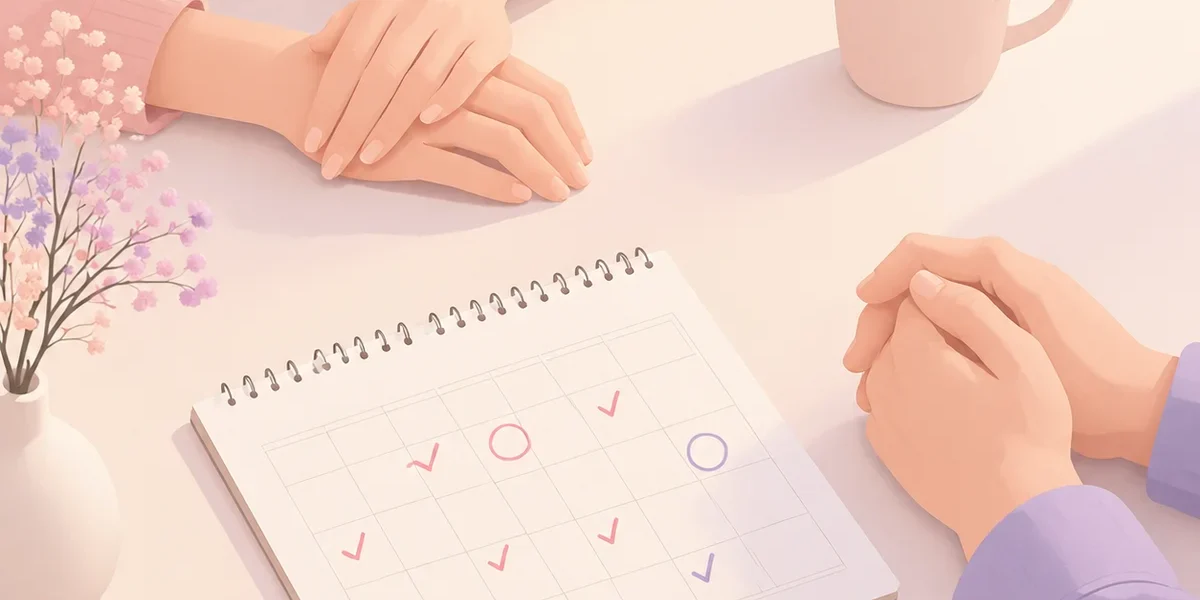
Most people assume caregiving eats time evenly. It does not. It eats time in clusters: a fortnight of almost nothing, then nine days of appointments, pharmacy runs, a discharge meeting and two nights on a fold-out chair. That shape is what breaks a relationship schedule, because it is unpredictable rather than merely large. A partner can plan around a standing Tuesday. Nobody can plan around a phone call.
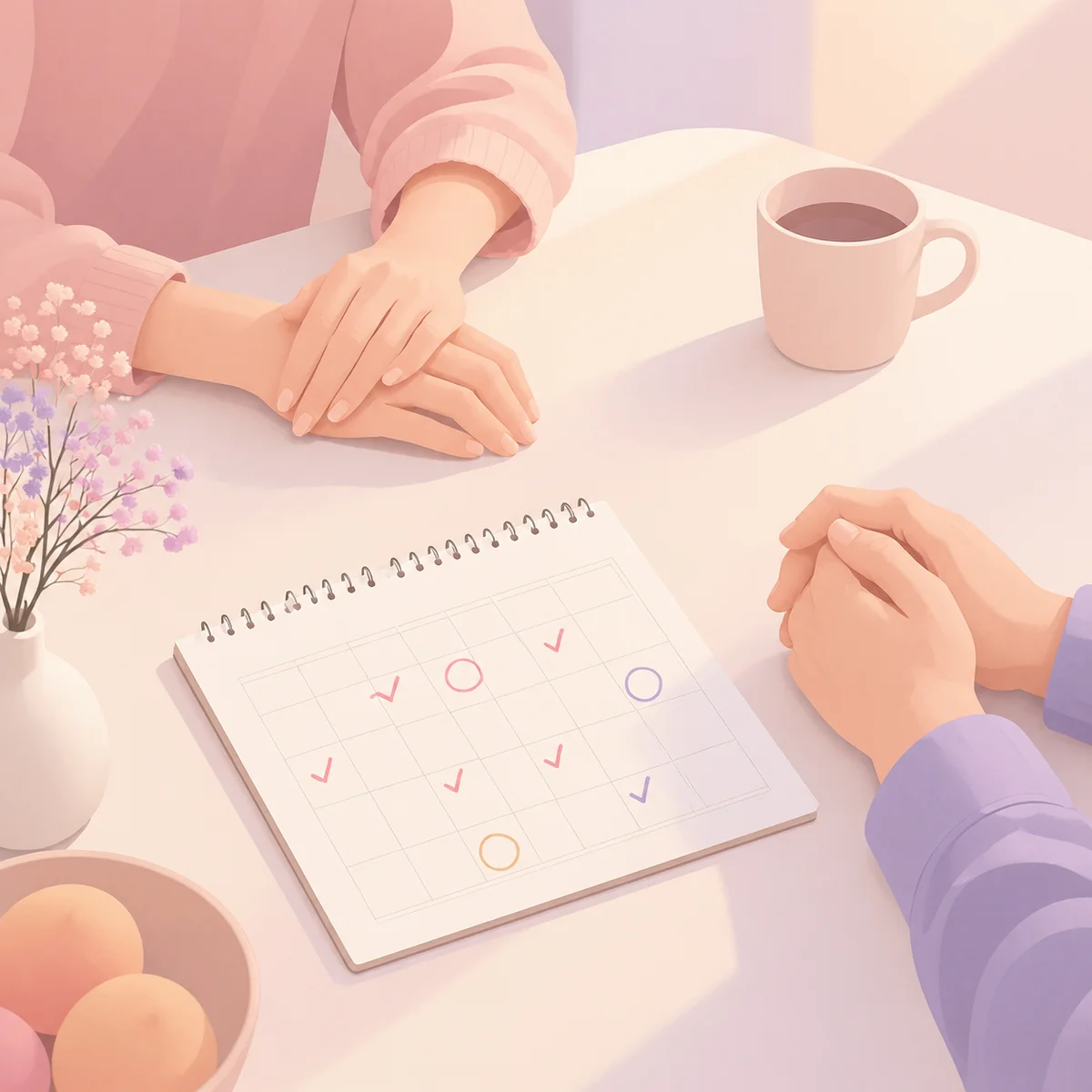
So the first practical move is to sort your time into three buckets and name them out loud. Fixed care — the appointments, the medication window, the overnight. Flexible care — the shopping, the driving, the phone calls that could happen any evening. Everything else — your job, your partners, your sleep. Once the buckets exist, you can tell a partner something true: the fixed block is immovable, the flexible block can move to accommodate them, and the third bucket is what is genuinely available. That sentence prevents most of the hurt.
The second thing worth naming is that caregiving is tiring in a way that changes what you want from people. Some weeks you will want company and will only have energy for the partner who sits quietly and does the washing up. Other weeks you will want to be taken out of the house entirely. Neither is a verdict on anyone. If you want the clinical framing of what sustained caregiving does to a person, the American Psychological Association’s topic page on caregivers and the National Institute on Aging’s caregiving resource are both solid, plain-language starting points.
Deciding Which Partners Meet Your Parent
Here is a decision that causes more anxiety than it should: not every partner needs to meet your parent, and not every partner wants to. Meeting a parent in a hospital corridor while they are frightened is not the introduction anyone would choose, and forcing a meet under those conditions tends to cost more than it buys.
A useful filter is three questions. Does this partner want to be part of this part of your life? Would their presence make the visit easier or harder for your parent? And can you introduce them accurately — as a partner, a friend, or simply a person who drove you? Any answer is legitimate. What matters is that the three of you are not improvising different stories in the same room.
When a parent is living with dementia or another condition that affects memory, the calculus shifts again. Repeated introductions to someone they cannot retain can be distressing rather than reassuring, and the kindest option is often a smaller number of familiar faces rather than a rotating cast. If you are already navigating family who know less than they think they do, talking to adult children about non-monogamy and navigating in-laws in a non-monogamous family both cover the conversation side in more depth than fits here.
One more angle that most guides miss: your partners are also allowed to be useful in ways that have nothing to do with your parent. The partner who cannot visit the hospital may be exactly the person who takes your car for servicing, or sits with you afterwards while you decompress. Let people help in the shape they can actually manage.

Front Desks, Forms, and the One Named Person
Institutions run on names. A ward, a care home, a GP surgery — all of them have a field for next of kin or primary contact, and most of them will talk to exactly one person unless paperwork says otherwise. In a monogamous family this is boring. In a non-monogamous one it is the moment your structure becomes visible to a stranger who is holding a clipboard.
Two practical things help enormously. First, decide with your parent — while they can still decide — who that named person is. It does not have to be a partner at all; plenty of people name a sibling or an adult child and keep their partners entirely outside the paperwork. Second, ask the institution directly what a second contact would be called and whether they can record it. Some can, some cannot, and asking is faster than guessing.
What you should not do is rely on improvisation at the front desk. Staff are busy, shifts change, and the version of your family that the day nurse understands may not be the version the night nurse was told. A single printed card in your bag — named contact, phone numbers, medication list, who is allowed to visit — resolves in ten seconds what would otherwise take four minutes of explanation at the worst possible moment.
Legal documents are a separate and much larger subject, and they vary sharply by country and state. This article is general information for adults, not legal advice. If you need to know who can make decisions for whom, speak with a qualified professional where you live rather than with a blog post.
One situation worth flagging separately: if your parent lives in later-life housing themselves — an assisted-living wing, a fifty-five-plus community — you will also be operating under their guest policy rather than your own. What non-monogamy looks like inside a retirement community covers that layer, including the overnight-stay rules that catch families out.

The Care Rota Nobody Writes Down
Every caregiving family has an unwritten rota, and it is almost always unfair, because it was built by whoever happened to be nearby first. Writing it down is the single highest-value hour you will spend. Not a formal contract — a shared note with names, days and tasks that anyone can look at without asking you.
| Situation | What tends to work |
|---|---|
| Three adults sharing care across a week | Split by day rather than by task, so each person gets a full recovery day instead of a daily slice every evening. |
| One partner living much closer to the parent | They take the weekday errands; the distant partners take the expensive or slow things — insurance calls, equipment, weekend cover. |
| A partner who cannot drive or cannot visit | Give them a defined off-site job: pharmacy deliveries, meal ordering, the group update thread. Defined beats vague. |
| Nobody wants the overnight | Schedule it explicitly and rotate it. Overnights that fall to whoever feels guilty are the fastest route to resentment. |
| A crisis week that blows the rota apart | Say the word crisis out loud and pause the normal arrangement. Restarting a paused rota is far easier than repairing a quietly abandoned one. |
The reason to name tasks rather than goodwill is that goodwill is invisible and therefore unmeasurable. Two people can both believe they are doing most of it. A rota with days on it ends that argument before it starts, which is worth more than any amount of goodwill.
If your situation involves partners in different places entirely, long-distance polyamory across time zones covers the coordination mechanics, and planning time away with multiple partners is the read for the opposite problem — carving out recovery time when care finally lets up.

When Caregiving Eats Your Relationship Time
This is the part people feel worst about, usually in the wrong direction. You are not failing your partners by being unavailable in a crisis. You are also not failing your parent by spending one evening a fortnight with somebody who makes you laugh. Both of those sentences are true at the same time, and holding them together is the actual skill.
What tends to go wrong is silence. A partner who hears nothing for eleven days fills the gap with their own explanation, and their explanation will be worse than your reality. A single message — short, factual, no apology spiral — keeps the thread alive: this week is bad, I cannot do Thursday, I will call you Sunday. That is the whole thing. If you already struggle with the mechanics, keeping up with several partners by message goes deeper on the formats people actually use.
There is also a specific trap worth naming. Some caregivers start treating their partners as one more dependent to manage, and some partners start treating the caregiver as fragile. Both distort the relationship in ways that are hard to undo. The useful question to ask each other, out loud, roughly monthly: are we still two people who chose this, or has one of us become a carer and the other a task? Asking it badly is still better than not asking.
And watch your own baseline. Caregiving is one of the recognised routes into burnout, and in a non-monogamous life the early signs often look like relationship problems — shortness with people you love, cancelling on everyone, losing interest in things that used to be easy. recognising emotional burnout in ENM relationships and preventing dating fatigue before it sets in are both worth reading before you need them.

Asking for Help Without Dumping It on One Partner
Most caregivers under-ask. They wait until they are at the edge and then ask for everything at once, usually from whichever partner happens to be in the room, which is a reliable way to make one person feel like the mule. The alternative is small, specific, and repeated.
- Ask for the task, not the feeling. “Can you do the Thursday pharmacy run for the next three weeks” gets a yes. “I need more support” gets a worried conversation and no pharmacy run.
- Rotate the ask. If the same person has said yes four times, ask somebody else the fifth time even if the first person would have found it easier.
- Say what good looks like. “Text me when you get there” or “do not wait up” removes the guessing that turns a favour into a chore.
- Let one partner opt out cleanly. A person who says “I am not the right person for hospital stuff” and then reliably does your grocery order is a gift. Do not punish them for the boundary.
- Name the end if there is one. “This is likely six weeks, not forever” is the most generous sentence available to you, and where you genuinely do not know, saying “I do not know” is the second most generous.
Two angles that rarely appear in caregiving advice. First, ask your partners what they actually have, rather than assuming capacity — someone between jobs has time you did not know was available, and someone with a newborn has none at all. Second, remember that care can flow the other way: if a partner is dealing with their own family’s illness, or a chronic condition of their own, the rota may need to include them as a recipient. non-monogamy with chronic illness or disability is written from that side of the table.
If the load is landing on you unevenly because of geography rather than choice, relocating with multiple partners covers the bigger version of that decision, and managing career boundaries around a polyamorous life covers the employer conversations that often surface around the same time.

Red Flags and Green Flags in a Caregiving Season
Stress does not create character, it reveals it. A caregiving season is one of the few periods in which you find out how the people around you behave when you have very little to offer in return. Most people rise. Some do not, and it is useful to know which is which early.
- Green: they take a defined job and report back without being chased.
- Green: they accept a no on a date without making your parent the antagonist.
- Green: they ask what would help rather than announcing what they have decided to do.
- Red: they use the crisis to escalate a claim on you — more access, more definition, more urgency — while you have the least capacity to think about it.
- Red: they keep score out loud, especially against other partners who have different constraints.
- Red: they treat the care recipient as an obstacle between the two of you. That framing does not improve when the crisis ends.
None of this means a struggling relationship during a hard season is a bad relationship. It means you should read the pattern rather than the moment. One selfish week is a bad week. A consistent posture of resentment toward the person you are caring for is information about the future, and it is better to have it now, while you still have the energy to act on it.
Caregiving seasons end, and the ending has its own shape. When it does, expect a strange mixture of relief, grief and guilt, and expect your relationships to need a deliberate restart rather than snapping back. If you have been living in crisis mode long enough to lose the habit of your own life, rebuilding hobbies and interests inside a polyamorous life is a gentle place to begin, and managing anxiety in non-monogamous relationships helps if the worry outlasted the emergency itself.
The honest summary is this: non-monogamy and caregiving are compatible, but only if you treat it as a scheduling and honesty problem rather than a feelings problem. Name the contact, write the rota, send the short message, let people help in the shape they can. The people worth having around will still be there when the calendar opens up again — and if you would like more of them in your life, there are plenty right here at 3Cupid.
Editorial note: This article is general information for adults about caregiving, family logistics and relationships. It is not legal or medical advice. Decision-making authority, next-of-kin rules and workplace leave vary significantly by country and state, so check your local regulations or speak with a qualified professional about your situation.
FAQ: Non-Monogamy and Caregiving
Do I have to tell my parent I am non-monogamous before they get sick?
No, and plenty of people never do. What helps is deciding in advance which partner, if any, will be presented as what — so you are not making that call while frightened in a corridor.
My partner says they feel deprioritised during my caregiving season. Are they wrong?
They are not wrong to feel it, and you are not wrong to be busy. The fix is usually information rather than time: a clear picture of what is fixed and what is flexible turns a feeling of being dropped into a known schedule.
Can a non-marital partner be listed as next of kin?
Often yes, but it depends on the institution and the jurisdiction, and the person holding the form is rarely the one who can answer. Ask the specific facility, and if decision-making authority matters, get proper legal advice where you live.
How do I stop one partner becoming the default carer?
Rotate explicitly. The default forms because they said yes first, not because they had the most capacity. Naming days and tasks breaks the pattern faster than any conversation about fairness.
Is it selfish to keep dating while caring for a parent?
No. Continuity is part of what keeps you capable of caring at all. The realistic version is usually smaller than before — shorter dates, fewer of them — rather than stopping entirely.