Table of Contents
- Why Camping With Multiple Partners Needs Its Own Plan
- Picking a Campsite When Privacy Works Differently
- Sleep Setups That Survive a Night of Rain
- Noise, Light and Being Overheard at a Campground
- Gear, Food and the Chore Split Before You Leave
- Camping With Multiple Partners and No Signal
- Check-Ins When There Is No Door to Close
- Frequently Asked Questions
Camping with multiple partners sounds easy right up to the moment you are standing in a campground at dusk with one tent, three sleeping bags and not a single door to close. Here is the short answer: an outdoors trip quietly removes four things that indoor plans rely on. Walls that block sound. Locks. Separate rooms. And the ability to step out without it turning into a moment. Plan around those four and most of the rest sorts itself out.
This is written for a throuple, a couple plus a guest, or a small polycule doing a weekend on public land or at a serviced campground. It covers picking the site, sleep setups, noise and light, the chore and cost split, what to do when the phones stop working, and how to run a check-in when the entire point of the trip is that nobody has privacy.
Three caveats before the detail. Campsite rules are local: group size limits, tents per pitch, quiet hours, fire bans and pet rules vary by operator, by season and by country. A serviced campground with toilets, water and a host is a genuinely different trip from dispersed camping with no facilities at all. And a two-night weekend is not a scaled-down week; it is a different plan with different failure points.
Why Camping With Multiple Partners Needs Its Own Plan
Indoors, privacy is the default state of a building. You pay for a room, the room has walls, the walls have a door, and the door has a latch. Almost every piece of advice about group dynamics quietly assumes that architecture. Take it away and the same three people behave differently, not because anybody changed but because the container did.
The practical effects are specific. Nobody can retreat without being seen retreating. Every conversation is audible to everyone on the pitch, and probably to the pitch next door. There is no room to be briefly annoyed in private, so small irritations either get swallowed or get aired in front of the whole group. And leaving is logistically hard: one car, no rideshare, possibly no signal. If you have read the difference between rules, boundaries and agreements, this is that distinction with mud on it. A boundary you cannot act on is just a preference with better branding.

There is an upside worth naming, because it is the actual reason people do this. Shared effort is genuinely bonding. Cooking on one stove, pitching a shelter together in the wind, and getting cold at the same time produce an easy familiarity that a restaurant dinner does not. The trick is not to eliminate the friction. It is to make sure the friction is the kind you chose, rather than the kind that arrives when three people discover incompatible assumptions at nine at night.
Group trips also tend to amplify whatever a relationship already is, which is the single most useful thing to know before booking one. Strong communication at home does not disappear in a field, and neither does a habit of avoiding something. The American Psychological Association on healthy relationships is a plain starting point if you want a shared vocabulary before you go, and getting the pacing right beforehand does more for a short trip than anything you can fix on site.
Which is why the plan starts before you book anything. The four decisions that carry the trip are where you sleep, how much sound carries, who carries what, and what happens when somebody needs out. Everything below is an expansion of those four.
Picking a Campsite When Privacy Works Differently
Start with the type of site rather than the specific location. Serviced campgrounds give you toilets, water, often a camp host, and predictable neighbours. They also give you quiet hours, pitch limits and a high chance that the family two pitches over can hear most of it. Dispersed or backcountry sites give you real distance and no facilities at all: no toilet, no tap, no bin, nobody nearby, and frequently no signal.
| Site type | What you gain | What you give up | Best for |
|---|---|---|---|
| Serviced campground | Toilets, water, a host, a defined pitch | Neighbours, quiet hours, tents-per-pitch limits | A first trip together, or mixed experience levels |
| Walk-in or hike-in pitch | Distance from cars and from other groups | Everything has to be carried in by hand | Small groups who already know how they travel |
| Dispersed camping on public land | Real separation, few rules beyond stay limits | No facilities, no signal, nobody to call | Experienced and genuinely self-sufficient groups |
| Cabin or pod on a campground | A door that closes, real beds, power | Less of the outdoors, usually more cost | Mixed-ability groups or anyone who needs a bolt-hole |
Two filters matter more than the view. First, sound: look at how far apart the pitches actually are, not how the map is drawn. A site described as secluded in the listing can still be fifteen metres from the next tent. Second, the carry from car to pitch. If you are moving gear for three people, a two-minute walk becomes a ten-minute argument on the third trip.
Check group and tent limits before you book. Many campgrounds cap the number of people per pitch and the number of structures, and some define a structure to include a shade shelter or a hammock stand. Arriving with three tents for a two-tent pitch is the kind of problem that has no charming solution. For federal sites in the US, Recreation.gov lists campgrounds with their limits and facilities before you commit to anything.
Sleep Setups That Survive a Night of Rain
The default assumption, one tent for three people, is the one most likely to go wrong. It is warm and it is sociable and it means nobody is ever alone for the entire trip. Even people who feel completely fine about that on the first afternoon often feel differently on the third morning.
The better default is separate sleeping spaces with a shared social space. Two tents, or one tent plus a hammock or bivy, with a tarp strung between them as the common area. It costs you some packing space and it buys everyone the ability to read, make a call, or simply stop being available for an hour without that meaning anything about the relationship.
| Setup | What it feels like | What it costs |
|---|---|---|
| One tent, three people | Close, warm, nobody is ever alone | No escape at all, and every noise becomes group property |
| Two tents side by side | Everybody has a door of their own | A second pitch fee, more to carry, slightly less cosy |
| Tent plus hammock or bivy | One person gets a genuinely separate spot | Only works if that person is happy to be the one outside |
| Tent plus a vehicle to sleep in | A bolt-hole with a latch and a heater | Condensation, comfort, and one person always volunteers |
Two things people forget. Ground insulation matters more than the sleeping bag rating suggests, because the ground draws heat far faster than cold air does, and one person in the group will always be colder than the others. And condensation is real: a small tent with three people breathing overnight will be damp inside by morning regardless of how good the tent is. Vent it, even when it is cold.
If anybody in the group has something that affects temperature, mobility, sleep or getting to a toilet in the night, raise it while you are still choosing the site rather than once you are standing in it. Three nights of managing something in the dark is a very different experience from three nights of it being planned around. Chronic illness and disability in ENM is worth reading before the trip, and so is being honest about what the walk to the toilet block actually involves at two in the morning.

One more: agree the sleeping arrangement before you leave, out loud, in daylight, with nobody tired. The version you arrive at by shuffling awkwardly at eleven at night is always worse than the one you agreed on a Sunday afternoon, and it is the version people remember afterwards.
Noise, Light and Being Overheard at a Campground
Sound carries further outdoors than indoors, and it carries in whichever direction you least want. There is no soft furnishing, no plasterboard, and the nearest neighbours probably have their own tent flap open. Quiet hours at most campgrounds start around ten at night and are enforced by whoever is on site. Assume that anything said at normal indoor volume is audible on the next pitch.
Light is the companion problem. Head torches and lanterns turn a campsite into a stage: inside a thin tent, a light on means a silhouette visible from outside, and a silhouette reveals more than most people intend. Agree a rule in advance. Lights off inside tents, red mode on torches after dark, one low lantern in the shared area that anyone can switch off without asking.
- Quiet hours that are earlier than the campground’s, not later.
- One lantern in the shared space, and nobody’s personal lamp pointed at a tent.
- Phone calls go for a walk, far enough that their content is nobody else’s business.
- Music only through headphones, and only for the person wearing them.
- Nobody has to explain why they are turning in early.
The phone call point deserves its own line, because it causes more quiet resentment than anything else on this list. Someone taking a call from another partner, a friend or a family member needs to be able to have that conversation without an audience. Equally, nobody should have to perform discretion by walking into the dark alone. The answer is a standing agreement that calls are simply not a group activity, which removes the decision from every individual call.
If a conversation on the trip turns into the conversation, that is the moment to stop and move it. Not because the topic is wrong, but because being overheard changes what people are willing to say, and saying less is how a small problem becomes a larger one by morning. The regular check-in habit you may already have at home does not transfer automatically to an audience of strangers who also paid for their pitch.

Gear, Food and the Chore Split Before You Leave
Gear is where three-person trips quietly go wrong, because two people’s camping kit does not scale to three. One stove that is fine for two is slow for three. One water container is not enough. A cool box sized for a couple is not sized for a weekend of three people eating properly. Make a list, assign it, and check it the night before.
- One person owns the shared kit list: shelter, stove, fuel, water, first aid, light.
- One person owns food: the actual meals, not the idea of meals, plus who cannot eat what.
- One person owns logistics: booking, route, arrival time, and the offline copy of all of it.
- Everybody owns their own sleep system, clothing and medication.
- One shared document, available offline, with the booking reference and a contact outside the group.
The chore split should be settled before you arrive, the same way it would be at home. Camping does not remove the division of labour, it compresses it. Cooking, washing up, water runs, fuel runs and the endless small tasks of a wet campsite all happen within a few hours and a few square metres. If you already split things at home, keep that. If chores are a sore point, splitting chores across multiple partners is a better read than this section will ever be, and a camping weekend is a fast way to discover that they are.
On cost: the structure of the split matters much less than it existing before the first payment. Camping is not free once you add pitch fees, fuel, stove fuel, food for three and whatever has to be replaced because it rained. Decide whether it is equal thirds, proportional to income, or the person who proposed the trip covers the booking. Splitting travel costs across multiple partners covers the version of this that goes wrong most often, which is the one where nobody said anything and everyone quietly kept receipts.
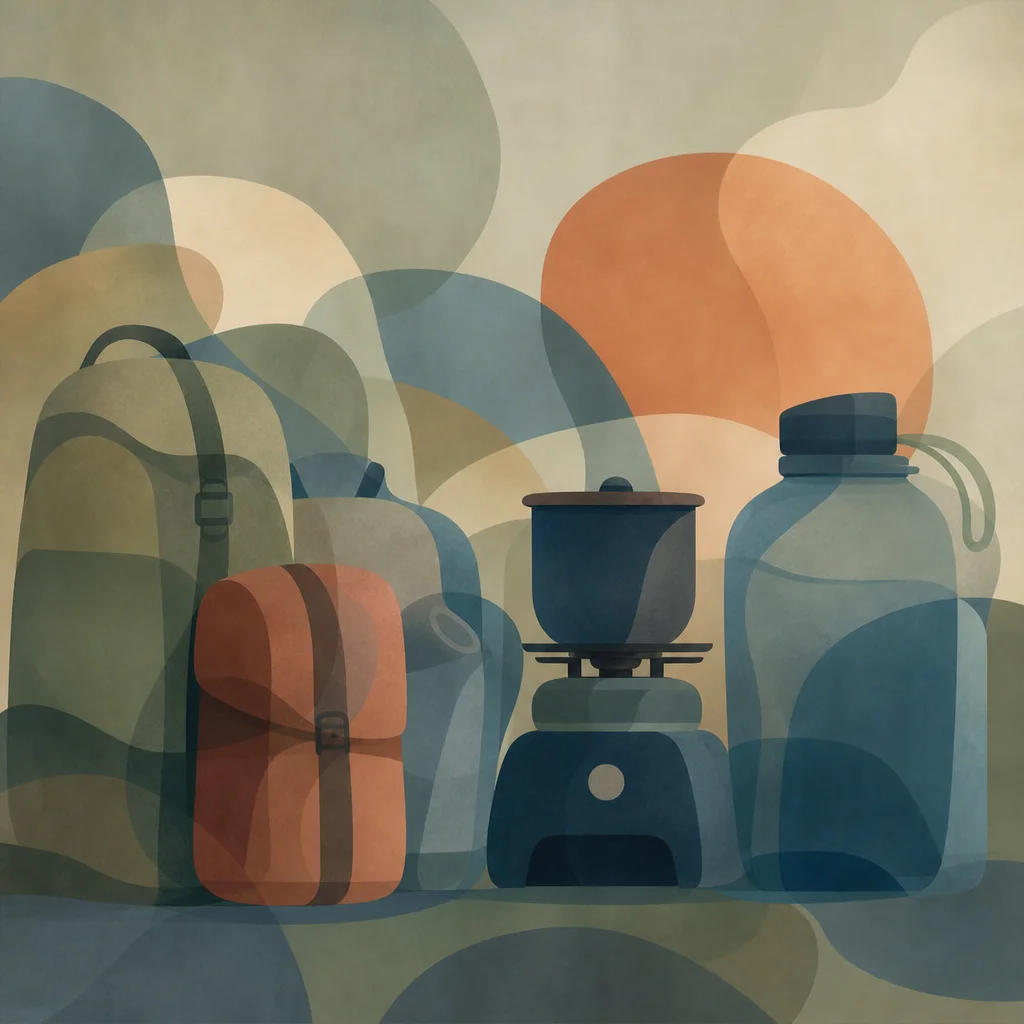
Practical details that are boring until they are not. Bring more water than you think, and a way to carry it. Bring one more towel than you think, and a dry bag for anything that must stay dry. Pack one warm layer per person beyond what the forecast suggests. And check whether the site sells fuel, ice or firewood, because the answer is usually no.
Camping With Multiple Partners and No Signal
The moment the phones stop working is the moment the plan has to already be finished. This is the section people skip and then wish they had not, because losing signal changes three things at once: navigation, safety, and the group’s ability to let somebody cool off separately.
Before you go, somebody who is not going should know where you are, what route you are taking and when you expect to be back. That is ordinary outdoors practice for any group, and it matters a little more here because a group of three has three sets of people who might reasonably worry. Download offline maps, write the route on paper, and keep a paper copy of the booking reference.
Navigation is the practical failure. If you rely on a phone to find the site and the phone has no bars at the turnoff, you will not find the site. Pin the location offline before you leave and write the last mile down in words: the turnoff, the landmark, the gate, the pitch number.
- Offline maps downloaded, plus one paper copy of the route.
- A contact outside the group holding the plan and the expected return time.
- Power: one power bank in the group big enough for more than one phone.
- If the group splits, agree a time and a place to regroup rather than relying on a message.
- Know where the nearest help actually is, and how long it takes to reach it.
Location sharing is its own decision and it should be made before the trip rather than improvised in a field. Some people share location with all of their partners as a matter of course. Some share with one and not another. Some find it reassuring and some find it suffocating. All of those are legitimate, and none of them should be settled while standing next to a car with one bar of signal. The fuller argument lives in location sharing in non-monogamy, and the device-level side in phone privacy for non-monogamous people.
The third effect is subtler. When the phones are dead, the group becomes the only available source of stimulation, and that is either lovely or claustrophobic depending on the group and the day. Agree in advance that going off alone is normal and unremarkable. Somebody walking into the trees for an hour is not a statement about anybody.

Check-Ins When There Is No Door to Close
A check-in at a campsite looks different from a check-in at a kitchen table, mostly because there is no kitchen table and no way to leave the room afterwards. The fix is to give it a shape. A walk is the best format the outdoors offers: two people moving side by side rather than facing each other, in motion, with an end point. Nobody is trapped, nobody is performing, and the conversation has a natural length.
Second, name the exit before anybody needs it. If somebody wants the evening to end early, or wants to sleep in a different space than planned, or wants to go home a day early, the request has to be cheap to make. That means saying out loud, in advance, that asking is not a criticism of the trip. Without that sentence, asking becomes a big deal, and big deals get avoided.
Third, watch the specific pressure that group trips create. In a small group in a remote place, the person who is uncomfortable has to weigh their discomfort against spoiling everyone’s weekend, and that arithmetic almost always favours staying quiet. Naming it in advance is most of the fix: say that you want to hear it early, and then respond well when somebody actually does. If you want a structure for that conversation, safewords and check-in signals is the short version and enthusiastic consent in non-monogamy is the longer one. The ability to say no without having to give a speech is the whole mechanism.
For the safety-and-pressure side of this specifically, womenshealth.gov on relationships and safety is a good plain reference, and it is worth reading before the trip rather than during it. The sentence you want in the group before you leave is short: anybody can change their mind, at any point, without having to justify it, and the trip continues afterwards.
And a note on alcohol, because it comes up on almost every camping trip. Plenty of campgrounds restrict it, some ban it outright, and it interacts badly with cold, with fatigue and with all three capacities above. If it is going to be part of the trip, set the limit while people are still clear-headed rather than afterwards. Alcohol limits in threesome dating goes into it properly, and staying present in group experiences is a useful counterweight to the general drift of a long evening.

Frequently Asked Questions
Is camping with multiple partners a good first trip together?
It can be, if it is short and serviced. Two nights at a campground with toilets, a host and a car five metres away gives everybody a way to leave that does not require a speech. A four-night dispersed trip with no facilities is not a first trip for anybody.
What if one person wants one tent and the other two want separate ones?
Take the two. Sleeping arrangements are one of the few places where the more cautious option costs almost nothing and the less cautious one costs everybody sleep. The person who wanted the shared tent is usually fine by the second night.
How do we handle other campers overhearing us?
Assume they can, and plan on that basis. Lower the volume, keep lights off inside the tent, take phone calls away from the pitch. Beyond that, most campsite neighbours are far less interested in your group than you are worried they are.
Who pays for what on a group camping trip?
Whoever agrees to, before anybody books. Equal thirds is simplest and most common; proportional to income is fairer when incomes differ a lot. What causes damage is not the split, it is the silence, and the same pattern shows up on any shared trip.
What belongs in the shared first aid kit?
More than you think, and above all the things specific to the people going: prescribed medication, allergy treatment, blister care, and a way to keep all of it dry. This is general information and not medical guidance, so check what your group actually needs and where the nearest help is before you rely on a kit.
Editor’s note: this is general information for adults, not professional guidance. Campsite rules, group size limits, fire restrictions and access rules differ between countries, land managers and seasons. Check the specific site and the specific land before you go, and treat wardens, rangers and camp hosts as the final word once you are there.
Camping with multiple partners works when the plan is made in daylight and reviewed in daylight. Four decisions, where you sleep, how much sound carries, who carries what, and how somebody leaves, cover most of what goes wrong. The remainder is weather, and weather you can only dress for. For the version of this that happens on the way there rather than once you arrive, a road trip with multiple partners is the companion piece, and planning a vacation with several partners covers the bigger trip that a camping weekend so often turns into. You will find people planning all of it right here at 3Cupid.