Table of Contents
- Chosen Family After a Breakup: What Actually Breaks
- Who Ends Up in the Middle
- Make a Shared-People Plan Before Anyone Splits
- Scripts for the People You Share
- Tangled Logistics: Housing, Pets, Group Chats and Money
- Rebuilding Your Own People Afterwards
- Questions People Ask After a Shared Network Splits
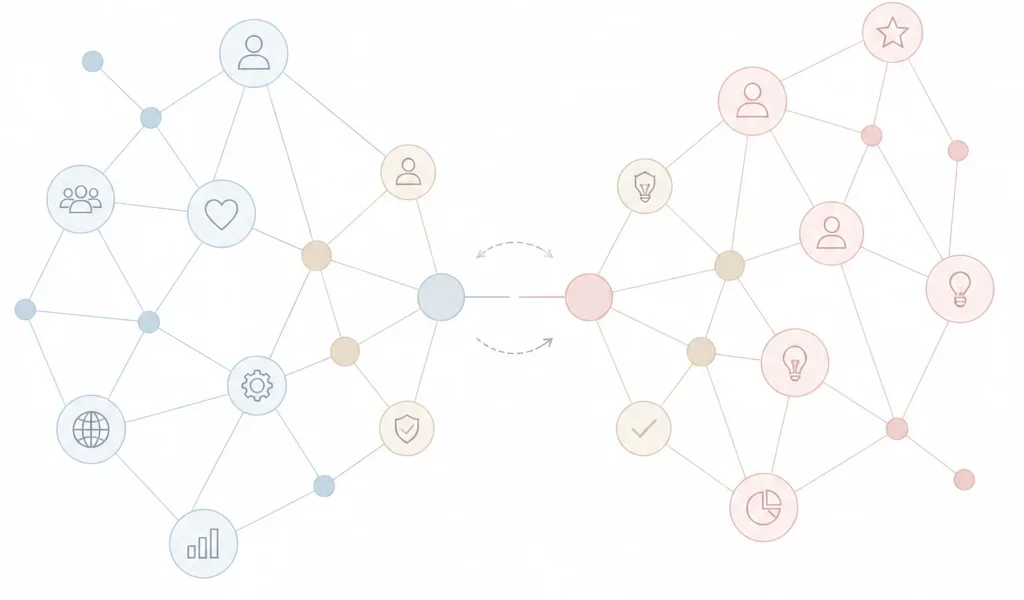
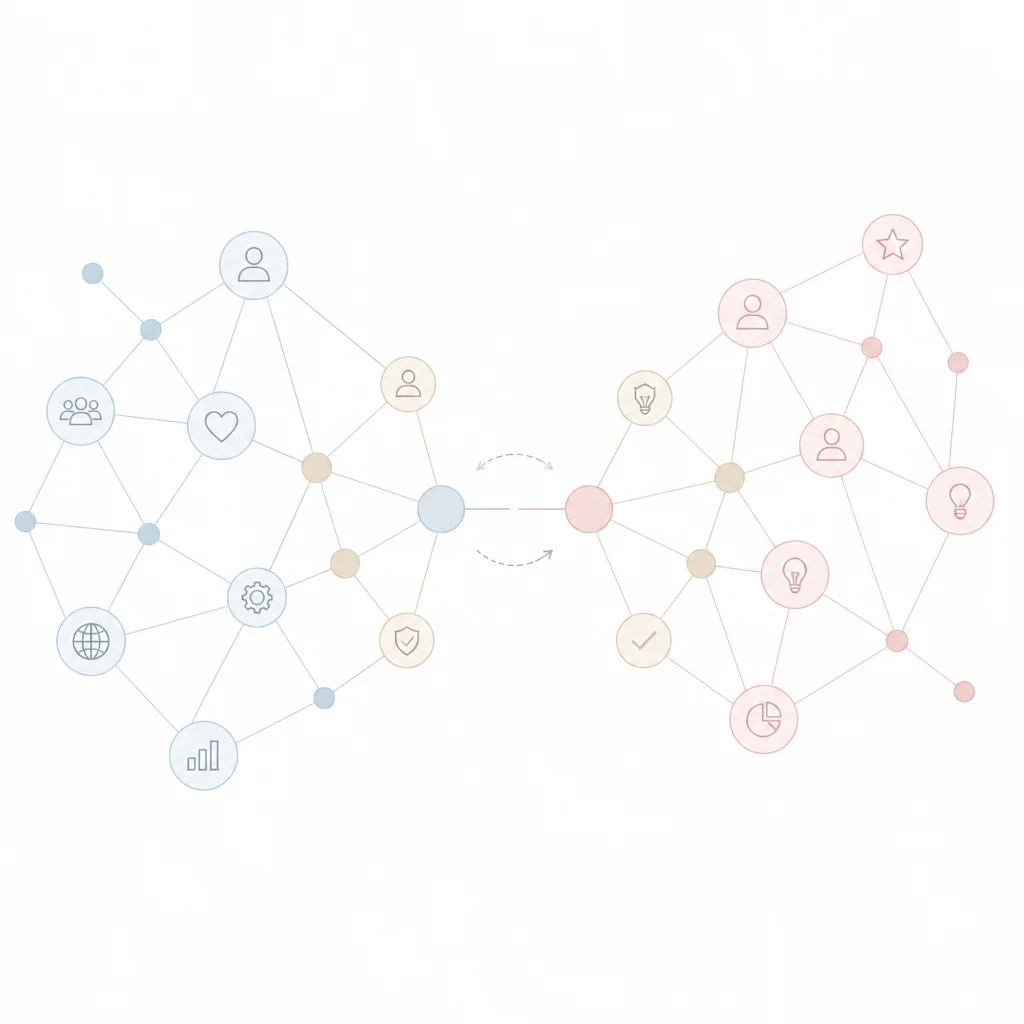
When a non-monogamous relationship ends, the relationship is not the only thing that ends. The Sunday dinners, the group chat, the friend who became your person because they were your partner’s person first – none of that has a custody arrangement. Chosen family after a breakup is one of the least discussed and most painful parts of ENM, largely because nobody wants to plan for it while things are good. The short answer: nobody owns the people, shared relationships get renegotiated rather than divided, and the plan you make before any split is worth more than any conversation you have during one.
This piece is about the people in the middle – friends, metamours, children, your own relatives – and what you can decide in advance that keeps them out of the blast radius.
Chosen Family After a Breakup: What Actually Breaks
Three things tend to go, and they go in this order.
- Rituals collapse first. The standing dinner stops because nobody wants to set a table where two people are avoiding eye contact. Rituals are the connective tissue, so losing them feels like losing the group even when the individuals are all still there.
- Then the narration war. Both people tell the story to the same friends. Friends who hear two versions usually go quiet rather than pick, and quiet reads as abandonment to whoever is hurting more.
- Then the quiet resettlement. Six months later the group has reformed around one person, and the other one finds out through an Instagram photo. This is the part that does the lasting damage.
Breakups in non-monogamous networks have a specific extra weight: the person you split from may stay connected to people you love, which means you cannot do the standard thing of removing them from your life entirely. Grieving and recovering from a polyamorous breakup covers the internal side; what follows here is the social infrastructure around it.
It also matters that not every ending is a dramatic one. De-escalating a polyamorous relationship – stepping back from partners to friends, or from nesting to dating – changes the shape of a chosen family without an official ending, and the same rules below apply, just quieter.
Who Ends Up in the Middle
Relationship loss is studied as a genuine stress event rather than a private disappointment – the American Psychological Association treats separation and divorce as major life transitions with measurable effects on health and social ties, and their divorce and separation topic page is a useful baseline for how much disruption is normal. In a non-monogamous network the disruption is wider, because more people are attached to the structure.
Metamours
A metamour who was close to you through your shared partner has the least structural protection of anyone. Ask what they want, before you assume they will stay with one side. Some metamours keep both relationships and are fine; some need distance from the whole situation; some have their own read on what happened and it is not the one you would write. All three are legitimate.
Mutual friends
Friends acquired jointly are the classic split. The workable rule is that a friend is not a shared asset – they get to keep both of you, and neither of you gets to require them to choose. If a friendship only ever existed in the context of the relationship, it may simply fade, and that is not betrayal either. Friendships in adulthood are maintained through contact and shared context, not loyalty oaths, which is worth remembering – the APA’s overview of friendship and social connection is a decent reminder of how fragile adult friendship already is before a breakup touches it.
Children
If there are children, stability beats everything. The adults who are known to them – including non-parental adults in a chosen family – should stay predictable, and the explanations should be short, repeated, and free of detail about the adults’ conflict. Where co-parenting exists across a polycule, a co-parenting plan for a polycule is the document that keeps this from becoming improvisation.
Your own family of origin
Relatives who took years to accept your relationships may quietly withdraw one of them when it ends, or may have bonded with a partner you have now split from and keep inviting them. Decide what you will say once, say it the same way every time, and do not make your relatives arbitrate.

Make a Shared-People Plan Before Anyone Splits
This is the single most useful thing in this article, and it only works while everyone is calm. Sit down with a partner – ideally once a year, the same week you review safer-sex agreements and calendars – and answer these out loud.
- Which people are genuinely shared, and which are each person’s own? Write the list. It is usually shorter than people fear and more obvious once said aloud.
- Who tells the group, and how? One message, from both of you if possible, beats two separate accounts. Agree on the wording now: “we have separated, we are both okay, we are not asking anyone to pick.”
- Which rituals continue, and in what form? Keep one, pause one. A Sunday dinner that survives a breakup in a modified form tells the whole group they are not losing their people.
- What happens to shared group chats? Decide whether to split, mute, or keep one channel with both in it. Improvising this at 2am is how people get hurt.
- What is off-limits to share? Health information, sexual details, private disclosures, and anything said in confidence. Name it before the temptation arrives.
- Who supports whom logistically? If one of you is moving out, whose friends help, and who stays out of it?
Write it down somewhere both people can find. It does not need to be a legal document – a shared note is enough – because the point is not enforceability, it is having already agreed on what decent looks like while you still liked each other.
If you are already in the middle of a split, a shorter version still helps: agree on the message to the group, agree on one ritual to keep, and agree not to narrate. For the person supporting someone through this, how to support a partner through a polyamorous breakup is the companion piece.
Scripts for the People You Share
Short, non-specific about fault, and explicit about what you are not asking for. Three that work:
To the group
“Sam and I have ended our relationship. We are both all right and neither of us is going anywhere from this group. We are not asking anyone to choose, and we would both rather you kept inviting us to things and let us each decide.”
To a metamour you want to keep
“You became my own person, not just my partner’s metamour, and I would like to keep you. I understand if you need space, or if you need to see them too. Whatever you decide, I will not make it mean something about the breakup.”
When someone asks what happened
“It did not work out, and I would rather not go into it. I am okay, and I would like to keep seeing you.” Then change the subject. Repeating this is not cold – it is what protects the group from becoming a courtroom.
| Say | Skip |
|---|---|
| “We ended it. We are both okay.” | A list of what they did wrong |
| “You do not have to choose.” | “I need to know whose side you are on.” |
| “I would like to keep seeing you.” | “If you see them, we are done.” |
| “I need a bit of space right now.” | Silence that leaves people guessing |
| “Here is what I would like kept private.” | Sharing a confidence to win sympathy |
| “Thank you for staying.” | Scorekeeping on who checked in more |
The last row matters more than it looks. Recruiting friends as witnesses is the fastest way to turn a breakup into a permanent faction, and the people who enjoyed being recruited rarely stay once the drama ends.
Tangled Logistics: Housing, Pets, Group Chats and Money
Chosen family overlaps with practical life more than people expect, and the overlap is where post-breakup friction lives.
- Housing. If someone in the group is also your roommate, the lease outranks the heartbreak. Living with non-monogamous roommates covers the boundaries that keep a shared home workable when relationships inside it change.
- Pets. Animals attach to people, not to relationships. Agreeing on access, costs and vet decisions in writing prevents the worst version of this. Pets in polyamory goes into the arrangements in detail.
- Group chats. Decide deliberately: split, archive, or keep one. The worst option is leaving everyone in a dead channel where nobody knows if they are welcome.
- Money. Shared subscriptions, a loan, a deposit, a trip already paid for. Settle these in the first fortnight if you can. Unsettled money keeps a wound open longer than the breakup itself.
- Care arrangements. If someone in the chosen family was providing care – to you, a child, an ageing parent – that does not end cleanly. Name a replacement before the gap appears.
One more: grief does not only follow death. Losing daily access to someone who is still alive and still in your group chat is a specific kind of loss, and grief in non-monogamy when you lose a partner and supporting a grieving partner both speak to it.

Rebuilding Your Own People Afterwards
After a split it is common to discover that your social world was narrower than you thought – that six of your eight close people came through one relationship. Rebuilding is slow and it does not start with dating. Dating again after an ENM breakup is a separate question from whether you have anyone to call on a bad Tuesday. Reconnecting is ordinary adult work – Psychology Today’s primer on relationships and social bonds covers why the boring, repeated contact is what actually rebuilds a network.
- Start with the people who were already yours and under-invested: an old friend, a sibling, a colleague you actually like.
- Rejoin one recurring thing – a class, a league, a volunteer slot, a standing dinner. Repetition is what turns strangers into people.
- Tell one person the truth about how you are doing. Being the only one who knows is heavier than the feeling itself.
- Do not recruit your new partner as your whole support system. That is the pattern that produces the same fragility again.
- If you have moved or the local network has thinned out, finding ENM community in a new city is the practical starting point.
- Give it a year before you judge the shape of your life. The first month is not data.
And if the loneliness is loud, loneliness in polyamory names it precisely: it is usually not about having enough partners. It is about whether anybody would notice – which is exactly the gap a chosen family is built to close.
Questions People Ask After a Shared Network Splits
Do I have to stop seeing our mutual friends?
No, and asking someone to drop a friend is a red flag in either direction. Practically: accept invitations you can handle, decline the ones you cannot, and do not monitor who else was invited. If every gathering includes your ex and you are not ready, build something new alongside rather than trying to exclude them.
My metamour took their side. Is that unfair?
It can feel that way and still be legitimate. A metamour’s first loyalty may be to the person they have known longer, or their own read on events may differ from yours. You can say once that you are hurt, and then accept it. Pressuring them to justify the choice usually ends the connection for good.
How do I keep a ritual going when one person cannot be in the room?
Run it in two forms for a while – the same dinner on a different night, the same walk with different people. Rituals that only exist in one configuration are fragile; giving them a second form is what lets them outlast a breakup.
Is it okay to stay close to my ex’s chosen family?
Sometimes, with care. If the connection was genuinely yours and everyone involved is comfortable, it can be one of the better outcomes of a non-monogamous breakup. Check that you are not staying close to stay close to them, and give your ex the same freedom in reverse.
Editor’s note: this article is general information for adults, not legal, medical or therapeutic advice. Housing, tenancy, child custody and financial arrangements have jurisdiction-specific rules – get local advice before acting on anything described here.
The whole point of a chosen family is that it outlasts any single relationship inside it, and the version you build on purpose is the version that survives a breakup – how to build a chosen family in non-monogamy is where that work starts. Chosen family after a breakup is survivable, and most of it comes down to two decisions: one honest message to the group, and one ritual you refuse to lose. If you are in the middle of the split right now, start there. You can also find people who have been through exactly this right here at 3Cupid.