Table of Contents
- What a Chosen Family Actually Means in Non-Monogamy
- Why Non-Monogamous People Often Need One
- Who Belongs: Mapping Your Chosen Family
- How to Ask Someone to Take That Role
- What a Chosen Family Cannot Cover on Its Own
- When Chosen Family Meets Family of Origin
- Keeping a Chosen Family Alive
- Chosen Family Questions People Actually Ask
Most non-monogamous people hit the same gap sooner or later. Your partners can hold a great deal – birthdays, bad weeks, the phone call after a rough doctor’s appointment – but no single person can be an entire safety net, and a partner who is on a date, out of town, or in their own hard month cannot always be the one who shows up. A chosen family is the answer a lot of people build on purpose: the group of friends, metamours, exes who stayed close, mentors and neighbours who take on the jobs a family usually does, without needing a blood tie or a legal title to justify it. This guide is about building a chosen family in non-monogamy – what it actually means, who belongs, how to ask, and where its limits are.
None of this replaces your partners, and none of it is a scorecard. It is about making sure that when something goes sideways, more than one person knows.
What a Chosen Family Actually Means in Non-Monogamy
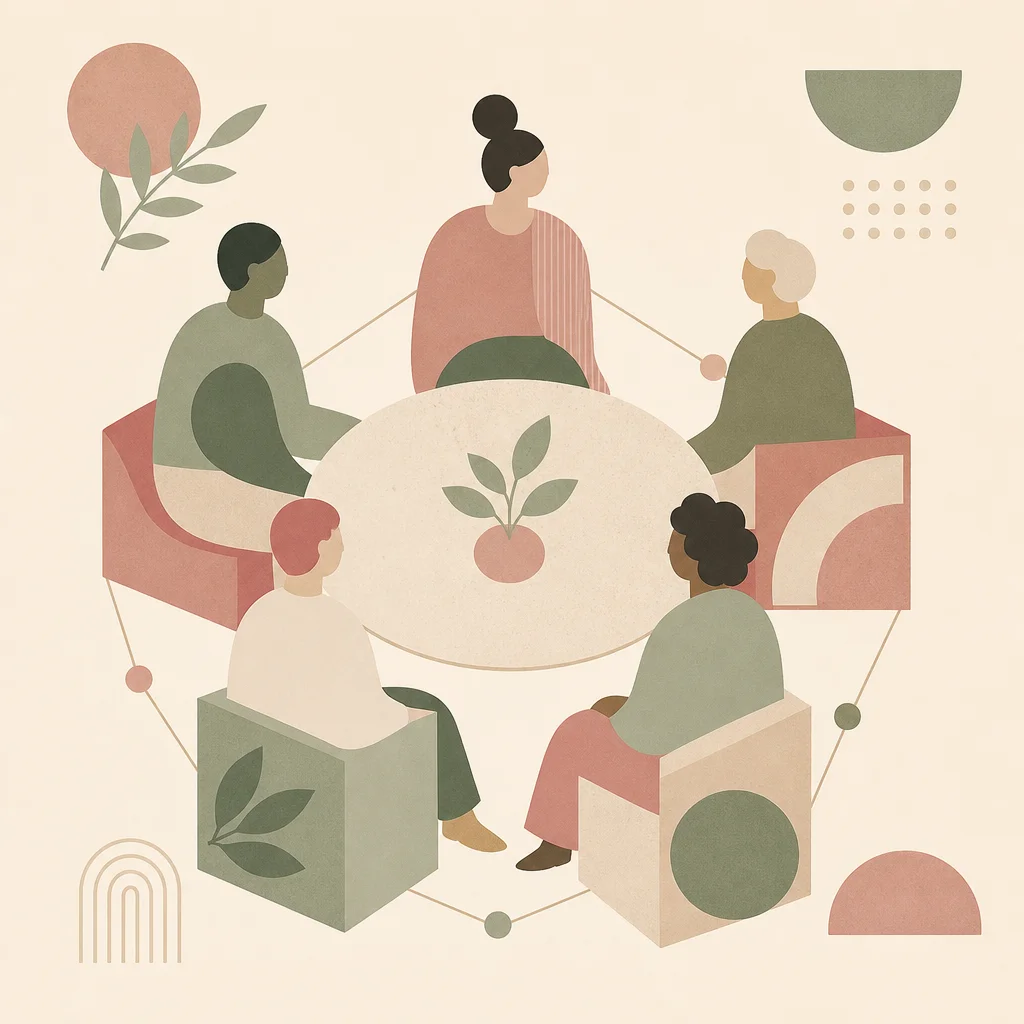
A chosen family is a group of people who take on family roles by agreement rather than by birth or marriage. The definition that matters is functional: who would you call at 2am, who knows your medical history, who has a key, who notices when you go quiet for a week. If someone does those things consistently and you do them back, they are family in the way that counts.
It helps to separate three words people mix up. A polycule is the map of your romantic and sexual connections and theirs – it is drawn by dating. A community is the wider scene you belong to – a city network, a club, a group chat with two hundred people in it. A chosen family is smaller and stickier than either: the handful of people who would reorganise their week for you. You can have a large polycule and no chosen family at all, and that combination is exactly where a lot of non-monogamous people feel most alone.
The language itself did not start here. Chosen family grew out of queer communities where biological relatives had withdrawn support, and the idea still carries that history: it is what you build when the default version does not hold you. The American Psychological Association describes family in terms of ongoing support and belonging rather than only legal or biological ties – see their overview of families and family relationships, and their material on LGBTQ+ topics for the community history behind the term.
Why Non-Monogamous People Often Need One
Three pressures stack up. First, capacity: every partner has limited hours, and a network of four partners is not the same as having four people available on a Tuesday night when your car will not start. Second, disclosure: telling relatives about your relationships can cost you the support you had, and plenty of people find that the friend group stays and the family table does not. If you are weighing that step, coming out to friends and family as non-monogamous covers the pacing question in more detail, and what to do if you are outed before you chose to be covers the version nobody plans for.
Third, logistics. Non-monogamous lives generate admin: overlapping schedules, more birthdays, more people who would need to be told if you were in hospital. A chosen family absorbs admin that a partner should not have to carry alone, and it keeps going when a relationship ends.
The absence of this is what people usually describe as loneliness in polyamory – not a lack of dates, but a lack of people who would notice if you disappeared for a month. Adding another partner rarely fixes it. Building sideways does.
Who Belongs: Mapping Your Chosen Family
Rather than promoting everyone you like, map by function. Most stable chosen families have four to eight adults in them, and almost nobody fills every role. Write down the jobs first, then the names.
| Role | What they actually do | Realistic frequency |
|---|---|---|
| Emergency contact | Picks up at any hour, knows your allergies and medications | Rarely used, must be reliable |
| Medical advocate | Sits in waiting rooms, asks the doctor the question you forgot | A few times a year |
| Practical help | Rides, key holding, pet care, a spare bed during a move | Monthly |
| Truth-teller | Says the hard thing about your behaviour without dumping you | When it matters |
| Holiday regular | Shows up for the meals and the anniversaries that are not theirs | Several times a year |
| Kid-adjacent adult | Known to the children, stable across your relationship changes | Ongoing |
| Long-distance anchor | Voice note at midnight from another time zone | Weekly |
Then run five questions on each name before you treat them as family rather than a friend you like a lot.
- Do they know the basics of your life – your address, your people, your medical essentials?
- Have they been steady through at least one hard thing, not only good times?
- Can you tell them no without the relationship wobbling?
- Would your partners recognise them as part of your support, not a rival for it?
- Is the care going both ways, at least roughly, over a year?
If someone fails three of five, they are a friend. That is a good thing to be. Not every friend is meant to be family, and treating every close friend as a candidate is how people end up with a wide, shallow network and the same loneliness they started with.
How to Ask Someone to Take That Role
You cannot promote someone unilaterally. Asking is a real request with a real answer, and the answer might be a partial yes – happy to be your emergency contact, not able to be at every Sunday dinner. Take the partial yes seriously instead of reading it as rejection.
Three scripts that tend to land, because they name the job instead of the feeling:
To a friend you have known for years
“You have been the person I call for years, and I would like to stop pretending that is casual. Would you be my emergency contact – the one the hospital calls? I would do the same for you, and I want to know what you would need from me for that to feel okay.”
To a metamour
“We got close through the same person, and I would like that to be ours rather than borrowed. If things between us stay friendly no matter what happens with them, I would like to count you as family. Does that feel good to you, or too entangled?”
To a relative who is already halfway there
“You have never made me explain my relationships, and that has mattered more than I have said. I would like to name it – I think of you as family, deliberately, not just by default. No paperwork, no speech, I just wanted you to know.”
Notice what all three have in common: they name a specific function, they offer reciprocity, and they leave room for a no. If your script cannot survive a no, it is not an invitation, it is a claim. If the idea of someone saying no to you is hard to sit with, asking for reassurance in ENM goes into that dynamic in more depth.

What a Chosen Family Cannot Cover on Its Own
This is the part people skip and then get hurt by. Being family in practice gives you none of the automatic legal standing that marriage or birth gives. Your chosen sister cannot consent for you in an emergency, inherit from you without a will, or be recognised as next of kin by a hospital unless you have done paperwork that says so.
- Healthcare proxies and HIPAA releases name who can be told what – without them, a hospital can exclude the person who knows you best.
- A will, a durable power of attorney and beneficiary designations are what actually route money and decisions.
- Tenancy matters: if you live together, a polyamorous household agreement and the lease determine who can stay when relationships change.
- Parenting needs its own document. If children are involved, a co-parenting plan for a polycule does work no amount of goodwill substitutes for.
The practical version of this is already written up in how to protect a polyamorous family without marriage, and it is worth an afternoon. Chosen family is the emotional infrastructure; paperwork is the load-bearing wall. You need both, and they do the same job from different angles.
Commitment rituals can help close the gap socially even where the law does not follow. Some people mark the relationship with a polyamorous commitment ceremony or write their own non-monogamous wedding vows, and those moments give the wider group a shared reference point for who counts.
When Chosen Family Meets Family of Origin
The tense version is not open hostility – it is a wedding seating chart, a holiday where you are expected to come alone, a relative who is warm to you and cold to the people you love. A few patterns hold up better than others.
| Do | Don’t |
|---|---|
| Give people one consistent way to refer to each person, and use it every time | Rotate labels depending on the room and hope nobody compares notes |
| Tell relatives what you need in advance – a plus one, a seat, a name on the list | Arrive with four people and let the host do the maths in front of everyone |
| Accept that some relatives will be warm and limited, and decide where that sits | Reopen the same argument at every holiday hoping for a different ending |
| Protect the people you bring – brief them, debrief them, leave together if you need to | Use a partner’s presence as a point you are making to your parents |
| Let children see the structure explained calmly and repeatedly | Assume kids will absorb the shape of your family by osmosis |
For some people the overlap is not a holiday problem but a care problem – an ageing parent, a sibling who needs help, a relative who needs to understand who is in the house. Non-monogamy and caregiving covers that territory, and non-monogamy in a retirement community covers the version where your household is the one being explained.

Keeping a Chosen Family Alive
Chosen families fail quietly. Nobody resigns; people just stop being asked, and six months later the group is a memory. The maintenance is boring and it is the whole thing.
- One recurring ritual that does not require planning – a Sunday dinner, a Tuesday walk, a standing call. Repetition beats intensity, and hosting dinner with multiple partners is a low-effort version that scales.
- A group channel with a stated purpose. “Logistics and crisis” behaves very differently from a chat with no reason to exist.
- One-to-one time outside the group. A chosen family made only of group events is a party, not a family.
- Repair after conflict, out loud. The people who can say “that stung” and stay are the ones who become family.
- Money honesty early – who pays for what, who is quietly covering whom, and whether anyone is keeping score. Marking birthdays and anniversaries is where the resentments usually surface first.
- An annual check-in: is anyone carrying more than they can, has anyone moved, does anyone need to step back?
Stepping back should be allowed without drama. People move cities, have children, burn out, start caring for someone else. A chosen family that lets someone rest for a year is one they come back to; one that treats a gap as betrayal is one they leave quietly. If you are the one who needs to step back, self-worth in non-monogamy is worth reading before you decide the whole thing was your fault.

Chosen Family Questions People Actually Ask
Is a chosen family the same thing as a polycule?
No. A polycule is drawn by who dates whom; a chosen family is drawn by who does the work of family. A metamour can be deep chosen family, and a partner you have dated for two years may not be. The two maps overlap but they are not the same map, and confusing them is why some people feel unsupported while technically having plenty of partners.
How many people should be in a chosen family?
Most people sustain four to eight adults over years. Fewer than three and you have single points of failure; more than eight and the maintenance cost exceeds what anyone has. Count by reliability, not by attendance at good parties.
What if my partners feel replaced by my chosen family?
Say what the group is for and what it is not. Most of the friction comes from silence – a partner notices you confiding in someone new and fills the gap with a story. Naming roles out loud, and keeping your partner central to the decisions that concern them, usually resolves it. If it does not, that is a relationship question, not a scheduling one.
Can a chosen family include exes?
Often the best ones do. An ex who stayed kind through the ending has already passed the steadiness test. The caution is the other direction: do not keep an ex in the inner circle when the contact is really a way of not letting go, and do not ask a new partner to be close to someone who was cruel to them. Staying friends after a threesome covers the earlier version of that judgement call.
Editor’s note: this article is general information for adults, not legal or medical advice. Rules on next of kin, healthcare proxies and tenancy vary by country and state – check the requirements where you live before relying on any arrangement described here.
If you are building a chosen family in non-monogamy, the people who make it easy to start are usually already in your phone – the ones you have been under-calling for years. And if you are thinking about the harder version, what happens to a chosen family after a breakup, that is the next thing worth deciding on purpose rather than by accident. Either way, you can start the conversation with people who already get it right here at 3Cupid.