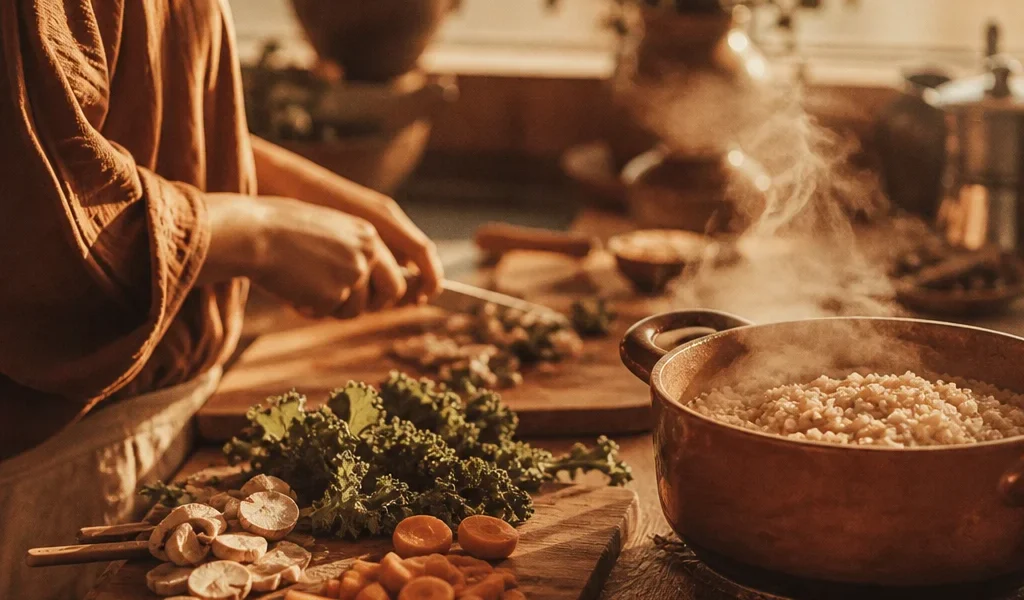
Nobody warns you about this part. Cooking for multiple partners is not really a cooking problem — it is a scheduling, memory and fairness problem that happens to take place in a kitchen. One partner cannot eat gluten. Another is vegetarian by conviction and quietly flexible on Fridays. A third eats anything but is never home before eight. Multiply that by whoever is sleeping where this week, and you end up with a fridge full of good intentions and a takeaway receipt.
Table of Contents
- Why Cooking for Multiple Partners Turns Into Logistics
- Build One Dietary Map Before You Cook a Thing
- Three Buckets: Allergies, Ethics and Preferences
- Cook Once, Eat Three Ways
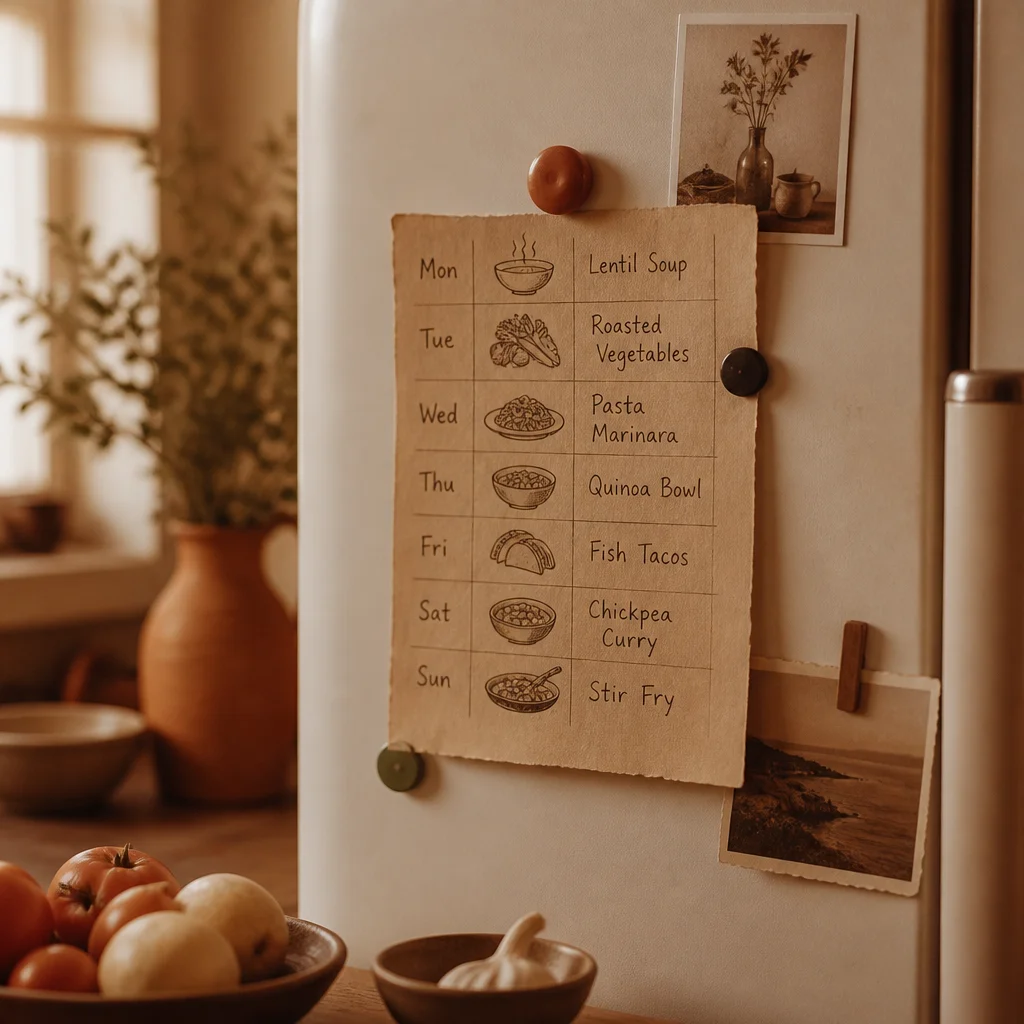
- Your Fridge Is a Calendar, So Label It Like One
- Who Cooks? Write the Rota Before Resentment Does
- Budget, Batch and the Shopping List That Holds Up
- FAQ: Cooking for Multiple Partners
Why Cooking for Multiple Partners Turns Into Logistics
Food is where a calendar becomes visible. You can tell yourself that your schedule is fine right up until three people are hungry at three different times and the pantry only supports one of them.
There is also a feeling layer underneath the practical one. Cooking for someone is one of the plainest ways of saying I thought about you. With one partner that gesture lands automatically. With more than one, it has to be distributed — and if the distribution is invisible, it reads as favouritism even when it is not. Two people can eat the same stew and one of them can still feel like an afterthought, purely because of who got asked what they wanted first.
So the goal is not to become a better cook. The goal is to build a small system that makes care visible and makes the logistics cheap. Everything below is aimed at that. If what you actually need is one evening rather than a weekday routine, the companion piece on hosting a dinner with multiple partners covers that side instead.
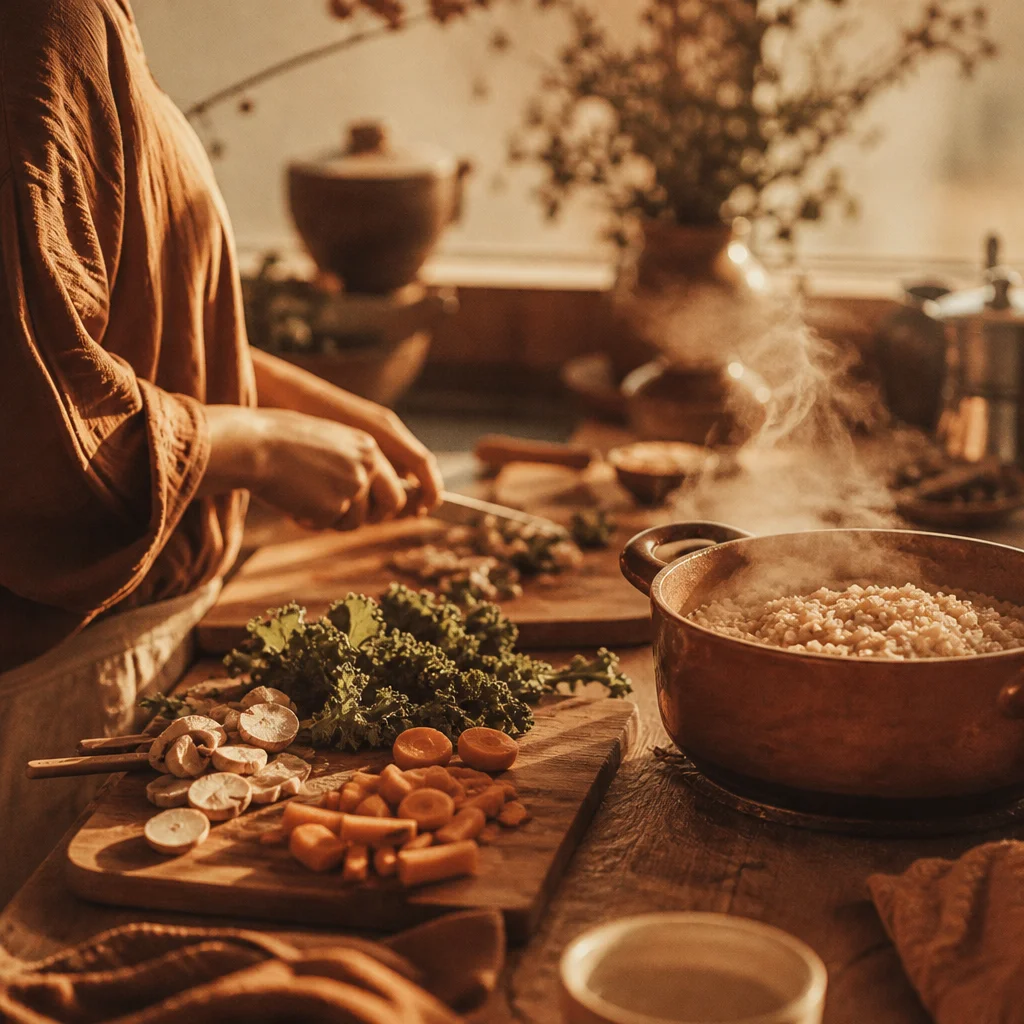
If your household is still figuring out how much day-to-day overlap it wants, that question sits upstream of the menu. The distinction between kitchen table and parallel polyamory tells you roughly how many plates you are planning for on an average week.
Build One Dietary Map Before You Cook a Thing
Do not keep dietary information in your head. It will feel reliable for about a fortnight and then it will fail you on the one night it matters. Put it somewhere everyone can see: a shared note, a whiteboard on the fridge, a pinned message. One line per person, three columns — what they avoid, why, and when you last checked.
The why column is the one people skip, and it is the one that saves you. “No dairy” written alone tells you nothing about cross-contact. “No dairy — reacts to trace amounts” tells you to use a clean pan. “No dairy — prefers oat milk” tells you to stop worrying. Same sentence, completely different kitchen.
Re-check it every few months. People change their minds, get diagnosed, start a medication that moves the goalposts, or quietly relax a rule they set years ago. A dietary map that was accurate in March can be wrong by September, and the person who pays for that is not you.
If one of your partners manages a diagnosed condition, the map is not a substitute for their own knowledge — it is a place to record it. When energy is limited, the cooking load often lands on whoever has the most of it; that pattern is worth naming early if you are also balancing chronic illness or disability inside the same household.
Three Buckets: Allergies, Ethics and Preferences
Every dietary need you will ever be handed falls into one of three buckets, and they are not the same weight. Treating a mild preference as though it were a medical requirement creates work nobody needs. Treating a medical requirement as though it were a preference is genuinely dangerous.
| Bucket | What it covers | What it asks of the cook | Cost of getting it wrong |
|---|---|---|---|
| Medical | Allergies, coeliac disease, intolerances with real symptoms, anything a clinician has named | Separate pans and boards, read labels every time, ask rather than assume, never improvise with a substitute | A hospital visit, or a partner who stops trusting you in the kitchen |
| Ethical or religious | Vegetarian, vegan, halal, kosher, fasting days, food tied to identity or upbringing | Respect it as identity, not as a taste; do not debate it at the table; do not “forget” because it is inconvenient | Trust, and a sense of not being taken seriously as a person |
| Preference | Dislikes mushrooms, loves chilli, avoids courgette, eats late | Accommodate when it is cheap, say no when it costs a whole second meal | Mild annoyance — and that is an acceptable outcome sometimes |
Notice that the third bucket comes with permission. You are allowed to serve a meal where one person picks around the courgette. You are not allowed to serve a meal where someone has to guess whether the sauce was safe. That distinction is most of the skill.
For the plain question of what a balanced plate looks like across a week, both the Academy of Nutrition and Dietetics and the NHS Eat Well guide publish straightforward, non-commercial guidance. Neither will plan your Tuesday for you, but both beat guessing while you shop.
Cook Once, Eat Three Ways
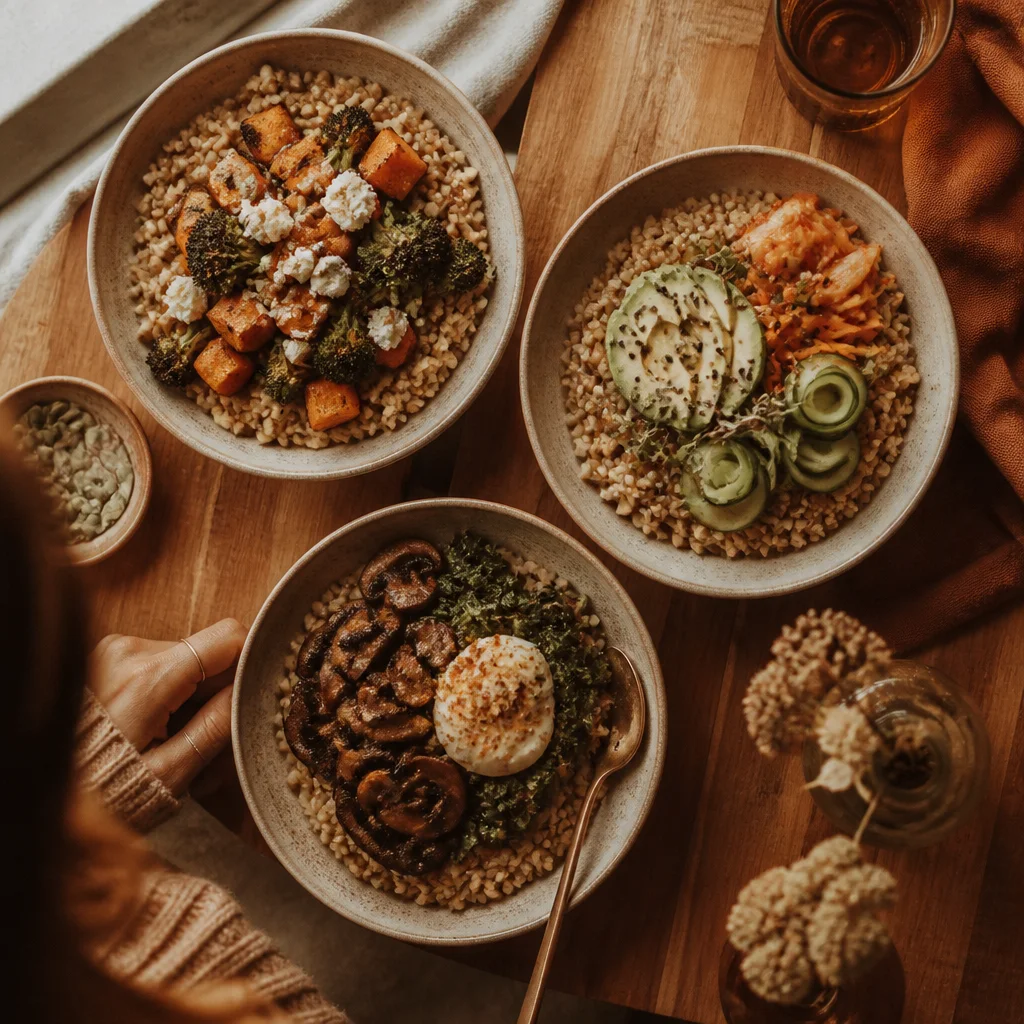
The single biggest lever is to stop cooking finished dishes and start cooking bases. A base is neutral, keeps for three days, and takes finishes at the table. Anyone who has ever run a taco bar already understands this — you just apply it to weeknights.
- Grain bowl: rice, farro or quinoa as the base. Finish with roasted vegetables, a soft egg, or a spiced chickpea pan. Cheese and yoghurt stay in separate bowls on the side.
- Pasta, deconstructed: cook the pasta plain, keep two sauces warm in separate pans, let people choose. One minute of extra washing-up, zero negotiation.
- Traybake: tray of roasted roots and onions for everyone; protein cooked separately and added at the end for whoever eats it.
- Soup plus: one blended vegetable soup, then three toppings — herbs, toasted seeds, a swirl of something creamy kept on the side.
Keep a small finishes shelf so this stays cheap: something crunchy, something salty, something sour, something green. Four jars. With those in the cupboard, a base you are bored of becomes a different meal. Without them, every dinner needs a plan.
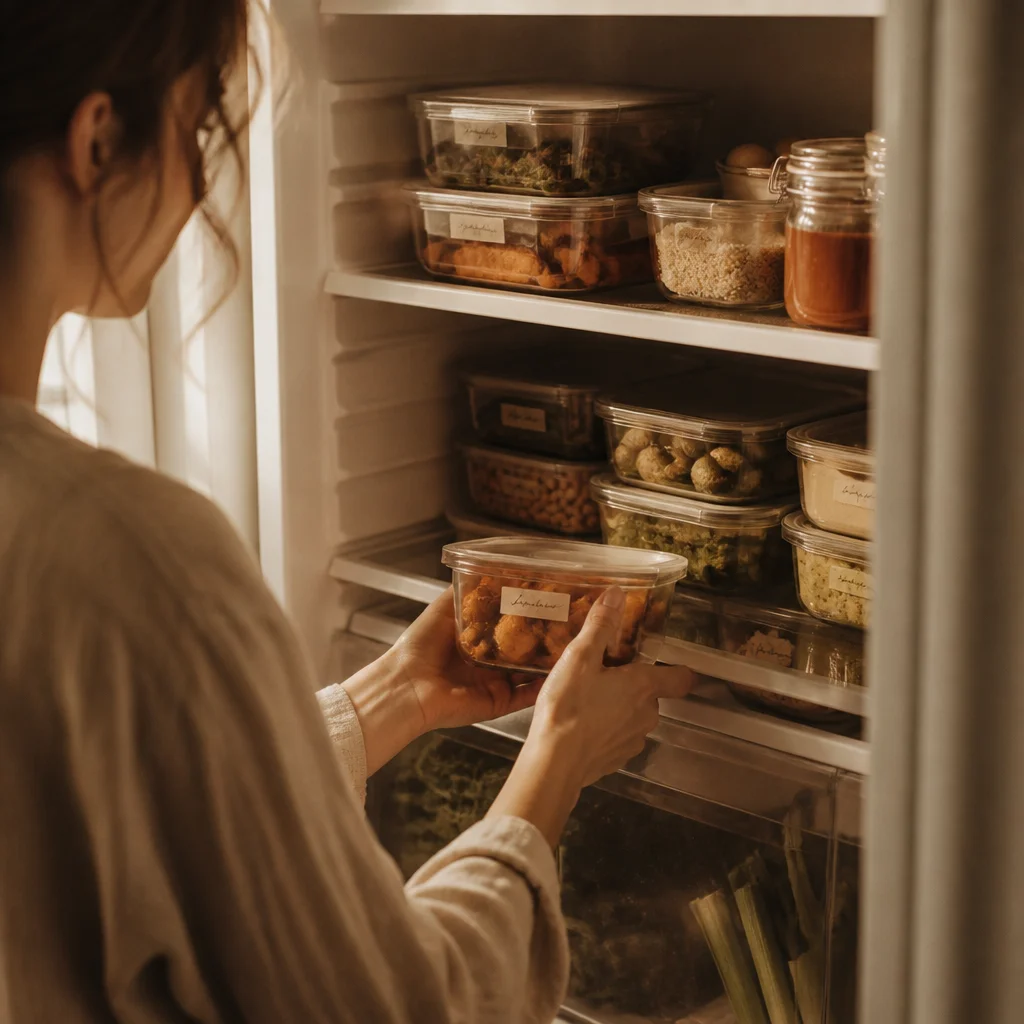
Your Fridge Is a Calendar, So Label It Like One
In a kitchen with more than one cook, unlabelled leftovers are a small recurring conflict that nobody escalates and everybody remembers. Masking tape and a marker fix it in about nine seconds. Name plus date, every time, no exceptions for “I’ll eat it tomorrow”.
- Label with initials and a date, not a full name — a container with a name on it can out somebody to a roommate, a child or a visiting parent.
- Give every base a three-day window. Anything older gets frozen or binned, decided on Sunday, not debated on Wednesday.
- Keep one shelf per person if the fridge is shared beyond your partners, in the same way you would with non-monogamous roommates.
The privacy point is not theoretical. Food is evidence. A labelled tub, a second toothbrush or a favourite brand in the door can tell a story to someone your partner has not chosen to tell it to. If discretion matters in your household, the same thinking that applies to social media privacy applies to the fridge shelf.
Who Cooks? Write the Rota Before Resentment Does
The default in almost every shared kitchen is that whoever cares most cooks most. It looks like generosity for a few months and then it looks like a job. This is the part of the system that most people never write down, and it is the part that actually breaks.
- Whoever cooks does not clean. One person cooks, the other clears and washes. It is a small rule and it removes most of the sting.
- Each person owns one night. Tuesday is yours, Thursday is theirs. Nobody has to negotiate on the day.
- One shared cook a week. Cook together once, batch the bases for the next three days, and eat from them. Efficient, and it makes the work visible to everyone.
- Rotate the planning, not just the cooking. Deciding what to eat is the tiring half. Hand that around too.
If your household has several adults who are not romantically involved with each other, this kind of practical detail is exactly what a household agreement is for — and the kitchen section is usually the one that gets used most. If the kitchen is shared with people outside the relationship entirely, it is also worth having the conversation in talking to a roommate about non-monogamy before the rota goes up on the wall.
None of this is set in stone. Bring the rota back to your regular relationship check-ins and change it when a schedule changes. A rota nobody revisits becomes a rota someone quietly resents.
Budget, Batch and the Shopping List That Holds Up
Feeding more people costs more, and the argument about whose money it is tends to arrive later than it should. Decide early: shared staples on one card, personal items on their own, or everyone pitches into a kitty. Any of those is fine. None of them is obvious.
- Staples shelf: rice, dried beans or lentils, tinned tomatoes, frozen vegetables, eggs, flatbreads, stock. With those on hand you can feed anyone at short notice.
- One big shop, one top-up. Two trips a week beats six. The top-up is for greens and dairy, nothing else.
- Batch only what reheats. Grains, beans, roasted roots, soups, braises. Anything crisp or delicate becomes sad by day two.
- Lower the bar on weeknights. A good meal on a Tuesday is one that exists. Save ambition for the night you actually have time.
And if you are the one doing most of the cooking while also managing several calendars, watch for the point where feeding people stops being care and starts being labour. That slide is slow, and burnout in ENM relationships rarely announces itself as burnout — it shows up as not wanting to cook for anybody at all.
FAQ: Cooking for Multiple Partners
One partner has a serious allergy. How careful do I actually need to be?
As careful as they tell you to be, and no more casual than that. Ask them to walk you through their own routine once, in person, rather than reading about the condition in general. Separate boards and pans, label-reading every time, and no substituting an ingredient you are not sure about. Organisations such as FARE publish practical cross-contact guidance that is worth reading once properly.
One partner eats meat and one does not. Am I cooking two dinners forever?
No. Cook a base that works for both and finish the protein separately, in one pan, at the end. Two complete meals every night is a fast road to hating your own kitchen. Save the fully separate dinner for nights when it is worth the effort.
Is it okay to have a signature dish for each partner?
Yes — that is care, not favouritism. The thing to watch is whether the special dishes line up with who gets your time and attention generally. A recipe is lovely. A recipe standing in for an honest conversation is not.
We do not share a kitchen at all. Does any of this apply?
Mostly yes, just portable. Keep the same dietary map in a shared note, batch when you are at whoever has the better kitchen, and accept that a cooler bag is now part of your relationship infrastructure.
My partner is a much better cook than me and I feel useless next to them.
Cooking is not a ranking. Split by task rather than by skill — one person plans, one preps, one cooks, one clears. Kitchens run fine with people who are good at different halves of the job, and nobody needs to be the best cook in the house.
Cooking for multiple partners well is less about recipes than about removing the same six decisions from every single day: who is eating, what they cannot eat, what the base is, who cooks, who clears, and what happens to the leftovers. Sort those once and the kitchen stops being the place where your relationship gets negotiated. If you want to go deeper on the planning side, our guide to balancing time across several relationships picks up where this one leaves off, and there is more like this right here at 3Cupid.
Editorial note: this article is general information for adults and is not medical or nutrition advice. Dietary needs involving allergies, intolerances or diagnosed conditions should be discussed with a clinician or a registered dietitian.