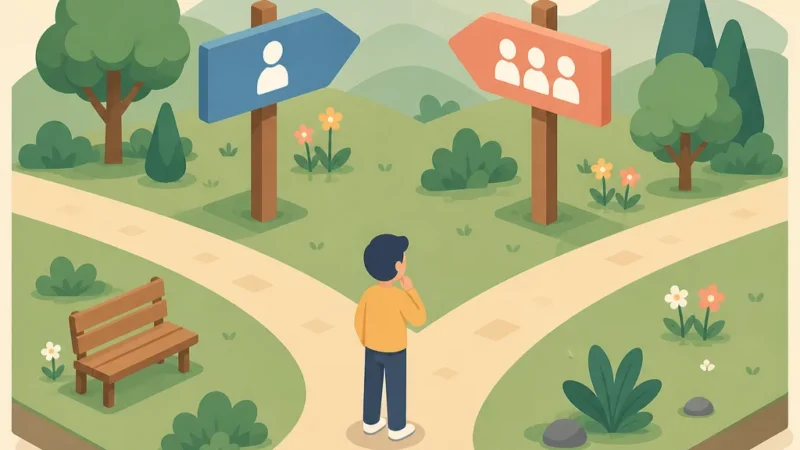
The honest answer to is polyamory right for you is that it depends on who you are, where your relationship stands, and what you’re willing to work on. There’s no single personality type that’s “made” for polyamory, and no questionnaire that hands you a clean yes or no. What you can do is look honestly at your desires, your capacity, and your current situation — and let those guide you.
This guide walks you through the real signals, both the encouraging ones and the cautionary ones, plus the questions worth sitting with before you change anything. If you’re still sorting fact from fiction, our guide to the most common polyamory myths is a good companion piece.
Table of Contents
- What “Right for You” Really Means
- Signs Polyamory Might Fit You Well
- Signs Polyamory Might Not Be the Right Call Right Now
- The Questions to Ask Yourself First
- How to Explore Without Overcommitting
- What to Do With Your Answer
What “Right for You” Really Means
“Right for you” doesn’t mean “you’ll never feel a hard emotion again.” Every relationship structure — monogamous or not — comes with its own challenges. What “right for you” really means is that the structure matches your values and your capacity, and that the rewards feel worth the effort. It’s a question of fit, not a question of virtue.
Some people are drawn to polyamory because it aligns with how they already love. Others are drawn to it for less helpful reasons — to fix something, to please a partner, or to avoid a hard conversation. Being honest about which camp you’re in is the first and most important step.

Signs Polyamory Might Fit You Well
A few patterns tend to show up in people who genuinely thrive in polyamory. None of these are requirements, and none guarantee smooth sailing — but together they’re a good sign.
- You like the idea of your partner having other loving relationships, not just tolerate it.
- You’d rather over-communicate than assume, and you’re comfortable naming feelings and boundaries.
- You have, or are willing to build, the time and energy for more than one relationship.
- You see jealousy as information to work through rather than a reason to shut a relationship down.
- You value autonomy — both your own and your partners’.
That last point matters more than most people expect. Polyamory asks you to hold two things at once: deep connection and a willingness to let your partners be their own people. If that combination feels natural to you, polyamory is a structure worth exploring. And if you want to understand the flip side of jealousy — the joy that can come from a partner’s other relationships — our guide to cultivating compersion is a good introduction.

Signs Polyamory Might Not Be the Right Call Right Now
There’s no shame in deciding polyamory isn’t for you, or isn’t for you right now. A few signals are worth taking seriously before you move forward.
- Your main motivation is to fix a struggling relationship.
- You’re doing it mostly to make a partner happy, not because you want it.
- You’re already stretched thin on time and energy.
- The thought of your partner dating someone else makes you feel panicked rather than just nervous.
- You’d feel the need to keep it a secret from people who matter to you.
None of these mean “never.” They mean the timing or the motivation isn’t right yet. Polyamory won’t repair a relationship that’s already cracking — if anything, it will expose every crack faster. If that last point about secrecy resonates, know that a healthy non-monogamous life is much harder to sustain when you’re hiding it. Our guide to coming out as non-monogamous to friends and family has a realistic look at that side of it.
One more thing worth saying plainly: choosing monogamy isn’t a failure, and choosing polyamory isn’t a promotion. They’re different structures with different trade-offs, and the right one is simply the one you can show up for with honesty and energy. If you’re on the fence, give yourself permission to sit with it for a while. This decision gets easier when you stop treating it as a deadline.

The Questions to Ask Yourself First
Before you commit to anything, sit with these questions. Write down your answers if that helps — seeing them on the page usually brings more clarity than turning them over in your head.
- Why do I actually want this — for me, or for someone else?
- How will I feel when my partner is on a date and I’m home alone?
- Do I have the time and energy for more than one relationship right now?
- Am I comfortable talking about boundaries, sexual health, and hard feelings?
- What will I do with jealousy when it shows up?
- How much hierarchy, if any, do I want in my relationships?
- Is my current relationship — if I have one — stable enough for this?
- What’s my plan if I explore this and decide it isn’t for me?
That last question gets skipped a lot, but it’s one of the most freeing. Knowing you can step back — and saying so out loud — takes the pressure off the whole decision. You’re allowed to try something and change your mind.

How to Explore Without Overcommitting
You don’t have to dive in all at once. You can read and learn first, talk to polyamorous people, join communities, and have long conversations with a partner before anyone dates anyone. There’s no deadline. Moving slowly is a sign of care, not hesitation. If you’re looking for a place to start, our beginner’s guide to polyamory covers the fundamentals.
Some people find it useful to write down what they’re curious about and what scares them, then revisit it a few months later and see what’s changed. Others start by talking through what each of you wants and doesn’t want, using a tool like the relationship smorgasbord to map it out together. The point is to explore at a pace that feels sustainable, not to rush toward a finish line.
It also helps to talk to people who are already living this way — not to be convinced, but to see what the day-to-day actually feels like. Real polyamorous lives are far less dramatic than the internet makes them look. Most of it is ordinary: scheduling, check-ins, cooking dinner, working through a small misunderstanding. Seeing that ordinary reality, up close, tends to do more for your decision than any article can.

What to Do With Your Answer
If your answers lean toward “yes, and I have the capacity,” the next step is learning — read up on the basics, and talk to your partner honestly. A solid place to start is Psychology Today’s overview of polyamory. If your answers lean toward “not right now,” that’s a complete answer too. Not being polyamorous doesn’t make you less open-minded; it means you know yourself.
Figuring out whether polyamory is right for you isn’t a one-time decision — it’s something you can revisit as your life changes. And remember, there’s a middle ground too: some people are happy in either monogamous or non-monogamous relationships, a fit our guide to ambiamory explains. Whatever you land on, the goal is the same — relationships built on honesty, consent, and mutual care. If you’re ready to explore, there are plenty of people doing exactly that, right here at 3Cupid.

Editorial note: This article is for adults 18 and older and is offered as general relationship information, not medical or psychological advice. Every relationship should be built on enthusiastic consent, honest communication, and mutual respect.