The practical answer to how to share space with multiple partners is: in tiers, on purpose, with a clear route back. Space in non-monogamy is not binary – nobody goes from stranger to cohabiting in one step. There is a gradient, and most of the conflict people hit comes from two people standing at different points on it without realising. One thinks a drawer means convenience; the other thinks it means commitment. One thinks a key is logistics; the other hears a promise.
This guide walks the gradient: whose place hosts and why, how much room a visiting partner actually gets, the objects that carry meaning far beyond their cost, what to do when roommates or children share the space, and how to handle keys and access without turning a romantic gesture into a security problem.
None of it requires a big conversation every time. It does require that the big conversation happens once, before the small ones.
Table of Contents
- How to Share Space With Multiple Partners Without Losing Your Home
- Whose Place, and Why It Defaults That Way
- The Drawer Question: How Much Room Is Actually Yours
- Overnight Kits and the Toothbrush Threshold
- When Roommates, Children or Neighbours Share the Space
- Keys, Codes and the Access Conversation
- What Belongs to the Relationship and What Stays Yours
- Space Questions People Actually Ask

How to Share Space With Multiple Partners Without Losing Your Home
The fear underneath most space conflicts is not clutter. It is the feeling that a home you built as yours is being quietly converted into something shared without your agreement. That fear is legitimate, and it is worth naming at the start rather than discovering it at the point where somebody has already moved a lamp.
Three rules hold up in practice. First, space offered is not space promised – you can give someone a drawer without signing up for a closet, and saying so early is kinder than letting them infer. Second, every tier needs a way down as well as up. Arrangements that can only escalate become traps. Third, the resident’s baseline wins in their own home; visitors adapt or contribute, they do not renovate.
The research backdrop here is not exotic. The American Psychological Association’s overview of healthy relationships treats respect for personal boundaries and autonomy as core components rather than nice-to-haves, and their material on social support explains why a stable home base matters more than the raw number of people in your network. Neither is written about non-monogamy specifically. Both describe what makes shared living survivable.
It also helps to know what kind of household you actually are. Kitchen table versus parallel polyamory describes the two broad shapes, and they generate very different space questions – one asks how many people fit around the table, the other asks how to keep two lives from overlapping in the hallway. Neither is more mature than the other, and the space rules follow the shape rather than the reverse.
Whose Place, and Why It Defaults That Way
Almost every network has a default venue, and almost nobody chose it. It is usually the home with the most space, the fewest roommates, the most tolerant landlord, or the shortest commute for everyone else. That is practical, and it is also invisible – which is exactly why it becomes a grievance.
The person whose home it is pays in three currencies: cleaning and hosting labour, loss of unplanned solitude, and the low-grade admin of always being the venue. The people who visit pay in commute time and in never being fully at ease. Both costs are real, and the arrangement works better when both are said out loud – a version of sharing emotional labour fairly that has a physical address.
Two things help. Rotate deliberately, even imperfectly – one night a fortnight at the smaller place changes the feeling of the whole arrangement. And if one home genuinely has to be the default, the people who benefit should contribute something concrete and specific rather than general gratitude. That might be the food shop, the post-visit reset, or covering the cleaner. If the pattern of who hosts and who travels has started to feel loaded, it is worth reading alongside fair scheduling without keeping score.

The Drawer Question: How Much Room Is Actually Yours
Objects in a home are not neutral. A drawer, a shelf, a hook by the door, a toothbrush in the holder – each one is a small public statement about where somebody stands, which is why they provoke far more feeling than their size warrants.
A useful way to think about it is as five tiers, each with a different meaning and a different exit:
| Tier | What it looks like | What it usually means |
|---|---|---|
| Visit | Nothing stays behind; you bring a bag each time | Real but early – nobody should read this as cold |
| Overnight kit | Toothbrush, charger, a change of clothes in a bag | You can stay without planning; still a guest |
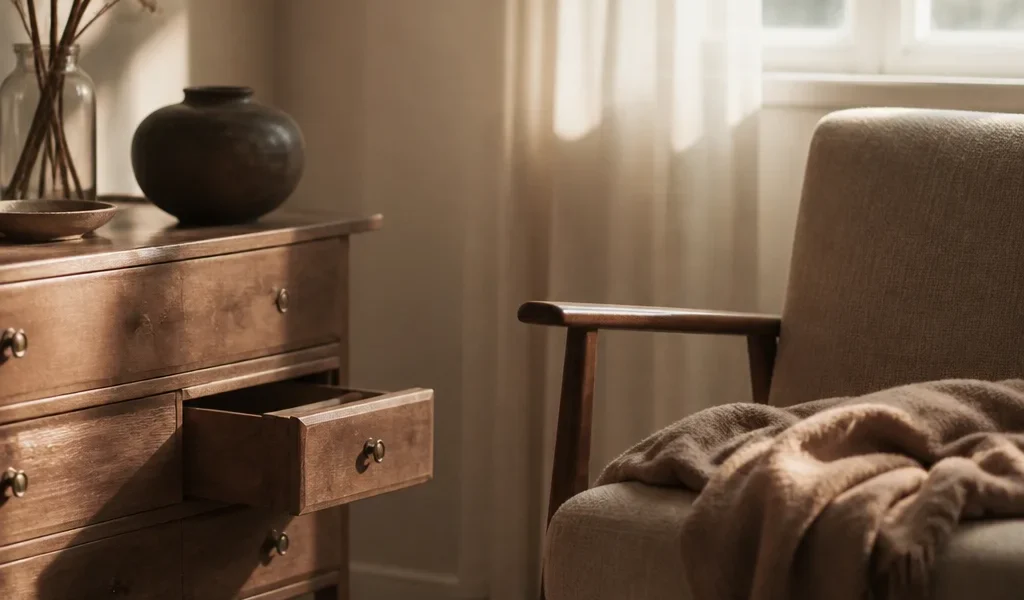
| Drawer or shelf | A designated space nobody else uses | You are expected here, and expected back |
| Closet and surfaces | Clothes hanging, books on the shelf, a side of the bed | You live here some of the time |
| Key or code | You can arrive when they are not home | Trust, access and a real security question |
Mismatches happen when two people read the same tier differently. Somebody offers a drawer as hospitality and is horrified to discover it was received as a commitment; somebody else receives a drawer and quietly builds a life around it. The only reliable fix is words – “I would love you to keep a few things here, and I want to be clear I am not ready for more than that yet” is a complete sentence and a kind one.
Where someone does live with you, this stops being symbolic and becomes an actual allocation. A polyamorous household agreement is the right document for it, and what a nesting partner is plus balancing a nesting partner with a newer relationship cover the versions where the space question has an incumbent.

Overnight Kits and the Toothbrush Threshold
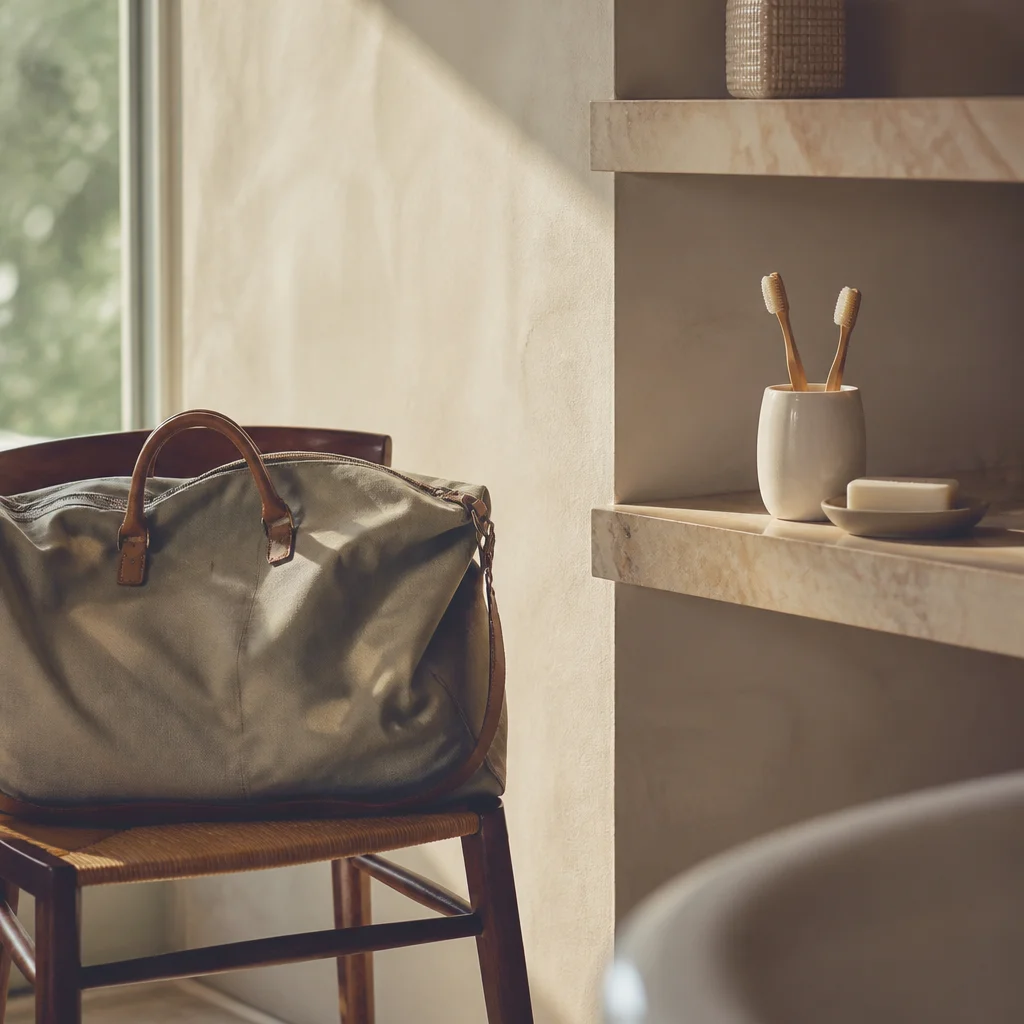
The toothbrush is the most emotionally loaded object in non-monogamy relative to what it costs. A toothbrush in the holder means no packing, no deciding, no asking. It means staying is the default rather than the exception. For some people that is lovely. For others it is a small daily reminder of a pace they did not choose.
The healthy version is to make it explicit and reversible. Ask before leaving things. Ask before leaving them somewhere visible to a roommate or a child. And agree what happens to them – the kit, the drawer, the hoodie – if the relationship changes shape. That last one sounds morbid at the start of something good, and it is the single kindest thing you can agree, because it removes the awful scene later of deciding someone’s belongings while they stand in the hallway.
A simple practice that works well: the kit lives in a bag or a box, not spread across the bathroom. It keeps the footprint honest, it makes the tier easy to step down without a dramatic clear-out, and it means a roommate or a child never has to ask a question nobody wants to answer. If the sleepover itself is new territory, threesome sleepover logistics covers the practical layer of who stays where.
When Roommates, Children or Neighbours Share the Space
Your space agreements do not exist in a vacuum. Other people live in or next to the home, and they did not consent to any of it. This is where non-monogamous people most often get careless – not out of bad faith, but because the arrangement feels so normal from the inside.
- Roommates first. They signed up to share a home, not to host your network. Agree a frequency ceiling and stick to it. Living with non-monogamous roommates and talking to a roommate about non-monogamy both start from that premise.
- Children change the calculus entirely. Kids read space, not explanations. Who is at breakfast, whose things are in the bathroom, who has a key – they build a model from that. Move at the pace of the child, not the romance; ENM and parenting and a co-parenting plan for a polycule go deeper.
- Neighbours notice patterns, not people. A rotating cast at the front door reads differently from a partner of two years, and in a small building or a close street it will be noticed. Non-monogamy and neighbours covers the privacy side.
- Guests of guests are a real boundary. Who can your partner bring to your home, and when? Answer it before it is asked at 11pm.
A useful default: anyone who is in the home regularly should be name-known to everyone who lives there. Not intimate details – just a name, a face and roughly why they are around. It costs nothing and it removes the worst version of the surprise.

Keys, Codes and the Access Conversation
Giving someone a key is a trust decision and a security decision at the same time, and it deserves to be treated as both. It is also the tier with the worst-defined exit, which is why it generates the most post-breakup chaos.
Before any key changes hands, answer four questions: Can they arrive when nobody is home? Can they bring someone else? What happens to the key if the relationship ends, and who actually asks for it back? And if it is a door code rather than a physical key, when does it get changed? A code is easier to share and far easier to forget you shared – if you use one, keep a mental list of who has it.
The revocation plan is the part people skip. Write it down while things are good: the key comes back within a set window, the code changes the same week, and nobody has to have that conversation in the middle of an ending. It is not pessimistic to plan it; it is the reason an ending does not also become a security incident. If the relationship is already changing shape, managing your ENM connections and understanding metamour dynamics are useful company.
One more: access should never be given as proof. If a key is being requested as evidence of how much you trust someone, or offered as a way to keep someone from leaving, the object has stopped being a key.
What Belongs to the Relationship and What Stays Yours
The last piece is the one that protects you. Sharing space works when something remains unambiguously yours – a surface, a drawer, a chair, a shelf, an hour of the morning. Not because you are withholding, but because a person with no private corner in their own home starts to resent the people they love, and they usually cannot say why.
| Keep yours | Negotiate together |
|---|---|
| One surface, drawer or shelf nobody else touches | Shared spaces: kitchen, living room, bathroom storage |
| Your morning or evening routine in the home | The overnight and hosting calendar |
| Items with history that you would be upset to lose | Furniture bought jointly and what happens to it |
| A key you do not have to justify holding | Who gets access and under what conditions |
| The right to say not tonight in your own home | How many nights a week each partner stays |
That last row is the important one. The ability to say “not tonight, I need my own place” is what makes every other generosity genuine. Without it, hosting becomes obligation, and obligation is where good arrangements quietly die. If you find you cannot say it, the issue is usually not space – it is a boundaries and agreements question, or sometimes competition between metamours showing up as territorial behaviour about a home.

Space Questions People Actually Ask
How much space should a partner who stays twice a week get?
Enough that staying is easy and not enough that leaving is complicated – typically a drawer or shelf plus space for an overnight kit. Beyond that, match the tier to what both people actually want rather than to a schedule. Frequency of nights is a weak proxy for the shape of a relationship.
Is it unfair that we always go to their place?
It is not unfair if it is chosen and the cost is acknowledged; it is unfair when it happens by default and the hosting labour is invisible. Either rotate, or have the people who benefit contribute something concrete. Gratitude that never turns into action stops counting fairly quickly.
When is the right time to give someone a key?
When you would be comfortable with them arriving while you are not home, and when you could ask for the key back without it becoming an existential event. If either answer is no, you are not there yet – and that is fine. A key is not a milestone you owe anybody.
My partner wants less space than I do. Are we incompatible?
Not necessarily, and it is one of the most workable differences there is. One person can be deeply committed and want a largely separate home; another can be committed and want overlap. What matters is whether the lower-space person can hear the request without hearing a demand, and whether the higher-space person can live at the lower tier without resentment. If both are true, you are fine.
Editor’s note: this article is general information for adults, not legal or medical advice. Tenancy, occupancy and who may lawfully hold keys to a property vary by jurisdiction and by your lease – check your agreement and local rules before making arrangements described here.
Figuring out how to share space with multiple partners is mostly about saying early the things that are obvious late. Offer the drawer, name the tier, plan the way back. And if the conversation has you adding up who does what around the house, how to split chores with multiple partners picks it up from there – right here at 3Cupid, where nobody needs the basics explained.