Table of Contents
- Why It Is Harder to Text Multiple Partners Than One
- Set Response Expectations Before They Turn Into Resentment
- Build a Weekly Message Rhythm You Can Actually Keep
- When Two People Need You at the Same Moment
- Group Threads: Genuinely Useful, Occasionally Awkward
- Phone-Free Time That Does Not Read as Rejection
- Tone, Length, and What Short Messages Get Wrong
- A Ten-Minute Weekly Reset
Learning to text multiple partners is less a memory problem than a clarity problem. Most people who feel like they are failing at it are not slow repliers. They are quietly carrying two or three different sets of expectations at once, and almost none of them were ever said out loud. One partner expects a reply within the hour. Another is happy with one good message at the end of the day. A third reads a short reply as a sign something is cooling off. Trying to satisfy all three silently is what wears people down.
This guide covers how to set response expectations that fit each relationship instead of applying one standard everywhere, how to build a weekly rhythm you can actually keep, what to say when two people need you at the same moment, when a group thread helps and when it quietly adds pressure, and how to take phone-free time so it reads as rest rather than withdrawal. There is a ten-minute weekly reset at the end you can start using this Sunday.
Why It Is Harder to Text Multiple Partners Than One
A single relationship has one messaging culture, and it gets built by accident over months. Add a second or third partnership and you now have several cultures, and you are the only person fluent in all of them. Your partners do not see each other’s threads. They only see what they receive, and they compare it against what they assume everyone else receives.
That comparison is where most friction starts. It is rarely about minutes. It is about what a pattern seems to mean. Am I a priority? Is this fading? Are they busy with someone else, or avoiding me? When those questions stay unasked, people answer them with their least generous guess.
The fix is not replying faster. Replying faster just moves the ceiling. The fix is making the pattern legible: telling each person, in ordinary language, what your week actually looks like and what they can reasonably expect inside it.

That legibility is the whole job. Once someone knows that Tuesday is your late night and Sunday morning is theirs, a slow reply stops being evidence of anything.
Set Response Expectations Before They Turn Into Resentment
Response expectations are not rules about behaviour; they are agreements about predictability. A rule says “you may not message them after ten at night.” An expectation says “I usually go quiet after ten, and if something is genuinely urgent, call me instead.” One controls the other person. The other simply informs them.
A workable expectation has three parts: a typical window, an exception path for urgency, and a reason. The reason matters more than people expect. “I am offline during work hours” lands completely differently from silence with no explanation attached to it.
| Context | Typical window | One line you can send |
|---|---|---|
| Weekday work hours | End of day | Heads-down today, I will reply properly tonight. |
| Weekend with another partner | Next morning | I am with someone today, catching up properly tomorrow. |
| New connection, first weeks | Same day | Still learning my week, but you will hear from me daily. |
| Established long-term partner | Within a few hours | Slow day here, replies may be quick or very delayed. |
| Travel, illness or a heavy week | Once a day when possible | Low capacity week, sending one good message a day. |
Notice that none of these promise instant availability. Promising instant availability is the fastest route to resentment, because the first time life interrupts you, you have broken an agreement you never needed to make in the first place.
If you want a wider frame for how expectations differ from rules and agreements, we go deeper on that distinction in rules, boundaries and agreements in ENM. The same thinking applies to messaging.

The point of naming a window is not to bind yourself to it forever. It is to give the other person something to hold onto while you are busy living your life.
Build a Weekly Message Rhythm You Can Actually Keep
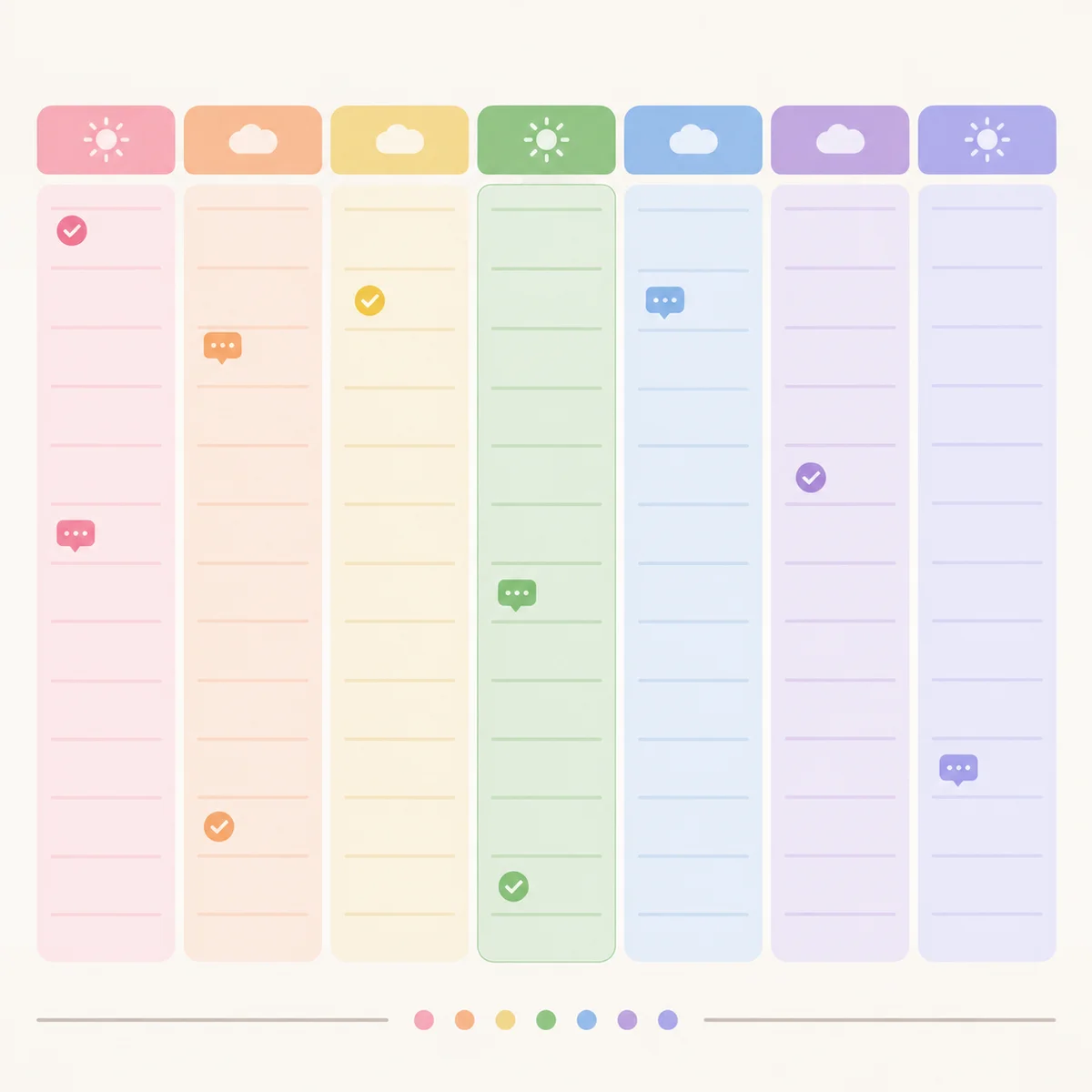
Most messaging stress is not about any single reply. It is the low-grade feeling of being permanently behind. A rhythm turns an endless queue into a finite set of touchpoints, and finite things are much easier to stop worrying about.
- Pick one anchor point in the day — a commute, lunch, or the hour before bed — and send your substantive replies there. Short acknowledgements can happen any time.
- Give each partnership one predictable weekly touchpoint: a longer voice note, a proper catch-up thread, or a scheduled call. Predictability does more for security than frequency does.
- Batch the logistics. Plans, schedule changes and date confirmations belong in one message rather than scattered across nine.
- Leave one slot genuinely empty. A week with no gap in it produces exactly the kind of silence you then have to apologise for.
If you already hold regular check-ins, the message rhythm should serve that structure rather than replace it. A quick “thinking about you, talk Sunday” is usually enough to bridge the gap between two regular ENM relationship check-ins.
One thing worth watching: if you find yourself answering the same question from three people every week, that is a sign your rhythm needs one shared announcement rather than three private explanations.
When Two People Need You at the Same Moment
It happens. One person has a genuinely bad afternoon on the same day another person needs a decision about the weekend. You cannot be equally present for both at once, and pretending otherwise usually leaves both of them feeling half-heard.
- Say which one you are handling first, and when you will come back to the other. “I am with someone in a tough moment right now, and I want to give this proper attention tomorrow morning.”
- Do not narrate the details of one partnership to the other. “I am with someone” is enough context. The specifics are not yours to share.
- Avoid equal-time accounting. People are not owed identical minutes. They are owed honesty about why you are unavailable.
- If this keeps happening, the real issue is scheduling rather than messaging, and it deserves a calendar conversation instead of an apology.
The instinct when you are stretched is to try to be slightly present for everyone. In practice, one honest “not right now” is far kinder than three distracted half-answers.
If your week is genuinely too full for the number of people in it, that is worth facing directly. Our piece on fair scheduling without keeping score covers the structural side of the same problem, and time management across several relationships goes further into the weekly planning.
Group Threads: Genuinely Useful, Occasionally Awkward
A shared thread with two partners or a metamour can save an enormous amount of repetition. One plan, one place, everyone informed. It can also turn into a small stage where nobody actually wanted to perform.
- Ask before adding anyone. A group thread is an introduction, and introductions need consent from both sides.
- Keep logistics in the group and feelings in direct messages. Nobody wants to process a hard emotion in front of an audience they did not choose.
- Agree on what a quiet thread means. Silence in a group chat gets read as disapproval far more often than it actually is.
- You are allowed to leave a thread that has stopped serving anyone. Say so plainly instead of fading out of it.
Group threads work best once the people in them already know each other a little. If they do not, start with a direct conversation between the two people who would actually be in it, and let the thread come later. There is more on this in our guide to group chat etiquette.

Another quiet rule: never use a group thread to deliver news that one person has not heard yet. Finding out alongside other people is not the same as being told.
Phone-Free Time That Does Not Read as Rejection
The common mistake is disappearing silently and explaining it later. Silence with no explanation gets filled in by the other person’s imagination, and the imagination is almost never generous.
The alternative is a stated window: “Putting my phone away from nine to eleven, back after.” That one sentence turns ninety minutes of absence from a possible threat into a schedule entry. It also protects whoever you are physically with, which is the actual reason to do it.
- State the window, not just the absence. “Back at eleven” does the reassuring work, not “going offline.”
- Give an exception path — a phone call, or one agreed word that means genuinely urgent.
- Keep the windows you announce. A stated window you break three times stops being reassuring and becomes noise.
- Do not use phone-free time to dodge a conversation you owe someone. That is withdrawal wearing rest as a costume.
Some people will still feel the gap. That is worth a direct conversation rather than more reassurance by message — and asking for it cleanly is its own skill, covered in how to ask for reassurance in ENM.
Tone, Length, and What Short Messages Get Wrong
Text strips out nearly everything that makes a message warm. No pace, no expression, no tone of voice. What survives — length, punctuation, speed — gets read as mood whether or not it was meant that way. Research on how digital communication shapes relationships is still catching up with how fast habits form; the American Psychological Association keeps a running overview of the topic at its social media and internet communication page.
A three-word reply from someone who is genuinely rushed and a three-word reply from someone who is irritated look identical on a screen. If you suspect a message could be misread, add one clause that supplies the missing context: “Short reply, running between meetings, more later.”
- If a thread feels off, name it early. “I might be reading this wrong, are we okay?” beats three days of quiet guessing.
- Emoji do real work in text. One of them can carry tone that a full sentence would over-explain.
- Voice notes solve one problem — they carry tone — and create another, which is that they are hard to answer discreetly. Ask before making them a habit.
- Long serious conversations belong in person or on a call, not in a thread that can be scrolled past and half-answered.
When someone you care about seems distant by message, it helps to remember that you are reading a format, not a person. Psychology Today has a solid plain-language primer on this in its relationships basics section.

Most of the time, the message is not the problem. The missing context around it is.
A Ten-Minute Weekly Reset
Messaging agreements rarely fail dramatically. They drift. One late reply becomes normal, then five, and by the time anyone mentions it, it has turned into a story about how much they matter to you. A short weekly reset catches the drift while it is still small enough to fix with one sentence.
- Scroll each thread once. Anything unanswered for more than two days gets either a real reply or a “not forgotten you” note.
- Check the coming week against your calendar. If a usual touchpoint lands on a night you are busy, say so now instead of apologising later.
- Look for the one conversation you have been avoiding, and send the first sentence of it even if the rest waits.
- Review your own capacity honestly. If you end every week feeling behind, the agreements are too generous, not you too slow.
- Tell one person something specific you appreciated this week. It costs twenty seconds and it is the cheapest security there is.
None of this needs a spreadsheet or a system. It needs ten minutes and a willingness to say the small thing before it has time to grow into the big thing.

If you are building a version of this with more than one person, the other half of the work is agreeing what both of you need from a screen — which is what we cover in asking for texting boundaries in ENM.
How fast should I reply when I have several partners?
There is no universal number. What matters is that each person knows your general pattern and hears from you often enough to feel held. Same-day acknowledgement on weekdays and one longer message a week is a realistic floor for most people.
Is it okay to tell one partner I am with another?
Context without detail is usually fine and often kinder than unexplained silence. “I am with someone tonight” respects both people. Sharing what you are doing, how it is going, or anything intimate is not yours to pass on.
One partner wants constant contact, the other barely texts. What do I do?
You are allowed to have different rhythms with different people. Say that out loud to both. Trouble usually starts when one person believes the difference means something about their standing rather than about the other person’s habits.
Should I mention my other partners before a new connection gets serious?
Early enough that nobody feels misled. It does not have to be the first message, but it should land before expectations form — and well before anyone has agreed to anything.
How do I raise a messaging problem without starting a fight?
Describe the pattern, not the character. “I notice we go quiet for days and then have a big catch-up, and I miss the small stuff in between” gives them something to work with. “You never text me” gives them something to defend.
Learning to text multiple partners well turns out to be mostly a matter of making the pattern visible. Messaging is the connective tissue of a non-monogamous week. It is where most of the small reassurances live, and it is also where most of the small misunderstandings start. Get the pattern visible and the rest of the relationship gets noticeably easier to run.
If you are looking for people who already understand why this matters, you can start that conversation right here at 3Cupid.
Editor’s note: This article is general information for adults, written from lived community practice. It is not a substitute for relationship counselling or mental health support.