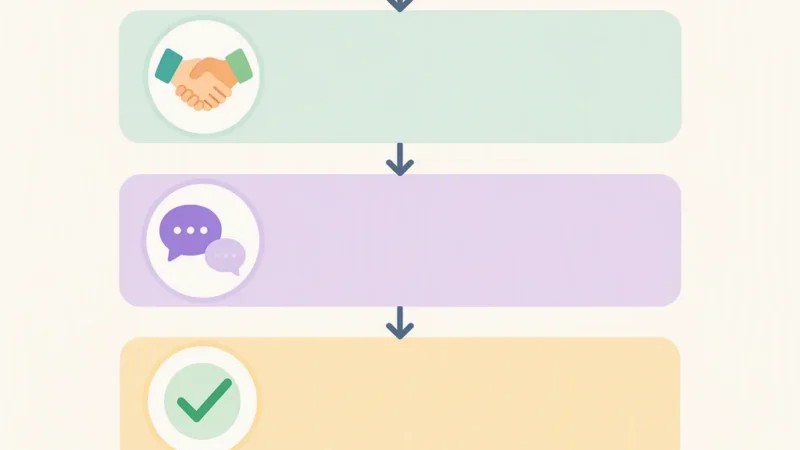
Envy in polyamory carries a special kind of shame, because it feels like it shouldn’t be there at all. You’ve chosen non-monogamy. You believe in your partners having full, rich connections. So why does watching someone else get what you want still sting? The short answer: envy isn’t a sign you’re doing non-monogamy wrong. It’s a signal pointing at something you want, and learning to work through envy in polyamory is mostly a matter of reading that signal honestly instead of hiding from it.
This guide gives you a step-by-step way to do that — from naming the want, to separating it from the person who triggered it, to turning it into a request you can actually make. If you’re still fuzzy on what envy is and how it differs from jealousy, start with our breakdown of jealousy vs envy before diving in.
Table of Contents
- Why Envy Feels So Shameful in Polyamory
- Step 1: Name What You Actually Want
- Step 2: Separate the Want From the Person
- Step 3: Turn the Want Into a Request
- Step 4: Use Comparison as Information, Not a Verdict
- Step 5: Talk It Through Before It Curdles
- A Do and Don’t Cheat Sheet
Why Envy Feels So Shameful in Polyamory
Envy is already uncomfortable, but polyamory adds a layer of guilt on top. You tell yourself a partner should be free to enjoy their other relationships, and then you feel a pang when they do — and the gap between the belief and the feeling reads as failure. So you shove the envy down, where it comes out sideways as irritability, comparison, or a vague resentment you can’t quite place.
The truth is that envy and support can coexist. You can genuinely want your partner to have great dates and still feel envious that they’re going on them while you’re home staring at a quiet phone. One feeling doesn’t cancel the other out. Letting both be true — instead of demanding you feel only the “good” one — is the first real step toward working through the envy rather than being run by it. If the comparison spiral is hitting hard, our guide to stopping the comparison trap offers a place to start.

Step 1: Name What You Actually Want
Envy almost never announces itself clearly. It shows up as “I hate that they always have plans” or “their other partner is so lucky.” Your job is to translate that into a want. Ask yourself: if I could change one thing, what would it be? Maybe you want more date nights. Maybe you want to feel more confident meeting people. Maybe you want your partner to plan something for the two of you instead of always fitting you in around other plans.
Write the answer down. Get specific — “more quality time” is a start, but “a standing Friday date, protected on the calendar” is something you can act on. The moment you turn a diffuse resentment into a named want, the envy stops being a cloud hanging over you and becomes a goal with a shape. That’s the difference between being stuck in a feeling and standing next to it, looking at it clearly.

Step 2: Separate the Want From the Person
Here’s the mistake almost everyone makes: you envy a specific person, so you conclude that person is the problem. You might catch yourself resenting your metamour, or a friend who always seems to have partners lined up, when what you actually envy is the thing they have — the time, the confidence, the ease. Separate those two, because they need different responses.
If you resent the person, the only “solution” is for them to have less — which is a dead end and, in a non-monogamous relationship, corrosive. If you name the thing, the solution is for you to have more of what you want. That’s a door you can actually walk through. Practice the sentence: “I don’t envy her — I envy the ease she has, and I want more of that for myself.” It sounds small, but it changes everything about what you do next.

Step 3: Turn the Want Into a Request
A named want only helps if it gets spoken. That’s the hard part, because asking can feel like admitting defeat — as if voicing what you want is the same as being needy. It isn’t. In a healthy relationship, a clear request is a gift: it tells your partner exactly how to show up for you, instead of making them guess while you quietly seethe.
So take “I want more quality time” and turn it into something you can ask for. “I’d love a standing date night that we protect every week.” “I want us to plan a short trip, just the two of us.” “I’d like help brainstorming how I can meet more people, since I’m feeling stuck.” A good request is specific, realistic, and about your own life rather than about controlling theirs. If you’re not sure how to phrase the harder ones, a structured format like a RADAR check-in gives you a natural opening.

Step 4: Use Comparison as Information, Not a Verdict
Comparison is the engine of envy, but it only becomes destructive when you let it hand down a verdict about your worth. Someone else having an easier time on apps doesn’t mean you’re undesirable; it might mean they have more practice, a different situation, or a profile that’s working better. Treat the comparison as data, then ask what the data says about what to do.
Jealousy tends to need reassurance; envy tends to need a plan. So when you catch yourself comparing, ask: is there a gap here I can close? If it’s about confidence, that’s buildable. If it’s about skills, those are learnable. If it’s about circumstance, that’s temporary. Not every gap is worth closing — some wants dissolve once you look at them honestly. But deciding that on purpose, instead of spiraling, is how comparison becomes useful. When the feeling is more about your partner’s other relationship specifically, our guide to building emotional resilience helps you sit with it without it swallowing you.

Step 5: Talk It Through Before It Curdles
Envy that gets processed alone tends to curdle into resentment, because the story you tell yourself about it gets more dramatic every time you rehearse it. Bringing it to your partner early keeps the story honest. The script doesn’t have to be elegant — it just has to be true.
- “I’m feeling envious that you have more dates lined up than I do, and I wanted to say it out loud instead of letting it fester.”
- “I noticed I’ve been prickly about your Friday nights. What’s underneath it is that I want more protected time with you.”
- “I don’t want you to change anything about your other relationship. I just want to figure out what I’m missing and ask for it.”
The key is to own the feeling without making it your partner’s job to fix. You’re not handing them a problem to solve; you’re asking them to witness a feeling and help you make a plan. Most partners respond to that with relief, because “I’m envious and here’s what I want” is a hundred times easier to meet than a week of unexplained coldness. If you want the full psychological backdrop on how these two emotions differ, Verywell Mind’s guide to envy versus jealousy is a helpful reference.

A Do and Don’t Cheat Sheet
- Do name the want (“I want more dates”). Don’t resent the person who has them.
- Do ask for what would help. Don’t expect your partner to read your mind.
- Do use comparison as data. Don’t let it become a verdict on your worth.
- Do bring envy up early. Don’t let it curdle into resentment.
- Do let envy and support coexist. Don’t demand you feel only the “good” emotion.
Working through envy in polyamory isn’t about becoming immune to it — it’s about getting quick at reading the signal and turning it into action. Every time you name the want, separate it from the person, and turn it into a request, you get a little faster and a little less afraid of your own feelings. That’s not just a relationship skill; it’s a life skill, and it’s one you’ll see practiced all the time in communities like 3Cupid. For the emotion that sits on the other side of both jealousy and envy, our guide to cultivating compersion is a good next read.
Editorial note: This article is for adults 18 and older and is offered as general relationship information, not medical or psychological advice. Every relationship should be built on enthusiastic consent, honest communication, and mutual respect.