
Table of Contents
- Why a Wedding Guest in Non-Monogamy Has One Extra Question
- Read the Envelope Before You Read Anything Into It
- The Short Conversation to Have Before You RSVP
- Names, Introductions, and the Words Used at the Table
- Seats, Photos, and the Two Hours You Cannot Rewind
- Gifts, Clothes, and Getting There and Back
- If the Answer Is No, or Only One Name Fits
- A Short Debrief After the Day
A wedding guest in non-monogamy has one question that other guests never have to ask: who exactly does the ‘and guest’ on this envelope mean? You might have two partners, or a partner and another person you are close to, or a connection that has no tidy label at all. The couple sending the card probably did not mean to leave anyone out. Most invitation wording simply assumes one extra place at most, because that is the template the stationer sold them. The whole thing is usually settled by one short, private conversation before you RSVP, and almost never settled gracefully at the door. This guide is for the person holding the envelope.
It stays on one side of the exchange: yours, the person who received the card. The other side – writing the invitations, setting a plus-one policy, seating people without making anyone a statement – is covered separately for the person sending them. The two jobs share a wedding and almost none of the same decisions, so the advice is deliberately not interchangeable. If you are planning your own ceremony instead of attending someone else’s, the commitment ceremony guide and the vows article are the closer reading, and bringing a second partner to a family event covers a nearby but different situation.
One framing note before the practical parts. This is general information for adults, not legal advice. Whom the law recognises as a partner, how names appear on formal documents, and what a venue requires differ by country, by state, and by the couple’s own choices. Nothing here tells you how any authority will read your relationship, and nothing here is a promise about how a family will react. Where something is genuinely binding, ask the couple directly and, if needed, a qualified local adviser. The aim is smaller and more useful: to help you ask one clear question early, and to keep everyone’s privacy intact while you do it.
Why a Wedding Guest in Non-Monogamy Has One Extra Question
For most people an RSVP is a yes or a no. The card says a name, maybe a plus-one, and a date to reply by. You tick a box and the matter closes. When your household does not fit the shape the card assumes, one reply splits into three questions: does the extra place cover more than one person, whose names go on the place cards, and what word will be used when someone introduces you across a table. None of those are grand emotional questions. They are administrative, which is good news, because administrative questions have steps.
It helps to see where the assumption comes from. Invitation wording, seating charts, and catering counts are built around a paired unit, and that default is old enough that nobody at the venue is making a point with it. Couple privilege describes a related habit of treating a pair as the real unit and everyone else as an addition; here it shows up as a printed form rather than an attitude. Relationship hierarchy and the difference between descriptive and prescriptive hierarchy are useful if the question behind your RSVP is really about who gets called a partner, but most of the time the card is just a card. The APA material on families is a fair reminder that family structures vary far more than any standard form expects.

One thing this is not: a test of anyone’s loyalty. Deciding whether you can bring two people is a logistics question with a possible no attached to it, not a verdict on which of your relationships counts. Self-worth in non-monogamy is worth a read if you notice the reply landing as a judgement rather than a headcount, and handling a plain no is a genuinely useful skill here. Ask the question as a question, and let the answer be a small thing.
Read the Envelope Before You Read Anything Into It
Before you draft a message, look at what is actually printed. Four wordings do most of the work in the English-speaking wedding world, and each one leaves a different amount of room. A single name with no guest line, a name with ‘and guest’, two names written out, or a family-style envelope that lists a household. What matters is not what you hope it means but what the person doing the catering will count. Read it as a headcount first and an emotional signal second, and you will save yourself a long evening of decoding.
| What the card says | What it usually means for a headcount | What to ask |
|---|---|---|
| One name only | One seat has been counted | Whether an extra place can be added at all |
| ‘And guest’ | One unnamed extra place is reserved | Whether the extra place can be split, and how to name it |
| Two names written out | Two seats are already counted | Only whether the spelling and titles are right |
| A household-style envelope | The hosts guessed who belongs together | Whether that guess matches your own household |
The last row is the one that catches people. A well-meaning relative addressing a card to ‘the family’ may have quietly decided which of your people count, and a household-style envelope is a guess, not a fact. Managing expectations is mostly about not letting a guess harden into an assumption you then have to undo in public. If the wording is generous but vague, that is the easiest situation of all: you only need to confirm names. If it is narrow, the next section gives you the sentence to use.
Children, former partners, and anyone invited through a different branch of the family each add their own line to the count. Do not try to solve all of them in one message. Note down what the card actually says, then decide which single question you need answered. Expectation alignment sounds like a grand phrase for this, but it really means agreeing on a number of chairs before anyone starts imagining a scene.
The Short Conversation to Have Before You RSVP
Ask privately, ask early, and make the no easy. That last part is the whole craft. A question phrased as ‘I assume it is fine if I bring both of them’ leaves the other person a social bill to pay if the answer is no. A question phrased as ‘is there room for two, and completely fine if not’ gives them a door. You are not asking permission to have a relationship; you are asking whether a venue has a chair. Keeping those two things separate is what makes the exchange comfortable for everyone. Enthusiastic consent is a useful baseline here: a reluctant yes is not a yes you want to build a day on.
- ‘I would love to come. Would it work if I brought both of my partners? Totally fine if the numbers do not allow it.’
- ‘The card says and guest. Is that one extra place, or may I put two names on the reply?’
- ‘If seats are tight, I am happy to come on my own – I just wanted to ask before the RSVP date.’
- ‘Could you let me know how you would like the names written for the place cards?’
Send it to the person who owns the guest list, not to a group chat and not through a mutual friend. One message, one recipient, one question. If you are also working out how much to say about your relationship at all, disclosing ENM status and the don’t-ask-don’t-tell versus full disclosure comparison both help you decide how much detail this particular couple needs – which is usually none beyond the names. The APA overview of communication is a decent general anchor for why a short, specific ask beats a long, careful hint.

Then write the answer down. A date, who said it, and the exact number of places is enough. People are not being unkind when they forget a verbal arrangement made six weeks earlier; weddings are a blizzard of small decisions and your one is not the only one. A saved message is not a contract and you should not brandish it like one. It simply means that on the morning of the event nobody has to reconstruct a conversation from memory. The rules versus agreements distinction applies neatly: you are agreeing on a number together, not laying down a rule.
Names, Introductions, and the Words Used at the Table
Somebody will introduce you. It might be an usher, a relative who has known the couple for decades, or the person sitting next to you who is simply making conversation. They will reach for the nearest available word – partner, friend, housemate, ‘plus-one’ – and that word may be wrong in a way that is not worth correcting in the moment. Decide beforehand, with the people involved, what you would like used. Then you only have to say it once, lightly, if it comes up.
- ‘This is Sam, my partner, and this is Rae, my other partner.’ – plain, symmetric, no explanation attached.
- ‘We came together, the three of us.’ – useful when the setting does not need labels at all.
- ‘Oh, just friends is not quite it – we are all partners.’ – a gentle correction that does not turn into a talk.
The privacy rule is simple and worth stating plainly: you may name your own connection to someone, but you do not get to name theirs for an audience. If one of your people would rather not be described as a partner in front of a room of strangers, that preference wins without a debate. Privacy in threesome dating and coming out to friends and family both treat disclosure as something each person controls for themselves. What to do if someone outs you is worth knowing before you need it, though at a well-run event you usually will not.

There is a version of this that gets over-managed. You do not need a briefing document for the ushers, and you do not need to correct every cousin who calls someone a friend. Aim for a sentence you can say without stopping the conversation, and let the rest go. Going out in public as a three has more on the ordinary version of this: most people are thinking about the food, the seating, and whether they remembered the card, not about the precise shape of your household.
Seats, Photos, and the Two Hours You Cannot Rewind
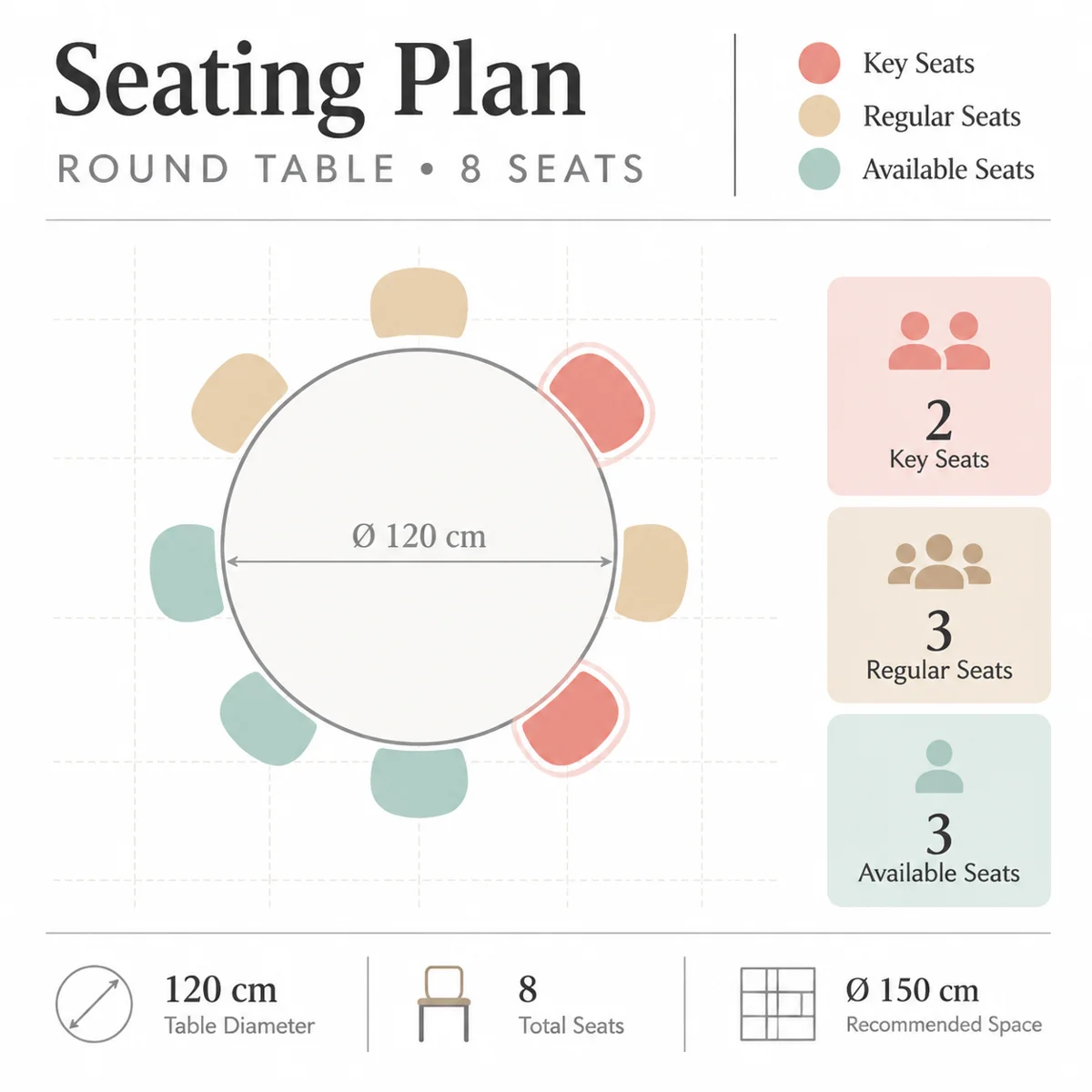
A seating plan is a set of decisions someone else made on your behalf, and it is worth seeing before the day if you can. Two people who asked to arrive together may find themselves on opposite sides of a round table because the chart grouped by surname or by which side of the family issued the invitation. That is almost always an accident. A one-line note – ‘could the three of us sit together if the table allows it’ – is a reasonable thing to send with the RSVP, and a reasonable thing for a host to answer plainly.
Photographs are the part with a longer tail. A wedding produces a photographer, a roomful of phones, and usually a shared album or a social post within days. If any of your people would rather not appear in a picture that travels beyond the room, say so before the cameras start, and treat a quiet or hesitant answer as a no. Social media privacy in non-monogamy and phone-level privacy cover the ordinary mechanics; the principle here is only that consent to attend is not consent to be published. The womenshealth.gov material on relationships and safety is a useful outside reference for why pressure in the moment is not agreement. APA on healthy relationships is a gentler general read on the same idea.
Children and older relatives in the room change the tone without changing the rule. You can be warm and brief with a curious nine-year-old, and you can let an uncle’s slightly old-fashioned wording pass without a lecture. Correcting someone is a choice with a cost, and most of the time the cost is higher than the inaccuracy. What you should not do is let a well-meaning host announce a relationship to a room on your behalf. Consent that can be withdrawn includes withdrawing from a description you did not agree to, and choosing how much to disclose is yours to make.
Gifts, Clothes, and Getting There and Back
The small logistics are where a good plan quietly earns its keep. A gift signed by three people needs a card with room for three names, or a deliberate decision to sign one name and explain nothing. Gift giving in polyamory is the wider read on not turning presents into a scoreboard; marking milestones covers the same instinct from the other direction. Neither is a rule. If a couple has a registry, using it is the kindest possible answer, because it removes the guessing entirely.
- Confirm the number of places in writing, with the date and who replied.
- Agree with your people on the word to use if someone asks.
- Decide the gift signature before you buy the card, not at the table.
- Check the dress wording once, and do not read a hierarchy into ‘formal’.
- Arrange your own transport so nobody is stranded if one of you wants to leave early.
- If you are travelling, book your own place to stay under your own name.
Clothes and travel rarely carry relationship meaning, but they do carry cost. Who pays for the room, the lift, or the new outfit is a question worth settling between yourselves rather than discovering on a receipt. Financial boundaries is the standard reference here, and the APA material on personal finance is a reasonable outside anchor for why a calm agreement about money prevents a disproportionate amount of resentment. Agree a number, agree who books, and move on.

Have an exit that does not require a scene. Someone may feel tired, uncomfortable, or simply ready to go long before the last dance. If you arrived in two cars, or know the train times, or have a quiet signal agreed between you, leaving is boring instead of being a negotiation. Withdrawing consent is usually discussed in much more intimate settings, but the ordinary version is the same skill: a change of mind should be cheap to act on. First-timer etiquette has a few more small conventions that are handy in a formal room.
If the Answer Is No, or Only One Name Fits
Sometimes the honest answer is no. Venues have a capacity, catering is counted per head, and a family may be navigating its own tensions about who is welcome. A limit is a fact about a room, not a statement about which of your relationships is real. If you hear yourself turning the reply into a referendum on your life, pause. Handling rejection is a practical skill rather than a personality trait, and advocating for yourself is useful precisely because it lets you ask once, clearly, and then stop pushing.
- Bring one person and be honest with the others about why, before the day rather than after it.
- Go on your own and treat it as a few hours with the couple who invited you.
- Decline, send a warm note, and arrange a separate meal with the people you wanted to bring.
- Accept only the part of the day that has room – the ceremony, or the later drinks – if the hosts offer it.
The decision about who comes, if only one place exists, belongs to you and the people involved – not to the host, and not to a seniority rule you never agreed to. There is no correct order. Non-hierarchical polyamory and the wider piece on hierarchy are useful if the question opens up something bigger between you, but a single invitation does not have to reopen your whole structure. Talk about it as a one-off scheduling problem and it usually stays one.

If the conversation went badly – a curt reply, a joke that landed wrong, a partner who felt sidelined – deal with that separately from the RSVP. Repair after a conflict and handling disagreement without taking sides both start from the same place: separate what happened from what it seemed to mean. A short check-in a few days later is a better tool than replaying the message twelve times. None of this needs to change your answer to the couple.
A Short Debrief After the Day
The day after, write down what actually happened before you write down what it meant. Who introduced whom, whether the seats matched the reply, whether any photo was taken that someone was uneasy about. Facts first is a surprisingly kind habit, because it stops a small awkwardness from growing into a story about a relationship. Regular check-ins and the list of harder check-in topics give you a low-stakes format for this if you want one; a two-minute conversation in the car is enough.
Two things deserve a follow-up if they occurred. If a photograph of your group was posted without asking, the guide on being outed and social media privacy cover the practical steps, and a brief, factual request to take it down is usually all it takes. If someone was introduced in a way that made them uncomfortable, say so to the host once, without a speech, and let it be fixed for next time. Repair works best when it is small and specific.
Then close the file. One wedding is not a precedent for every future occasion, and holidays and special occasions will raise their own version of the same question soon enough. What you are really building is a habit of asking early, naming people the way they want to be named, and keeping the answer boring. That habit travels well beyond one Saturday.
Can I just bring both partners without asking?
It is kinder not to. A catering count is a real constraint, and arriving with an extra person puts the hosts on the spot in front of other guests. One short message before the RSVP date costs almost nothing and gives everyone room to answer honestly. This is general information, not legal advice; it is simply the version that tends to go smoothly.
What if the card says ‘and guest’ but I have two partners?
Ask whether one extra place can become two, and make the no easy. If it cannot, you are back to the four ordinary options: bring one person, go alone, decline and arrange something separate, or attend only the part of the day with room. The host side of this exchange sets out how a clear policy makes that answer less awkward for everyone.
Do I have to explain my relationship to the couple’s family?
No. You need a number of seats and a set of names; you do not owe a roomful of strangers a description of your structure. How much to disclose is your decision, and keeping some things private is a perfectly ordinary choice rather than a slight to anyone.
What if a photo of us gets posted without anyone asking?
Treat it as a practical problem, not a drama. A short factual message asking for it to come down is usually enough. Social media privacy and what to do when private information spreads cover the follow-up, and womenshealth.gov on safety is a sound outside reference for why an unenthusiastic yes is not consent.
Most of this is unglamorous: one message, one saved reply, one agreed word for an introduction, one plan for getting home. None of it asks the couple to understand your relationships in detail, and none of it asks you to explain yourself to a room. The point is that a formal occasion with fixed seating does not have to become a public statement about anyone’s private life.
Being a wedding guest in non-monogamy is mostly a scheduling question with good manners attached. Ask before the RSVP date, write down the answer, let each person choose how they are described, and keep an easy exit available. Do that and the day can be about the two people getting married instead of the shape of your household. More practical guides like this one are right here at 3Cupid.
Editor’s note: this article is general information for adults and is not legal advice. How partners are recognised in law, how names appear on formal records, and what a venue or a couple requires vary widely by location; ask the hosts directly and consult a qualified local adviser where something is genuinely binding. It offers no statistics, no outside cases, and no promise about how any event or family will respond. Nobody owes anyone an explanation of their relationship in order to be seated, and no host’s wording can decide for you who your people are. If a situation ever feels unsafe or pressured, prioritise your own safety and step away.