Table of Contents
- The First Hour After a Coffee Date
- Write What Happened Before You Explain It
- Send One Follow-Up Message, Then Wait
- Read the Reply Without Building a Story
- Debrief With the Partners Already in Your Life
- Deciding Whether There Is a Second Meet
- When the Answer Is No
What to do after a coffee date in ENM is its own small skill, and almost nobody treats it as one. The meet itself gets all the attention – the venue, the opening line, whether there was a pause – and then the cups are cleared and you are alone with a head full of interpretation. Within an hour most people have built a story out of six data points, sent a message they will reread nine times, and quietly decided what the silence means.
This piece starts where the other one ends. It covers the first hour, the one follow-up message, how to read a reply without inventing a verdict, the debrief with the partners already in your life, and the ordinary decision about whether there is a second meet. It is general information for adults, not professional advice. If you are still choosing the cafe, planning the coffee date is the half that comes first.
One assumption worth stating: a first coffee meet is a small event. Nothing was promised, nobody owes anybody a sequel, and the most useful thing you can do in the following day is keep the event that size. The Psychology Today overview of relationships is a reasonable reminder that early impressions are noisy and that people behave differently when they are tired, nervous or being observed.

The First Hour After a Coffee Date
Do nothing decisive for an hour. That is the whole instruction. Walk, get on a bus, sit in a car, buy something unrelated – anything that puts a little distance between the table and your phone. The first version of your reaction is usually adrenaline and relief wearing a costume, and it is a bad basis for a message you cannot take back.
There is a practical reason beyond the emotional one. In non-monogamy there are usually other people with a legitimate interest in how your afternoon went, and their interests are not identical to yours. If you send a verdict to the person you just met before you have spoken to an existing partner, you have set a sequence you did not choose. A short buffer keeps the order yours. Texting several partners and group chat etiquette both describe how quickly a hastily written line can land in the wrong room.
The American Psychological Association has a clear page on how stress shapes attention and judgement; the useful takeaway here is simply that a mildly charged hour tightens your focus and makes a single ambiguous detail feel like the whole story. Give it sixty minutes and the same detail usually shrinks back to size.
Notice what you are not doing. You are not deciding whether you like this person, you are not drafting the message, and you are not checking whether they have posted anything. You are letting a small event be small. That is harder than it sounds, and it is the single most useful habit in the twenty-four hours after a coffee date.

Write What Happened Before You Explain It
When you are ready to think, write three or four facts before you write a single feeling. Not a diary entry – a short list of things you could defend if somebody asked tomorrow. They arrived at ten past. We talked about work and a book. They asked two questions about my other relationship and stopped when I gave a short answer. We left at eleven.
The point of separating facts from interpretation is that interpretation is where all the distortion lives. One quiet moment becomes they were not interested. One enthusiastic moment becomes this is going somewhere. A delayed reply becomes a rejection. Each of those may turn out to be true, but on the day they are guesses. Difficult topics in a check-in and the radar check-in format both use the same discipline at relationship scale: describe first, explain second.
| What you actually observed | The story people tell themselves | A fairer reading |
|---|---|---|
| They were quiet for part of the hour | They did not like me | They were tired, thoughtful, or letting me talk |
| They left exactly at the stated end time | They could not wait to go | They respected the time box you both agreed |
| They asked about my other partners | They are prying or jealous | They are working out how your agreements actually work |
| They have not replied by evening | It went badly | They are at work, with family, or simply slower than you |
The expectation alignment guide is worth a look here, because most post-meet disappointment is not about the person at all. It is about an unspoken picture of what the hour was supposed to produce. If you went in hoping for a clear sign and got a pleasant forty minutes, that is not a failed meet; it is a mismatched expectation, which is a much easier thing to fix.
Keep the note somewhere private. It is for you, not for the group chat and not for the person you met. Privacy in non-monogamous dating and social media privacy both apply even to something as harmless as a few lines about a stranger’s job.
Send One Follow-Up Message, Then Wait
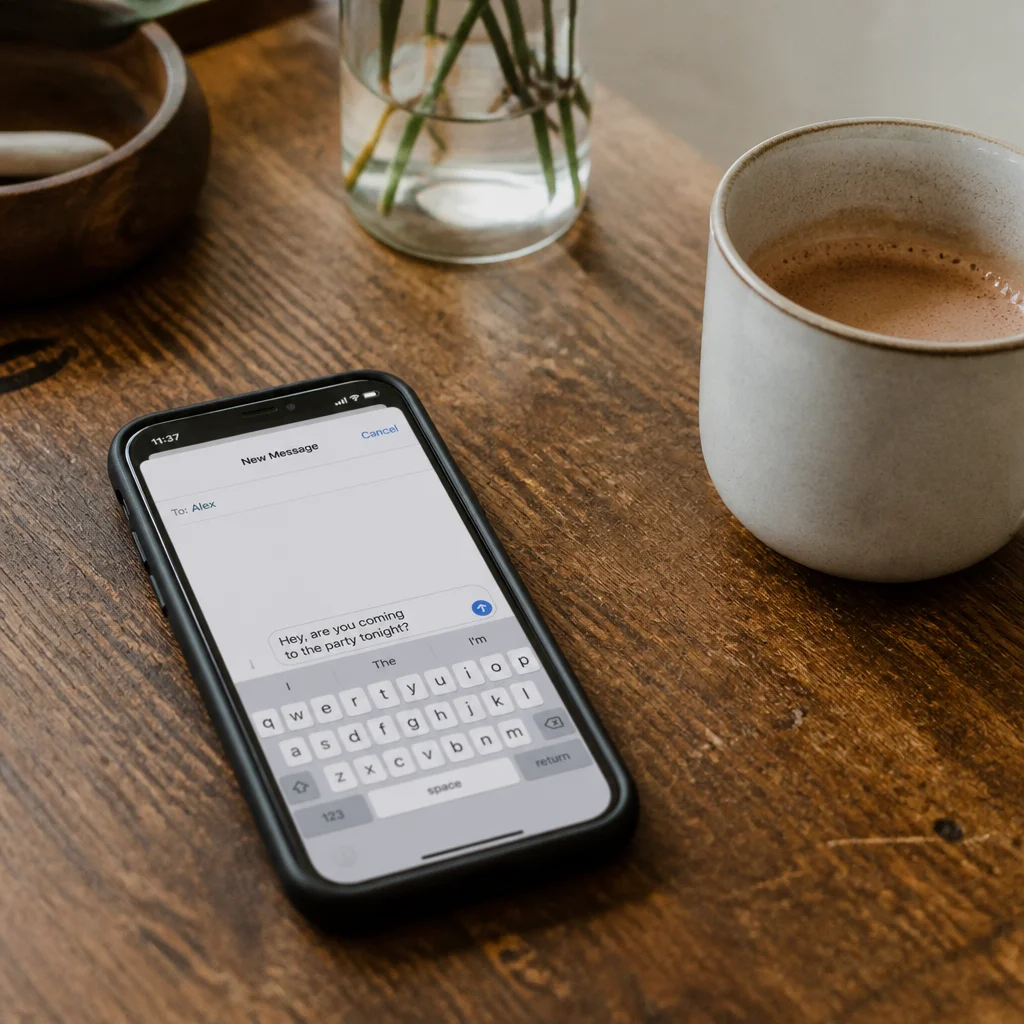
One message, sent once, within a day. Short, warm, and with a clear next step or a clear no next step. Most of the anxiety people feel after a first meet is generated by the message itself – the drafting, the rewording, the reading of a delivered receipt – and it disappears almost completely if you treat it as a small administrative act rather than a performance.
Three shapes work, depending on what you actually want.
- If you want a second meet: I liked this morning. Would you like to do it again next week, same kind of place? No pressure either way.
- If you are unsure: Thanks for today. I enjoyed the conversation and I am going to sit with it for a couple of days before suggesting anything.
- If you do not want to continue: Thanks for the hour. I do not think I want to take this further, and I wanted to say that plainly rather than fade out.
Notice the third one. A clear no is kinder than a slow fade, and it is also kinder than a vague yes that leaves somebody waiting. Ghosting after a meet and handling rejection in ENM dating both describe the cost of leaving a person to guess; the short sentence above costs you twenty seconds and saves them a week. Unwanted messages in ENM dating is the useful mirror image if you are on the receiving end of persistence.
Then put the phone down. The American Psychological Association has an accessible overview of social media and digital communication; the relevant point is that asynchronous messaging gives you unlimited room to reread a line that was never meant to carry that much weight. Send it once and go and do something with your hands.
Read the Reply Without Building a Story
Replies after a first meet come in a handful of ordinary shapes, and almost all of them are about the other person’s day rather than about you. A short reply usually means somebody typed between two other things. A slow reply usually means somebody was busy. A warm long reply is pleasant, and a brief thanks is not a verdict. None of these is a reliable measure of interest on its own.
| What arrived | What it most often is | What to do |
|---|---|---|
| A short reply within the hour | A busy person acknowledging you | Answer once, at the same length, and leave it there |
| No reply for a day or two | Work, family, or a slower messaging style | Wait; do not send a second message to check the first |
| A warm reply with a concrete suggestion | Genuine interest and a clear next step | Pick a day, keep the format small again |
| A vague reply that offers nothing | Uncertainty, politeness, or a soft no | Do not push; a soft no is still an answer |
| A reply that asks for details you kept private | A boundary worth noticing early | Answer only what you are comfortable sharing |
The Psychology Today material on attachment and how people read ambiguity is useful here without needing any labels. Some people are comfortable with a quiet day and some find it loud. Knowing which one you are lets you discount your own first reaction rather than obeying it. Asking for reassurance without draining anyone and not tying self-worth to rank are the two pieces worth reading if a slow reply reliably ruins your afternoon.
Watch for the one pattern that actually means something: pressure. A reply that pushes for a second meet tonight, asks why you have not answered, or tries to move the conversation somewhere private before you have agreed to anything is information, and it is not ambiguous. Consent and pressure in relationships covers the wider picture; the practical move is simply to slow down or stop.
Do not triangulate. Checking whether they have been active elsewhere, asking a mutual acquaintance, or rereading the profile for a hidden signal turns an ordinary wait into a project. Understanding jealousy in non-monogamous relationships is the longer version of why that project never ends well.

Debrief With the Partners Already in Your Life
If your agreements include a check-in after a meet, have it – but keep it a check-in, not a deposition. The useful content is small: it happened, it ran about this long, I am fine, and here is whether I want to see them again. Your existing partner does not need the other person’s name, their job, or a reconstruction of the conversation unless those things are genuinely relevant to an agreement you share.
Two boundaries make this easier. First, the other person’s confidences stay private even from a spouse; the fact that somebody told you something in confidence is not yours to spend. Second, do not use the debrief to reopen an unrelated argument. A pleasant coffee meet is not leverage for renegotiating a boundary somebody else already found difficult, and handling conflict without taking sides is the relevant skill if the conversation starts to slide that way.
Some households use a standing slot for exactly this, and how to run a radar check-in plus scheduling regular check-ins explain why a predictable twenty minutes beats an ad hoc serious talk at eleven at night. If something about the meet genuinely unsettled an existing partner, that deserves its own time rather than the last five minutes of a tired evening; repair after a conflict is a separate clock from the practical update.
There is an older habit worth borrowing here. Couples who debrief after a threesome and people who process a swing experience together both describe the same rule: say what happened, say how you are, and agree what changes – if anything – before you start interpreting. A forty-minute coffee meet does not need the full ritual, but the order is identical, and the scale should match the event.
Keep your own account intact. If you have written three factual lines and then hear a strong opinion from somebody you love, it is very easy for their version to replace yours. Building vulnerability with a newer partner and pacing a connection both assume you still know what you think, so say your version first.

Deciding Whether There Is a Second Meet
Strip the question down. Do you want another forty minutes with this person, yes or no, setting aside what you think they want and what you imagine the meet was supposed to lead to. That is the entire decision. A first coffee meet is not an audition for a place in your life; it is a sample, and one sample is allowed to be inconclusive.
- Do I want another hour, or do I want the idea of another hour?
- Did anything in the meet actually cross a boundary, large or small?
- Was I able to say no to anything, and was that received normally?
- Is my interest mine, or is it a reaction to how quickly they replied?
- If I say yes, does the format stay small and public for now?
- If I say no, can I say it plainly in one sentence?
Question four catches more bad decisions than the others. A fast, enthusiastic reply is flattering and genuinely pleasant, and it is also not a reason to see somebody again. Self-worth that does not depend on being chosen and asking for reassurance cleanly are the useful reading if you notice your answer changing with their message length.
A no-show or a cancellation is its own case. One cancelled plan with a clear apology is a scheduling fact; repeated vagueness is an answer, and you are allowed to treat it as one without a confrontation. When somebody disappears covers the harder version. Either way, the decision stays with you: you are not obliged to keep a slot open for somebody who has not said they want it.
When the Answer Is No
Saying no after a coffee date is not a dramatic event. One sentence, sent once, is enough: thanks for the hour, I do not think I want to take this further. No explanation is owed, no catalogue of reasons is required, and no apology for having taken up forty minutes is necessary. Most people would genuinely rather have that line than a week of pleasant vagueness.
A few situations call for a firmer version rather than a softer one. If the meet involved a boundary being pushed, a question you declined being asked again, or any attempt to move things somewhere private before you agreed, you do not need to be diplomatic about the no. Enthusiastic consent and first meetup safety are the right reference points, and app safety and privacy covers what to do if the contact continues after you have said no.
Look after your own side of it too. A no you delivered cleanly can still leave you replaying the hour, and that is ordinary rather than a sign you decided wrongly. Handling rejection in ENM dating and separating your value from the outcome apply whichever end of the no you were on. Give it a day, keep the note you wrote, and do not turn a small event into a project.
Then stop reviewing. The useful work after a coffee date in ENM is three things: a short buffer, one honest message, and a decision you can state in a sentence. After that the best thing you can do is let the day end.
How soon should I send a follow-up message?
Within a day is a comfortable default, after you have had an hour to settle. Sooner is fine if you already know what you want; later is fine if you said you would take a couple of days. The thing to avoid is silence that leaves the other person guessing.
What if they reply with one word?
Assume it is a busy person acknowledging you, not a verdict. Answer once at a similar length and leave it there. Reply length is a scheduling fact far more often than it is a feeling.
Do I have to tell my other partners about the coffee date?
Follow the agreement you already have. Most people share the timing and how they are, and keep the other person’s name and anything said in confidence private. Nobody should find out about your day by accident.
Is it all right if I never want a second meet?
Yes. A clear, kind no is a complete and respectful outcome. You do not need a reason that would satisfy anybody else, and a slow fade is usually harder on the other person than one plain sentence.
The short version: what to do after a coffee date in ENM is mostly about keeping a small event small. Sit with it briefly, write facts before feelings, send one message, read the reply as a scheduling fact, debrief only as far as your agreements ask, and decide the next step in one sentence.
None of that is romantic, and all of it is why the format works. A coffee date after a coffee date should leave you with information rather than a story, and planning the coffee date well in the first place is what makes that possible.
A coffee date in ENM does not become significant because you worried about it for two days. It becomes significant only if you both decide, plainly and without pressure, that you would like another hour – and that decision is allowed to be ordinary.
Editor’s note: this article is general information for adults and is not legal, medical or therapeutic advice. Relationship agreements, disclosure practices and privacy needs differ widely; follow the arrangements that fit your own life and seek qualified help where it is needed. More practical guides like this one are right here at 3Cupid.