Table of Contents
- What Dating Someone from Your Cycling Group Changes
- A Ride Is Weak Evidence
- Faster, Slower and the Coaching Trap
- Telling the Group Without Making an Announcement
- Tracking, Photos and the Record You Did Not Make
- When It Ends, Saturday Keeps Coming
- Five Questions Before You Ask
Every standing hobby brings its own dating problem, and dating someone from your cycling group is mostly a problem about the clock. Saturday arrives whether the two of you work out or not. A dozen other riders will see the whole thing unfold from a saddle, in hi-vis, at close range, and there is no way to end it privately because the group chat knows both of you. So the order of operations is: work out what you actually witnessed before deciding what it means, ask while both of you are standing still, inform the handful of people it affects rather than the entire ride, and settle what happens if it ends while things are still good.
The upside is that you are not starting from zero. You have watched this person deal with a mechanical that was not theirs, seen whether they wait at junctions, noticed how they speak to the rider nobody else bothers with, and learned whether they remember anything you said three weeks ago. Most people get that grade of information three dates in, if they ever get it; here you get it without putting anything on the line.
Two outside sources are worth reading alongside this. The APA topic page on healthy relationships covers what separates a connection that lasts from one that merely felt intense, and the womenshealth.gov section on relationships and safety describes what pressure looks like when somebody is being thoroughly charming about it. Bicycles feature in neither; the part that goes wrong does.

Before anything else, the premise. Nobody in a riding club signed up to be approached, and the ride exists so that people can ride. Treat the group as a shortlist and you will find the group quietly stops including you — not through an argument, just through fewer texts on a Friday night.
What Dating Someone from Your Cycling Group Changes
Start with what is genuinely different. Drifting away is not available to you, because the ride is on the calendar regardless. Everyone else becomes a witness who never volunteered for the role. Tracking apps and cafe photographs mean a record of who rode beside whom exists before you have agreed on anything at all. And the Saturday belongs to the club rather than to the pair of you, so if it splits, neither person walks away with it.
Then the subtler shift. Ordinary dating lets you decide how much two areas of your life overlap. This does not: your new person lands in a thread with your friends, quite possibly with your partners, and certainly with whoever picks the route. Some people find that relaxing and some find it suffocating, and the moment to work out which you are is before it happens rather than four months in. Building vulnerability with a new partner is worth reading here — closeness normally accumulates in small doses, and riding together every week compresses that schedule without anyone having agreed to speed it up.
The closest comparisons are other standing scenes, and they land on the same trade. Dating a teammate, a fellow dancer, someone from your board game group and someone you met at karaoke all describe situations where the group outlives the romance. The lesson from every one of them is identical: the scene comes first, because the scene is the thing that keeps turning up.
So the question to sit with is not do I fancy them. It is would I still want this ride if it went badly. If the honest answer is no, waiting six weeks costs you very little and tells you a great deal about whether the feeling survives an ordinary wet morning.
A Ride Is Weak Evidence
This is the section people skip, and it is the one that matters. Two hours of exercise is a genuinely unreliable basis for deciding anything. Everyone is a little braver and a little warmer after forty kilometres in decent weather, endorphins flatter everybody, and a person who waits for you on a climb may simply be a person who waits for everyone.
| What you saw | What it might have meant | How to check |
|---|---|---|
| They waited for you on the climb | They are stronger than you and the group regroups anyway. | See who they wait for when nobody else is watching. |
| You always end up riding side by side | You ride at the same speed, which accounts for most of it. | Deliberately change position for a few rides and see who follows. |
| They fixed your puncture | They are the kind of person who fixes punctures. | Watch whether they do the same for the rider nobody talks to. |
| They suggested a longer route for two | They wanted a longer ride and you were available. | Suggest something with no bicycles in it and see whether they take it up. |
| They message after every ride | They organise the rides and message everyone. | Notice whether the messages are about riding or about you. |
What does count as a signal? Small, boring things that cost effort. They remember something you mentioned three rides ago. They ask a question that has nothing to do with bicycles. They notice when you are not there and say so afterwards. They follow up rather than only replying. None of that is romantic, and all of it survives contact with a wet Tuesday in February.
Where to ask, then. Ask somewhere stationary, with an ending built into it: the cafe stop, the car park while everyone is loading bikes, or a message the next day. Never mid-ride, never in the group chat, and never at the top of a climb where the other person is out of breath and cannot think. A sentence that works: I really like riding with you. Would you want to get a coffee sometime that is not at the end of a ride? It is specific, it is low stakes, it asks nobody to define anything, and the last clause makes clear you are proposing something different rather than another Saturday.
The next bit is what separates a real answer from a polite one. Give them somewhere to go. Truly fine if you would rather not is not putting yourself down, it is handing over the option to decline — and a person who would otherwise have to manage your disappointment in front of a dozen mutual friends will say yes when they mean maybe. How to withdraw consent cleanly and the guide to enthusiastic consent go through the mechanics properly.

And if they say no, what you do afterwards matters more than how you asked. Be there next Saturday, behave as you normally would, keep it to yourself, and do not quietly stop coming. Riding groups shrug off an unrequited ask easily. What they do not shrug off is somebody vanishing, because a dozen people will invent an explanation and none of them will be kind.
Faster, Slower and the Coaching Trap
A skill gap is the most underrated power gradient in this whole setup. It feels like a practical detail — one of you is fitter — and it quietly decides who sets the pace, who picks the route, who waits for whom, and whose day is harder. It also produces an asymmetry nobody agreed to: the stronger rider is the one offering help, and help is very difficult to refuse gracefully.
- They decide the route, so they decide how hard your Saturday is.
- They lend kit, lend tools or lend a bike, which creates a debt nobody has named.
- Pace comments land completely differently when one rider is already at their limit.
- Unsolicited technique feedback is coaching, and nobody asked for a coach.
- The slower rider stops being able to say no to a longer route without it looking like weakness.
If you are the stronger rider, the fix is mostly asking rather than assuming: do you want the long way or the short way today instead of deciding, do you want me to wait or meet you at the top instead of waiting in a way that obliges them. And if you are the slower rider, notice whether you have started shaping your Saturdays around somebody else’s idea of a good ride, because that is the point where a pleasant gap in fitness has become a decision-making imbalance.
The same applies to experience as much as speed. Somebody who has ridden for twenty years knows things, and sharing them is generous. Sharing them when they have not been asked, repeatedly, in front of other people, is a different activity with the same surface. The piece on couple privilege describes the structural version of this; the ride version is that expertise plus audience plus goodwill is a combination that can make it very hard for somebody to say that is enough, thank you.
Telling the Group Without Making an Announcement
A club is not owed a briefing, and a lay-by is a dreadful place to give one. What you do owe the people around you is enough candour that nobody has to pretend not to have noticed, and enough restraint that nobody feels conscripted into something.
- Any existing partners hear it first. Before the club, before anybody else.
- Tell whoever organises the ride before the regulars work it out for themselves.
- One sentence, once. Not a running commentary across six weeks.
- No pet names and no in-jokes in the group chat, which a dozen people can read over breakfast.
- Do not expect the club to rearrange its routes around the two of you.
- If a metamour rides with the same group, loop them in early rather than letting them hear it at a junction.
That last one is the one people get wrong most often, and it is worth being blunt about. If your partner’s other partner is on the same ride, the group now contains a structural relationship nobody designed and everyone can see. That is manageable, but not by accident. Agree between the adults involved what the Saturday looks like, whether anyone takes a different ride for a while, and what happens when two of you are in the same place on the same morning.
Then the boring coordination, which is where most of the actual friction lives. Rides are long and start early, and a new relationship takes the same hours as an old one. Dating with an unpredictable schedule and preventing ENM dating burnout both deal with the arithmetic, and the short version is that a Sunday morning is not free just because nobody has claimed it yet. Say out loud which Saturdays are the ride, and which are something else.
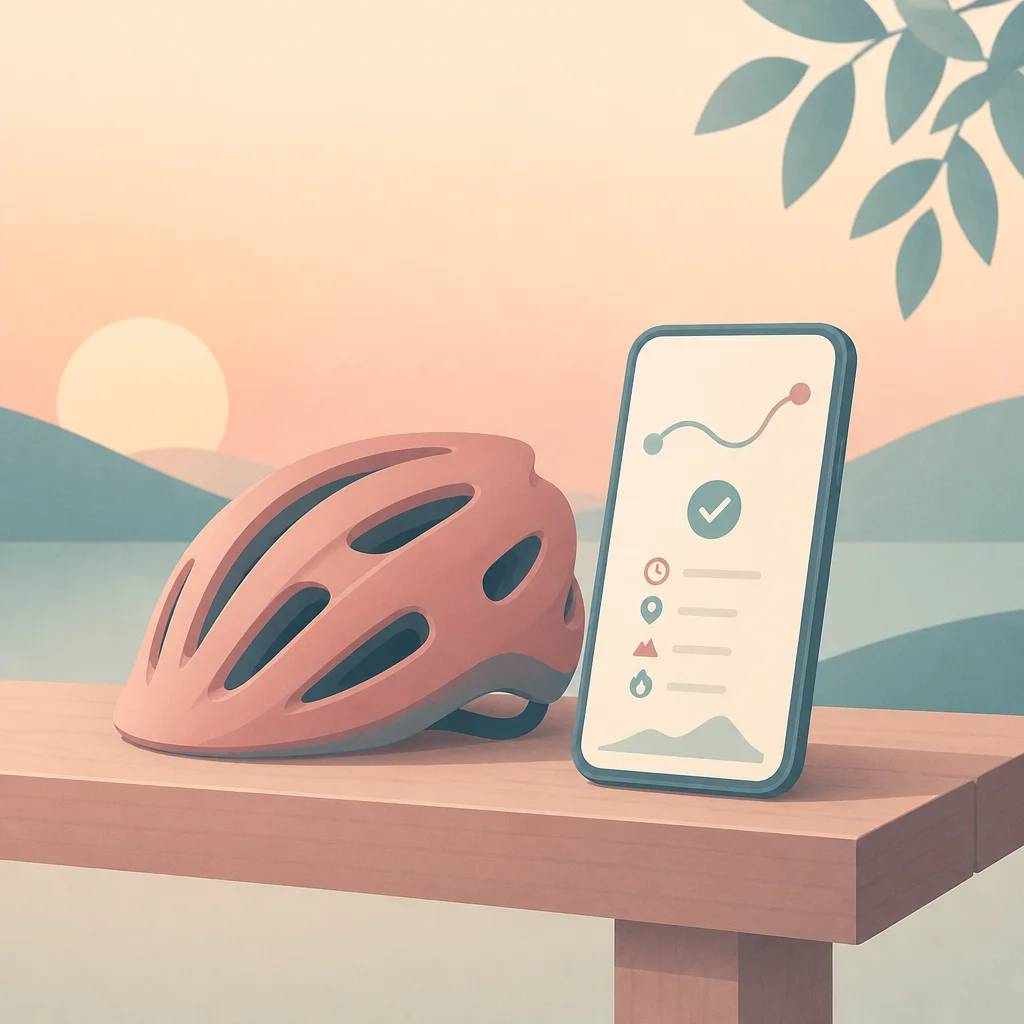
And if the two of you are going to keep riding in the same group, agree the small public things before somebody else notices them: whether you arrive together, whether you leave together, and how much of it anybody needs to comment on. Most groups will take their cue from you. If you treat it as unremarkable, it mostly becomes unremarkable.
Tracking, Photos and the Record You Did Not Make
Cyclists document things. Ride tracking apps publish start points, finish points, routes and, depending on settings, who rode with whom. Club pages post photographs. Somebody always takes a picture at the cafe. Before you have agreed what the two of you are, a record of it may already exist in three different accounts.
Agree between yourselves before somebody else decides for you. Does either of you post rides at all? Do you check before tagging the other person? What about the club account, which is usually run by whichever volunteer agreed to do it? Those are small questions, and they are much easier to answer calmly in advance than to argue about after something has been up for a day.
The wider point is that a weekly ride creates a semi-public record of your private life even when nobody posts anything. Twenty people know who you arrived with, who you rode next to, and who you did not wait for. If you are not out, if your work is in the group, or if your family watches your social media, that matters more here than it does in most dating. The guide to ENM profile photographs and sending photos to a new partner are the longer versions, and texting boundaries covers the quieter half — the thread that starts about a puncture and ends up somewhere neither of you intended.
And if something of yours turns up somewhere you never agreed to, asking for it to be taken down is ordinary rather than dramatic. Say it once, directly, to whoever posted it rather than to the whole thread.
When It Ends, Saturday Keeps Coming
Here is the part that separates dating inside a hobby from dating outside one, and it deserves plain language. Settle the ending now, while nobody needs it. One sentence spoken out loud is enough: if this stops, we both keep riding, we do not recruit sides, and neither of us turns a Saturday into a statement. Riders who have said that out loud tend to honour it. Riders who have not tend not to, and the club absorbs the difference either way.
- Keep turning up. Vanishing is what converts a small ending into an enormous one.
- Do not let the club divide into routes, days or cafes.
- Resist telling people one at a time, which turns a private matter into a group project.
- If it really is unbearable, sit out a few weeks and offer one sentence of explanation.
- You do not owe the group a story. You do owe it an absence of fallout.
If you are a regular watching two people on your ride split up, the useful move is to stay neutral and keep the route moving. Groups survive breakups when the group declines to become a courtroom. Staying present during group experiences is, underneath, about the same skill: noticing what is actually happening rather than the story you have started telling about it.
And if it is going well, the same discipline applies in the other direction. Do not let the ride become the relationship’s only setting, because then every Saturday carries the weight of the whole thing and a cancelled ride feels like a bad sign. Keep one part of your life that has no bicycles in it.
Five Questions Before You Ask
Run through four of these, and if most of the answers are no, give it another month.
- Have I watched them be decent to riders they are not interested in?
- Would I still want this ride if this went badly?
- Do my existing partners know this is on the cards?
- Is there a gap — speed, experience, who sets the route — that I am pretending not to see?
And one more, which nobody can answer for you: is this about that particular person, or is it about how generous everybody feels after forty kilometres in sunshine? Both happen all the time. Only the first one is still there in February rain.
None of that is romantic, and it is exactly why this setting works. Bad weather, punctures and long climbs show you somebody before either of you has put anything on the line, which almost nowhere else lets you do at the cost of a spare tube.
The ride itself is worth protecting either way, and the companion piece on cycling groups in non-monogamy covers how to do that — who decides the route, what the road makes public, and how to keep a group that still exists in two years.
Do I need to be as fast as them to date someone from a cycling group?
No, and speed has nothing to do with compatibility. What is worth noticing is how a skill gap gets handled: whether they decide the route without asking, whether pace comments land as encouragement or pressure, and whether you have started shaping your Saturdays around their idea of a good ride.
Where is the worst place to ask?
Mid-ride, in the group chat, or anywhere the other person has an audience. All three turn a private question into a public one, and a question that cannot be declined quietly is not really a question. Wait for the cafe stop, the car park, or send a message the next day.
What if my partner also rides with the same group?
Then it is a metamour situation with an audience, and the sooner the adults involved know the shape of it the better. Agree together what the Saturday looks like, whether anyone takes a different ride for a while, and what happens when two of you are in the same place on the same morning.
Should we tell the group we are dating?
Tell the people directly affected — existing partners first, then whoever organises the ride. You do not owe the group an announcement, and you should not make one. One sentence, once, and then let the ride carry on being a ride.
Editor’s note: this is general information for adults, not legal, medical or therapeutic advice. Nobody in a riding club owes anybody a relationship, and nobody owes the club a rundown of their private life. The point of what follows is to reduce avoidable damage to a Saturday morning that other people also rely on — not to adjudicate who anybody may or may not ask out.
Handled slowly, dating someone from your cycling group is one of the better ways to begin something: weeks of ordinary behaviour, one question asked while standing still, an answer you have made straightforward to refuse, and an ending agreed before anybody needs it. The ride goes on the calendar next Saturday regardless. That is what makes it possible to start gently, and what makes it worth getting right.