Table of Contents
- Why Social Dancing in Non-Monogamy Works So Well
- The Etiquette Nobody Writes Down
- Touch, Consent and Close Embrace
- Arriving Together, Arriving Alone
- When to Mention Your Relationship Structure
- Chemistry on the Floor Is Not Always Chemistry
- Shoes, Scent, Sweat and Sound
- Frequently Asked Questions
Social dancing in non-monogamy is one of the most underrated ways to meet people, and one of the few scenes where touch, consent and honest conversation are already built into the structure. You do not have to explain why you are there. Everybody is there to dance, the etiquette does most of the social work for you, and the unit of interaction is one song of about three minutes. The complication is that partner dancing puts you in sustained physical contact with people you barely know, in front of partners you care about, in a room where the rules are real but almost never written down.
Here is the short version. Dance with whoever you like, ask plainly, take a no without negotiating it, mention your relationship structure at the point where it becomes relevant to the other person rather than as an opening line, and treat the floor as a scene with its own culture instead of an extension of your dating life. Everything below is that sentence unpacked, plus the practical details nobody tells you before your first social.
Two things worth having in the background while you read. Partner dancing is real physical activity, and the APA topic page on exercise and fitness is a sensible reference if you are returning to movement after a long gap. And because these rooms involve a lot of close contact with strangers, the womenshealth.gov section on relationships and safety is a useful yardstick for what pressure looks like when it arrives politely.

One framing note before the specifics, because it saves a lot of awkwardness. A dance floor is not a dating app with better music. Most people in the room are there for the dancing, and the ones who are not will make that clear in ways you can respond to. Treating the room as a scene you are joining rather than a market you are shopping in is what makes everything below feel easy rather than tactical.
Why Social Dancing in Non-Monogamy Works So Well
Partner dancing solves three problems at once, which is why it keeps coming up in non-monogamous circles. It gives you a repeat, low-pressure place to see the same faces weekly. It teaches you physical literacy, meaning you get better at reading and signalling with your body instead of guessing. And it provides a script for closeness that is not automatically romantic, which is genuinely rare.
That last point deserves more attention than it usually gets. In most dating contexts, physical closeness arrives already loaded with meaning, and both people have to work out in real time what it implies. On a dance floor, closeness is the activity. Two people can be chest to chest for three minutes, thank each other, and part as friendly strangers. For anyone new to non-monogamy, that is a low-stakes way to discover that proximity and intention are separable things.
The one-song structure is the second underrated feature. A song is a bounded unit with a natural ending. You are never trapped in a long encounter you cannot exit, and neither are they. Compare that with a two-hour first date where leaving early requires an excuse, and you can see why so many people find dance socials easier than app-based dating.
There is also an emotional argument that has nothing to do with meeting partners. Dancing is a skill you can visibly improve at, so some of the attention you receive is earned rather than random. For people whose confidence has taken a knock after a breakup or a rough patch, that distinction matters more than it sounds. If you are building a social life that is not organised entirely around dating, the guide to hobbies in polyamory makes the same point at greater length, and finding your ENM community in a new city covers the broader version.
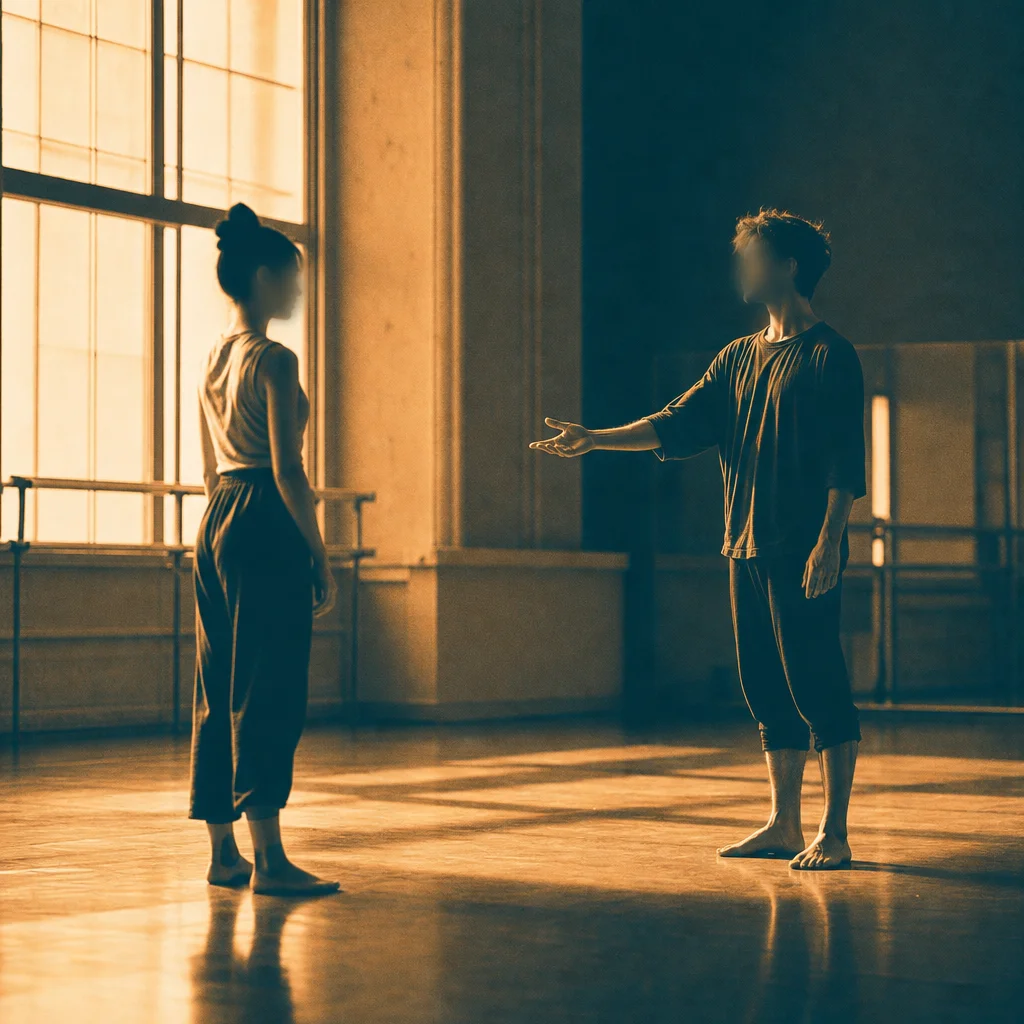
The scenes themselves are more welcoming than outsiders expect. Salsa, bachata, tango, ballroom, blues, West Coast, kizomba and country all tend to run a weekly social with a beginner lesson in the first hour. That lesson is the single best on-ramp in the whole scene: everyone is new, everyone rotates partners, and nobody is impressed by anybody yet.
The Etiquette Nobody Writes Down
Every scene has local variation, but a handful of norms hold almost everywhere in partner dancing. Learn these five and you will be fine in any room on your first night.
- Ask plainly and briefly. Would you like to dance? works in every scene. No preamble, no apology for asking.
- Take a no as information, not rejection. People sit out songs for shoes, breath, an old injury, or because they already promised the next one to somebody else.
- Rotate. Two songs with the same person is friendly; four reads as a statement in most rooms, and everybody notices.
- Thank them at the end and walk off the floor together rather than turning away mid-room.
- Do not teach on the social floor. Corrections belong in the lesson, and unsolicited ones land as criticism however kindly meant.
- Ask before you change the frame. Moving from open position to close embrace is a change to someone’s personal space, so name it first.
The lead and follow roles deserve a sentence, because newcomers sometimes read them as a hierarchy. They are not. The lead proposes the shape of the movement and the follow interprets it, and the good version of both roles is a conversation rather than a command. Plenty of scenes now teach both roles to everyone, which is worth doing if only because it doubles the number of people you can dance with.
If you have ever been to a structured social event in this wider world, the etiquette will feel familiar. The guide to non-monogamy at conventions describes the same pattern of unwritten norms in a very different setting, and the general principle is identical: learn the room before you work the room.

One more norm that newcomers miss. Standing at the edge and waiting to be asked is a losing strategy in most scenes, because the people who get asked most are the ones who ask. If you are nervous, ask the person standing next to you at the edge. They are almost always in exactly the same position.
Touch, Consent and Close Embrace
This is the part that surprises people. Depending on the style, partner dancing means a hand on the waist, the shoulder blade or the lower back, and some styles spend most of the song in close embrace with torsos touching. That is a lot of contact with a stranger, and it happens within seconds of saying hello.
The good news is that consent on the dance floor is continuous, mostly non-verbal, and socially supported. You can widen or narrow the frame. You can drop back to open position. You can step away mid-song, thank them, and leave. None of those reads as rudeness in a healthy scene; all of them read as normal calibration.
The guide to touch boundaries in non-monogamy goes deeper on why this matters so much in non-monogamous life specifically, and enthusiastic consent in non-monogamy covers the version where words are needed. On a floor, though, you mostly need a short sentence for each of six recurring moments, and the table below is what many dancers actually say.
| Moment | What many dancers say | Why it works |
|---|---|---|
| They ask and you would rather not | I am sitting this one out, thank you. | A reason invites negotiation; a preference does not. |
| You want more distance than they chose | Could we stay in open position? | Names the change without accusing anyone of anything. |
| You want to stop mid-song | Thank you, I am going to get some water. | Closes the unit without issuing a verdict on them. |
| They hold on after the music ends | Thanks for the dance, plus a step back | A clean ending is kinder than a slow fade. |
| You are new and unsure | I am still learning, could we keep it simple? | Sets expectations before movement starts, not during. |
| They ask again after you said no | I said no, please ask somebody else. | The repetition is the problem, not the original ask. |
Notice that none of those sentences contains an apology, and none contains an explanation longer than the sentence itself. That is deliberate. Long explanations on a dance floor make the other person feel obliged to argue with you, and withdrawing consent cleanly is the same principle applied to a bigger decision.
Arriving Together, Arriving Alone
How you walk in shapes the whole night, and this is where non-monogamous people most often get caught out. The failure mode is not jealousy itself; it is arriving with an unspoken assumption and discovering at song three that your partner’s assumption was different.
If you come as a pair, decide three things out loud before you leave the house: whether you are dancing with other people tonight, roughly how long you plan to stay, and what happens if one of you wants to go home early. Sixty seconds in the car prevents the walk-home conversation that ruins the evening.
If you come as a triad, remember that paired dancing means somebody sits out. Rotate that deliberately. The person who always sits is the person who quietly stops coming, and it is usually the same person every week.
And if you come alone, you have the easiest job in the room and the most to gain. Say you are new, ask the regulars, and do not spend the first hour scanning for someone to take home. The guide to going out with two partners and going out in public as a threesome both cover how visible groups read in public rooms, which transfers directly.

Watching a partner dance well with somebody else is one of the better low-stakes exposures available to anyone working on jealousy. The contact is bounded, it is in public, it ends in three minutes, and you get to watch them come back to you. If it still lands badly, that is useful information, and supporting a partner who is struggling with jealousy gives you somewhere to take it. The piece on cultivating compersion handles the version where you want to move toward the good feeling rather than just manage the hard one.
When to Mention Your Relationship Structure
Not on the first song, and not as a warning. Disclosure belongs at the point where it becomes relevant to the other person: when you are swapping contact details, when the conversation turns to dating, or when it becomes likely you will keep running into each other.
A sentence that works in most rooms: I should mention, I have partners / we are open. Happy to keep dancing either way. It states the fact, it does not ask for anything, and the last clause signals that the dancing is not conditional on their reaction.
The reason to get ahead of it is structural rather than moral. Dance communities are small and talkative. Being the person who mentioned it early is a much better position than being the person somebody heard about. And if you are in a room where your structure would be a problem, you would rather find that out on night one than night ten.
Two adjacent issues come with it. First, how you disclose ENM status while dating is the same skill applied off the floor, and the pacing logic is identical. Second, these rooms get filmed constantly, usually for the organisers’ social accounts, and a clip of you dancing can outlive the evening. Ask before posting anyone, and read social media privacy in non-monogamy and the guide to ENM profile photographs before you appear in somebody’s highlight reel. If the wider world knowing is the thing that worries you, handling social stigma is the honest version of that conversation.
Chemistry on the Floor Is Not Always Chemistry
This section exists because good dances create feelings that feel like evidence and are not. Synchrony, eye contact, loud music, physical exertion and a shared skill all produce a strong sense of connection. The feeling is real. The interpretation is the part that needs checking.
The cheapest test is unglamorous: talk to them for ten minutes at the water table with no music playing. If the interest survives the absence of rhythm, it is probably interest. If it evaporates the moment the band stops, it was the song, which is a perfectly good thing for it to have been.
A second test is the minute after the song ends. How you feel when the music stops — whether you want to keep talking or want to find somebody else — tells you more than how you felt during it. People who dance regularly learn to read that dip, and it saves a lot of mistaken confidence.
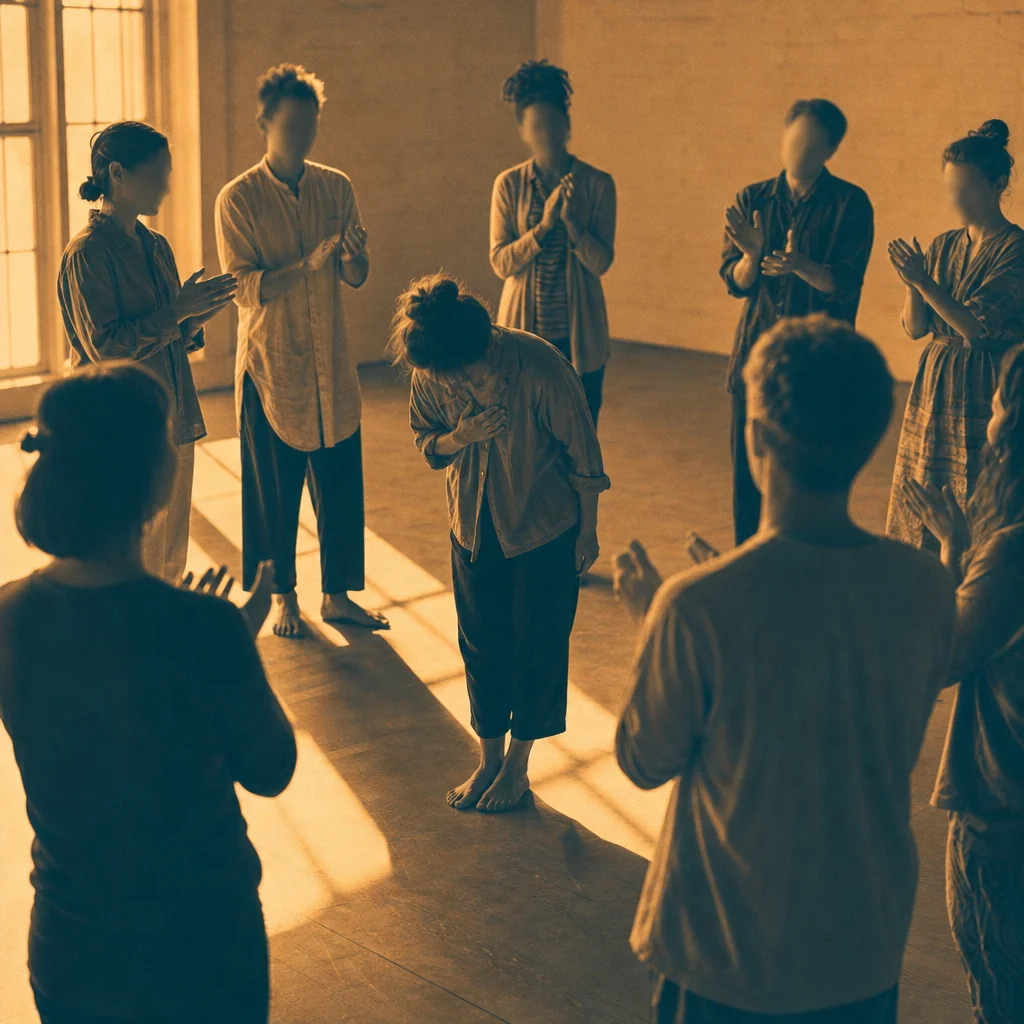
None of this is an argument against pursuing something. It is an argument for checking before you do. If you are reading bodies rather than words, the guide to reading body language on a threesome date is a useful companion, and staying present during group experiences covers why heightened settings distort judgement in predictable ways. If it turns out to be real, the companion piece on dating a fellow dancer picks up exactly there.
Shoes, Scent, Sweat and Sound
The unglamorous half of the guide, and the half that decides whether you go back. Four things matter more than people expect.
- Shoes. Most studios ask for a dedicated pair that never touches pavement, partly for the floor and partly for grip. Suede or leather soles, snug fit, and nothing with a deep tread.
- Scent. Close embrace means your fragrance is somebody else’s breathing space for three minutes. Many studios now ask people to arrive scent-free, and it is not a request anyone should argue with.
- Sweat. Bring a second top and a small towel. Changing shirts between the lesson and the social is normal and unremarkable.
- Sound. Socials are louder than first-timers expect. Agree a leaving signal with your partners before the music starts, because shouting across a room does not work.
- Hearing. If loud rooms bother you, musicians’ earplugs exist and are invisible at conversational distance. Nobody will notice.
The physical side connects to things this site already covers in other settings. Hygiene before a threesome and how to talk to a partner about hygiene both apply directly when you are going to be within arm’s length of twenty people in a warm room, and handling sensory overload is worth reading if bright lights plus loud music plus touch tends to tip you over.
Alcohol deserves its own line, because plenty of socials run in venues with a bar. Dancing is balance-dependent, and drink hits differently when you are also exerting yourself. Setting limits around alcohol and the guide to ENM dating without alcohol are the two internal references, and the NHS alcohol guidance is the neutral external one.

And a note on bodies, because it comes up. Dance scenes contain people of every shape, age and ability, and the ones who look most at ease are usually the ones who have been doing it longest rather than the ones who look a particular way. If nerves about that are what is holding you back, body image insecurity in threesome dating and the body-positive guide both speak to the same worry from a different angle.
Frequently Asked Questions
Do I need to bring a partner to a dance social?
No, and going alone is genuinely the easier version. Most scenes rotate partners constantly, so a solo newcomer has more dances than somebody who arrives already paired. If you do bring someone, agree in advance whether you are both dancing with other people, because that is where most first nights go wrong.
Is it dishonest to dance closely with someone without saying I have partners?
No. A dance is a dance, and your relationship structure is not relevant information for a three-minute song. It becomes relevant when you exchange contacts, when the conversation turns to dating, or when you are clearly going to keep seeing each other. Mention it at one of those points, plainly, and let it be ordinary.
My partner dances with one person every week and I hate watching it. What now?
Say so before the next social rather than after it. The feeling is common and worth taking seriously, and it is often about the regularity rather than the person. If you want a structure for the conversation, scheduling a regular relationship check-in gives you a format, and understanding jealousy in non-monogamous relationships handles the feeling itself rather than the dance floor.
What if someone touches me in a way I did not agree to?
Step back, say what you want instead, and if it repeats, tell whoever is running the room. Healthy scenes take that seriously because their reputation depends on it. The wording in the table above works here too, and withdrawing consent covers the bigger version of the same skill.
Can a dance social actually lead somewhere, or is it just exercise?
Both, depending on the night and the people. It is a good way to meet anybody, including partners, precisely because you see the same faces weekly and find out how someone handles a no before anything is at stake. If something does start, dating a fellow dancer covers the part most people improvise badly: what happens when you share a room.
Is it safe to go to a social alone in a city I do not know?
The usual precautions apply, plus one local one. Dance socials are public, well attended and usually run by an organiser whose name is on the event page, which makes them safer than most first meetings. Tell someone where you are going, check the venue and the organiser beforehand, and leave when you said you would. The guide to finding a third safely covers the verification habits that transfer well.
Social dancing in non-monogamy is worth trying once even if none of it leads to a date. You get a room where touch has a script, where a no is unremarkable, and where you can watch your partner be close to somebody else and come back to you three minutes later. Start with the beginner lesson, ask the person standing next to you, and go twice before you decide. Plenty of people figuring out how to build a social life around non-monogamy are doing it the same way, and you will find them right here at 3Cupid.
Editor’s note: this is general information for adults, not medical or professional advice. Partner dancing is physical activity, and joints, balance, hearing and stamina differ enormously from person to person. Studio policies on shoes, scent, filming and touch vary by venue and by country, and what is normal in one scene may be unusual in another. If you have an injury, a health condition or a concern about how much a class asks of your body, ask the teacher and, where it matters, a clinician.